For some time, Roger Scott and his brother-in-law Craig Rountree had toyed with the idea of restoring a classic runabout, perhaps a Chris-Craft from the 1940s or ’50s, whose lines and craftsmanship they both admired. They checked out a couple of boats, but it wasn’t until about five months into his retirement, “just as the rhythm of unstructured days was beginning to settle in,” says Roger, that Craig called. He had seen a listing on Craigslist for a partly built small wooden runabout in need of finishing. The boat in question was an 11′ Glen-L Squirt. It was not exactly what Roger and Craig had mused about, but it was full of possibility. The hull and framing had been completed by the seller, John Hodas, some eight years earlier, but he had been forced to set the project aside and now was looking for someone to take ownership and finish the build.
 Photographs courtesy of Roger Scott
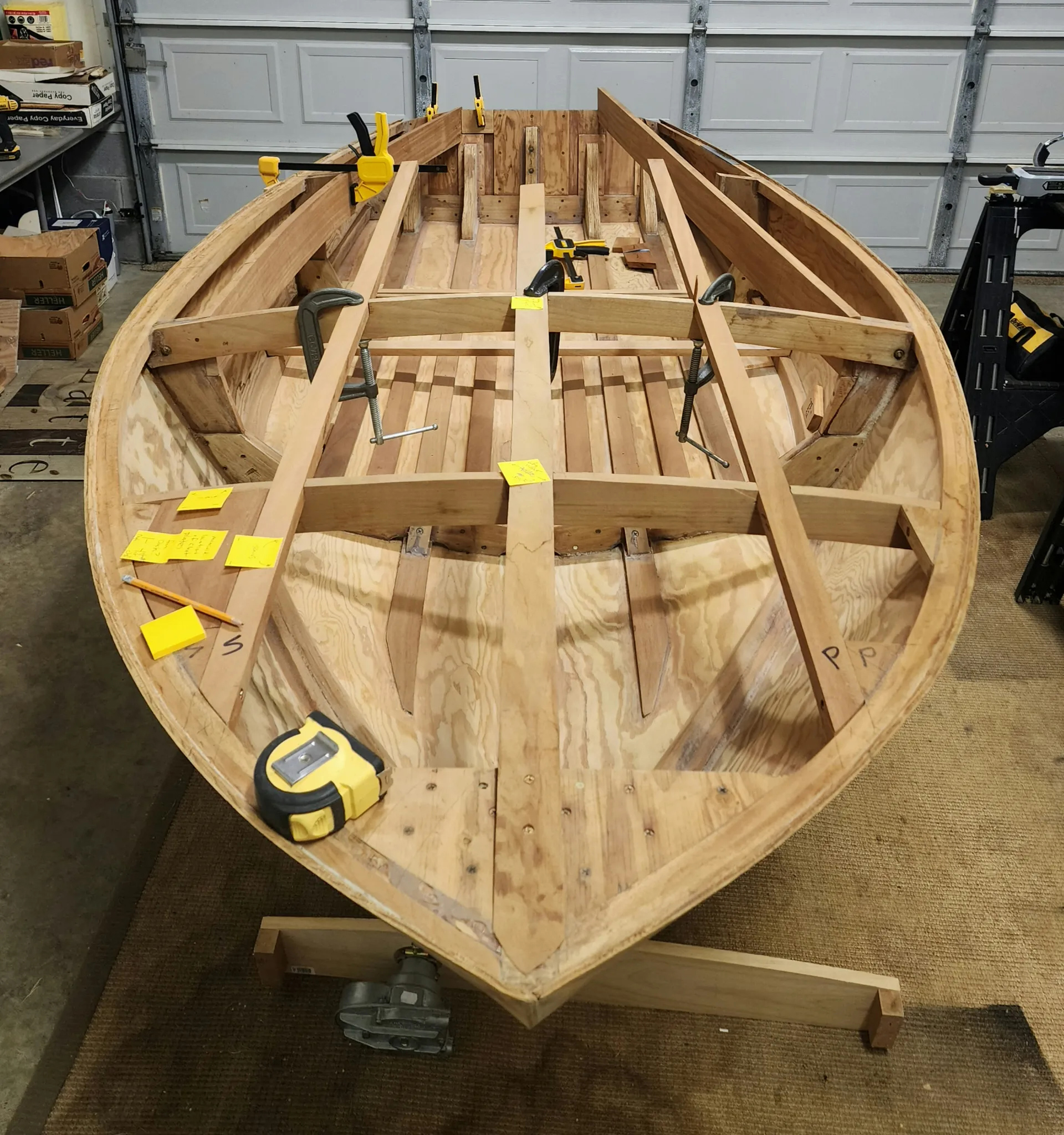
Throughout the project, Roger took time to dry-fit whole sections of the boat before committing any single component to the build. Here he was dry-fitting the hardwood framing, including the supports for the seat and the carlins and beams for the boat’s deck.
Craig bought the boat but a few weeks later transferred it to Roger’s garage in Yorktown, Virginia. Craig, says Roger, “already had too many projects underway, and I was unexpectedly captivated by the promise and challenge.” He had, he says, never planned to build a boat. Rather, he had imagined retirement allowing him to spend more time outdoors, “balancing the technical focus of my 30-year IT career with pursuits like wildlife photography and astrophotography—hobbies that require patience and precision. Boatbuilding hadn’t crossed my mind.”
Yet, here he was, with the shell of a boat in his garage and little woodworking experience beyond basic furniture and home renovation projects—“solid, square endeavors with predictable right angles.” He had, however, long enjoyed being on the water, sailing with friends on Chesapeake Bay and in the Florida Keys, deep-sea fishing off the Outer Banks of North Carolina, and nearer to home, going out in his own Stingray 20′ powerboat. Through it all he had learned one “fundamental truth about boats: they defy the 90° world. They curve, they sweep, they flow. Nothing is quite straight or square.” He was drawn to the challenge.
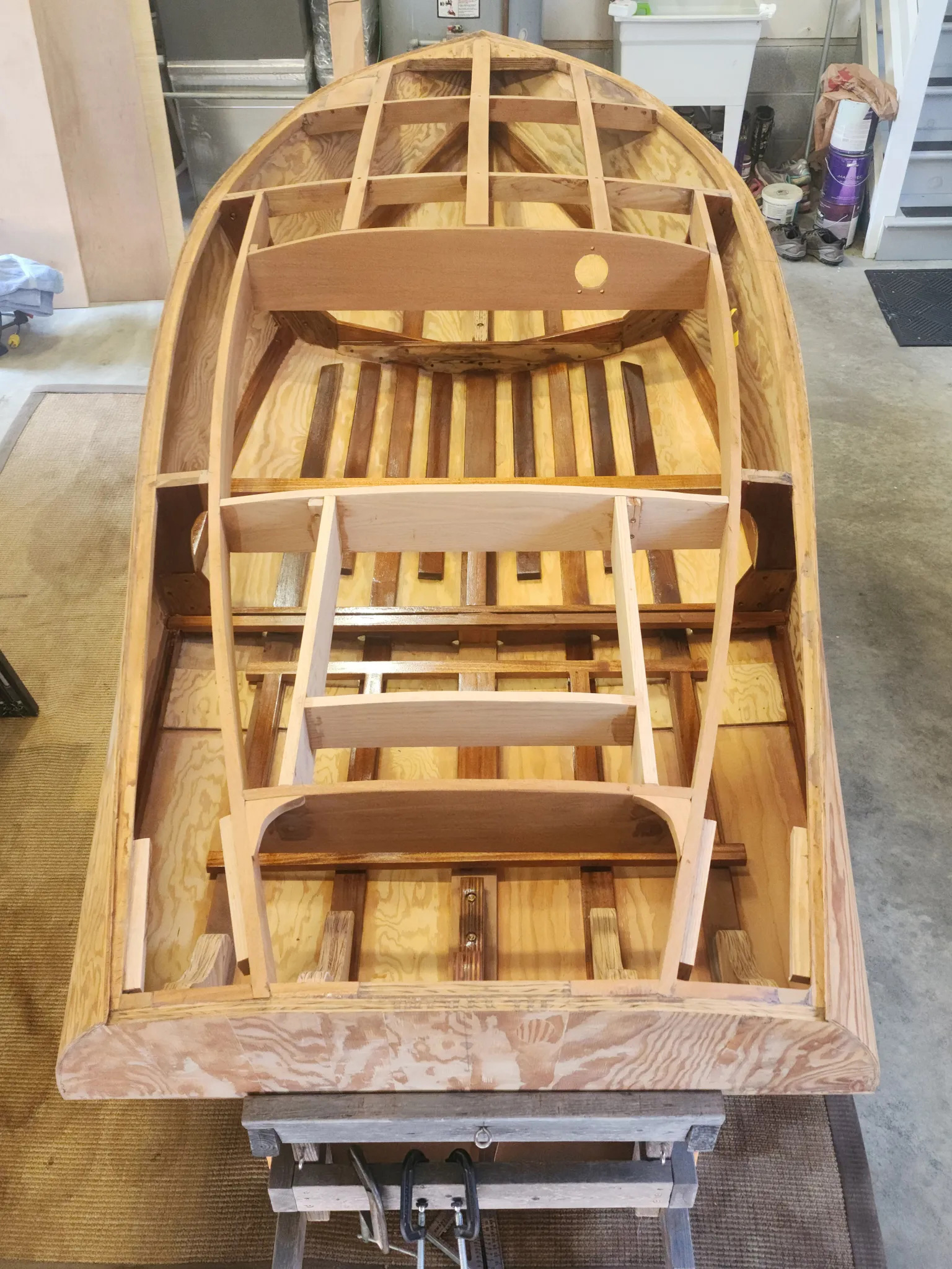
Once he was satisfied with the fit of all the parts, Roger screwed and glued the deck framing. Seen from astern, the shape of the cockpit and the opening for the compartment that will house the battery and gas tank are easily recognized.
For decades Roger had lived with high-pressure deadlines and tightly packed work schedules; this project, he decided, would be different. “There would be no rushing to meet arbitrary milestones, no late-night sprints to satisfy a calendar. The boat would be finished at a pace that felt restorative rather than urgent.”
Roger began his work in May 2023, completed the build in January 2024, and launched in April. Those eight months included a four-week pause after he’d painted the outside of the hull and wanted to allow the paint to fully cure before turning it over to complete the interior, deck, and outfitting. His determination to take things slowly meant that some days he did very little at all but instead took time to stand back and study the lines, appreciating how far he’d come. “Other days,” he says, “were devoted to quiet planning: sketching out next steps, selecting paint and stain colors, diving into research—there was plenty of that. And on many days, I found myself happily immersed in the work for anywhere from two to six hours, shaping, fitting, sanding, assembling. In the process, the build became more than a project; it became a practice in patience.”
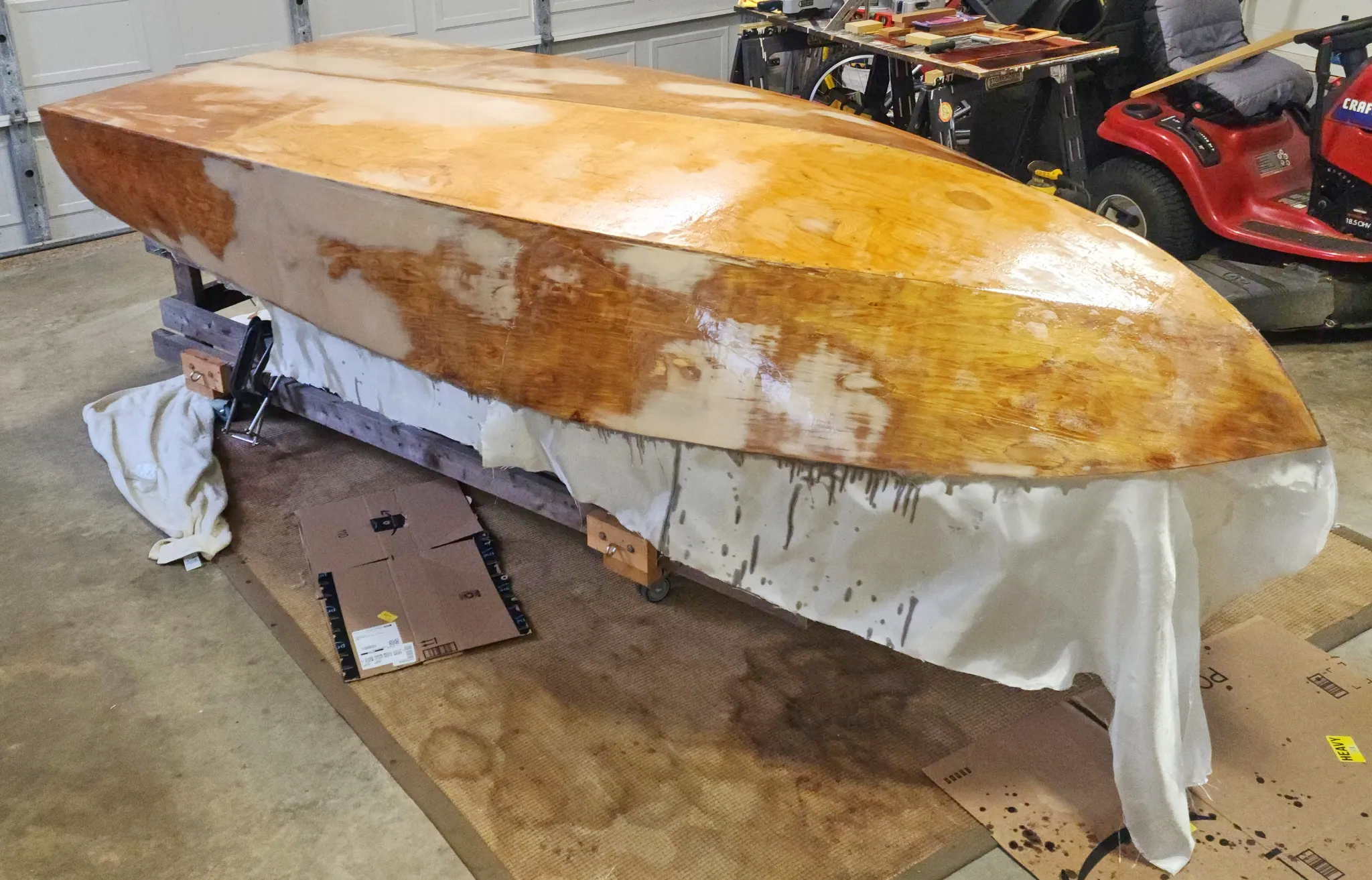
After completing the deck framing, Roger inverted the boat to sheathe the hull. He coated the outside of the hull with one coat of epoxy before laying the fiberglass cloth and then applying four more coats of epoxy.
When Roger took delivery of the boat, its hull and internal framing were complete. John, he says, had crafted the hull with meticulous care, and his work gave Roger a solid foundation on which to build. John had built the hull of 1⁄4″ marine plywood on mahogany frames, while the breasthook, knees, transom, and stem were all of 3⁄4″ plywood. Roger would continue in the same manner, using mahogany for the coamings, sheerstrakes, dashboard, seat frame, battery and gas-tank platform, deckbeams, and frames. The deck was of plywood planks with white-oak strips inserted in the seams.
Along with the boat, John had also passed on templates that he had used to build the frames, some pieces of mahogany, numerous boatbuilding books, and fittings such as the wiring kit, a gas tank, cleats, running lights, and the steering unit. For the rest, Roger was on his own.
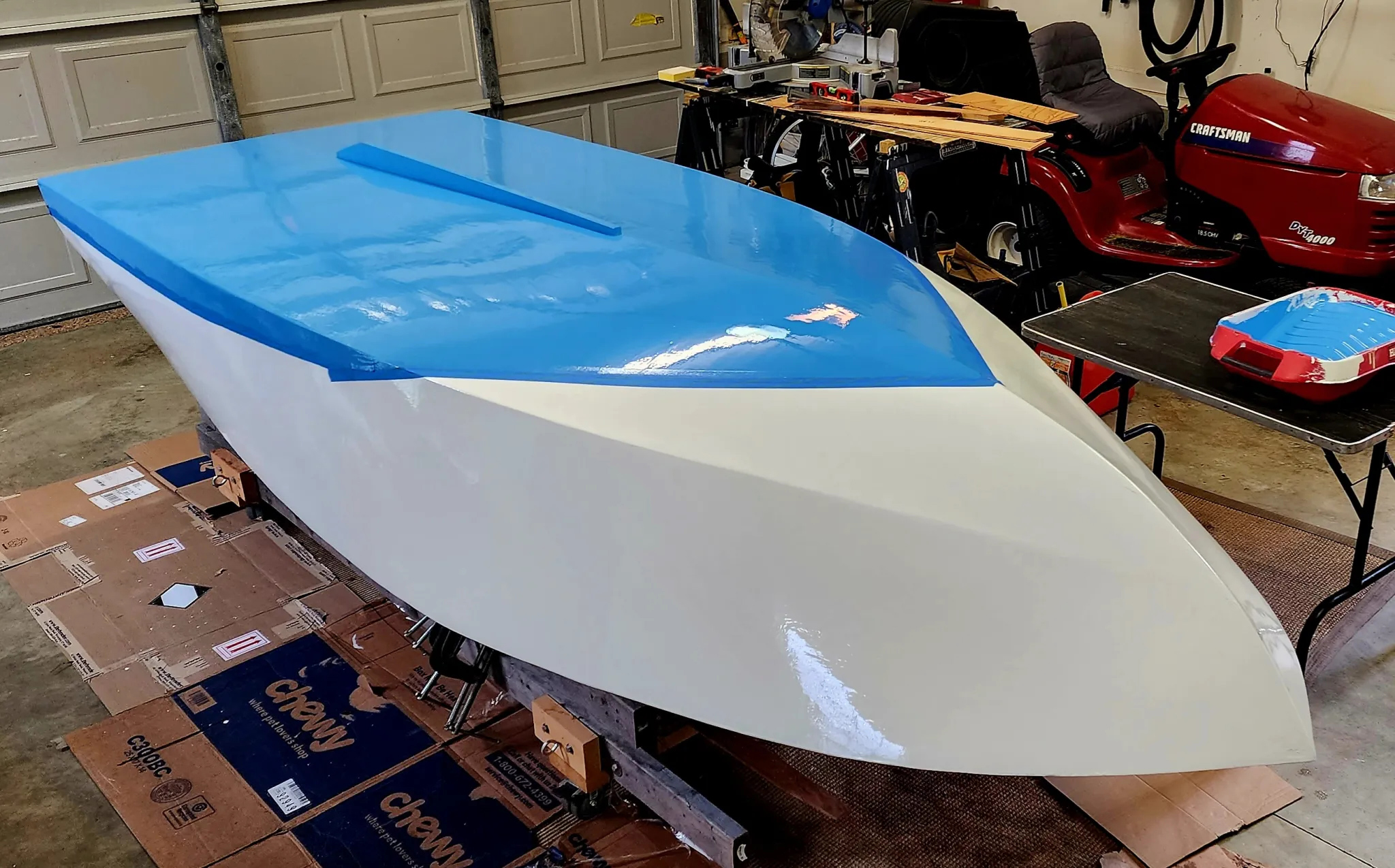
Before painting the hull, Roger glued and screwed the white-oak skeg to the bottom. He then applied five coats of paint, which he left to thoroughly cure for four weeks.
He did a lot of dry-fitting. He would build entire sections of the boat—such as the framework for the deck, complete with carlins, beams, and forward framing. He would cut out and place the components using clamps, brass screws, and bolts; take measurements, make adjustments, and ensure everything fitted and worked perfectly before disassembling everything and putting it back together permanently with bronze fastenings and epoxy.
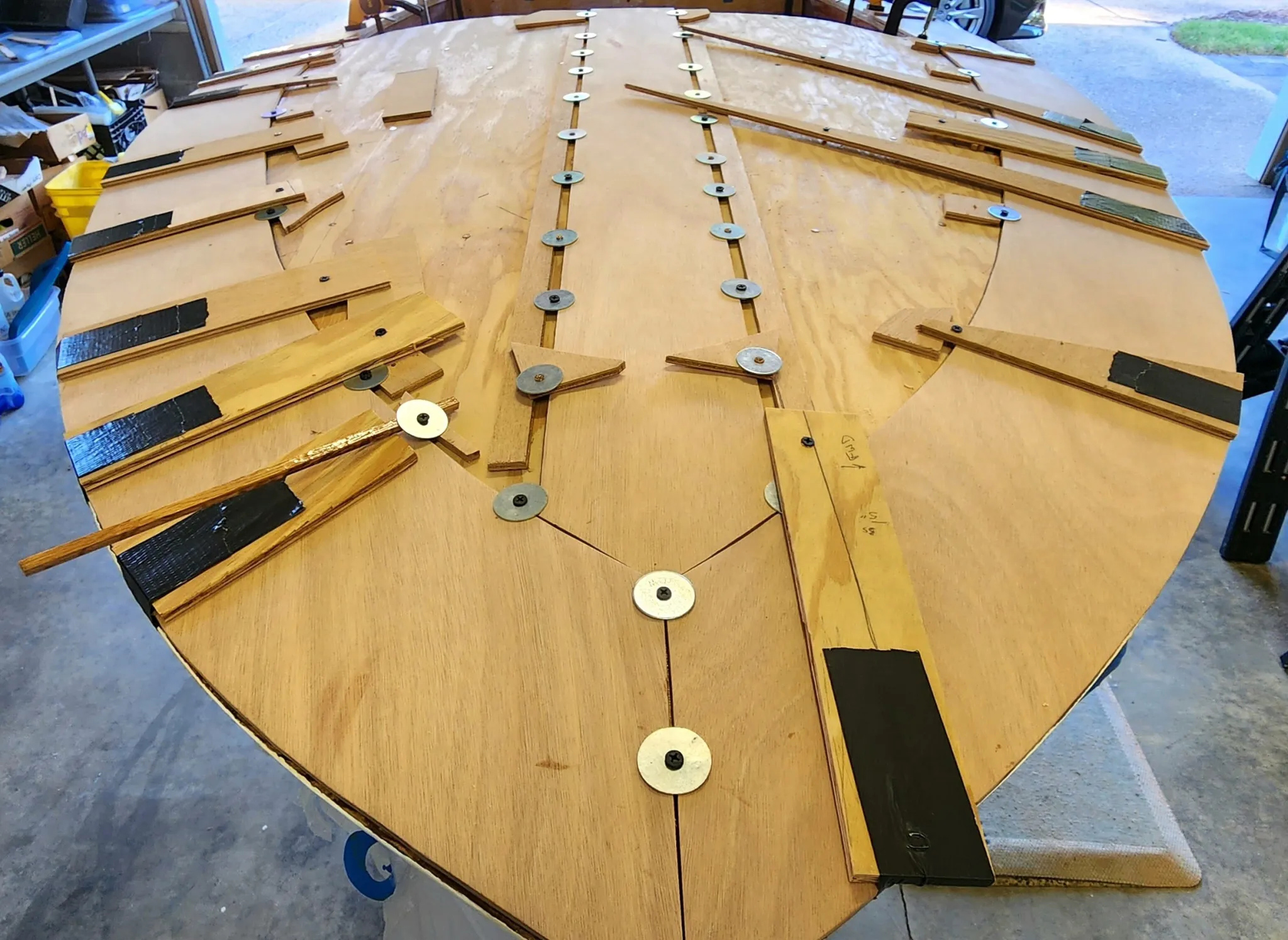
When he installed the kingplank and covering boards, Roger applied pressure with battens taped over the side of the boat and screw-fastened into the sub-deck using fender washers to avoid unsightly holes in the mahogany plywood.
Probably the hardest part of the build, says Roger, was laying the deck, which was also one of the final steps in the construction. Prior to decking, he finished the interior with stain, epoxy, and a two-part polyurethane varnish, ran the wiring for the motor and electrical fittings—automatic bilge pump, fuse panel, LED cockpit lights, and navigation lights—installed the gas tank and battery housing, ran the steering cable from stern to steering wheel, and built the seat back and base, complete with cup-holder cutout. Then it was time to lay the deck.
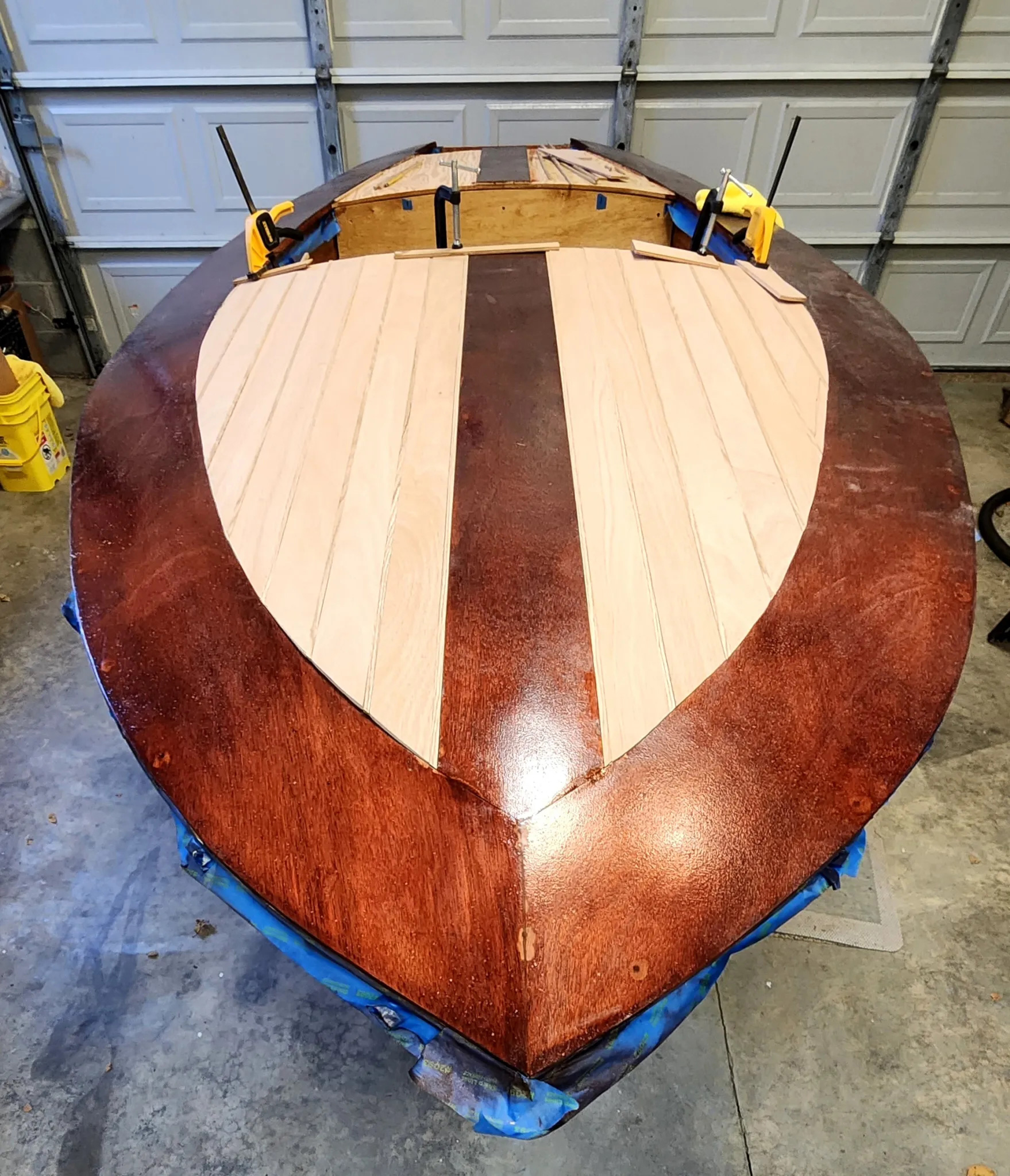
Roger laid 1⁄4″-square white oak strips between the mahogany plywood deck planks to create the illusion of a traditional caulked deck.
First he dry-fitted the plywood subdeck. The Glen-L plans called for 1⁄4″ plywood, but Roger went with 3⁄8″ to “increase overall strength and stability.” In total he used two-and-a-half sheets, epoxied on the underside prior to installation. When he was satisfied with the fit, he epoxied the plywood in place and moved onto the upper, decorative, layer. His goal was to create a deck that looked and felt like the deck of the Chris-Craft runabouts he so admired. He cut and fitted okoume 9mm kingplanks and covering boards, then cut 2 1⁄4″-wide planks of 9mm okoume plywood, which he separated with 1⁄4″ × 1⁄4″ strips of white oak, once more dry-fitting everything to ensure perfect fit. He stained the plywood to blend in with the mahogany, but left the white oak its natural color to create the classic alternating colors across the deck. He glued the top layer to the lower subdeck and finished the entire deck assembly with four coats of clear epoxy and two coats of Epifanes clear-gloss polyurethane.
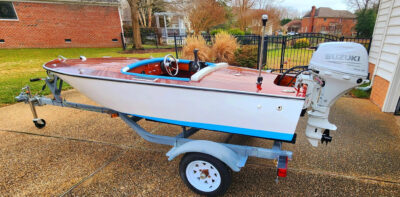
Finally, Roger installed the motor. He had spent time researching vintage 1950s and ’60s outboards, having seen other Squirts with such power, but in the end decided on a more modern solution. “I went with a 20-hp Suzuki,” he says. “It had the right aesthetic—modern retro—but all the advantages of a fully modern motor, like power tilt and electric start.”
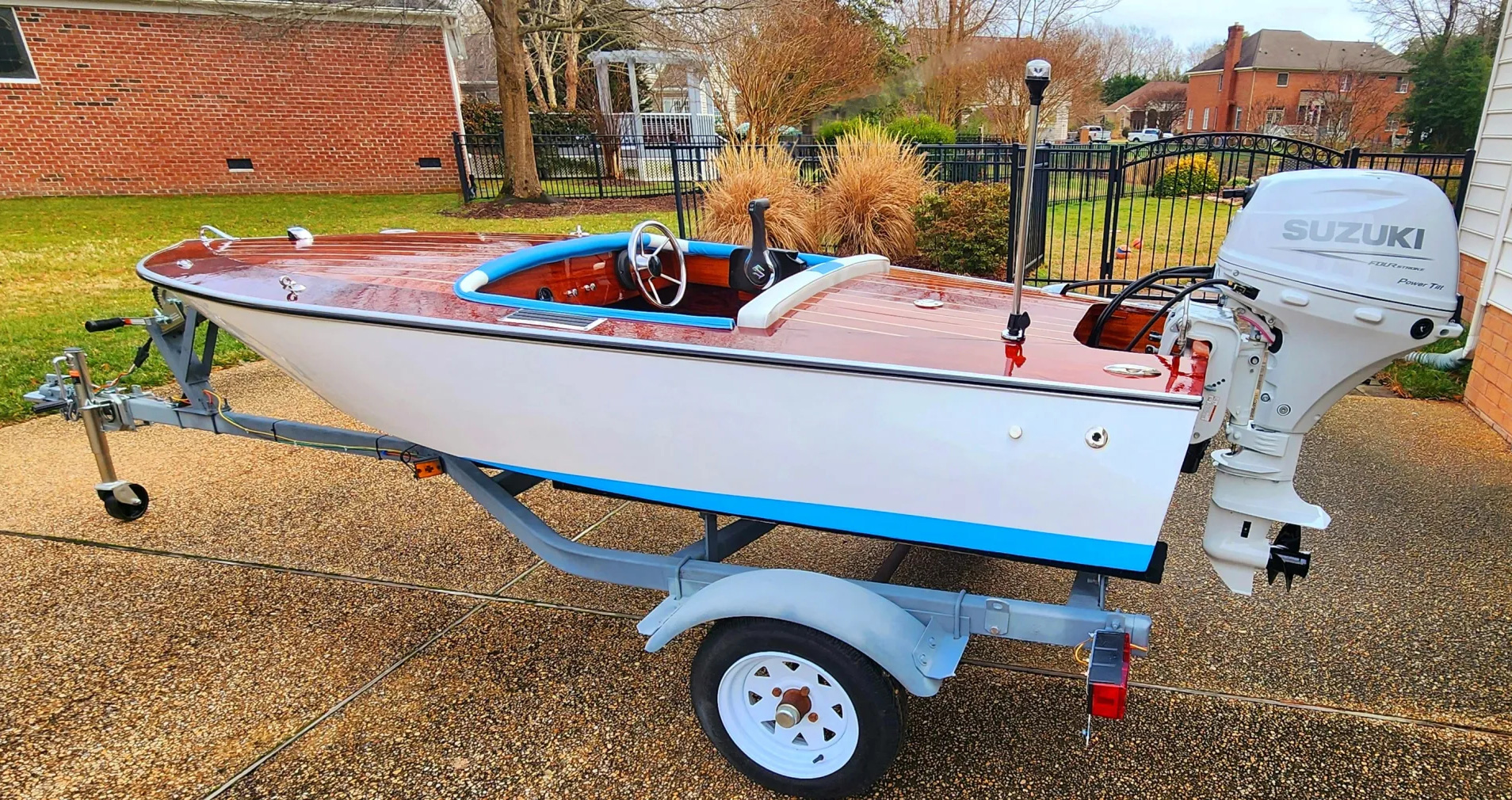
LIQUID THERAPY, all ready to go, her decks and chrome fittings gleaming. Roger would later add trim tabs to the transom to counteract her tendency to porpoise at speed. He would also add a speedometer and tachometer to the dashboard.
During the construction, John Hodas stopped by a few times to catch up on Roger’s progress and to talk about his long-held dream of building a boat. More than anything, says Roger, “he wanted to see it finished—wanted it to ‘see the water.’”
When the day of launching came, Roger joked that he hoped it didn’t leak. But, standing at the ramp, he “felt complete confidence that it wouldn’t.” After all, he reasoned, there had been months of planning, cutting, sanding, fitting, and problem-solving that had brought first John—and now him—to this moment. And, indeed, LIQUID THERAPY passed her maiden voyage with ease—flying across the waters of the Poquoson River at an estimated 15 knots with the motor running at half throttle.
Since launching, Roger has added a tachometer and speedometer to the dashboard, and fitted tabs to the transom to counteract the boat’s tendency to porpoise at speed. LIQUID THERAPY has, he says, “made some waves in local waters.” But just as important as finishing the project are the memories that have since been made. “I’ve shared the helm with my then 12-year-old grandson,” he says. “Watching him grip the wheel with determined excitement as we skimmed across the waves together…that alone made every hour in the garage worthwhile.”
Jenny Bennett is editor of Small Boats.
For a closer look at Roger’s Squirt project, visit his blog.
For more on the Glen-L Squirt and other boats designed for amateur builders, visit Glen-L Boat Designs.
Do you have a boat with an interesting story? Please email us. We’d like to hear about it and share it with other Small Boats readers.
Interested in other designs from Glen-L Boat Designs? See:
Glen-L Bo-Jest, an 18 footer with tugboat lines and surprising amounts of accommodation
Malahini, a sweet runabout for four adult passengers
Glen-L 15, a sloop-rigged daysailer



Join The Conversation
We welcome your comments about this article. To include a photo with your remarks, click Choose File below the Comment box.