Tyler Ellis was introduced to boating at a young age. He grew up in the Washington, D.C., area where the family owned a Bayliner runabout. During the long, hot summers, they would often take the boat out on the Potomac River and cruise into Alexandria, Virginia, to spend the afternoon and eat lunch out. As he grew older, Tyler helped take care of the boat, learned to fish—something he stills loves to do—and became involved for many years in competitive swimming. It all shaped his connection to the water, he says, and ultimately led him to study and earn a bachelor’s degree in Ocean Engineering at Virginia Tech, before pursuing a career in naval architecture.
 All images courtesy of the Ellis family
Tyler made the most of various software programs to help him design his boat. This early diagram allowed him to establish the minimum hull length.
In 2022, a year after graduating from Virginia Tech, Tyler began yearning for a boat of his own; nothing too fancy, just something in which he could “get to enjoy time out on some of the local lakes.” But, he says, there was a problem: “I had neither the money to buy nor the space to store a ‘regular’ boat.” Nevertheless, the more he was confronted by the complications of boat ownership, the more determined Tyler became. “The problem inspired me to use my engineering background to create my own compact, fully functioning boat that I could transport in the trunk of the car. If it wasn’t a large boat, I wouldn’t need storage space or a trailer, and that would all save me money.”

Tyler spent time laying out and dry fitting the deck to ensure a pleasing classic-runabout look. Despite appearances, all the plywood was exterior-grade sumauma, but Tyler discovered that if soaked in water, the wood released tannins causing it to become darker, even after drying out.
Tyler has always liked the aesthetic of classic wooden runabouts and decided that would be his starting point. “I created a vision board of designs that I liked—Chris-Crafts, Glen-Ls, Rivas—and from there I sketched some two-dimensional concepts in a 3D modeling program called Fusion 360. Then I established some size parameters.” First he worked on the minimum dimensions. “I started with a ‘stack-up length’ calculation. It lays out the essential components—battery, motor, seating, etc.—in sequence, end to end, to determine the shortest length the boat could be.” At the same time, he calculated the displacement required to safely carry the equipment and himself—with some safety margin built in—which established the hull’s minimum volume requirement. Finally, he measured the interior dimensions of his 2009 Honda CRV’s trunk to determine the maximum size his boat could be.

Persuading the plywood to bend around the curve of the hull required an overnight soaking of the wood, patience, and help from Tyler’s brother.
With the “design envelope” finalized, Tyler set to work on the boat’s lines, still basing the look on the classic runabouts he so loves. When he came to the boat’s interior dimensions, in particular ensuring an ergonomic and comfortable cockpit, he climbed into his bathtub. It was, he says “a handy real-world reference. It gave me a quick, relatable sense of the minimum length and width—especially for leg room and armrests—that would feel natural for most people.”
With a rudimentary design in hand, he went back to the computer to create a refined 3D model. “I calculated the displacement, center of gravity, and center of flotation.” He even ran “static-stability analysis with a marine-stability software program to ensure the hull would feel stable and safe on the water.”

When Tyler glued down the outer deck layer he used any weights he could find to ensure uniform adherence.
At last Tyler was ready to build. He transferred the dimensions for the stem onto a piece of 2×4 pine, for the transom onto a 1⁄2″ plywood panel, and for the ring frames onto 1×5 pine (which he strip-cut into 1 1⁄2″-thick pieces). He assembled the ring frames from four pieces, joined and reinforced at the corners with plywood braces; the ’midships frame gives the side panel a flare of 100°, while the after frame is set at exactly 90°. Next he cut out the plywood panels for the sides, sub-deck, and bottom. In order to keep costs down while still working with a water-resistant material, Tyler used exterior-grade sumauma plywood throughout (1⁄2″ for the transom and bottom, 1⁄4″ for the sides and two deck layers).
After dry-fitting the bottom, deck, stem, transom, and frames, Tyler started assembling. First he glued and screwed the frames, stem, and transom to the bottom panel. Next he cut the hole for the cockpit opening in the sub-deck panel. To get the appearance of a classic laid deck, Tyler built the outer deck layer in strips, again of 1⁄4″ plywood. He cut the kingplank and covering boards from a darker panel to complement the narrower strips and filled the seams with white silicone deck caulking. He glued the deck strips and kingplank to the subdeck, and then glued and screwed the finished deck to the frames, transom, and stem.

STELLA ROSE and her dolly fit in the trunk of Tyler’s 2009 Honda CRV.
The trickiest part of the hull construction, Tyler says, was persuading the side panels to take the curves of the hull—both into the bow and around the tumblehome into the transom. “I soaked the plywood in water overnight and bent it to shape with the help of my brother, Hunter.” As they worked to bring the panels into the curves the brothers screw-fastened them to previously placed pine blocks along the chine and sheer.

STELLA ROSE’s dolly was built out of PVC pipe and a couple of bicycle wheels and allows Tyler to pull her by himself even over rough ground. The total cost for the dolly parts was $91.45.
When all was assembled, Tyler faired everything, fiberglass-taped all the exterior joints, applied a layer of fiberglass to the bottom panel, and then finished with several coats of epoxy both inside and out.
Before fitting out the cockpit, Tyler cut a hole in the bottom of the boat. “I wanted to have an ‘inboard engine,’ which would have been common in classic runabouts, so decided to install a repurposed Minkota 30-lb-thrust electric trolling motor in the cockpit, with its shaft going down through the bottom of the boat near the stern. Then, because I didn’t want to have to reach back and manually move the trolling motor head, I installed a steering wheel with a pulley-cable system from it to the motor—it’s similar to the steering systems you find on Soap Box Derby cars.”
All that was left to do was to mount a varnished dashboard for the steering wheel and dry-fit a simple plywood plank seat with a back. While not fastened to the boat, the seat is the same width as the hull so cannot shift side to side; it’s prevented from moving fore-and-aft by the after deck and the weight of the boat’s operator. As luck would have it, seat cushions from a chair given to Tyler by his grandparents fit the boat perfectly.

Tyler established the interior ergonomics by sitting in his bathtub and figuring out the measurements for maximum leg and arm comfort.
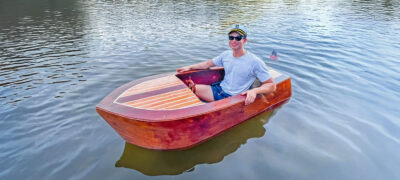
Tyler launched the boat, named STELLA ROSE, at Lake Audubon in Reston, Virginia, in 2022. The whole project, he says, including design and build, took two months and cost him just over $550, including the price of two bicycle wheels and some PVC tubing from which he fabricated a custom dolly to transport the boat from car to launching ramp and back. Whenever he takes her out, he says, STELLA ROSE is admired and photographed. And when it’s time to go home, he pulls her back onto the dolly, loads everything into the trunk of the car, and drives away.
Jenny Bennett is editor of Small Boats
Do you have a boat with an interesting story? Please email us. We’d like to hear about it and share it with other Small Boats readers.
Other reader-built boats that have redefined “small boat”
“A Tubby Tug”: from lumber to launch in 33 hours
“Patrick’s Scow”: the ultimate kid’s workboat
“Sea Bestia”: a race boat built for a holiday challenge





Love the aesthetic, a tribute to a time when boats looked like boats, and crafted better than furniture. I salute your ingenuity in making something within very difficult parameters.
Thank you! I really appreciate the kind words. It was certainly a challenge, but a lot of fun to come up with a design that worked within those parameters.
Haha all skippers get that same smile on their boat 50ft or 5ft.
It’s not too bad! There is a lot to strive for!
Well done, beautiful boat. Any plans? I’m sure a lot of readers would enjoy this
Thank you for the kind words! I’m really glad you liked the design, it was a fun build.
I’ve had a few people ask about plans, so I recently put together a set of detailed digital plans for anyone interested in making their own version of the Stella Rose. You can find the plans here: https://southlakesboatco.etsy.com/listing/4314013223
Happy to answer any questions you have about the process or the materials I used!
The children’s version is also very interesting! The child is happy!
An adult could also fit in it. The topic of micro boats is very interesting and tempting!
My son built a similar size boat as a sail boat. It’s quite the sight on Lake Washington.