Lunch break for the Old Salt build class is ending, and James Thomas, 78, offers a suggestion: “They ought to supply this class with little roll-out pads so we can all take our naps on the shop floor.”
It’s a joke, of course. The six guys in this two-week class, hosted by the Northwest Maritime Center in Port Townsend, Washington, have been working like demons, rarely taking breaks except for bathroom and lunch; if it weren’t for the blizzard of white hair and silver whiskers, you’d never guess that their average age is 71. If progress on the five boats under construction has fallen a little behind instructor Joel Arrington’s hopes, it’s not because the builders are slacking. As anyone who’s ever built a boat knows, it always takes longer than it’s supposed to. The builder’s vintage doesn’t matter.
Apart from the prototype, completed in December 2025, these are the first Old Salts to be constructed. The design is a product of several years of collaboration between Joshua Colvin, editor of the online magazine Small Craft Advisor; and Brandon Davis, owner of Turn Point Design, a CNC fabricating firm in Port Townsend, Washington. This class is both an opportunity for a few amateur builders to get first crack at building and owning one of the boats, and a proving ground for Brandon to work out any kinks in the kit. I’ve dropped in just to evaluate and report. I’ve built three sailboats from kits by three different designers, so have a solid baseline for comparison.
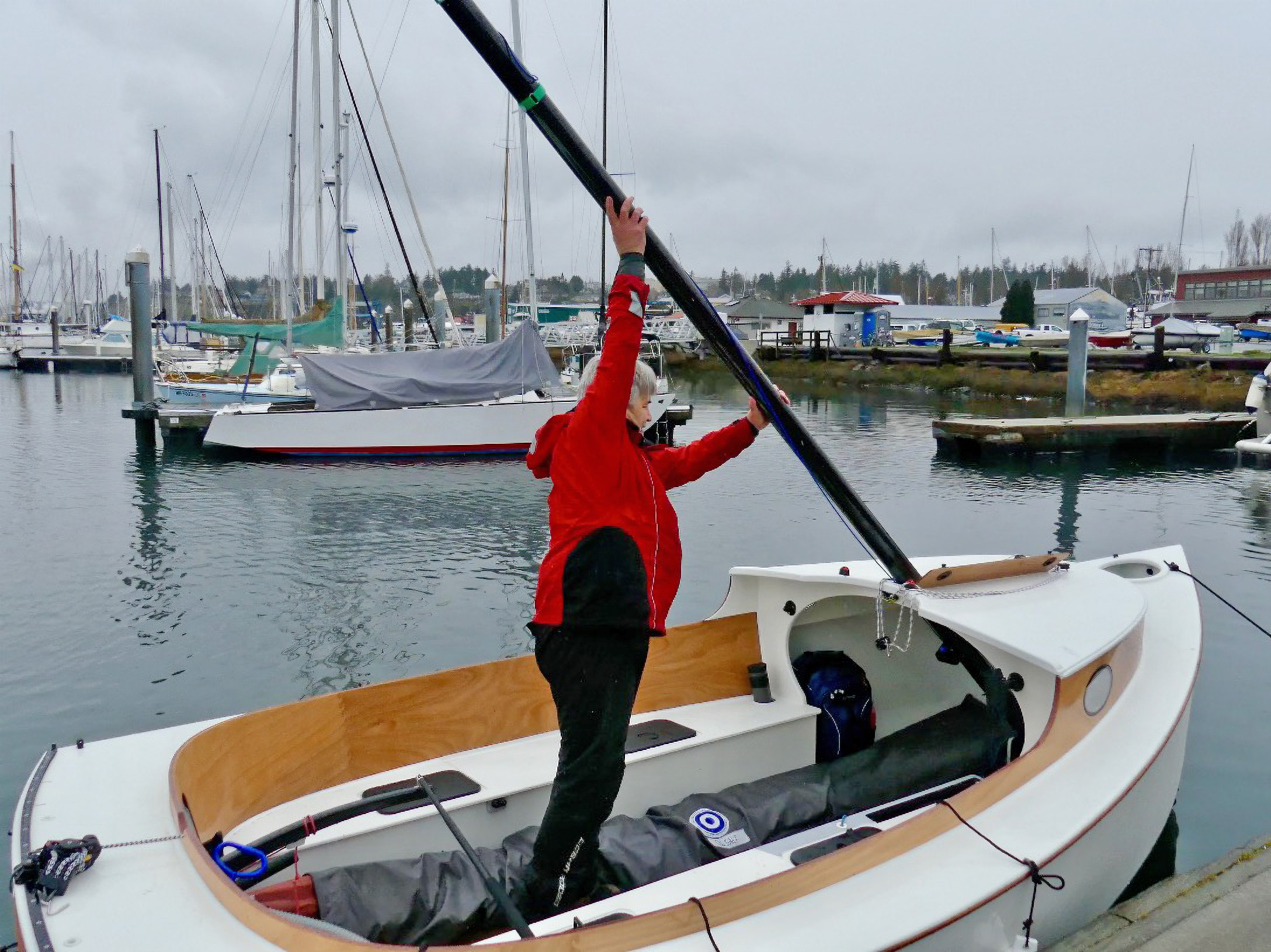
The idea powering the design was to create a small sailboat that would address every issue older sailors are likely to worry about; issues that might make us give up sailing or boating altogether. Prime among these worries is safety: Few of us seniors look forward to an unplanned cold-water swim, so the Old Salt’s catboat proportions—15′ 3″ length with very generous 7′ 6″ beam—provide a platform with tremendous form stability. The cockpit is very deep, very long, very wide, and unencumbered by a centerboard trunk, which is offset and integrated into the starboard seat. Rarely, if ever, should anyone have to leave the cockpit. There’s even a concave belly-fitting cutout in the after edge of the cuddy-cabin roof in which to stabilize a body when standing at the mast, fiddling with the rigging.
 Lawrence W. Cheek
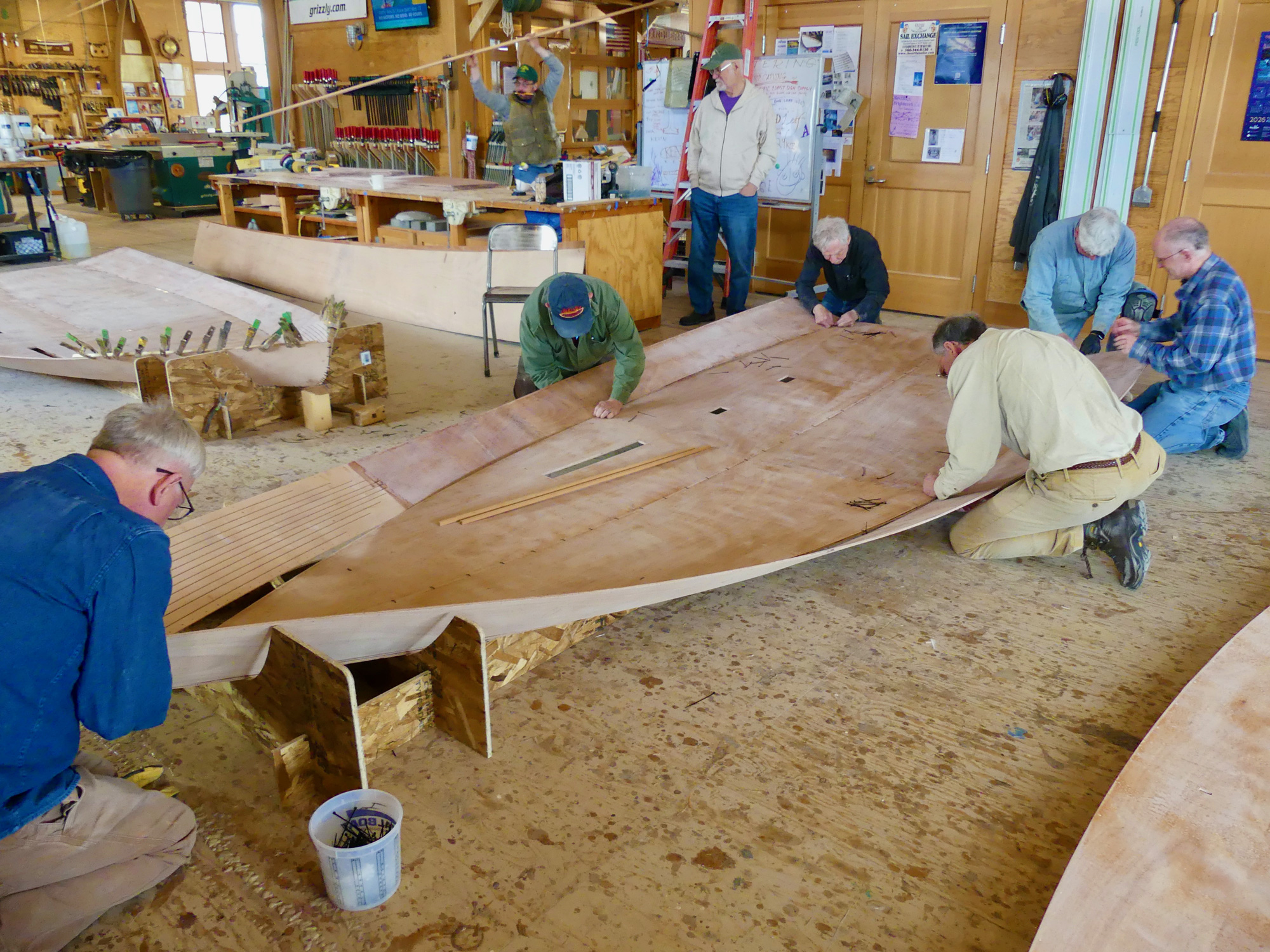
The Old Salt’s hull is made up of seven marine-plywood hull panels stitched together with zip ties. The panels are predrilled with holes for the ties, ensuring neat alignment. The three holes in the starboard bottom panel, as seen here, are for the offset centerboard slot. Rather than a full-length hole, which could weaken the panel before assembly, there is one long and two short guide holes to facilitate the accurate cutting of the slot after the hull is fully assembled.
Another issue that often overwhelms older sailors—and many younger ones—is everything that falls under the heading “fuss.” James Thomas tells me that he owns a popular sloop about the same size as the Old Salt, and is frankly tired of the rigging rigamarole. “It’s getting fairly physically challenging to get the rig set up for sailing,” he says. “It takes at least an hour. I expect to be able to rig this boat in 10 minutes.”
This is, however, a kit boat, so there’s necessarily a mountain of fuss to be summited before one ever sees the water. This class is just base camp. Joel has structured it as mass production, with all hands working on a single process such as ’glassing interior hull panels for all five boats at once. Nevertheless, months of solo work await the participants after they trundle the hulls home, and Joel and Brandon will take a few weeks to write the instruction book, incorporating what they’ve learned from the class.
Building the Old Salt
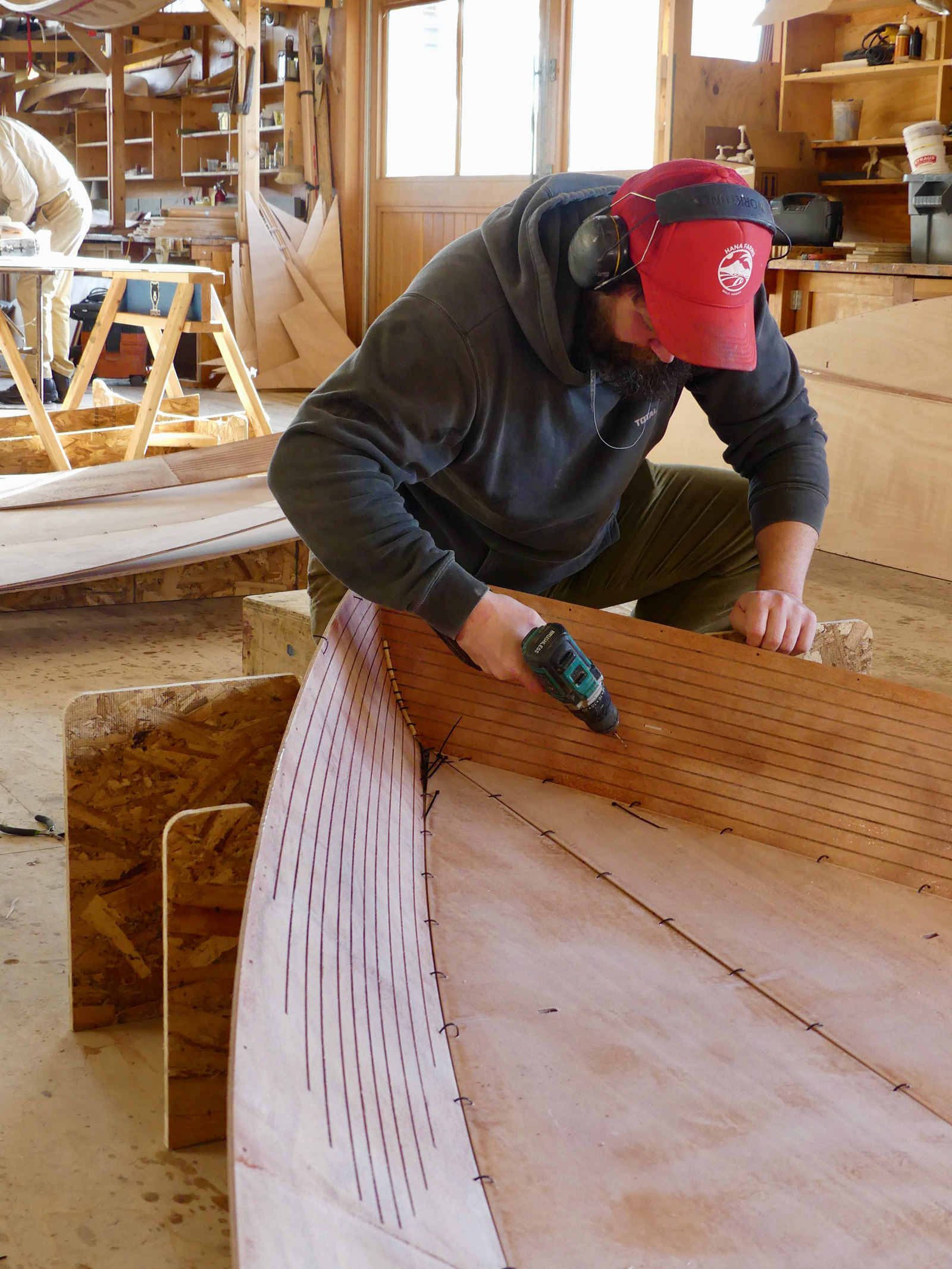
The Old Salt is a stitch-and-glue design, with seven marine-plywood hull panels to stitch together with zip ties over a building jig. One smart innovation is Brandon’s strategy to help the builder accurately shape the boat at the bow, a chronic problem with plywood boats. Designers like compound curves, and plywood fiercely resists them. Brandon programmed the CNC cutter to furrow a field of parallel kerfs halfway through the panels so they can be coaxed into the designed curves, and the building jig includes an unusual female mold outside the hull to accurately establish its shape. The curves are then permanently locked into the plywood by filling the kerfs with epoxy.
Another welcome innovation is the use of tabs or outlines scribed into the plywood panels for the placement of bulkheads and other panels—something easy enough for a CNC cutter to do, and not intended as an insult to the kit builder’s intelligence. “If you have to measure something to figure out its placement, you’re going to get something wrong once in a while,” Brandon says. “I feel like the more we can do to design the kit so no one can put anything together wrong, the better it is.” He adds: “Fewer phone calls to us, too.”
 Lawrence W. Cheek
The forward ends of the garboards have pre-cut shallow kerfs along their inside faces to facilitate a compound curve. Once the bottom and garboard panels are stitched together, each garboard is screw-fastened to the concave side of a female mold to force a transverse curve into the kerfed area. The kerfs will later be filled with epoxy to make the compound curves permanent.
Experienced builders who enjoy the challenge of fabricating some parts themselves—spars, cabin parts, trim bits—might feel bereft when unpacking an Old Salt kit, because it will include nearly everything except the hardware, fiberglass, and epoxy needed to build the complete boat. The mast is a two-piece, tapered carbon-fiber tube. There is no boom, gaff, or yard. The cabin sides and coaming are puzzle-jointed to each other into an extravagantly curvaceous wraparound ellipse, fabricated as a 4mm plywood-and-foam sandwich. The ellipse would be a virtuoso feat for an amateur to fabricate from scratch, likely resulting in a bonfire pile of three failed attempts before getting it right, but the kit should make it relatively easy. And it crowns the boat with a brilliant character piece.
There are moments in the build where there is room for creativity: at the sheer builders are left to devise their own rub strip or ornamental sheerstrake. The cockpit sole can be customized to provide character; Brandon built the prototype with strips of cork carpet underlay separated by black caulking. And if I were building my own Old Salt, I would be tempted to add some form of handrails on the cabintop. While I wouldn’t plan any excursions to the foredeck, I found the rain-slicked seat tops hazardously slippery when boarding and disembarking.
Most Old Salt builders will come up with their own amendments. Few forces in the universe are stronger than a boatbuilder’s impulse to alter a designer’s plans. Indeed, on the final day of the building class, Brandon and Josh have been brainstorming the design of an optional camp-cruising tent over the cockpit, and before two minutes of talking have passed it is morphing into a convertible tent/bimini. The Old Salt design, fortunately, seems secure and solid enough to absorb a good deal of customization, even overcomplication (albeit this would go against one of the principal goals of the design).
 Lawrence W. Cheek
Brandon Davis and Joshua Colvin designed the Old Salt for older sailors, hoping to keep them active on the water for as long as possible. With this demographic in mind, all the running rigging is led into the cockpit so there should never be a need for a skipper or crew to go up on the foredeck to tend to the sail. The mast, a two-piece carbon-fiber tube, is light enough for one person to raise or lower singlehandedly. It is guided through the gate in the top of the cuddy cabin and lowered down to the mast step on the cabin sole. Once raised, the mast requires no standing rigging, and if a crew member needs to go forward to reach it, there is a rounded cutout in the overhanging aft edge of the cabin roof into which they can lean for stability.
The Old Salt on the water
Early this year, during one of the Old Salt sea trials, Brandon committed a geezer-type error that inadvertently affirmed the boat’s suitability for its intended market. After motoring from the boat launch ramp onto Port Townsend Bay, he prepared to bend on the sail and discovered that the halyard’s working end was marooned at the masthead, 20′ up. No matter: the mast weighs all of 15 lbs, so he plucked it out of its step, lowered it, retrieved the halyard, and re-stepped the mast. And so a blooper that in other boats would have provoked a gale of curses and an unhappy trip back to the dock was fixed in half a minute on the water.
On the final scheduled day of the building class we’re conducting another sea trial. Class members have been eager to try out the prototype boat, but the weather, typical for March in Puget Sound, Washington, hasn’t cooperated. Every day has delivered rain, no wind, too much wind, or some combination of them all. Today it’s still raining, and there’s less than 5 knots of wind, but given what we’ve been seeing, it’s a go.
The prototype previews its beamy form stability when we board at the dock. Even though we’re not filling the water ballast tank today, it bobs no more than you’d expect with a 20’ ballasted keelboat. Brandon says he hasn’t even used the water ballast in trials yet; he predicts he’d wait for wind at 11 or 12 knots before filling the baffled bilge tank. If needed, the 50-gallon tank can be filled underway after slowing the boat, but emptying the ballast at sea would require hand pumping.
Though it’s more than a foot beamier than a standard king-sized bed, the Old Salt motors easily out of the marina with the ePropulsion eLite electric outboard drawing only 300 watts of its dainty 500-watt rating. It’s another preview, hinting that the hull is plenty slippery, and that even with only 3 or 4 knots of wind, we might enjoy some actual sailing today.
 Brandon Davis
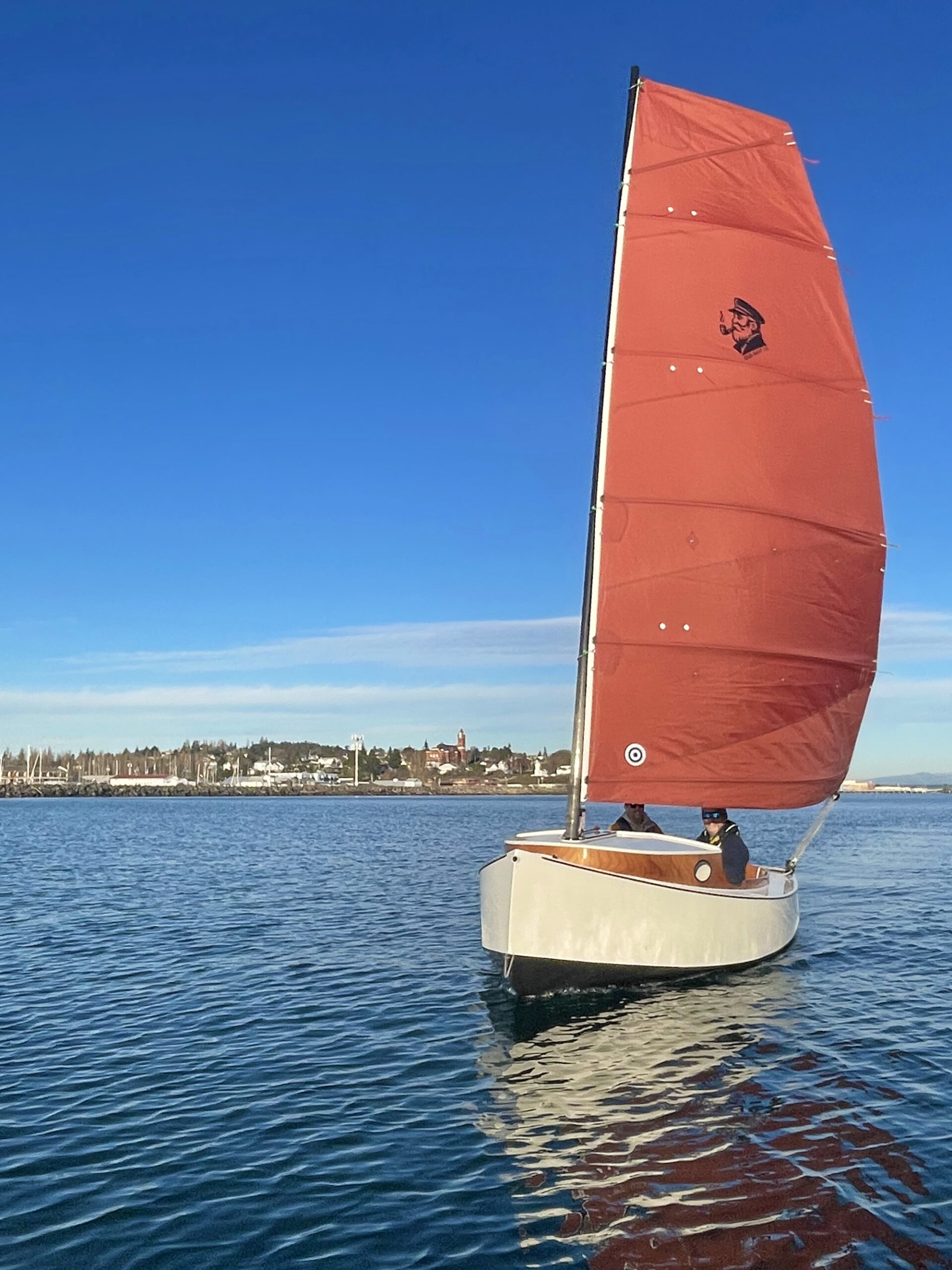
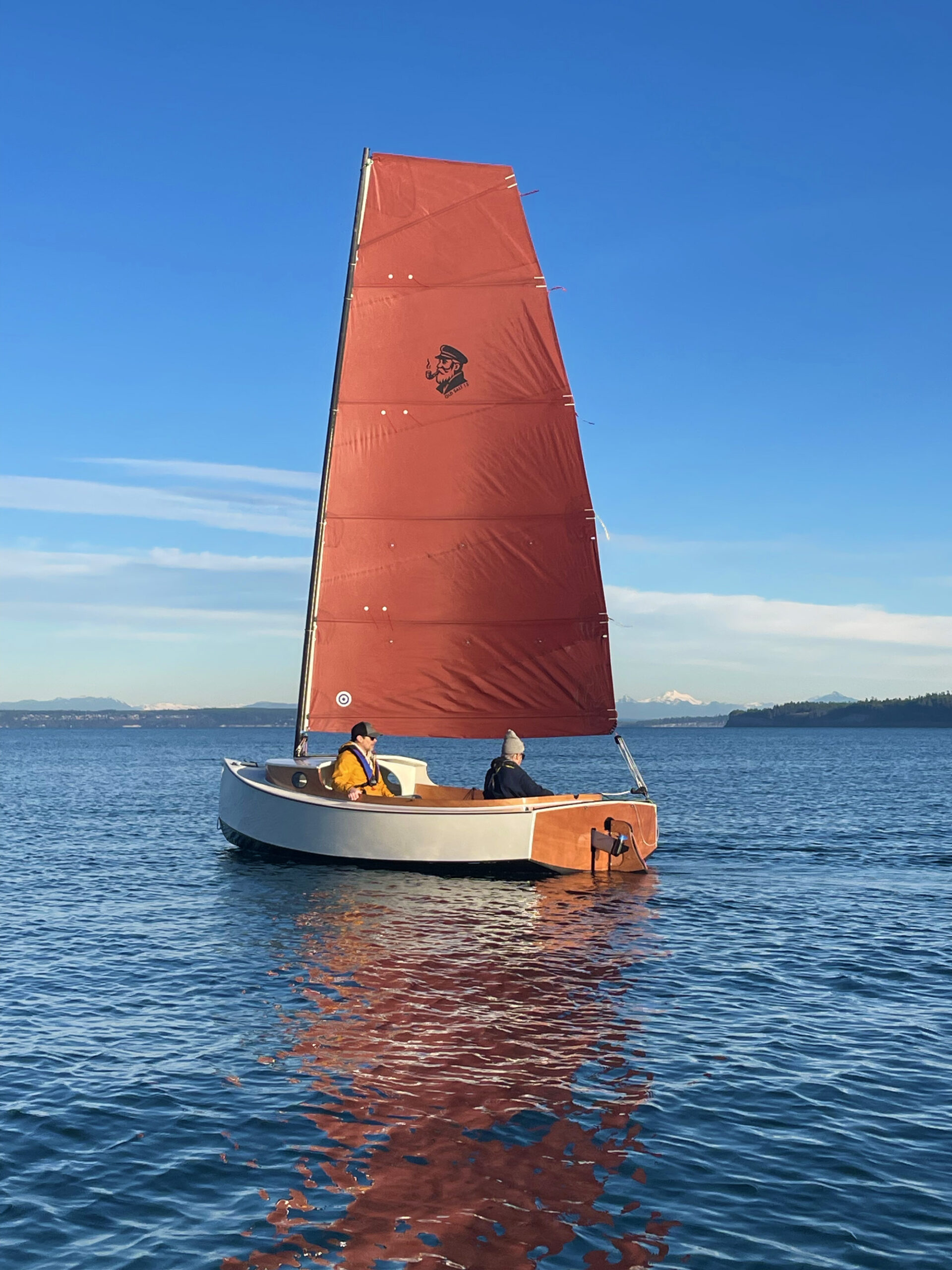
The Old Salt’s single sail has one halyard and one sheet—keeping fuss to a minimum. With no boom—cutting out the possibility of being whacked over the head when raising or lower the sail or during a less-than-controlled jibe—the sail gains its shape from six full-length battens.
And we do. The first thing that’s apparent is that Brandon and Josh have hit their objective of delivering fuss-free simplicity. There are only four lines to tend: halyard, downhaul, mainsheet, traveler. The helm is feather-light and neutral at these low wind speeds; earlier tests report just a touch of weather helm when the wind picks up. With three aboard in this light air, the boat doesn’t care how we configure the human ballast. Shuffling crew between sides when tacking would be wise and useful in 10 or 15 knots, but an imprecisely choreographed boogie would not result in disaster. And there’s no boom to whack anyone’s skull. When Josh takes the helm, in fact, he executes a jibe without bothering to haul in the mainsheet or alert the crew. Brandon, a little surprised, observes, “This boat is going to help people develop bad habits.”
My gaff-rigged cutter also sails very well in light air, but it takes a fandango of tweaking and tending seven sail-control lines to tune it to the conditions. The Old Salt, with its extremely generous 152 sq ft of sail, does at least as well with simple management of mainsheet and traveler. While it looks to me like the sail doesn’t set with enough camber to be an efficient low-speed wing, it’s hard to argue with results: we’re seeing 3–4 knots of boat speed in 3–5 knots of wind. In stronger wind, one could juggle the mainsheet and traveler and coax the battened sail into the ideal shape for the conditions.
Because we have a lot of 3–5-knot days in Puget Sound, I would make one change: with its internal battery, the recommended eLite will run for a maximum of 90 minutes at half power. With a larger, though still modest, 1-kW electric outboard and a higher-capacity battery, the motor could be employed for extended light-air motorsailing, running quietly enough that it would be easy to forget it’s on duty. This would also make Old Salt more useful for camp-cruising, which its expansive cockpit and cuddy certainly encourage.
A worthy sailboat for old salts
The two-week build class ends with boats a long way from completion. Hulls are stitched together with bulkheads in place, with some fiberglass tape reinforcements on the joints but many more to go. At home, the builders can look forward to: exterior fiberglass sheathing, sanding, cockpit sole, deck, cuddy cabin, coaming, cockpit seats, more sanding, paint, trim, hardware, and rigging. Simple though the Old Salt may be, and with a kit refined well beyond the usual, building a boat is still a long, twisty, arduous trail.
 Brandon Davis
With an aft-led mainsheet and offset centerboard, the generously-sized cockpit is uncluttered. The tiller, along with the rudder blade’s lifting lines, is led through a cutout in the transom, as is the ePropulsion eLite electric outboard, so that everything can be controlled from within the safety of the cockpit.
I urge Brandon to give me a brutally honest time estimate, and he tells me he figures an amateur would need 500 to 700 hours. He and Josh believe the market will bring out a lot of customers who just want to go sailing and are in a hurry to start doing it, so eventually there will be a production boat to sell, possibly all fiberglass.
It would be fine to offer that alternative—not everyone has the time and space to build a boat. But anyone with the resources and the barest acquaintance with a drill and sander should undertake the build. It will literally make you a better person—more capable, more confident, more able to manage the emotional tidal cycles of discouragement and elation that life deals us in every arena of endeavor. It’s never too late for old salts to build character.
Lawrence W. Cheek is a journalist, frequent contributor to Small Boats, and serial boatbuilder. He lives on Whidbey Island, Washington, and since 2002 has built two kayaks and five sailboats.
Old Salt 15 Particulars
LOA: 15′ 3″
Beam: 7′ 6″
Draft (centerboard down): 3′ 6″
Draft (centerboard up): 7″
Dry weight: 425 lbs
Maximum load capacity: 800 lbs
Sail area: 152 sq ft
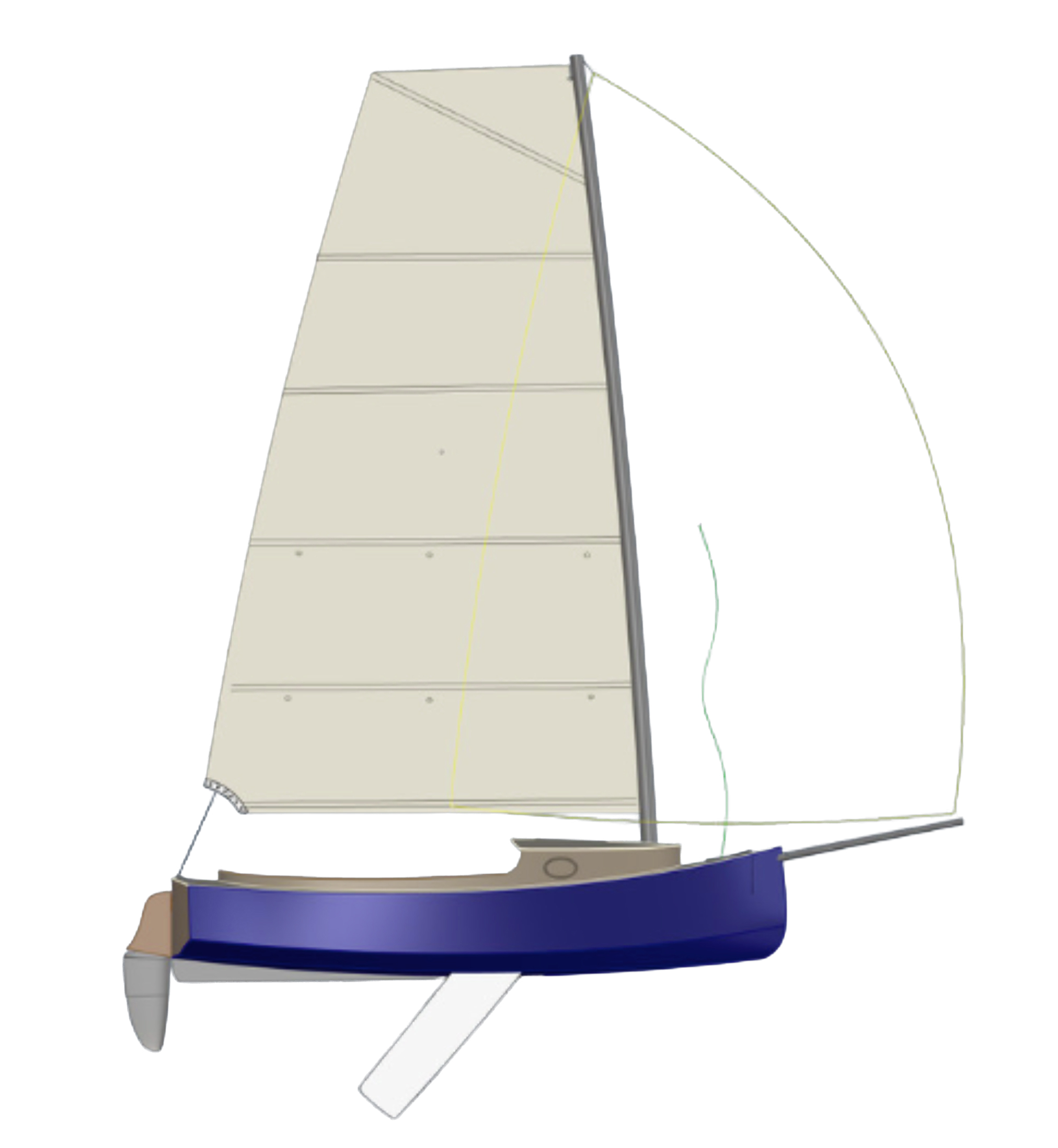
The Old Salt kit will be available from May 2026. Basic kit: $4,200; carbon-fiber mast: $1,500; sail, tanbark or white: $1,500. For more information and details, visit Kit Boats Co.
Is there a boat you’d like to know more about? Have you built one that you think other Small Boats readers would enjoy? Please email us your suggestions.
For more boat profiles by Lawrence W. Cheek, see:
Song Wren, a Devlin gaff-rigged cutter
Winter Wren II, a pocket yacht for two
Shrimper 19, a trailer sailer from Cornish Crabbers
For more inspirational “retirement” boating stories, see:
The BETTY Effect, a retired couple downsize from a sloop to a row boat and discover the joys of exploring the Thames River under oar.
Building a Goat Island Skiff, in the Upper Rhine valley, Gerald Trumpp learns to build a boat so he can learn to sail a boat.
The Tuesday Group Builds a Boat, a group of volunteers, all retirees, follow a retiring museum restoration manager, and get together once a week to build a Crandall Flyer.







Well … that looks very promising for my future as silver-sailor. A perfect concept for an easy and safe daysailor. And with about 200kg not as heavy as expected.
She looks sea kndly. Would like to see more on how the outboard was rigged.
Beautiful looking boat, and the sea trials seem to bear out the design’s objectives.
While I am sure this is heresy, at 72, and building a CLC passage maker dinghy right now, the idea of this boat is extremely appealing. I wonder if it could handle a 3.5 outboard, or a transom mounted 30 lb thrust trolling motor?
You wrote “He and Josh believe the market will bring out a lot of customers who just want to go sailing and are in a hurry to start doing it, so eventually there will be a production boat to sell, possibly all fiberglass.” Please let me know when you get to that stage … at 81 I’m not interested in building one but it could be the perfect boat for me. Very interesting article and a lovely boat. Thanks.