A few years ago, I discovered Building a Strip Canoe by Gil Gilpatrick. Of the eight canoes described within the book, one design immediately stole my heart: the 14′ Puddle Duck. Gilpatrick describes it perfectly: “A canoe you can leave hidden at a favorite small stream or pond that will be there for you to use without any preparation. The Puddle Duck is small and light enough for an average person to handle solo both in and out of the water. It has the capacity to carry two people, if necessary, though it’s better suited to one handler with the tools and gear for the day’s work or play.” It was exactly what I needed. Too many times have I stood at the water’s edge, wishing I had something light and simple that would let me get out there without fuss—and here it was, the Puddle Duck. I decided to build two, one for me and one for my partner, so we could glide side-by-side on quiet outings.
Building the Puddle Duck
Gilpatrick’s book takes a builder through every step of construction, and beyond. The first three chapters cover safety; the difference between the eight models (for which there are plans); and the preliminary setup, including building the strongback, setting up the stations, and cutting the strips. As Gilpatrick says, while the strips may not come into play until later, “sawing and machining them is a dusty job that is necessary to have behind you before the fun stuff—the building—begins.” The middle four chapters cover the build of the canoe, including planking and fiberglassing the hull, installing the gunwales, decks, and yoke, and making and installing the seats. Finally, there is a chapter on how to repair your canoe in the event of it being damaged later in life, and another on how to make paddles. The whole book is written in a friendly, informative, and easy-to-follow style with many photographs and step-by-step instructions that offer encouragement to the novice but won’t irritate a more experienced builder. Full-sized plans for eight canoes and a paddle are folded and tucked into the back of the book.
 Photographs by the author
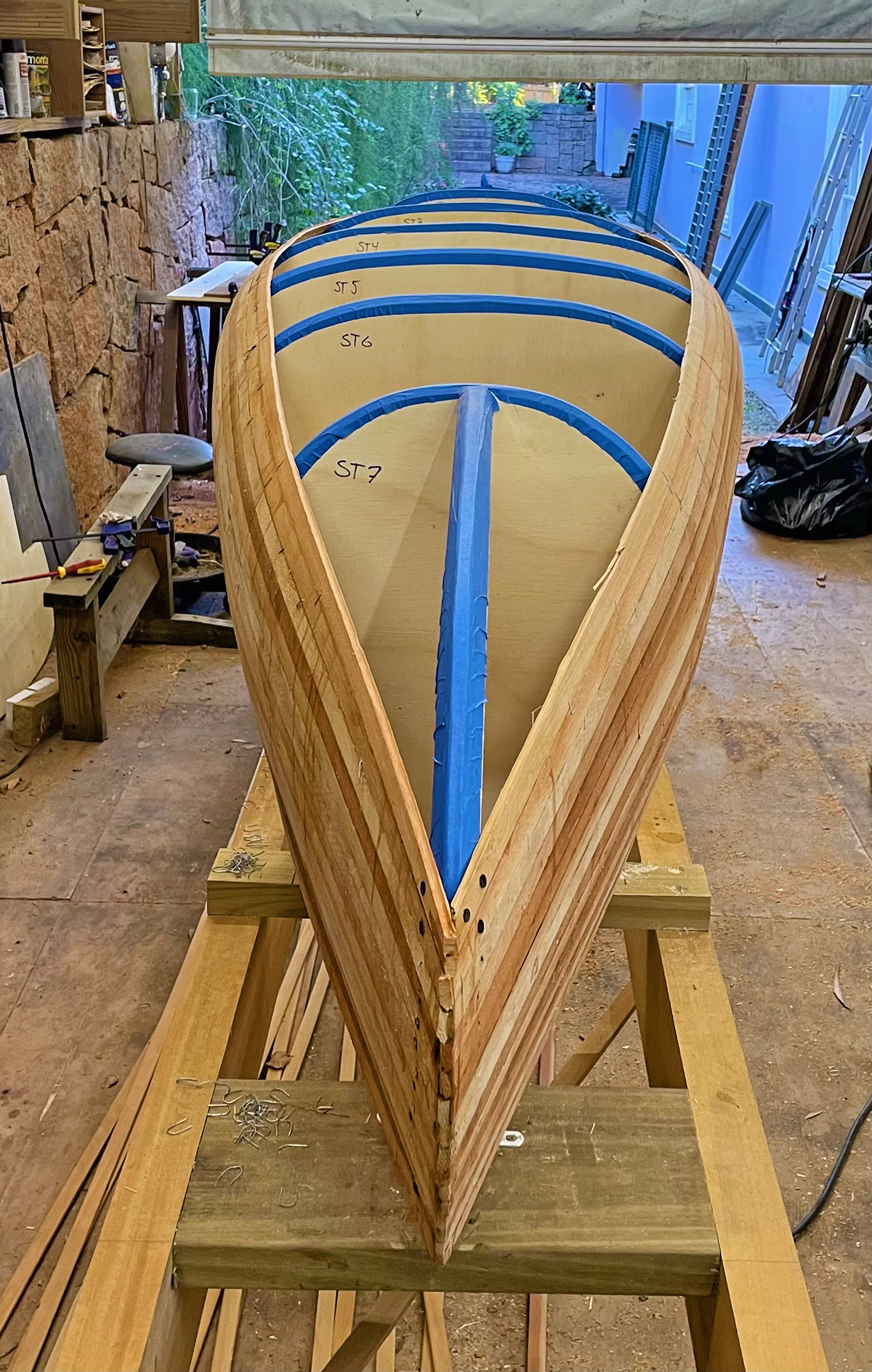
The Puddle Duck canoe is strip-planked over seven station molds and two stem forms. For the most part, I needed only tape to hold the strips in place as the glue cured. Occasionally, however, I did use drywall screws, especially at the stems, to temporarily fasten the strips to the station molds. Such screws can sometimes become set in the glue and break when being backed out. To avoid this, I hold a soldering iron to the screw to warm it as I work it out. Using this method, I have never had a fastening break as I remove it.
My first task was to take the full-sized plans for the Puddle Duck to a print shop in order to get them scanned. From there I digitized everything into AutoCAD—partly to understand the lines better, and partly so I could CNC-cut the station and paddle molds. The plans can, of course, be used as patterns for cutting pieces in the home workshop in the traditional manner. Whatever the construction technique, having precisely cut molds makes the building process easier and much more enjoyable.
I made my strongback from peroba rosa, a Brazilian wood known for its resistance and low warping— the book recommends either 2×6s or plywood—and made the seven station molds and two stem forms from inexpensive plywood. For the strips I used milled Brazilian marine cedar, a local substitute for the western red cedar Gilpatrick recommends. It’s a beautiful wood, rich in color, but denser and about 53% heavier than its North American equivalent.
Stripping the hull was pure meditation—each strip, carefully milled to a bead-and-cove profile, clicked into place like a puzzle piece. The book states that common carpenter’s glue can be used to glue the strips to each other—as the hull will be fiberglass sheathed—but I used waterproof Titebond III. Most of the strips fell beautifully into place and didn’t need to be stapled. I occasionally taped some strips in place, and others were temporarily fastened to the molds with drywall screws. At the stems I alternated port and starboard overlaps for extra strength. On the bottom of the hull, where the two sides come together, I switched from bead-and-cove strips to square-edged, which made it easier to bring the strips together.
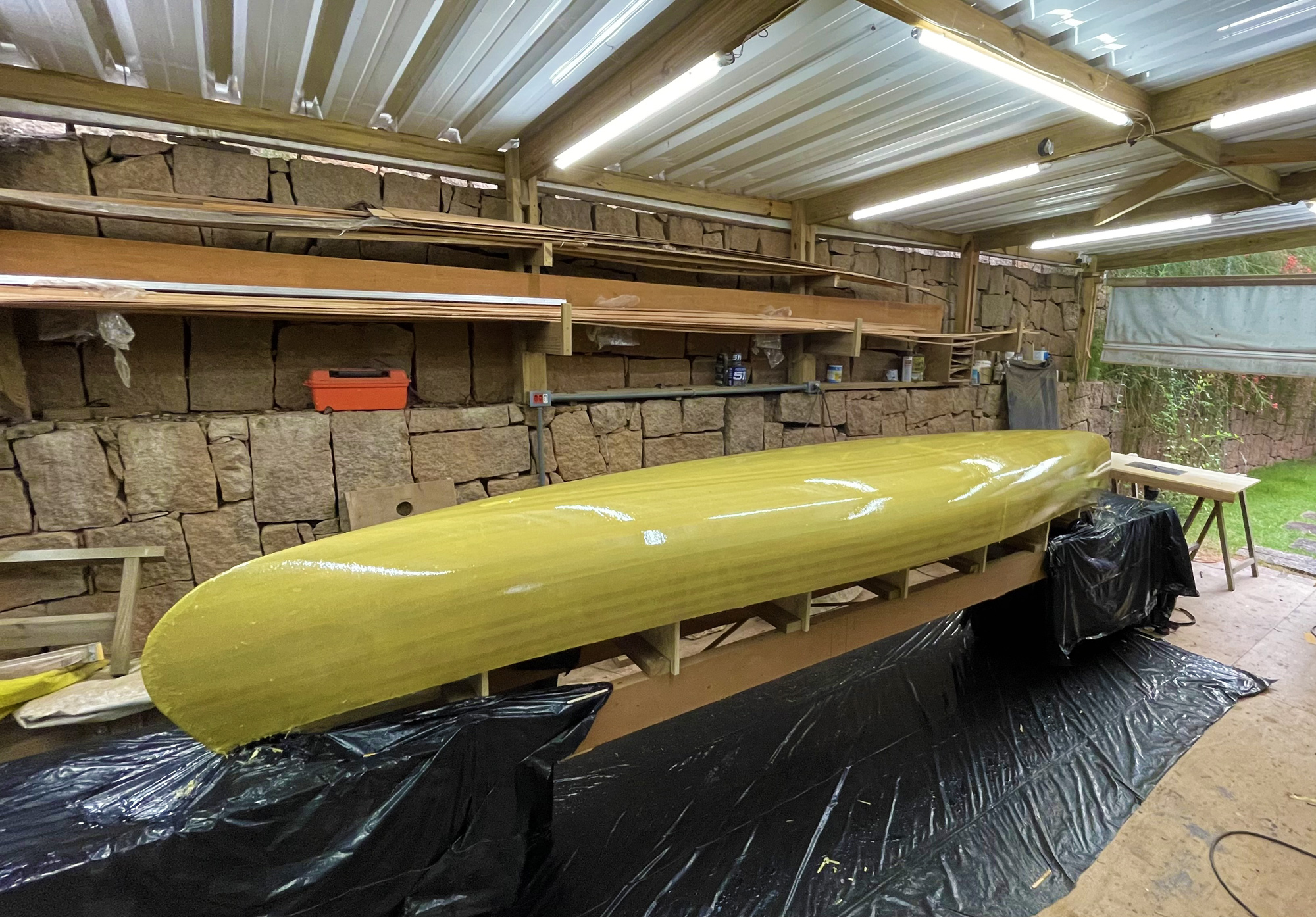
After the strip planking is complete the hull is sheathed. Gil Gilpatrick recommends using 6-oz fiberglass cloth. I chose to use Kevlar, which has greater tensile strength but is nearly opaque, so I chose to paint the hull rather than give it a clear finish.
Once the hull was fully planked and the outside was faired and smooth, it was time for the sheathing. Instead of Gilpatrick’s recommended 6-oz fiberglass cloth, I used 6-oz Kevlar fabric. Kevlar is lighter than fiberglass with an equivalent tensile strength and is far tougher against rocks and scrapes, which will give peace of mind for years of adventures. I also find that it folds more easily to the contours of a hull. But there are some trade-offs: Kevlar is opaque—which meant I had to paint the outside of the hull instead of varnishing it to show the wood—and it is difficult to cut. In order to achieve the clean cuts required, I bought a pair of serrated scissors specifically designed for Kevlar and other aramid fabrics. Finally, Kevlar doesn’t wet out as readily as fiberglass, and when sanded it produces stubborn fuzz that is almost impossible to fully eliminate and finish smoothly. I dealt with the fuzzy spots by applying a fairing putty made from epoxy mixed with microballoons, spreading it widely to avoid creating high spots, and then sanding it back carefully.
On the inside of the canoe I followed Gilpatrick’s directions and used a 6-oz fiberglass cloth, which offers good protection and allowed me to finish the interior with a clear polyurethane varnish, to protect the epoxy from the sun and to expose the beauty of the wood.
In another departure from the original design, I added a surfboard fin box near the stern. When preparing to paddle on long flatwater stretches I install the fin prior to launching; it provides laser-straight tracking. But for quick, nimble turns in tight streams, I leave it off. It has given us the best of both worlds and only required a small internal reinforcement—a 15mm-thick piece of hardwood epoxied to the inside of the hull directly above the fin’s external bracket.
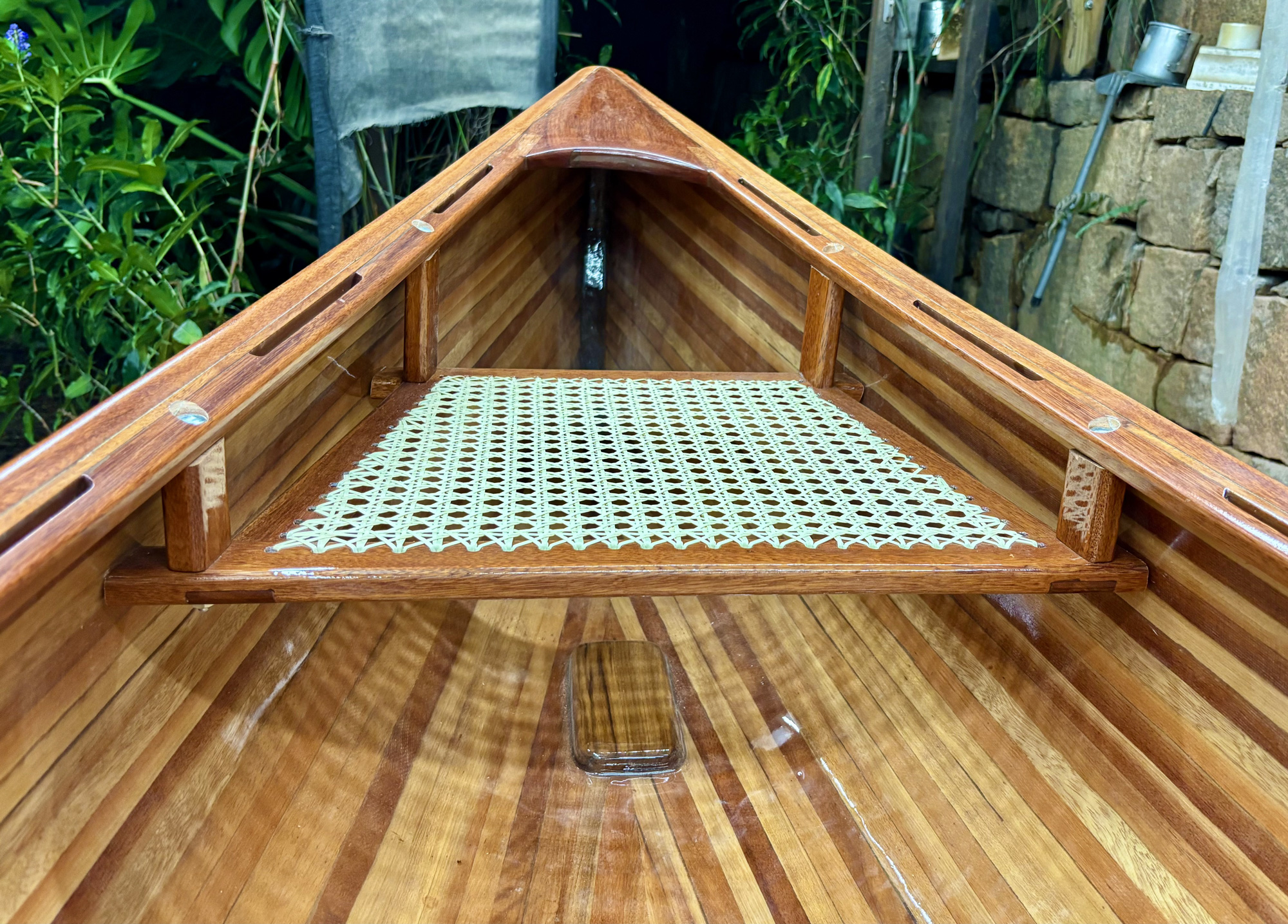
Gilpatrick gives detailed instructions on how to build and cane the seat. I was so happy with the result that I made a second seat so two people can paddle the canoe in comfort. The small block seen here beneath the seat is a backing reinforcement for the surfboard fin box that I fastened to the underside of the hull.
Although Gilpatrick recommends a hardwood for the gunwales, I used Brazilian cedar, which was readily available and, while not a hardwood, is much stronger than North American red cedar. I cut slots into the inwale to reduce weight, to allow water to drain when the canoe is stored upside down, and because I like the look of scuppered inwales. The decks, also of Brazilian cedar, have a gentle camber that blends into the gunwales. Shaping the compound curves here was tricky, but the result is genuinely elegant. A single, centered yoke, as described in the book, balances the canoe well for comfortable carrying solo and gives the hull athwartship stiffness.
I decided to make my own caned seat and was dreading the challenge: the cane looks classic and beautiful, but the weaving was new to me. But, thanks to Gilpatrick’s excellent instructions, it was surprisingly straightforward, and the finished look is stunning. So stunning, in fact, that I added a second seat for two-person comfort.
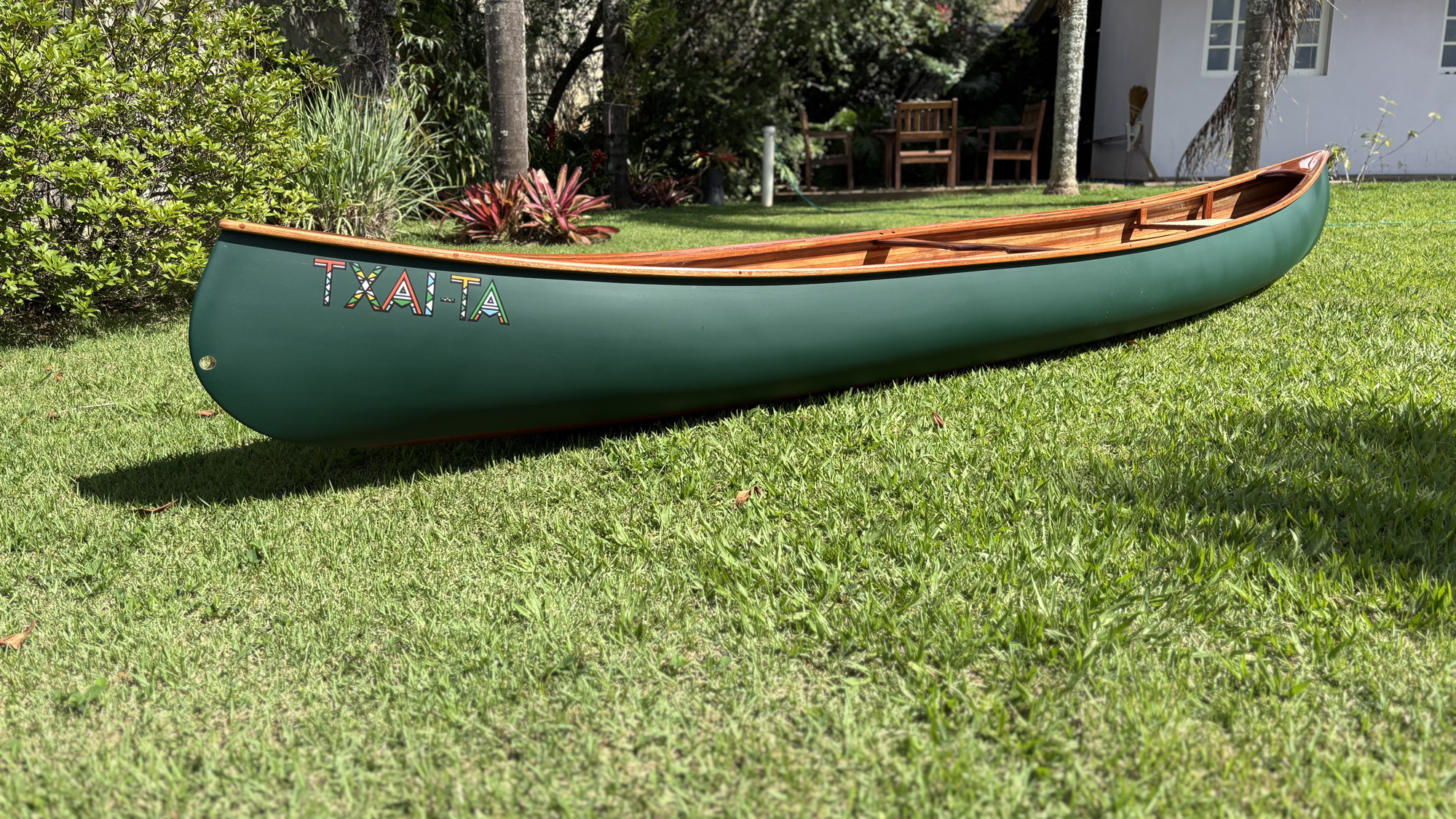
The inside of the canoe is sheathed in fiberglass, allowing for a clear finish to display the beauty of the cedar-strip planking. I made paddles following the detailed instructions and plans published in Gilpatrick’s book.
Finally, as the book includes an entire chapter on making paddles—including plans—I couldn’t resist making two of those as well. Gilpatrick recommends cedar for the paddle blades with hardwood strips to strengthen the shaft. I used marine cedar for the blades and freijó (Brazilian walnut) strips for the shaft—strong yet flexible, freijó is a perfect local stand-in for cherry. I made one paddle with the thicker (1 5⁄16″) shaft shown (but not described) in the plans and a second thinner one (1 1⁄8″) as described in the book. The first offers rugged toughness, the second graceful lightness. I followed Gilpatrick’s advice and reinforced the blade tips with epoxy-impregnated nylon cord, an important step that should not be skipped.
Puddle Duck on the water
Because of my use of Brazilian marine cedar, this first Puddle Duck is heavier, at 29kg (almost 63 lbs), than the book’s 20kg (45 lbs) estimate, but still light enough to hoist onto a shoulder and carry to the water.
When stepping into the canoe, there is good initial stability and the hull has little or no tendency to tip. Once I’m settled, the caned seats are extremely comfortable, and at just the right height to maintain the canoe’s stability. Even though the Puddle Duck is designed for solo use, two adults plus a picnic cooler fit with room to spare, and the canoe becomes extremely stable. On our maiden voyage we paddled for six hours, stopping only for a short picnic—there were no numb legs, and no discomfort. With both of us paddling in rhythm we cruised at a relaxed, all-day pace of 3.8 knots, hitting 4.2 knots in some more spirited bursts. With the skeg installed, the canoe tracks well and needs few corrective strokes—without the skeg, she spins on a dime.
The Puddle Duck is everything Gilpatrick promised: light, nimble, stable, and utterly delightful on quiet waters. Building it was a rewarding project, suitable for novice builders as well as experienced ones, and now we have our own canoe ready and waiting for the next adventure—big or small, whenever the mood strikes.
Oliver Ilg is a German-born Brazilian entrepreneur, former automotive executive, and passionate wooden-boat builder. He launched his first boat in 1987, a 53′ steel sailboat. In 2003, he founded Sterling Yachts in Brazil, producing modern-classic fast trawler cruisers, and in 2008 began building small wooden boats after hours. He continues to build boats in his backyard and, while he has plenty of high-end power tools, he is especially proud of his meticulously maintained hand planes.
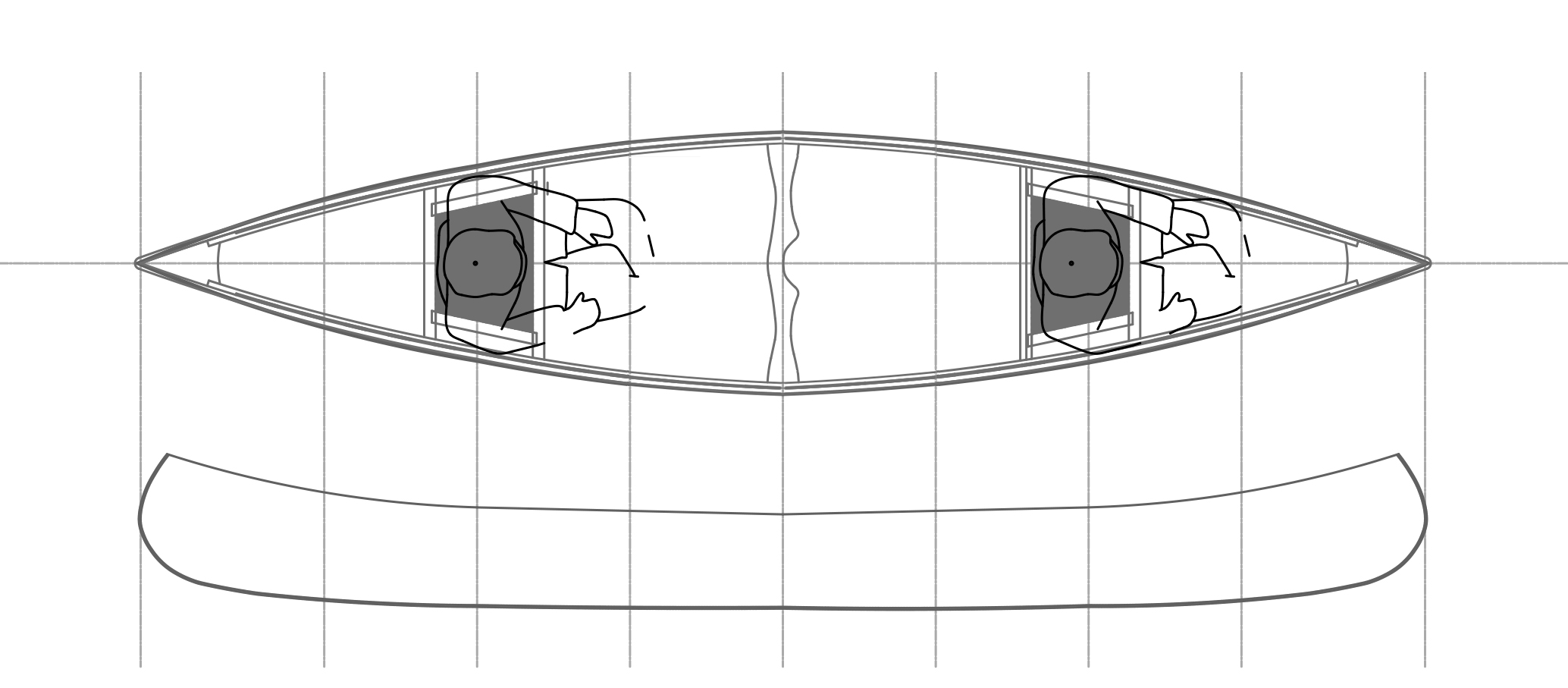
Puddle Duck Canoe Particulars
LOA: 14′ (4.27m)
Beam: 34 1⁄2″ (0.88 m)
Depth: 12″ (0.30 m)
Stem height: 20″ (0.51 m)
Designed weight: 45 lbs (20 kg)
Building a Strip Canoe (second edition, revised and expanded) is available from The WoodenBoat Store, $24.95.
Is there a boat you’d like to know more about? Have you built one that you think other Small Boats readers would enjoy? Please email us your suggestions.
To read more about Oliver and his boats, see:
Home-Built Elegance, how Oliver reimagined and built his own Duck Trap Launch
Duck Trap Wherry, an elegant rowboat designed by Walter J. Simmons
and for another canoe from Gil Gilpatratick’s book:
The Laker Canoe, an all-purpose strip-planked canoe

Join The Conversation
We welcome your comments about this article. To include a photo with your remarks, click Choose File below the Comment box.