I didn’t choose my boat; it chose me. That might sound like a cliché, but it’s true. In 1997, while I was editor of Classic Boat magazine, I heard that the legendary multihull designer Nigel Irens (responsible for Ellen MacArthur’s solo around-the-world record-breaking trimaran B&Q/CASTORAMA, among many others) had designed a 13′ 7″ dinghy, which was to be produced as a kit for amateur construction. It was too good a story to miss, and in no time at all we’d agreed to write up the project and sell the kit through the magazine. It was in the early days of CAD and CNC and Nigel, being the visionary designer that he is, had seen the future.
“There’s more than a whiff in the air that kit building is in for a revival,” he wrote. “Partly because, as in the post-war years, people are again looking for a way to get afloat without mortgaging their soul, and partly because there’s some new technology about that makes the whole idea more accessible to those who cannot claim to be master builders.”
The design Nigel and his protégé Ed Burnett produced was a long, slender boat with a bold upright stem and an elegant counter stern—angled to discourage the use of an outboard. The boat was primarily intended for rowing but also had a small lug rig, along with the associated daggerboard and rudder. They named it the Western Skiff.
 Nic Compton
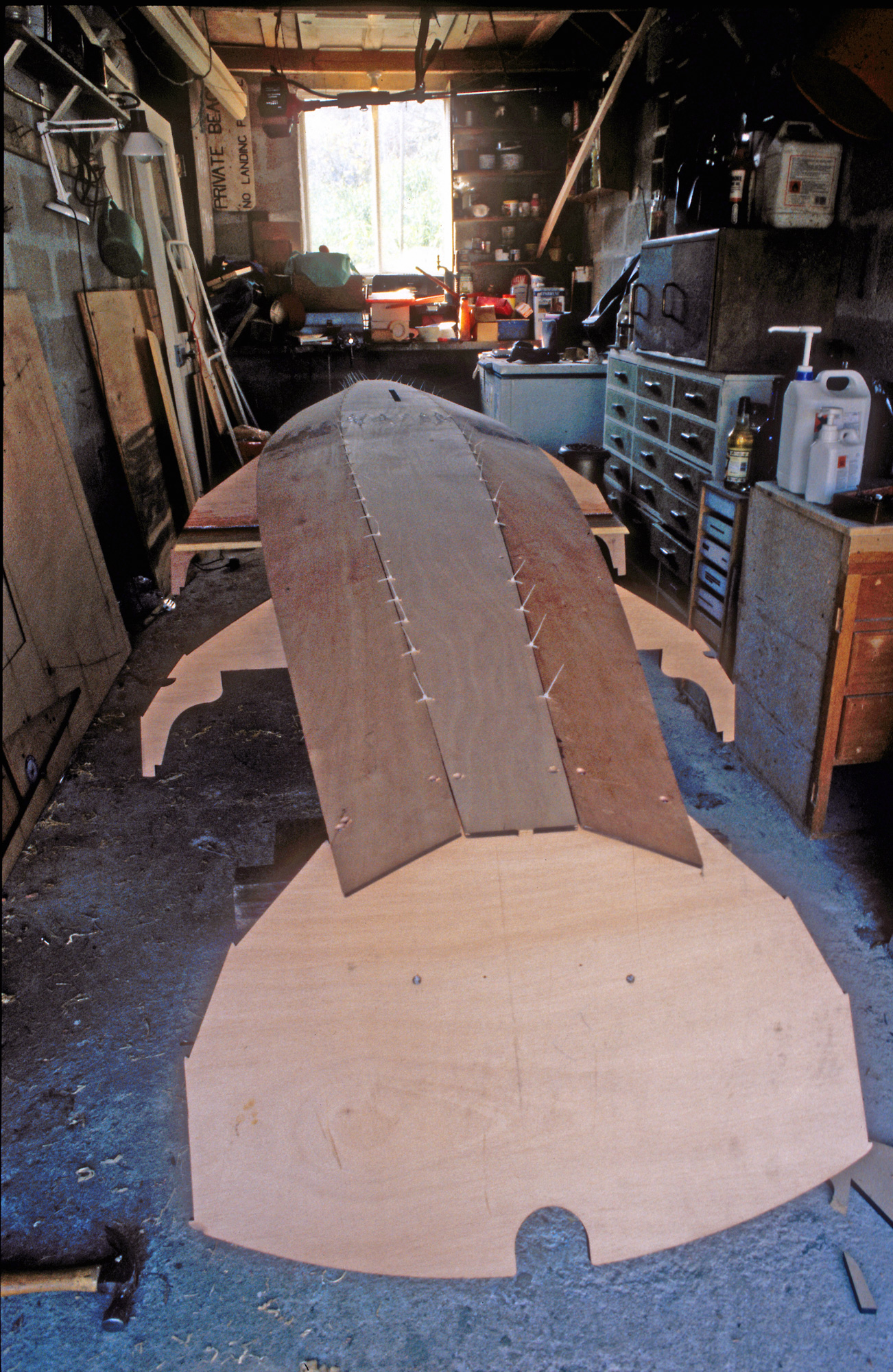
The Western Skiff’s kit includes an MDF strongback but no molds. Instead, the boat’s shape is determined by the bulkheads, central frames, transom, and stem.
The prototype had been built and tested, and Nigel and Ed were looking for four “guinea pigs” to test the kits and the instructions Ed had written. I jumped at the opportunity—not least because they were offering the kit at half price.
Building the original Western Skiff kit
The kit was ingeniously simple: seven sheets of plywood, and two sheets of MDF for the strongback. Solid wood was supplied for the thwarts, keel, and gunwales, while the hollow wooden mast and solid spars arrived eight-sided, ready to be planed and sanded into shape. There were no molds. Instead, the two bulkheads, two central frames, transom, and stem were set up on the strongback to determine the boat’s shape. Each strake was assembled from two pieces, joined together with precut triangular finger joints, which were set in epoxy, and the full-length planks were then wrapped around the skeleton, where they were temporarily stitched together with cable ties. The lands were left square and the resulting gaps in the overlap between the planks were filled with epoxy, not only creating a strong bond but also effectively producing stringers to stiffen the boat longitudinally.
It was boatbuilding for amateurs, using the benefits of a laser-cut kit combined with the forgiving nature and strength of epoxy. Even the quarter knees were made by gluing together two layers of plywood, staggered to give the required angle, with the resulting gaps filled with thickened epoxy. The solid-wood forward and after thwarts were bedded onto the plywood buoyancy tanks with a layer of thickened epoxy. The two middle thwarts were notched into the tops of the frames, which did duty as knees, and were secured with a heavy fillet of epoxy at each end.
 Sol Compton
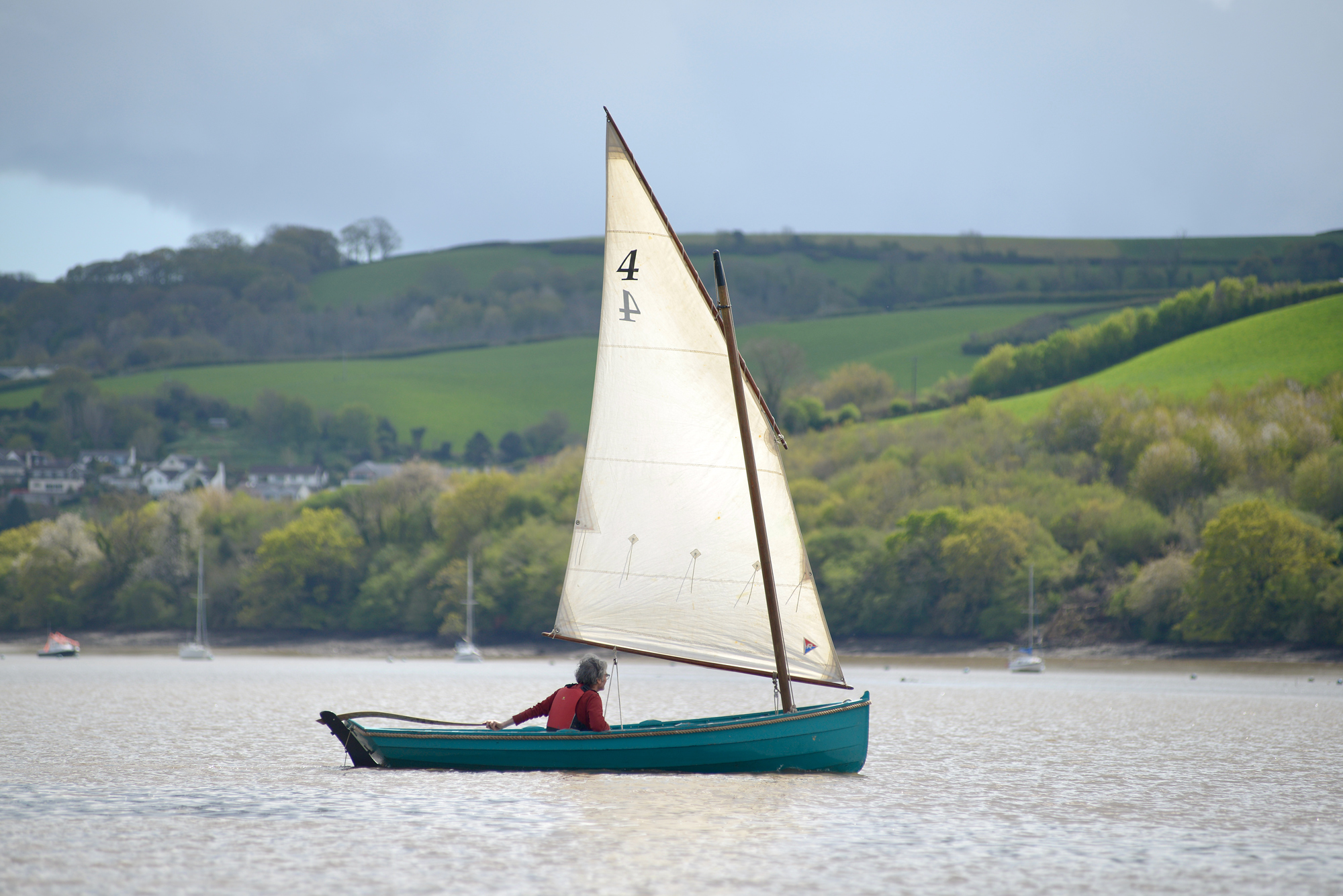
The balance lug rig is ideal for a boat of this type and size; it’s simple to handle, needs no standing rigging, and the spars all fit within the length of the boat. However, for optimal upwind sailing performance, I should have moved the downhaul farther forward along the boom.
It sounds crude, but it has stood the test of time. The only area of weakness after 30 years of use has been in the finger joints, which in retrospect I should have strengthened with a layer of fiberglass, something that is recommended in the most recent version of the kit. Indeed, today’s kits have replaced the original finger joints with a choice of either short finger joints backed by fiberglass on the inside, or with conventional beveled scarf joints.
The Western Skiff on the water
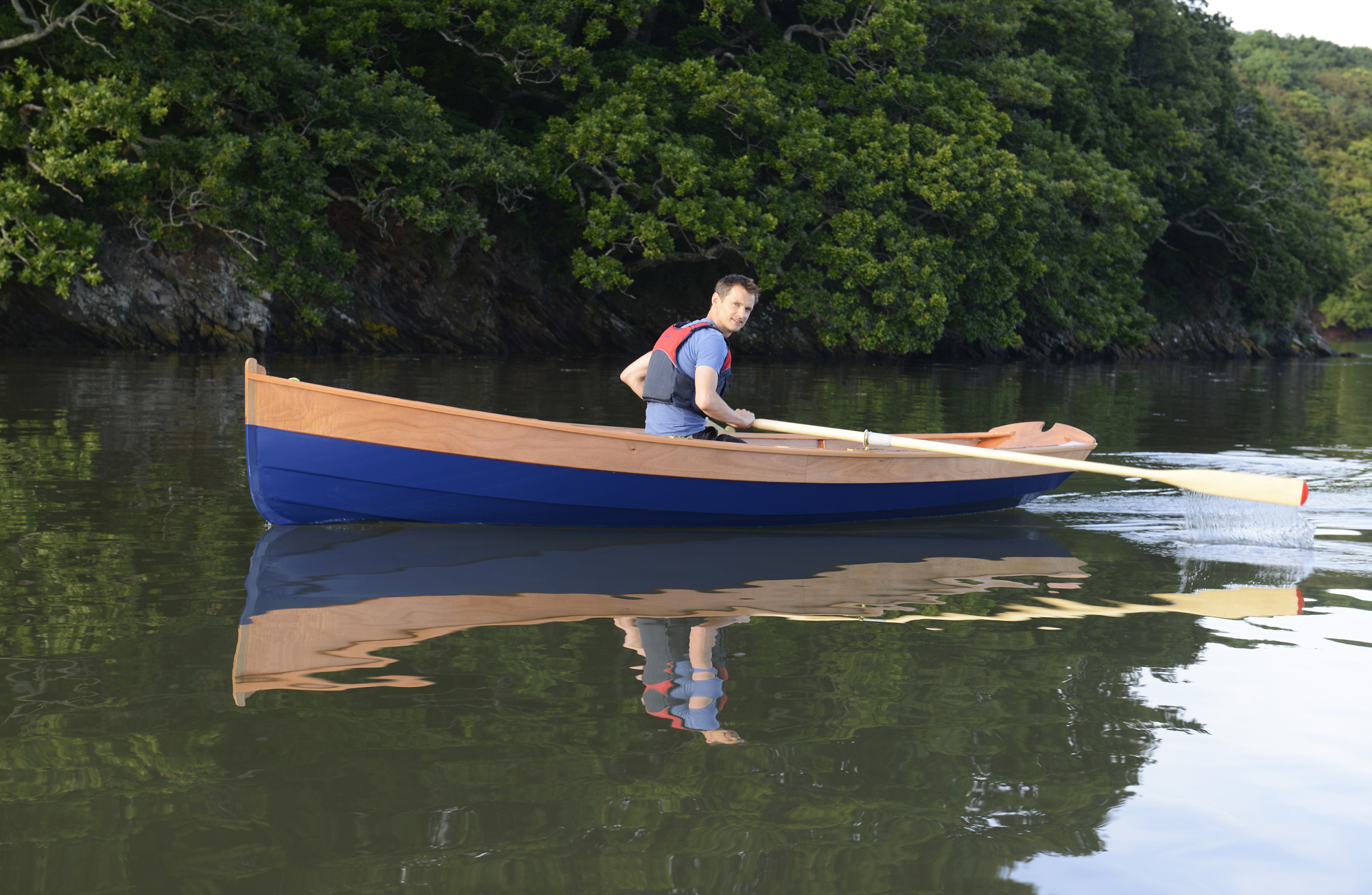
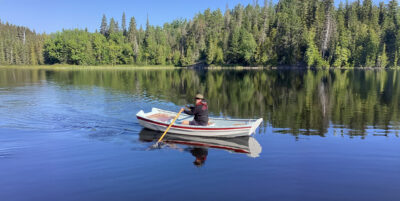
I launched my skiff in the summer of 1997 and have used her ever since. At just 70 kg (154 lbs), she’s easy to launch and recover from a trailer or dolly. She’s also a pleasure to row solo, although I think she carries her way better with a little weight in the bow—either a jerrycan filled with water or, in my case, more typically a 55-lb dog. She can be rowed by two people, either with each rower handling one oar or, for maximum speed, a pair of oars apiece. The space between the rowing thwarts is tight, however, and if you get the timing wrong, the stroke rower is likely to get an oar handle in their back.
 Nic Compton
Nigel favored the raked transom both for its good looks and because it made mounting an outboard motor almost impossible. He wanted to encourage the use of sail and oar, and the Western Skiff does, indeed, row well, either solo or with two at the oars.
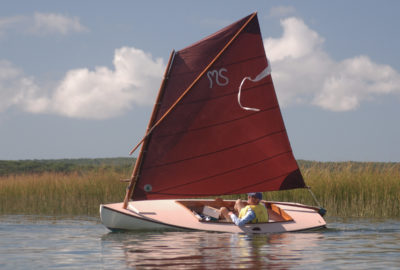
Under sail, following Nigel’s lead, I usually sit in the bottom of the boat. The idea is to keep the weight as low as possible, but despite this, the Western Skiff is decidedly tippy (both the designer and I have capsized our respective boats). In a stiff or gusty breeze, you have to be prepared to release the sheet or head into the wind at a moment’s notice, which can make it hard to get any consistent speed to windward. Off the wind, she flies along quite happily.
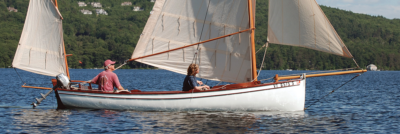
The balance lug is a forgiving rig for the dinghy—it is simple, the spars can all fit inside the boat, and the sail can be raised and lowered quickly in the event of changing conditions. The halyard, downhaul, and sheet blocks on my boat are all attached with lashings, as I originally thought I’d try out different positions before permanently fixing them in place. In the event, I never got around to that, so they tend to move around a little. The most critical item is the position of the downhaul on the boom. For best performance, it should be closer to the tack for upwind sailing and eased off for downwind. However, for the kind of sailing I do (pottering around an estuary), it makes little difference—although I have to admit that my lackadaisical attitude may well account for my boat’s slightly disappointing windward performance.
For flotation, there are built-in buoyancy tanks in the bow and stern, as well as designed side tanks forward of the daggerboard thwart. I never fitted the latter, preferring to leave the interior free and uncluttered. I did plan to hang inflatable buoyancy bags beneath the two ’midship thwarts, but again, have never gotten around to it. Without the built-in side flotation compartments, my boat does float when capsized, but emptying her while afloat is impossible as the water floods back in through the daggerboard case. If I were to build anew I would likely still leave out the fitted side tanks but would definitely install bags.
Over the past 30 years, the skiff has lived on a trailer and been used in a variety of situations, first as a family dinghy in a sheltered river, then as a bachelor boat off a sloped pebble beach, then as a family boat again on the very tidal River Dart in Devon, southwest England. During those same three decades, I’ve owned five big boats—ranging from 22′ to 36′ LOA— but, while those have come and gone, I’ve never felt tempted to sell my Western Skiff.
 Nic Compton
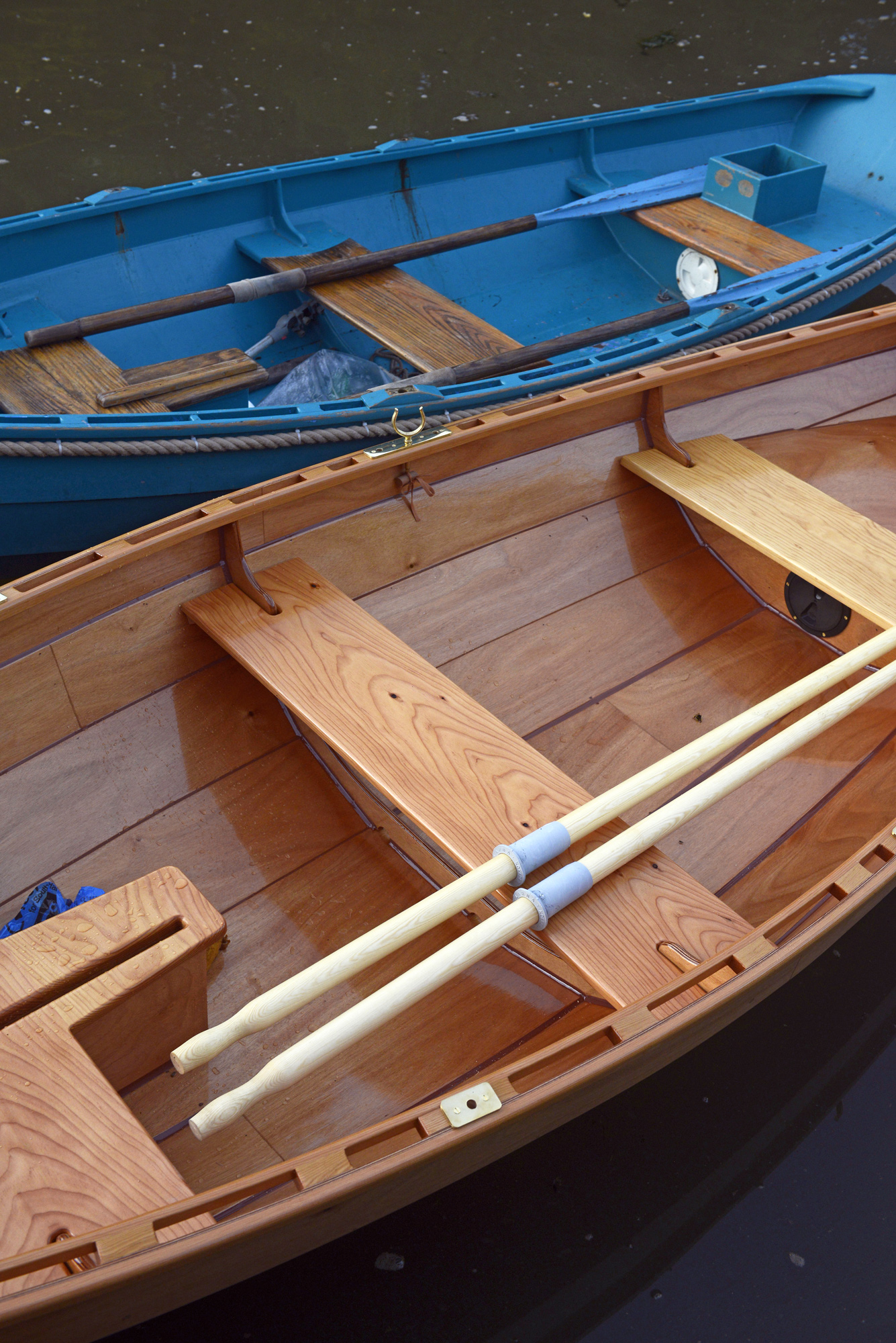
Two generations of Western Skiffs rafted up: in the foreground is one of the newer skiffs built in 2018, and beyond is my original boat, built some 30 years ago. The layout has remained the same as has the general build, although the long finger joints have been replaced by either short fingers or beveled scarf joints. In the starboard quarter of my boat can be seen the outboard well box, which I fitted retrospectively with Nigel’s blessing. It takes a 3.5-hp motor and has greatly expanded my family’s use of the boat.
Ten years ago, I did the unthinkable and, with the designer’s blessing, fitted an outboard well, which greatly expanded the boat’s range. Suddenly, from just rowing a mile or two from our home, we could head down to the mouth of the River Dart and out to sea.
I wrote an article about that metamorphosis for Small Boats, and the positive response to the story helped relaunch the Western Skiff design. Nigel was enthusiastic, naval architect Jack Gifford kindly agreed to convert the CNC cutting files into a set of full-sized templates, and Practical Boat Owner magazine offered to host the project on its website, where downloadable cutting files are now offered, free of charge. Simultaneously, Alec Jordan of Jordan Boats made the boat available as a kit, through his own website in the U.K. and later through Hewes & Company in the U.S.
 Sol Compton
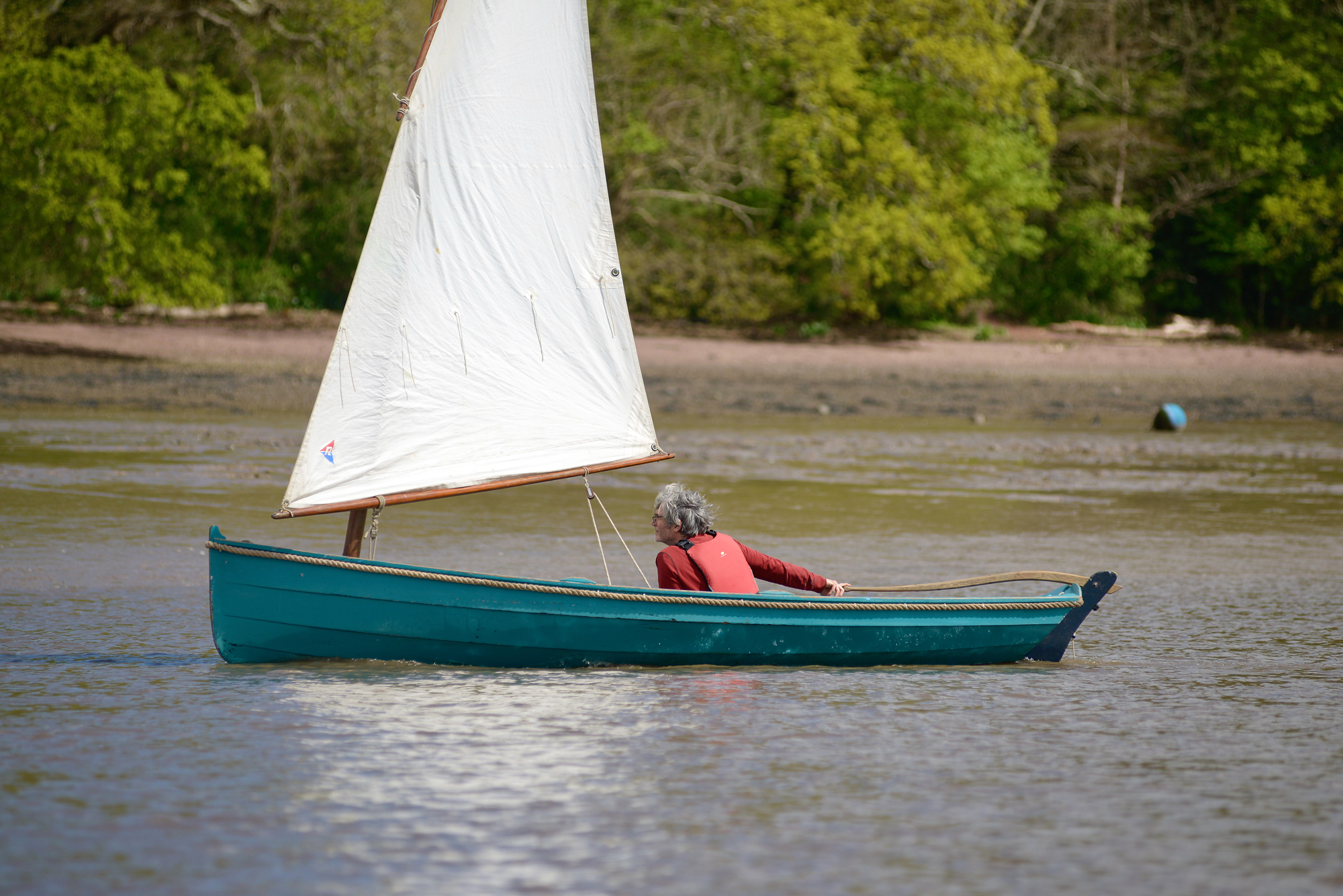
The sleek lines of the Western Skiff, with her sharp entry, sloped transom, and curved sheer that rises gently to the bow, reflect a marriage of traditional looks and good performance—a trademark of Nigel Irens’s design work.
Thus, in June 2018, the first official Western Skiff to be built in almost 20 years was launched on the River Dart, coincidentally just a stone’s throw from where Nigel had tested the original design. The new boat was built by former professional boatbuilder Jeremy Butler from a kit supplied by Jordan Boats and featured several innovations: all four thwarts are removable so that the boat is now light enough to be lifted on to a car roof rack; and two wheels on a detachable bracket can be fitted to the forward end of the keel so that the boat can be wheeled to the slipway (Jeremy worked for a time for the Barrow Boat Company in the U.K.).
Since 2018, there has been a steady trickle of new builds on both sides of the Atlantic, and their progress is often shared on the Western Skiff Forum on Facebook. At least one boat has been built with removable thwarts and a tent for sleeping on board, following the current trend for dinghy cruising. If a measure of a design’s success is how well it can adapt to the changing times, the Western Skiff has more than proven its worth over the past 30 years.
A regular contributor to Small Boats, Nic Compton is a freelance writer and photographer based in Devon, England. He currently sails, rows, and motors his Western Skiff—30 years after he built it—and a 33′ Freedom cat-ketch.
Western Skiff Particulars
LOA: 13′ 7″
Beam: 4′ 5″
Draft, min: 4–6″; max: 2′ 6″–3′
Sail area: 61 sq ft
Weight: 154 lbs
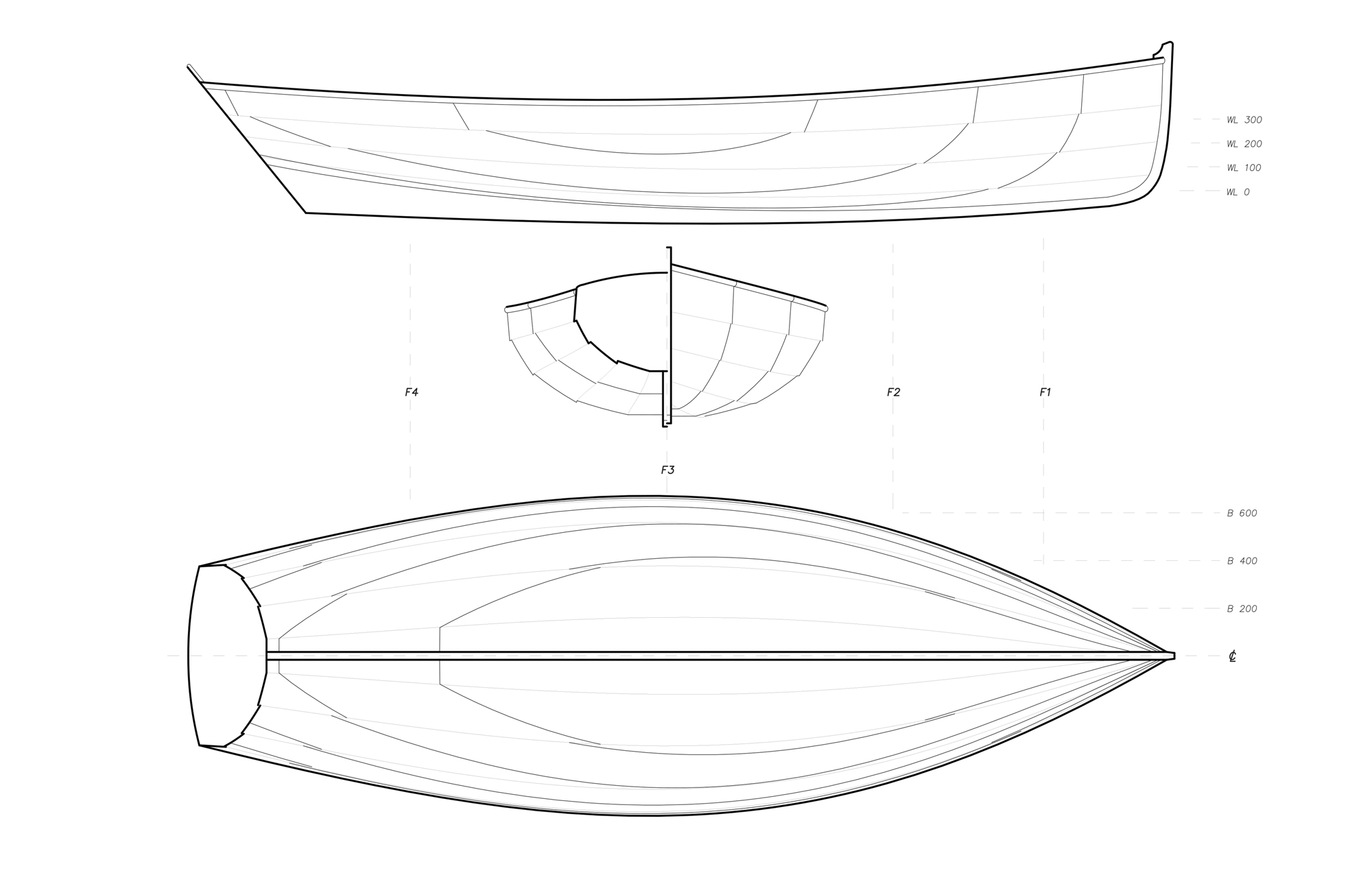
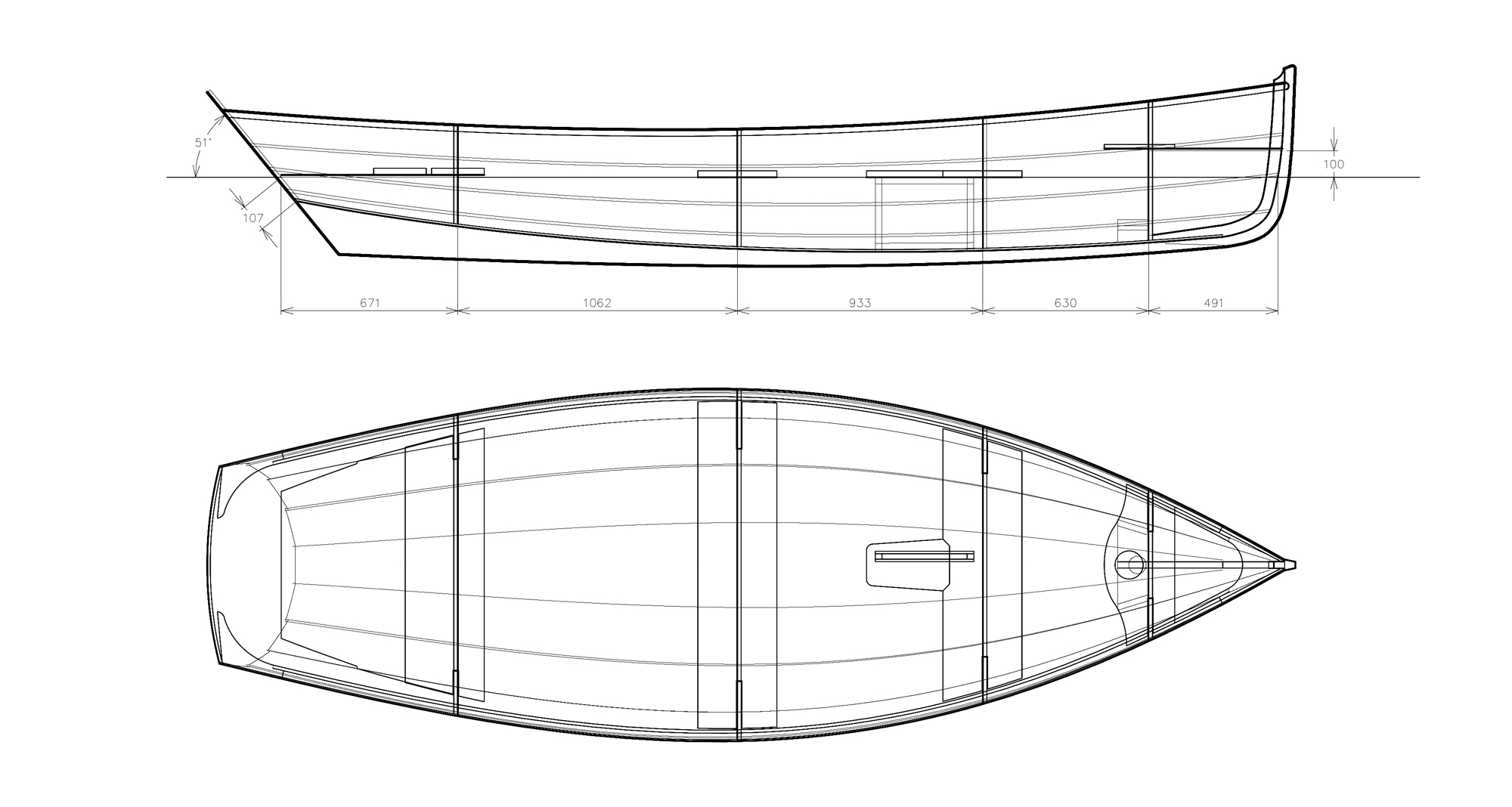
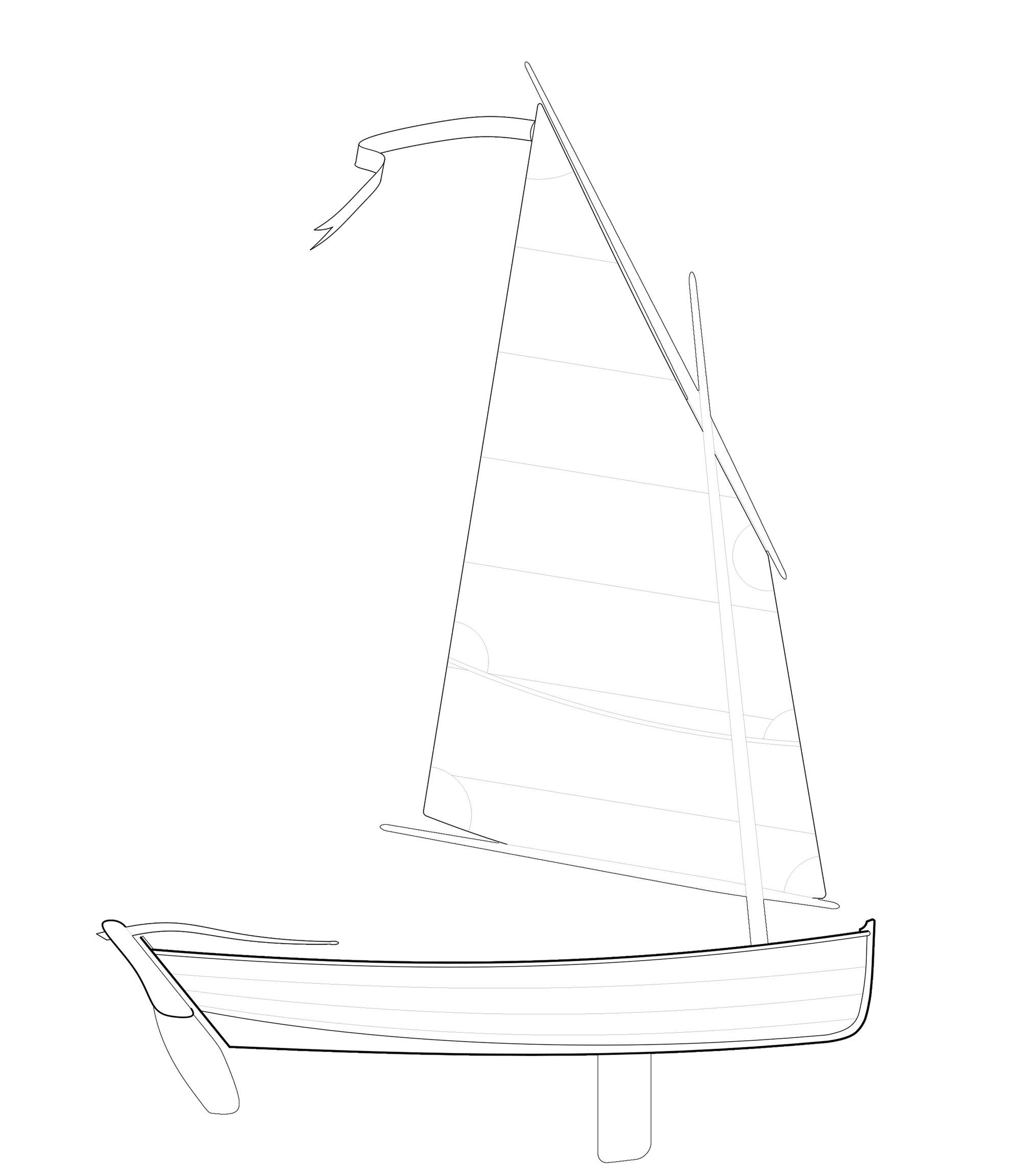 Downloadable cutting files for the Western Skiff are available from Practical Boat Owner, free of charge.
Kits are available in the U.K. from Jordan Boats, from £1,749 and in the U.S. from Hewes & Company, from $3,165. Note that the current kit only includes the plywood building parts and a plywood strongback. Patterns for the solid timber parts are included.
Is there a boat you’d like to know more about? Have you built one that you think other Small Boats readers would enjoy? Please email us your suggestions.
For more articles by Nick Compton, see:
The BETTY Effect, a retired couple discover the joys of river cruising under oar.
The Seahopper Light, a flatpack boat for sail, oar, and outboard.
From Hope Cove to the Helford River, a young man, new to sailing, goes dinghy cruising along the Devon coast.




Beautiful Boat! And practical, too. Forty-plus years ago we built a similar concept boat, Phil Bolger’s “Gypsy” using 1/4″ plywood planks cut to Bolger’s and Dynamite Payson’s layouts. Similar simple drop-in rig with a sprit boom sail that we sewed ourselves. It remains our family’s favorite boat. More complex (and heavier) boats remain in the shed while this one comes out to play. Now grand-kids are using her to learning to row & sail…