Alison and Paul, Dawn and Simon were longtime friends living in the southeast of England. The two couples had met through work and quickly discovered a mutual love of sailing. Simon’s family owned a 34′ cruiser-racer, and Paul and Alison would join Simon and Dawn for outings off the East Coast. They went on a flotilla-sailing holiday together in the south of France, chartering a 27′ catamaran, and for a while they co-owned a twin-keeled Channel 27 cruising yacht. And even though Paul and Alison eventually took a step back from sailing to pursue other interests, the two couples remained firm friends.
 Photographs courtesy of Paul Scott
The two young couples, Simon and Dawn, Alison and Paul, met through work and became firm friends, sharing sailing holidays and, for a time, co-owning a 27′ sloop. Simon, far right, was the original owner of the Barrowboat kit.
Then, in 2020, Simon fell ill. Diagnosed with a form of blood cancer, he went through more than two years of treatment, remission, and more treatment before succumbing to the disease in early 2023. Paul and Alison stayed close to Dawn and, more than a year after Simon’s passing, she called them. She had been clearing out the loft and had come upon a kit for a Barrowboat—a 6′ glued-lap pram dinghy with a lug rig. When built, a small wheel would be attached to the keel plank forward, and oars could be inserted through two holes in the aft transom, so that the boat could be lifted and wheeled around like a barrow. Simon had bought the kit 35 years earlier at the London Boat Show, thinking that he’d build the dinghy to use as a tender to the family boat, but somehow it had never happened. Knowing that Paul had developed a keen interest in woodworking as a retirement hobby, Dawn wondered if he’d like to take the kit and build the boat. Paul didn’t hesitate. It would, they both agreed, be a nice way to honor Simon’s memory.
A few days later Paul brought the kit home. It seemed it was all there: 32 pieces of precut plywood, all the fittings, the sail, mast, and yard; the original bottles, cans, and packets of epoxy, hardener, filleting powder, and varnish; even the instruction manual, How to Make the Barrowboat, which included plans, step-by-step directions, and hand-drawn sketches featuring a curious, occasionally helpful, dog. Created in the 1980s, it was a friendly manual, very much of its time.
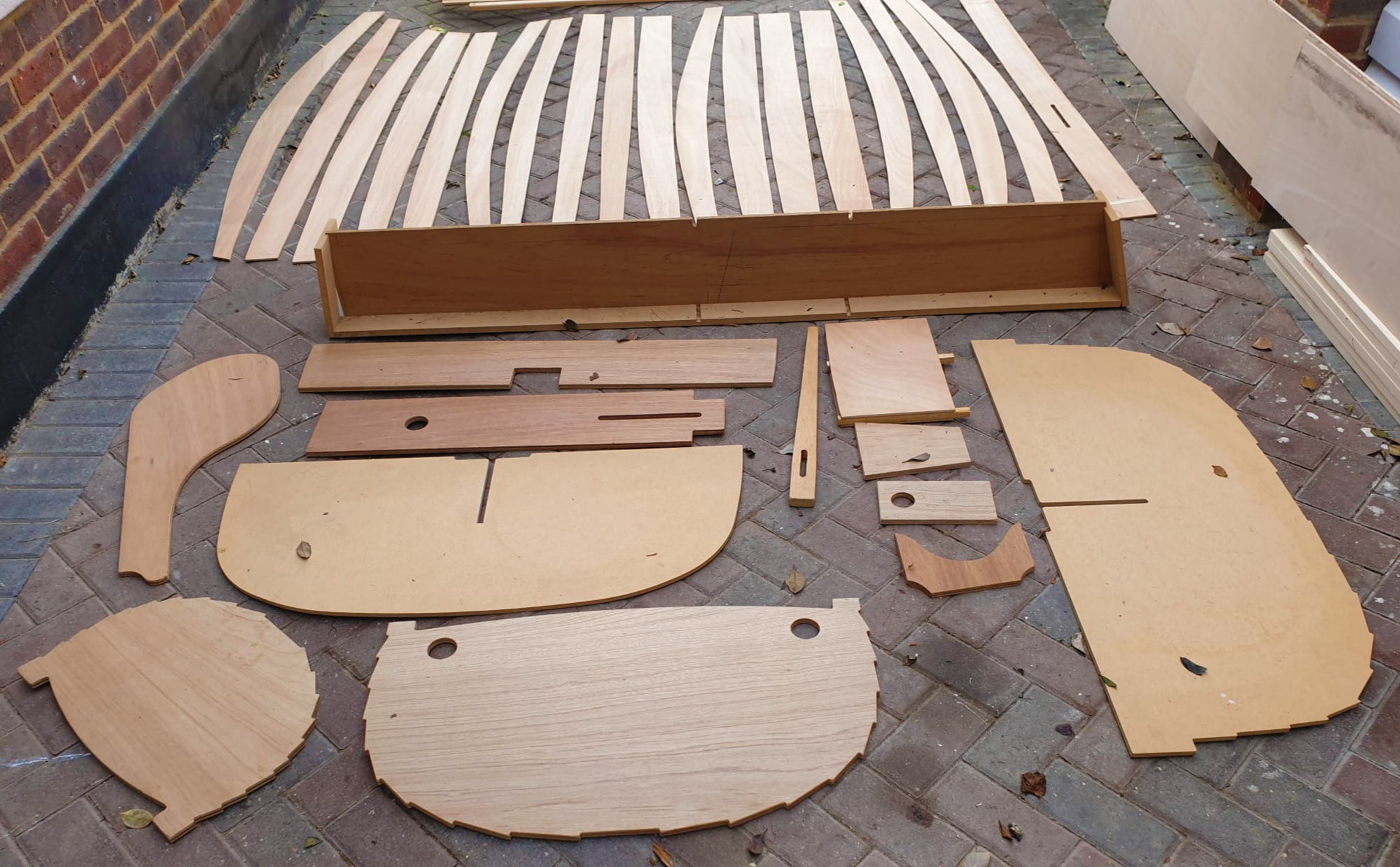
Despite having been stored in an unheated loft for 35 years, the plywood pieces of the Barrowboat kit were in good shape.
Paul unpacked everything, threw out the long-expired adhesives and finishes, bought replacements—along with mixing pots, syringes, and tongue depressors for applying the epoxy fillets—and set to work. The Barrowboat would be built upside down on a plywood strongback (that would later be cut up to make the daggerboard and one of the thwarts), with two molds and a bow and stern transom defining the boat’s shape. With the jig set up, the planks were laid from keel to sheer plank. The process was simple. The keel plank was laid in place and screwed to the two molds and transoms. Next the garboards were laid down: each precut plywood plank was positioned into its corresponding step on the ’midship mold, where it was temporarily screwed in place. Screws were then inserted through the plank into the second mold and the two transoms. Subsequent planks were fitted, overlapping, and temporarily screwed to the neighboring plank at 18″ intervals. Once the screws were all in place, a “small blob of epoxy” was inserted between the planks beside the shaft of each screw. Once the epoxy was cured, all the screws were removed. Paul was, he says, “a bit skeptical about whether that series of epoxy blobs would really hold the planks together, but they did, and having completed the boat—which involved a steep learning curve in how to use epoxy—I now understand the considerable strength of epoxy resin.”

The manual is peppered with illustrations of a man in a striped shirt and his patient, often impressed, dog. Neither is named, although the illustrator is identified on the front cover as Meg Bungey.
Being new to working with epoxy, Paul found the next step—filleting the joints between the overlapping planks—challenging. “The instructions said where to put the epoxy, but not really how. I watched a YouTube video in which someone was working with epoxy in a plastic bag, in the same way that’d you pipe a cake. It worked well. But I’m glad the manual said to work first on the outside of the hull—where things are bit less visible—because my technique improved as I went on.”
Paul taped above and below each lap “so the epoxy didn’t go everywhere, and then I smoothed it off with the tongue depressors to make a neat fillet—well, that was the goal! By trial and error, I figured out the optimum time between applying the epoxy and removing the masking tape—about an hour—but even then, some of the tape got stuck and wouldn’t fully release, leaving me with a bigger cleanup later.” Once he’d finished filleting the outside laps, Paul turned the boat over and filleted the inside. “It was mostly okay, but there were plenty of ‘snots’—overspill and runs—which I finally managed to get off with some carbide-steel rotary burrs, and then finished up with a power sander. It all came clean in the end.”
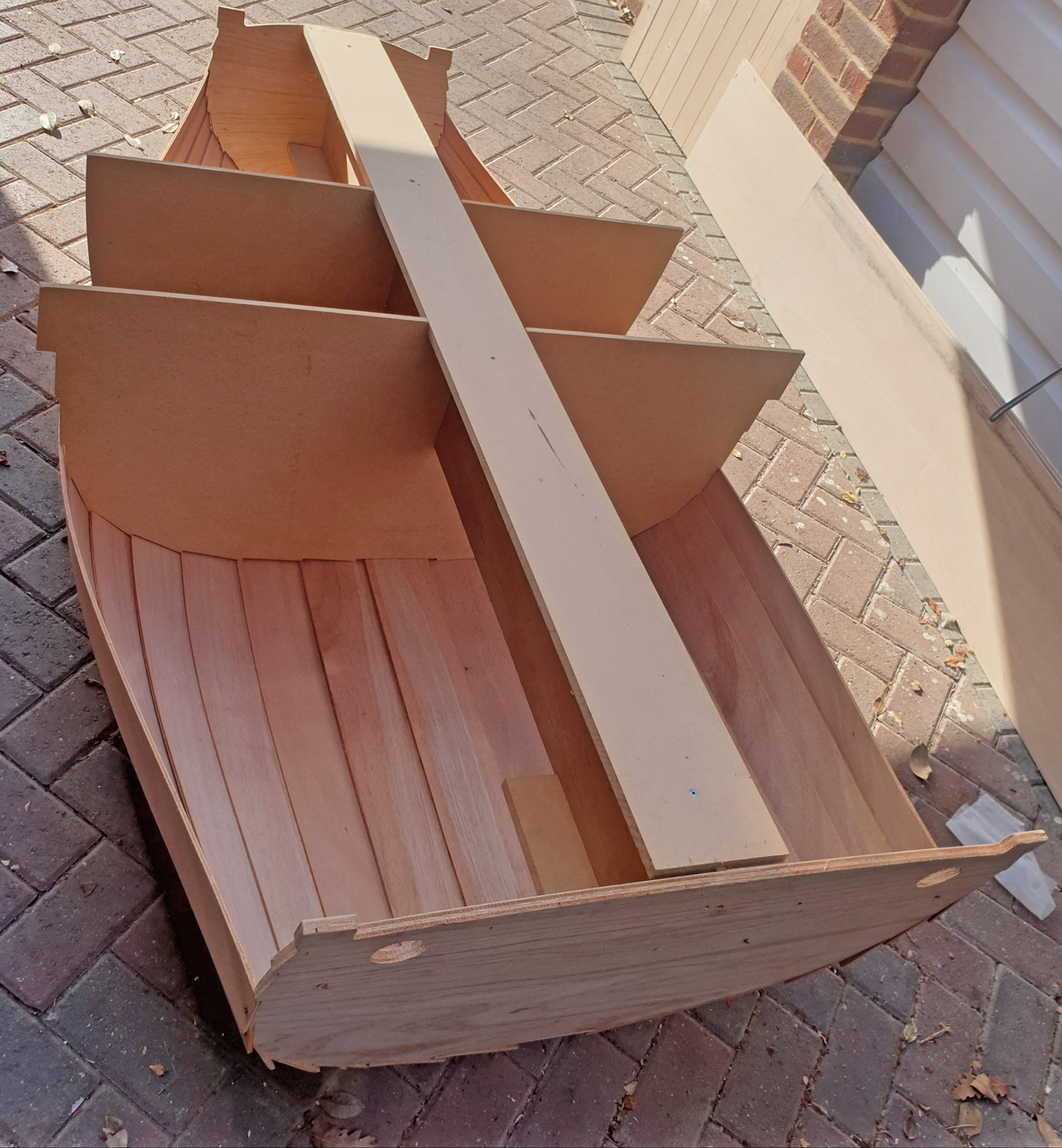
Even before he had laid all the planks, Paul turned the hull upright—with its building form still in place. He would re-invert it to finish the planking, and then the strongback (from which would be cut the daggerboard and aft thwart) and molds would be removed.
Having taken the hull off the jig, Paul cut the aft thwart and daggerboard out of the strongback and fitted the inner keel plank. “The plank was described in the instructions but wasn’t in the kit, so I cut one out of some 6mm plywood that I already had. I also added a plywood support beneath the center thwart. That wasn’t suggested in the manual, but the thwart flexed quite a bit and I was sure that if I sat on it we’d have had a catastrophic seat failure!”
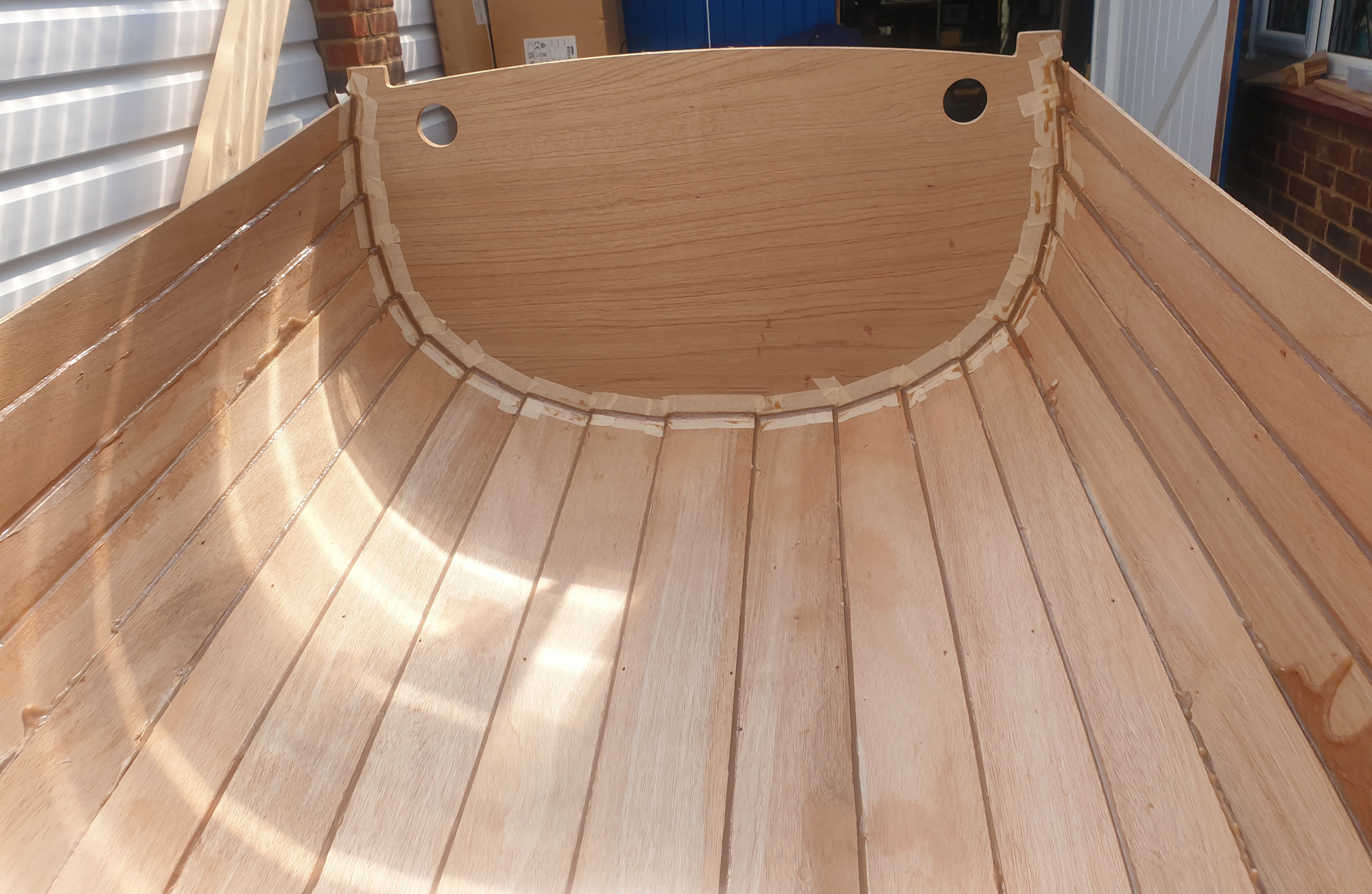
With all the planks in place, Paul removed the building form and filleted the joints between the planks and aft transom. Once that epoxy was cured, he would begin the task of grinding and sanding away the runs that had seeped through from the outside of the plank laps.
For the rest of the fit-out, the kit was complete: the daggerboard trunk; the forward bench seat (identified as the “bumboard” in the manual), which included the opening for the daggerboard and the mast gate; the aft thwart; six plywood knees; rudder and rudder fittings; sail, spars, rigging; and the hardwood gunwales. “The instructions said to screw the gunwales and inwales in place, but they didn’t bend easily, so I clamped them on and then eased them into shape with stainless-steel button bolts.”
After sanding everything with a power sander and by hand, Paul decided the boat’s appearance was worthy of being varnished inside and out. “I used Epifanes varnish and thinners as recommended by the kit suppliers. I thinned the first coat to 20 percent varnish, the second coat to 50/50, and then applied four more coats of full-strength. Applying the first coat was joy; it immediately brought out the grain and enriched the color, and after all six coats were on, she looked great.”
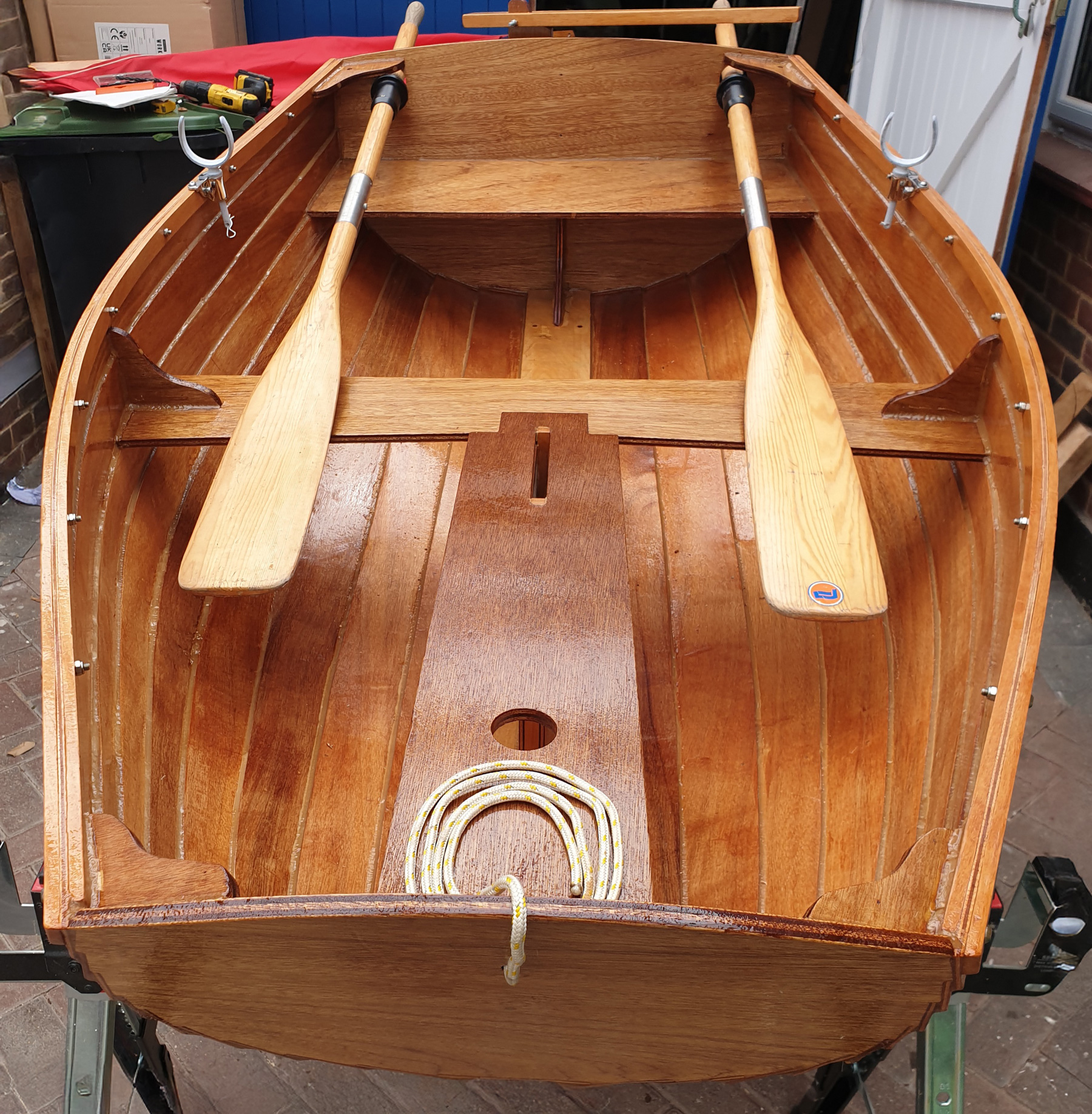
Once the interior was faired and fitted out, Paul decided to varnish the boat, inside and out. The oars are placed through the aft transom to act as handles while the boat is rolled along like a barrow—from which the design got its name.
As he neared the end of the project, things moved fast. “I had started building in the spring of 2025, and in September, I wheeled her out of the carport and rigged her for the first time. She’d been in a box in an unheated loft for 35 years and here she was, her red sail billowing, the sun shining on her brightly varnished hull, gently rocking from side to side. I imagined she was smiling.”
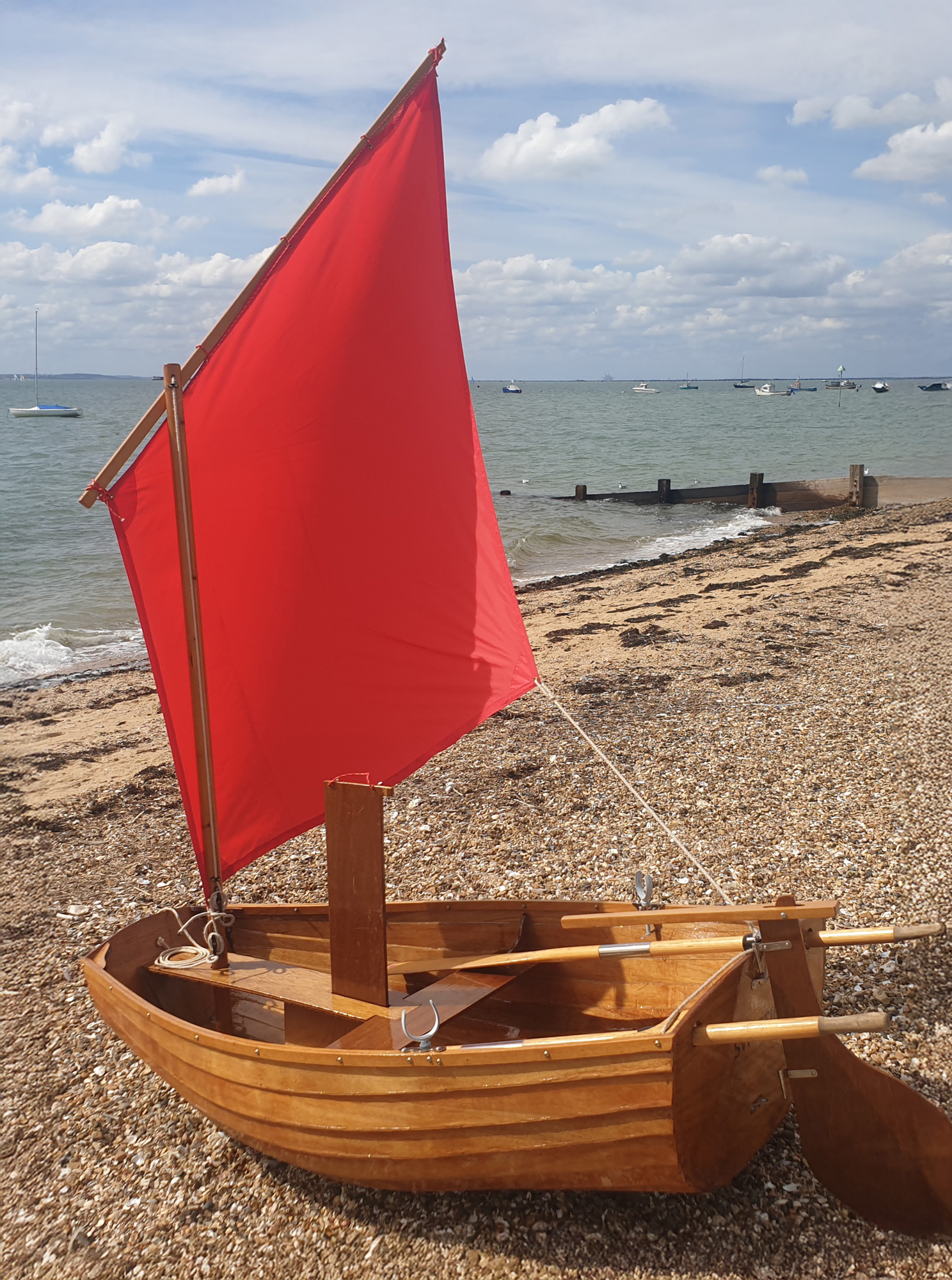
SWEETIE was launched on a windy September day into the lower reaches of the River Thames.
Two weeks later, Paul, Dawn, Alison, and friends launched the boat into the lower reaches of the Thames River at Southend-on-Sea. They named her SWEETIE. As Dawn said, “seeing the boat brought to life was such a pleasing experience; her build went so smoothly, despite her long stay in the dark, and as Sweetie was my pet name for Simon it seemed an apt name for such a sweet little boat.” The conditions on the river were too rough to sail, but Paul managed a few pulls on the oars and happily bore witness to the fact that she neither sank nor leaked.

In the run-up to Christmas 2025, SWEETIE was bought by Leeds Castle to be part of the Mermaid Lagoon display, in the castle’s Christmas Neverland event. A share of the proceeds from the event went to the Great Ormond Street Hospital of London.
It had never been Paul’s intention to keep the Barrowboat, so he advertised her around Norfolk and on Facebook and eBay. Eventually he was contacted by Louise Roots, a wedding and events florist working on a display for the Christmas celebrations at Leeds Castle in Kent. The event, “Neverland at Leeds Castle,” was to be held in partnership with Great Ormond Street Hospital (England’s most prestigious children’s hospital, to which J. M. Barrie gifted the rights to Peter Pan in 1929) and revenue was to be shared between Leeds Castle and the hospital. SWEETIE, Louise said, would lend the perfect nautical touch to one of the displays.
It was, perhaps, the perfect ending to the story. “When I was building her,” says Paul, “none of us could have imagined that Simon’s Barrowboat, SWEETIE, was destined to be famous. But there she was, being admired by thousands of people, and raising money for the care of sick children. I couldn’t have asked for more.”
Jenny Bennett is editor of Small Boats.
For more information on the Barrowboat range, visit The Barrow Boat Company.
Do you have a boat with an interesting story? Please email us. We’d like to hear about it and share it with other Small Boats readers.


That little boat brings a big smile. Huzzah!
Hi Kent
Thank you kindly Sir.
Much appreciated.
Paul
Inspiring story about friends honoring friends who shared times together. Found objects connecting them again and the inherent power of working with your hands. I think that deep in my bones is a yearning to build a boat and here the barrow boat story fans those embers a little more. I grew up sailing wooden boats as my father had as well. His father and grandfather operated a boat livery on the Lake of the woods out of Keewatin Ontario. As a child I was called on to wield sandpaper and paint brush as Dad resurrected a Y-Flyer and I became a crew member weighing in first, as ballast then going on to hiking out on the trapeze and later in life racing 14’s. Thank you, Jenny Bennett and Wooden Boat/Small Boats for writing and publishing this inspiring story.
Somewhere in my collection of plans I remember a barrowboat, but so far have not been able to find it. This one had a large diameter wheel mounted in the centerboard slot. It would help if I could remember the designer, but no luck there either. Seems like the object is to make a sturdy wheel that will withstand being rolled over cobble beaches, yet move efficiently through the water. Ideal for someone within walking distance of a beach.