In August 2025, Davis Taylor set off in his Tango 17 Whitehall from Bass Harbor on Mount Desert Island in Maine for a four-day rowing cruise through the nearby islands.
As I worked with Davis on his article, I was reminded of an overnight Maine Island trip I’d made 30 years before, in August 1995. Like Davis I had had perfect weather, but unlike Davis I had done little to prepare for my trip, beyond checking the weather and leaving a note saying where I’d be going.
 Photographs by the author
The WoodenBoat magazine and school offices are still housed in the 1900s brick-built “summer cottage,” which I first saw in 1994. Situated on a small rise, it looks south across Great Cove to Jericho Bay.
I had been in Maine for less than a year, having arrived from England the previous fall to take up an editorial position at WoodenBoat magazine in Brooklin. It was my first time in the U.S. and I could not believe my luck to have arrived in such an extraordinary place. The WoodenBoat offices occupied a rambling early-1900s painted-brick mansion that stood beside a field overlooking the waters of Great Cove. From the house, a dirt road descended a gently sloping hill to the WoodenBoat School workshops, forking off around the bottom of an orchard to lead down to the water’s edge and a hundred-year-old shingled boathouse built on a fieldstone foundation. Stone steps led from a small garden at the side of the building to a long wooden dock, sloped ramp, and float. Close inshore, a fleet of some 15 or 20 small boats bobbed to moorings, while across the cove and beyond were islands, as far as you could see.

The boathouse, built in 1910, was an Aladdin’s cave. Beneath the living space, behind the double doors, was all manner of boat gear and equipment, and at one time even a couple of ultralight canoes.
Coming from the crowded waters of southwest England, I was enchanted by the feeling of uninhabited space, the long vistas, the possibilities for day-sailing, and, as I would come to appreciate, the protection of Eggemoggin Reach, and the shoal waters between the myriad islands all around. Even the names of those tree-covered granite outcroppings were whimsical to my ears: Bear and Little Bear, Smuttynose, Potato, Babson and Little Babson.
Then, I learned that as a member of staff I could use the boats when they were not needed for WoodenBoat School classes, and I realized with delight that not only had I landed in small-boat paradise, but I had also been handed the keys.
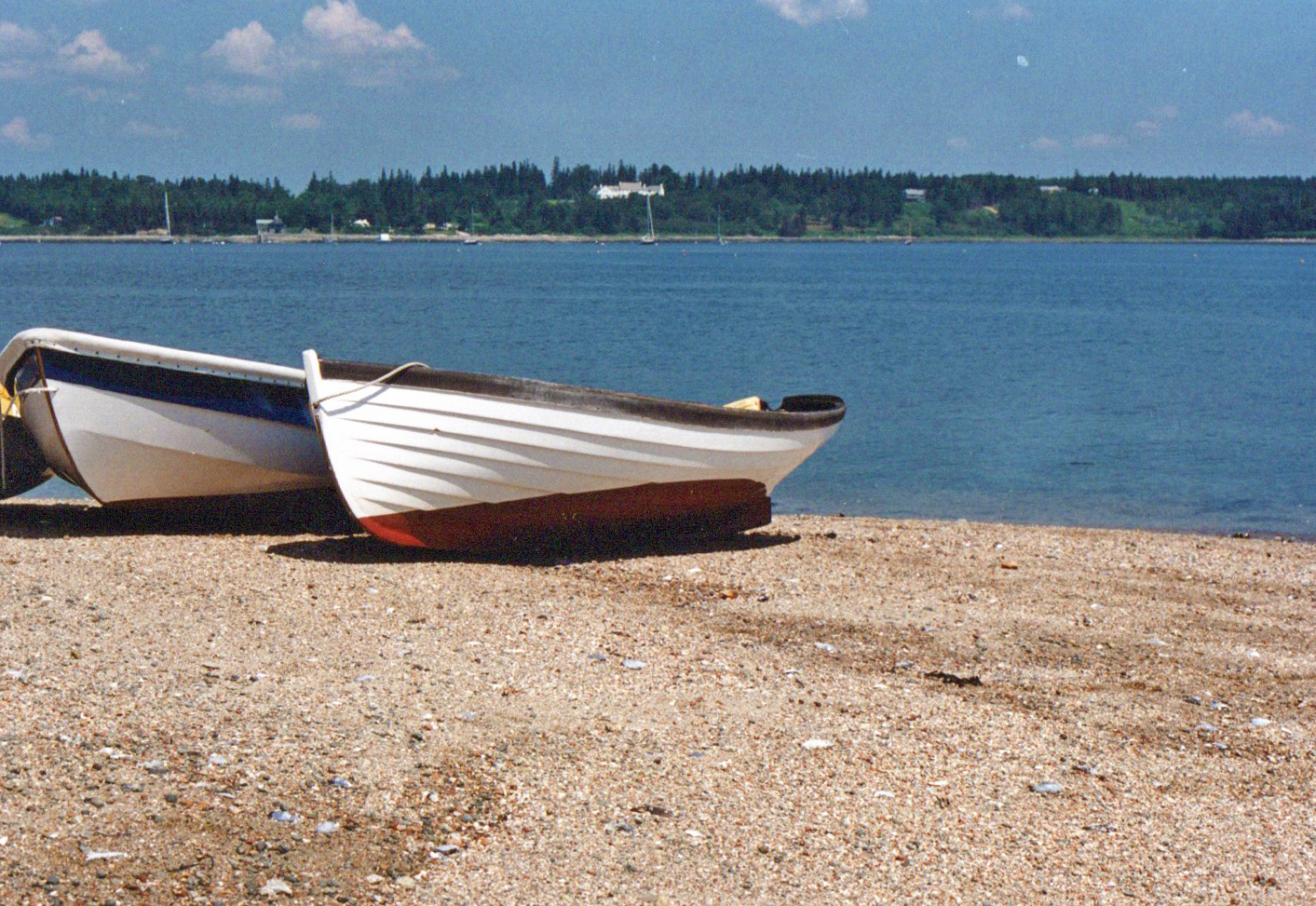
During my first summer I would often row across to Babson Island with friends or WoodenBoat School students. Here, looking back across Great Cove from the island’s gently sloping beach, you can see WoodenBoat’s house in the trees above the cove.
I spent much of my first summer taking boats out for a short row in the morning before work, or a longer sail in the afternoon after work, and, more often than not, on at least one weekend day a week for longer excursions around the islands—charting a different course to new waters each time. Early in the season I sought out the waterfront director: Could I take one of the boats for an overnight? His answer was unequivocal: Absolutely not, the boats were for day use only and must be back on their moorings before sunset. I understood but was disappointed. Then, one Monday late in August, he called me in the office. If I wanted to go for a night later in the week, I could, assuming the weather was fair, and I didn’t mind taking the Shearwater. I was thrilled. The Shearwater, a double-ended narrow-beamed 16′ rowboat with an auxiliary lug rig, had about it a touch of class. Designed by Joel White but heavily influenced by the traditional working boats of Norway, it was low, and sleek, and, with a shallow draft, ideal for some introductory island-hopping.
Over the coming days, I studied the NOAA weather reports with keen interest. For a while all looked good, but by mid-week the weekend forecast began to look far from settled. If I was going to go, it would have to be overnight on Thursday. And so it was that after work on the appointed day, I left the office, drove down the hill with my tent, sleeping bag, food for a couple of meals and snacks, a PFD, extra sweatshirt, and rain jacket, and got a ride out to the Shearwater in the School launch. I tossed my gear up forward, set the sail, and cast off, bound for a beach on the west side of Hog Island, less than 2 miles distant.

Beyond the low rocky tip of Babson Island is the eastern end of Eggemoggin Reach and Jericho Bay. The land to the left of the picture is Hog Island, my destination for the night.
Halfway to my destination the wind died. I lowered the sail and rowed around the northern headland of Hog and into the beach. Hog is an island of two halves, north and south, separated by a low narrow isthmus, and it was there that I landed and pitched my tent just beneath the tree line on the western shore. I dined looking west into the sunset over Deer Isle, turned in as the day grew dark, and was lulled to sleep by the sound of lapping water. I would, I mused as I drifted off, sleep late, rise slowly, and push off sometime around mid-morning when the wind picked up.
I had not accounted for the commercial fishermen.

Making landfall on Hog Island close to low tide was straightforward and, with the Shearwater’s shallow draft, gliding into the muddy shore was uneventful. The massive granite boulder is an erratic left behind by the receding ice cap at the end of the last ice age.
Before dawn I was awakened by the roar of diesel engines and the accompanying discordant sounds of Kiss FM. I poked my head through the tent door and saw two white-hulled lobsterboats, powering through tight circles, stopping abruptly to pick up a pot buoy, pulling away, circling, stopping, weaving in and out, in perfect disharmony. And all the while the engines roared and the radios blasted. Ten minutes later they were gone. I settled back to sleep.
Suddenly, something fell with a quiet thud on the tent roof above me. I looked up. Silence. Thud. Silence. Thud. Then came the unmistakable sound of a red squirrel laughing hysterically. In my memory this repetitive torment lasted for at least 30 minutes; in truth it was probably less than five before the rodent tired of its game and went about more serious work. But between nature and man, I was now wide awake. I walked through the trees to the eastern shore of the isthmus and sat down to watch the dawn spread slowly across the silver-calm waters of Jericho Bay.
 ©1986 by Jane Crosen, Mapmaker, used with permission
Maine’s coastline is a maze of islands and inlets; you could spend a lifetime exploring in a small boat and not discover every cove or beach. Jane Crosen, Small Boat’s proofreader, has mapped much of the region.
Later that morning, I followed a circuitous route home, rowing first around the southern tip of Hog Island to Sellers Island and then, as the breeze picked up, sailing west down Eggemoggin Reach south of the Babsons and the Torreys before turning east to come back into the western end of Great Cove and finally to the mooring field. I had covered barely 10 miles, spent less than 24 hours adventuring, but had come back to the mainland refreshed, fulfilled, and, quite honestly, triumphant.
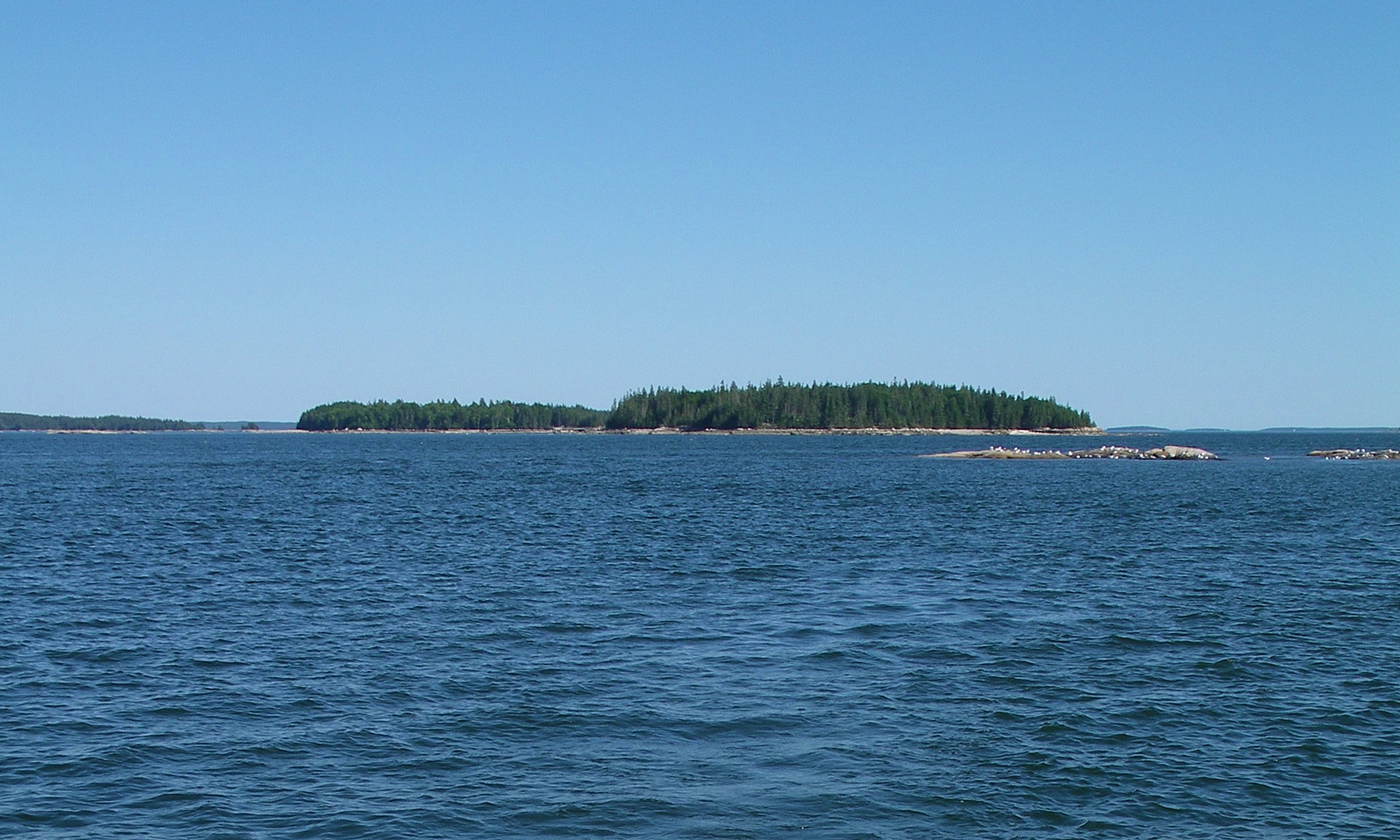
My return voyage took me along the south side of the two Babson islands—seen here with Little Babson on the right and Babson, beyond it, on the left—and the Torreys. The rocky ledge in the foreground to the right of Little Babson, is off the eastern end of Lower Torrey and marks the outer edge of a narrow channel into Great Cove; at mid-tides the currents here can be challenging and the entrance is known locally as the Guzzle.
I have been on longer sailing trips—both before and after the Hog Island expedition—but I can’t think of a single one that I look back on with such vivid memories nor with such a sense of achievement. There is nothing, it seems, quite like taking a small engineless boat to a small island, and coming back in one piece, to make you feel whole… ask Davis Taylor, he’ll tell you.



My family got to stay on Hog Island for two weeks at a time, across four or five summers as the 1970s rolled to the ’80s. We knew the caretaker, Lou Black, and it was easier for him to ensure every lightbulb and outlet was working if he had someone living there on occasion, rather than him checking everything every few weeks amidst his full time lobstering job. Those weeks in that 1800s house on an 80-acre island are one of the highlights of my life. One memory that stands out is Lou taking us there in fog so thick I couldn’t see the bow. We thump out of Seal Cove, Lou turns the heading a few degrees to starboard, and we thump along for a while. Entire trip I cannot see the bow, and I keep wondering how this is going to work. Then Lou hits reverse, the boat stops, and the dock is right there, 1/2in off the port side. (This long before any kind of digital 5#!+ pipsqueaks these days confuse for nautical navigation). Lou and my dad laughed at my amazement. “He’s been doing it every day for 40yrs!” Well, yeah, but how’d he stop w dock 1/2in away?!? Skill can get a captain to where luck can get him to 20ft, but 1/2in? Now I assume he could read wave action, knew by the reflections just exactly where he was when he needed to. Lou Black was one of the old boys. Made his own plank-on-frame lobster boats in winter, worked them in summer. Started out w a kinda wonky looking 25fter, white, with oversized wheelhouse and horizontally split windows. That remained my favorite cuz it was an ugly duckling but still confident with its own flair. Then a more standard appearing 36fter, green hull and white wheelhouse, and finally a glorious 45fter, cobalt blue and white.
After posting the above comment I realize that the Hog Island I stayed on is a different one, also in Penobscot Bay, about 10m NW of the Hog Island where Jenny stayed: Deer Isle is just about smack dab between them.
The WBS is a special place. Glad you are taking the time to enjoy it between deadlines.