Fifty-plus years ago, while living in California, I met some folks from Washington who told me about commercial fishing in Alaska. The idea took hold, and along with a buddy and my dog, I hitchhiked to Northwest Washington in search of jobs on the water. It took a while, with a few rabbit trails, but I settled into a 20-year stretch of commercial fishing for salmon, shrimp, herring, and Dungeness and king crab, as well as a stint working as a shipwright. I fell in love with boats of all sorts, mainly working craft, and dreamed of building one. I had my WoodenBoat magazine subscription and bought any book I could find on the subject of boatbuilding. But dreams often get hijacked by reality, and a family, a mortgage, and a construction business put that particular fantasy on hold.
Fast-forward 50 years and I’m retired, the kids are grown, and the mortgage is paid. Now, I have time. One day, with clarity, it hit me: I would build a boat. I started looking at plans and setting parameters to make sure I could pull it off. It had to be a design and a method of construction that I could be sure of starting and finishing in a predictable time frame—I didn’t want an incomplete project to be staring at me for years. It had to be built in the space I had available—one-half of my two-car garage. It needed to be challenging and to include lofting; there would be no templates or kits. I was drawn to the lines and construction of Nexus Marine Corporation’s 16’ San Juan Dory. Of all the designs I considered, I felt it had the fairest lines and its construction seemed more traditional than others. I also had much of the necessary material. All the framing and removable deck grates could be built from clear vertical-grain (CVG) Douglas fir that I had salvaged from a church remodel and stored for the past 40 years. I purchased one 16’ piece of CVG Douglas fir for the chine logs. The plans call for white oak for the guards, inwales, spray rails, and trim, but I substituted repurposed decking—a tropical hardwood marketed as tigerwood (Goncalo alves)—leftover from a previous job.
 Nick Ivancovich
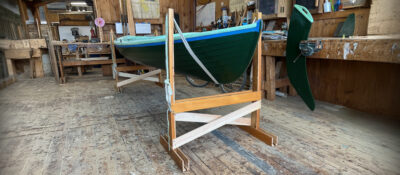
The ladder frame on which the San Juan Dory is built can be used in the early stages of the project to support a plywood lofting table (seen here at left leaning against the workshop shelves). The frames, chine logs, and stem are all Douglas fir.
Building the San Juan Dory
David Roberts, owner of Nexus Marine, designed the 16′ San Juan Dory for a client some 30 years ago; it was based on a 21′ cuddy-cabin dory he was then building. It has been one of his best-sellers both in finished boats and plans. Throughout my building of the boat, he was extremely helpful, filling in whatever details I asked for. The plans for the San Juan Dory include three 24″ × 36″ pages showing profile, body, and plan views as well as seven 8 1⁄2 × 11 pages of specifications, a table of offsets, a detailed list of lumber and fastenings (hardware choices such as hinges, latches, and oarlocks are left to the builder), offsets for spray rail and waterline, ladder frame measured drawings, frame section and bevel drawings, and a bibliography of suggested reading. While I didn’t choose them, Mylar templates are offered, which make lofting unnecessary.
The plans call for 1⁄4″ okoume plywood for the boat’s sides and 3⁄8″ for the bottom, scarfed for length and coated with epoxy resin—three coats per side—before cutting. I used approximately 4 gallons of WEST System 105 epoxy resin, mixed with 206 slow hardener, throughout the build for sealing all components and for gluing, using their 403 microfiber adhesive filler. To begin the build, I cut out the Douglas-fir frame parts, assembled them, then set them aside. I built the ladder frame and set it on sawhorses that supported a white-painted 1⁄8″ sheet of plywood to serve as a lofting table. With the Douglas-fir frame sections drawn full scale, cutting and assembling them was easy and accurate. The transom, bow, stem, and splash well were also constructed using the full-scale drawings on the lofting table. Once all the components were completed, the lofting plywood was removed, the ladder frame was lowered to the floor, and assembly could begin. First the frames, transom-splash-well assembly, and stem were set up, plumbed, leveled, braced, and quadruple checked, and then the chine logs could be installed.
 Nick Ivancovich
The hull is heavy enough to require a few helping hands when it was time to turn it upright for finishing the exterior. The plans specified the locations for the spray rail and the waterline, so those features could be applied after the hull was painted and before it was rolled over.
Next came the plywood bottom and side panels. The instructions suggest having two people for installing the panels, but I found that by clamping a 2×4 across the breadth of the boat at the sheer near the stern, I could support the plywood panels as I screwed them in place starting at the stem and moving aft one frame at a time. Once cut to fit, the sides and bottom are glued to the frames, stem, and transom with epoxy and screwed with stainless-steel fastenings. I added another coat of epoxy to all exterior and interior surfaces including framing after installing the white-oak chine logs, runners, and skeg. I then coated the outside of the hull with two coats of epoxy primer and four coats of Interlux Toplac. Because my boat would be trailered, I did not use an antifouling bottom paint.
When it came time to turn the hull over, a few willing neighbors helped and the task was accomplished without a hitch. I modified the interior layout to fit my needs. The designer’s specifications state that no interior bulkheads are required, and the plans call for a cockpit configuration that leaves little open space. As I would be using the boat for sportfishing and crabbing, space for crab pots was important. In the stern quarters, where the plans show fixed side benches, I substituted hinged benches that fold down flush against the frames when they are not needed. There’s still plenty of seating for four or five people, which is all you’d ever want, and then only in calm weather. Next, I installed four interior bulkheads, creating a bow locker, storage under the ’midship thwart, and more storage either side of the splash well. Again, I deviated from the plans, which called for foam flotation in most of the enclosed spaces; I wanted lots of storage so significantly reduced the amount of foam. Discussing this with David I learned that the main reason for the flotation—other than the obvious safety factor—was to meet Coast Guard requirements if the boat were built commercially. My decision to reduce the flotation was personal and may not be for everyone, but the storage was important.
 Nick Ivancovich
As designed, the San Juan Dory has fixed benches connected to a wide thwart near the stern. However, the layout can be adapted, and designer David Roberts is willing to discuss ideas and answer questions. My dory’s side benches are hinged so that they can be folded down when not needed, and I removed the thwart to provide more space aft.
Next, I painted the entire interior with a marine enamel, then I turned to the solid-wood parts of the build, all of which I would leave bright-finished to complement the painted hull. Tigerwood is a beautiful deep amber red with contrasting streaks of black; it’s also strong and resistant to rot. On the negative side it can be brittle and difficult to bend, but on the San Juan Dory there are no extreme bends. I used grown black locust crooks for the breasthook and quarter knees. Fitting these was probably the most demanding part of the construction, but it was also the moment when the boat really started to take on an identity. I’ve had years of carpentry and finishwork experience, which made the task possible, but I think without that I would have struggled with this aspect of the construction. Having the right tools is key: Essentials include a good tablesaw with plenty of room fore and aft, because some of the components are 16’ long; a handheld circular saw (I used it for cutting most of the plywood); a miter saw and bandsaw; block planes; a jack plane for scarfs and straight edges; a bevel square; and plenty of sharp pencils.
Once everything was built and fitted, I treated the hardwood components with six coats of varnish. There were still things to be done, but the hull was finished. From receiving plans to the last stroke of the brush had taken five months. It was a full-time job, but the challenge and satisfaction were worth every minute. I asked David for his evaluation of the build’s difficulty level. I estimated it as moderately difficult for a first-time builder. But I liked his evaluation better: “It’s instructional. You’ll learn a lot building this boat.”
 Mark Ouellette
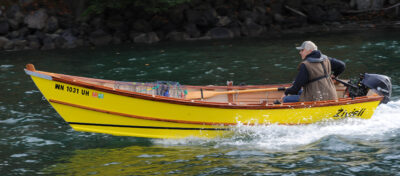
At speed, the San Juan Dory planes but does ride high in the bow. The weight of a passenger seated forward brings the bow down without noticeably affecting the speed.
The San Juan Dory on the water
I haven’t weighed the boat, but David estimates the finished boat to be between 450 and 500 lbs. The specs call for a 25-hp (maximum) outboard. I purchased a Tohatsu 20-hp, EFI, tiller-steered motor with electric start and power tilt. It weighs approximately 110 lbs. With two 3-gallon fuel tanks, the boat and all its equipment weigh approximately 650 lbs.
With myself and my first mate, Khodi, in the stern, I’ve had the San Juan Dory running at 23 mph. It gets up on plane but rides a little high at the bow. An additional passenger forward brings the bow down with no real change in maximum speed. The boat handles well in a 1′ chop at half-throttle and stays dry while setting and retrieving crab pots. While hand-hauling and lifting pots over the side with two additional people on board, it is stable and comfortable, provided that attention is given to weight distribution.
 Mark Ouellette
The San Juan Dory handles well in a chop and stays dry, the rails being well placed to deflect most incoming spray.
I’ve set up my dory with manual outriggers for both freshwater lakes and saltwater trolling. I will also be designing a custom davit for hauling crab and shrimp pots. I have in mind doing day trips and overnight island camping in the San Juan Islands for which the design is named. I have called the boat ŽIVJELI, Croatian for “Live Life.” For me, building the San Juan Dory was exactly that.
Nick Ivancovich, 74, is a retired general contractor and former commercial fisherman. He lives in Northwest Washington with his wife Debra and their two dogs. His hobbies are hunting, fishing and woodworking, and he spends time working with a competitive youth clay-target shooting team.
San Juan Dory Particulars
LOA: 16′
Beam: 5′ 6″
Draft: 4″
Dry-hull weight: 450 lbs
Power: 10–25 hp
Estimated design speed: 12–18 knots

Plans for the San Juan Dory are available for $75 from Nexus Marine Corporation.
Is there a boat you’d like to know more about? Have you built one that you think other Small Boats readers would enjoy? Please email us your suggestions.
Other boats from Nexus Marine Corporation
Nexus Planing Dory: A planing dory for home construction
BEATRICE: A modified Saint-Pierre Dory




Nice job Nick!!
I visited David Roberts shop back in 1995, when I had first started thinking about building a boat and was inspired to take the leap and start cutting and gluing wood together.
Best looking Dory fit-out I’ve ever seen. Classy working boat right there.
Doing the lofting on a semi-vertical panel has several advantages. The main benefit is that with a straight edge screwed to the bottom of the panel, gravity becomes your friend when you’re drawing vertical lines with your square to designate the stations (frames, stem, and stern or transom). Also, keeping the panel off the floor keeps it free of footprints and dings from dropped tools, etc. Tilting it back a few degrees, rather than perfectly vertical is called for. Most people think doing the lofting is too bothersome and wastes time, Instead, it saves time in the long run. The shape and bevels of many parts can be taken right off the drawing. I have lofted even tiny boats as part of the build. And the panel can be saved for building additional boats of the same design. Oh, the lofting also reveals any errors in the table of offsets, which tend to creep into designs by even the most meticulous of designers.
Nick, nice job on the story of the dory and on building a beautiful boat. Kudos!
Mike G
Years ago I built a San Juan Dory in my backyard. I put a 25 hp 4stroke Big Foot on it and went on countless adventures with my son. It is an amazing boat and will handle much more than I care to be out in or what you should be out in.
Yes, great looking Dory, recalling back to childhood at the New Jersey shore in USA as there were several in our bay. Love to have a 18 foot version of the Dory. Does anyone have one available?