In the introduction to his recently published book, Sailing the Shallows, Roger Barnes writes, “Boats are an important part of my life, but they are not perhaps the most important, and going out in them must be fitted around everything else I need to be doing.” For many of his dedicated followers, this may seem an unexpected—perhaps even unsettling—statement. After all, Roger Barnes, who has had a long and successful career as an architect, has made a name for himself as the guy who talks about, writes about, makes videos about his many adventures in and around small boats. Nevertheless, the observation reflects the unsentimental, no-nonsense personality of the man. And, as if to ease the mind of any anxious reader, worried that Roger might be losing his passion, he quickly qualifies the statement:
“Being an amateur sailor does not mean that the activity is inconsequential or unimportant to me. A weekend on the water allows me to return to work the following Monday, renewed and revitalised. The challenges of sailing are quite different to my working life, and taking a small boat out onto open water is rarely humdrum. The sea is the last great wilderness on Earth, uncontrolled by humanity and savage in bad weather. The salt seas course into coastal waters with the flooding tide, mingling the wildness of the open ocean with the perils of the shoals. Sailing the shallows is never dull, and one must always be prepared for the unexpected there.”
 Courtesy of Roger Barnes
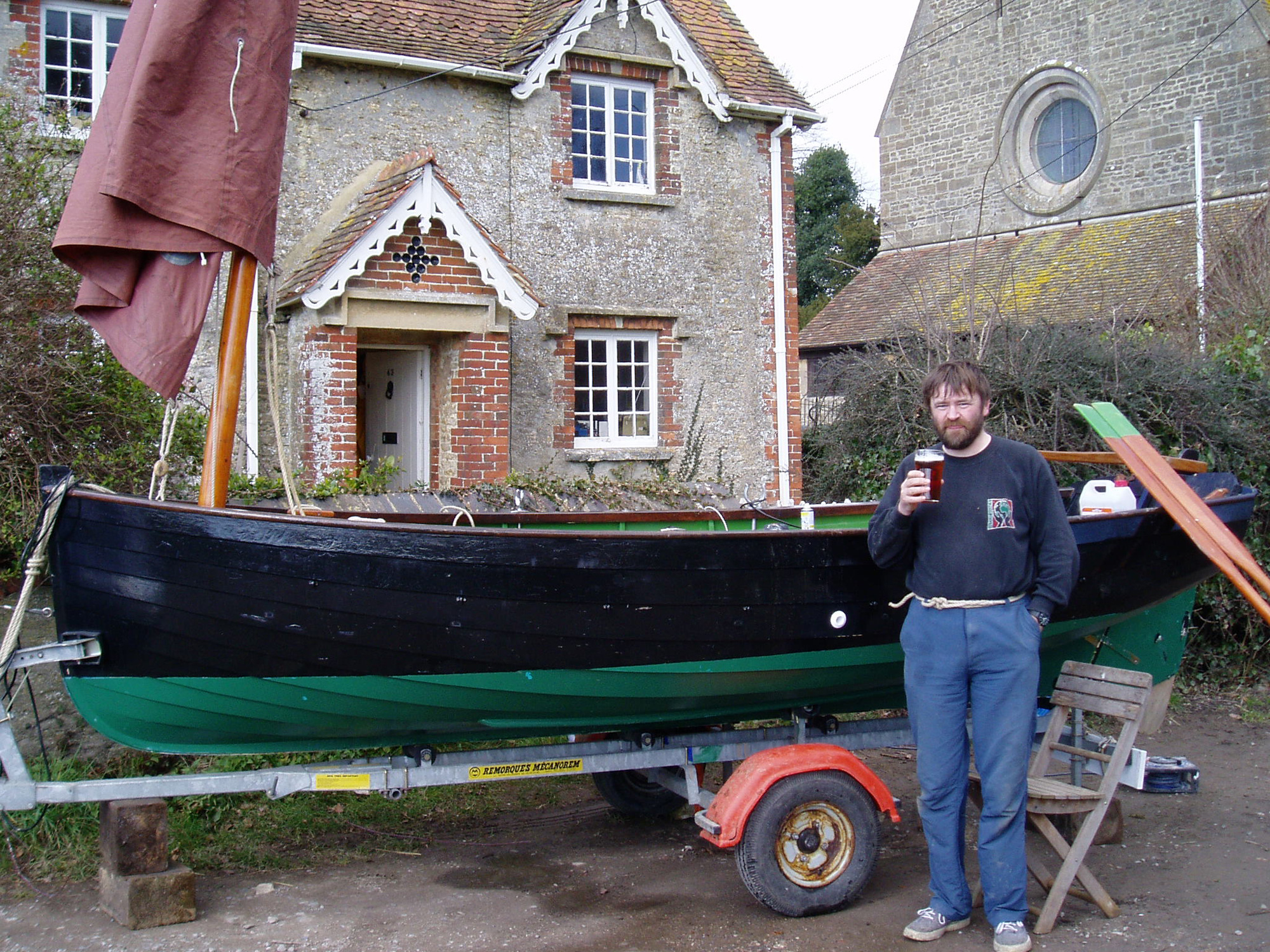
Roger bought his beloved François Vivier–designed Ilur, AVEL DRO, in 2004. He trailered her back from France to his home in Somerset, England, where he took care of a few minor repairs and fitted her out for cruising.
In June 2025, Roger visited the United States as President of the Dinghy Cruising Association, founded in the U.K. in 1955 and now with chapters around the world. He was hosted by some of the American East Coast chapters, was a guest speaker at Mystic Seaport during The WoodenBoat Show, and taught a weeklong class in “Messing About in Boats” at WoodenBoat School in Brooklin, Maine. He was in the country for a month but his itinerary was full, his schedule seemingly ever busy. Hoping to meet up, I had suggested possible dates and venues in Maine, but he was already booked. We settled on a breakfast meeting during The WoodenBoat Show, at Carson’s Store restaurant in Groton, Connecticut. An easy ride from Mystic Seaport where we would both be on duty later in the day, it was the ideal spot to sit, chat, and share a meal.
Like most of his YouTube followers, I already felt as though I knew Roger, long before I met him. I expected, and met, a casually dressed man from the north of England, with chestnut-brown hair that flops across his forehead, a close-cropped graying beard, and eyes that seem to be endlessly smiling. We found a table, ordered breakfast, and got talking about his life in boats.
Roger first appeared on the small-boat public stage in 2002, through a column in the British magazine Dinghy Sailing. He followed that with a book, The Dinghy Cruising Companion, published in 2014. But he truly entered the international consciousness of small-boat sailors 10 years ago when he posted a short video on YouTube. He titled it “Living in a Cruising Dinghy,” and filmed himself—not so professionally—sitting in a beached boat beneath a tent and hanging lantern. The opening sequence cuts to images of the boat on the beach, and then to the boat floating as the morning sun rises. Finally, we return to Roger relaxing in the early sunlight, surveying his surroundings from the now-floating boat and, ultimately, eating half of a cantaloupe melon.
 Courtesy of Roger Barnes
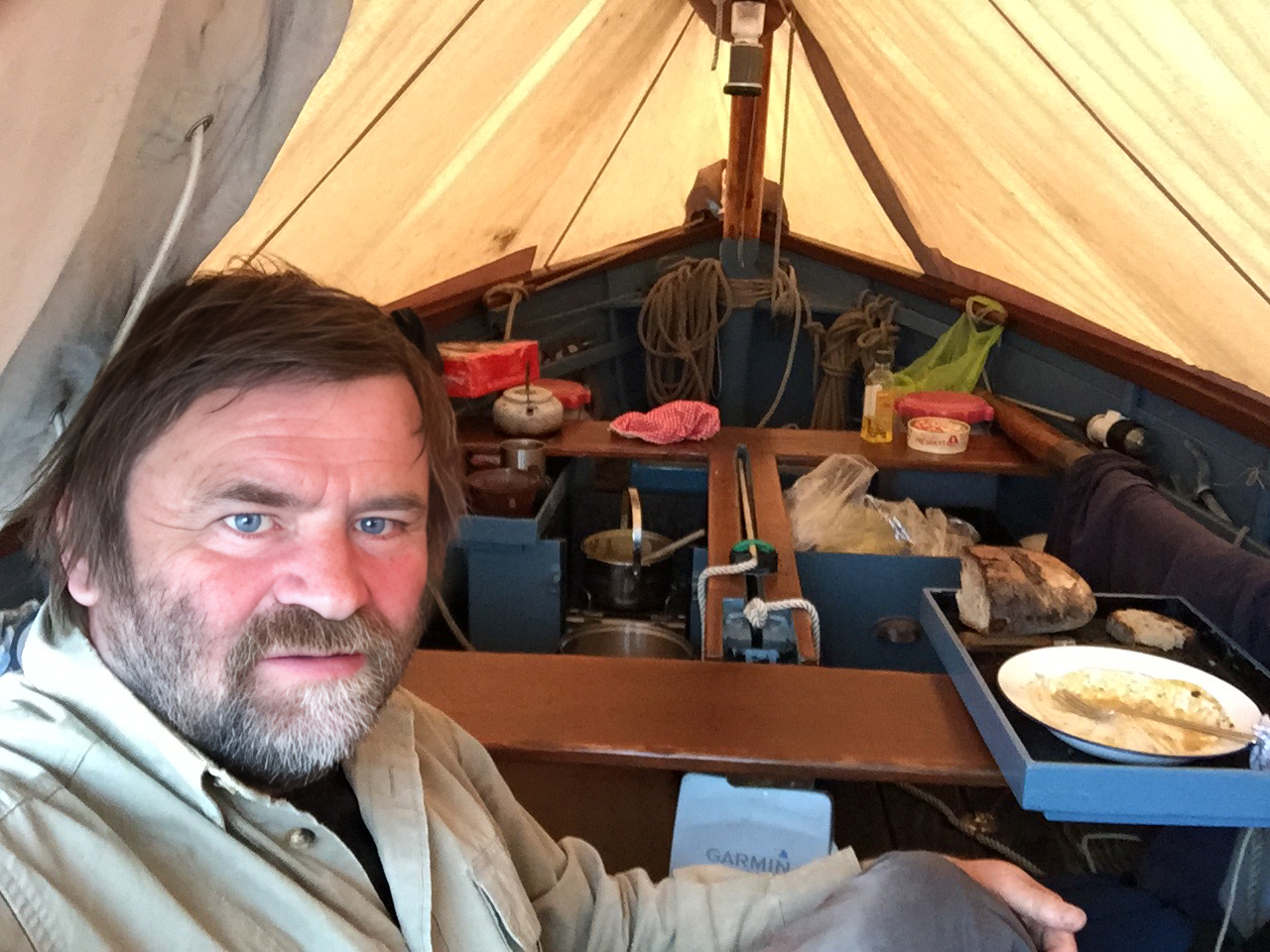
Roger established his cruising layout (seen here in 2015) in his first year of owning AVEL DRO. Beneath the forward thwart to port are the boxes containing pots, pans, and the stove, while to starboard is the food box. The only significant change from the original setup to the one seen here is the custom-built canvas tent that replaced the original tarpaulin.
As a piece of film-making it is nothing special, but in just under four-and-a-half minutes, it captures the essence of small-boat cruising. What stands out, apart from the images themselves, is Roger’s ability to talk off-the-cuff to camera and to paint pictures of the world off-screen: “There’s a beautiful full moon casting shadows,” he says from the confined space beneath the tent, “lovely starry sky, beautiful lonely beach, view of the rocks silhouetted against the night sky, the wind in the trees just behind me.” The words are as unpolished as the man delivering them, but they are at once unpretentious and evocative.
Ten years on, Roger has made 102 videos for YouTube, and has a dedicated following of 48,000 subscribers. For many who cruise in small sailing boats, and for others who aspire to do so, he is a dinghy-cruising guru.
Born in 1958 in Carlisle, a small city in the far northwest of England, Roger Barnes did not come from a sailing family. His father had served in the Royal Navy, having been called up immediately after the Second World War. While in service, he had hoped to learn to sail and see the world, but neither goal was achieved: there was no time for sailing, and he would see no more of the world than the North Atlantic. Nevertheless, before Roger was nine years old, his father had taught both himself and his two sons to sail.
 Courtesy of Roger Barnes
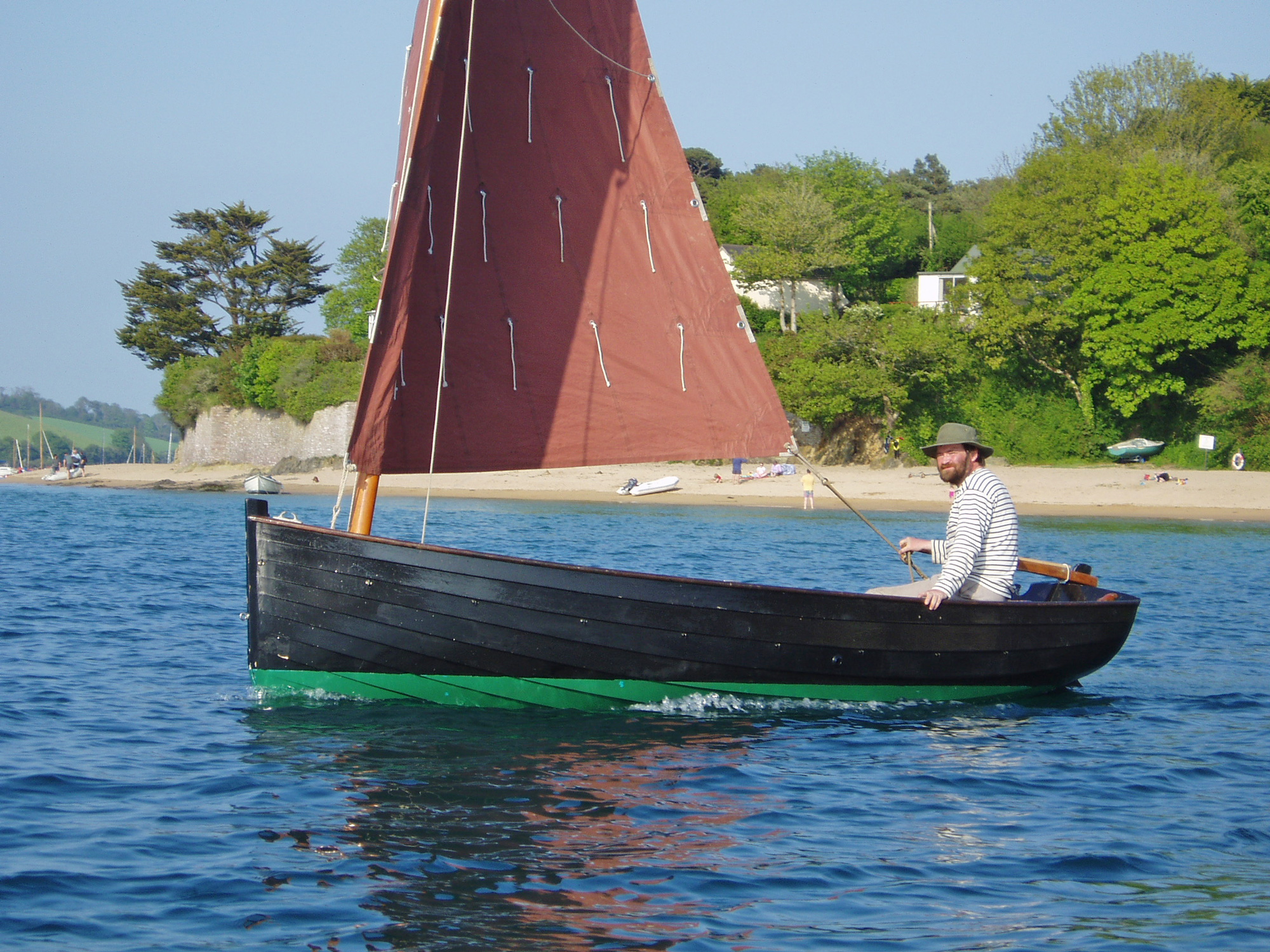
Within weeks of buying her, Roger had AVEL DRO, freshly painted and organized to his liking, back in the water. Here, with Roger at the helm, she is sailing off Salcombe, England, in 2004.
In the early ’60s, the family relocated from Carlisle to near Preston in Lancashire. Settled into the relatively flat landscape of their new home, his parents missed the hills of Cumbria so they rented a share in a holiday cottage on Windermere in the Lake District. Their share, Roger says, “was one room, with a partition screen down the middle, and an outside toilet—it was one quarter of a converted barn, and we had a third share. We got to use it every third weekend and for a third of each of the school holidays. We were friends with the other families but never there at the same time.”
Roger’s parents had no thoughts of going afloat. Instead, their dream was to spend their time hillwalking. But the barn was a stone’s throw from the shore, and with two small boys drawn to the water and all it had to offer, they bowed to the inevitable and bought a boat. Roger recalls the pre-purchase conversations and dreams that he and his younger brother shared: perhaps their parents would buy a sleek motor launch, or maybe a traditional wooden sailing dinghy like those described by Arthur Ransome in Swallows and Amazons. The reality was rather different: a bright-yellow slab-sided plywood rowboat that his mother christened BANANA SPLIT.
 Courtesy of Roger Barnes
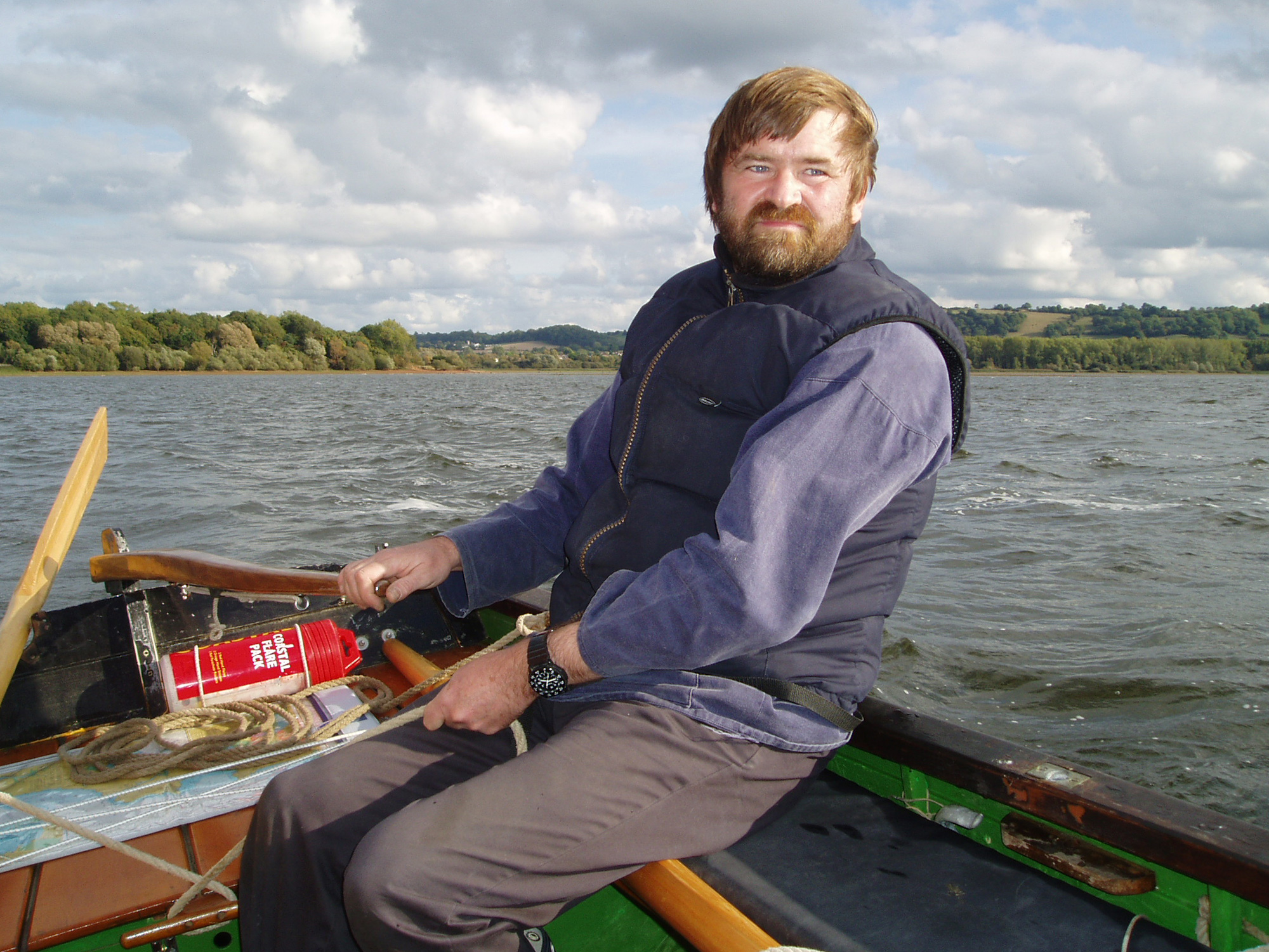
Sailing off the Devon coast in 2005, Roger was getting used to AVEL DRO’s mainsail. Here, in relatively light and steady wind, he has the sheet turned around a ’midship cleat
Humble it may have been, but that small boat introduced the young family to the possibilities of grand expeditions. “Dad would clamp a J.A.P. Sea Bee outboard onto the transom and motor us across the lake, the whole boat throbbing with the vibration from the engine,” Roger wrote in Sailing the Shallows. “The rasping noise of the air-cooled power head and the smell of two-stroke oil imparted a heady drama to our slow progress… After chugging noisily across the lake, Dad would cut the engine. In the sudden silence that followed, we would hear the waves lapping on the shoreline close by.”
The following year, BANANA SPLIT was replaced by a red-hulled 11′ 3″ Heron dinghy and Roger learned to sail. For two blissful summers, he sailed and rowed about the lake with his father or brother. But when he was 10, the family’s share in the barn was given up and the lake adventures were over. By then, Roger was hooked and the Heron was brought down to the marine lake in Southport, near the family home. There was a small but busy sailing club, and Roger’s parents would drive him to the lake, drop him off while they went to run errands, and pick him up on their way home. Roger was happy with the arrangement but soon learned that the focus at the lake was on racing and the Heron was not one of the club’s class boats. Within the year the Heron was sold and replaced by a Mirror dinghy.
 Courtesy of Roger Barnes
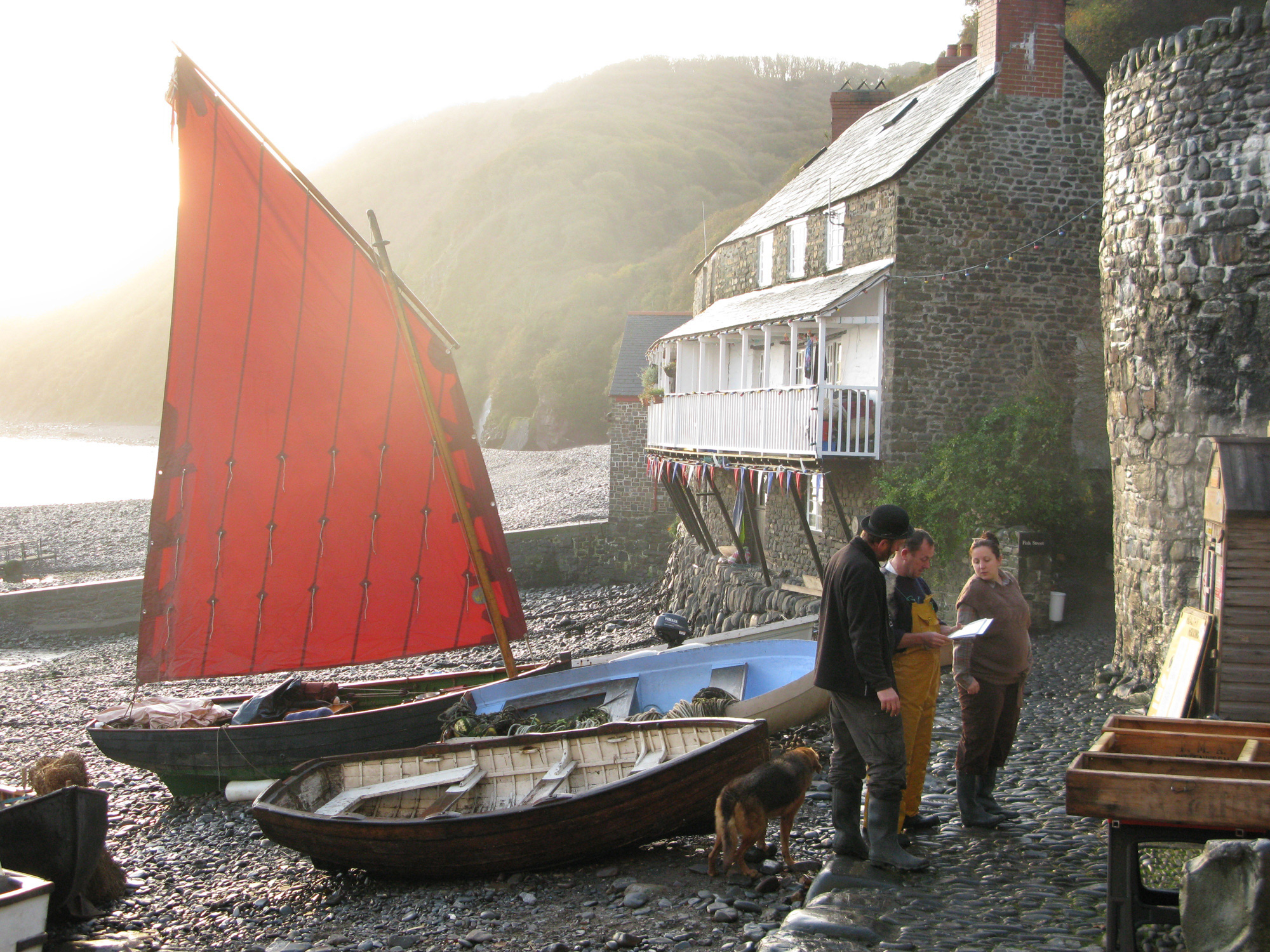
Pulled up on a stone beach, surrounded by small working boats, AVEL DRO fits right into a picture that, were it not for the fiberglass dinghy beside her and the outboard visible beyond her bow, could have been taken 100 years ago.
A school friend also had a Mirror and the two boys took turns. “There were two races every week. One race I’d crew for him, the other race he’d crew for me,” Roger recalls. “We were rubbish, but we got better.” When a third friend, who also had a Mirror, joined them, their sailing received an unlikely boost. “His parents had a caravan,” Roger says. “So we were allowed to go up to Windermere with one of the boats. We’d be dropped off to stay in the caravan, on our own. We were 14 years old at the time. We were marooned, we had to sail to the shops; it was my first experience of ‘almost’ dinghy cruising.”
Roger sailed all through his childhood, but when he went away to university, and even after, boat ownership became difficult. With no house, no garage, and no car, he was limited to occasionally renting boats on the Norfolk Broads or Ullswater in the Lake District. But at last, he remembers, having married and bought a house and car, the old yen to buy a boat returned. “I’d always liked the 12′ Tideway dinghies. There was a journalist, John Glasspool, who wrote about sailing for the Portsmouth Daily Echo and published a book called Open Boat Cruising. He was cruising in a Tideway and I figured if he could, we could. We bought a Tideway, BAGGYWRINKLE, rigged it up for camping, and went sailing. We’d take it for short holidays, up to Scotland, all over.”
For most of his life, Roger has lived far from the sea, and so small boats that can be trailered to cruising grounds have made sense. For some years in the late 1990s, however, he owned a 26′ Harrison Butler—“a yacht,” he says with emphasis—and dinghy cruising was sidelined into the column of “things I used to do.” But around the turn of the millennium, when his marriage was breaking up, and he had moved home twice, he sold the yacht.
 Amy Edelman/ Courtesy of Roger Barnes
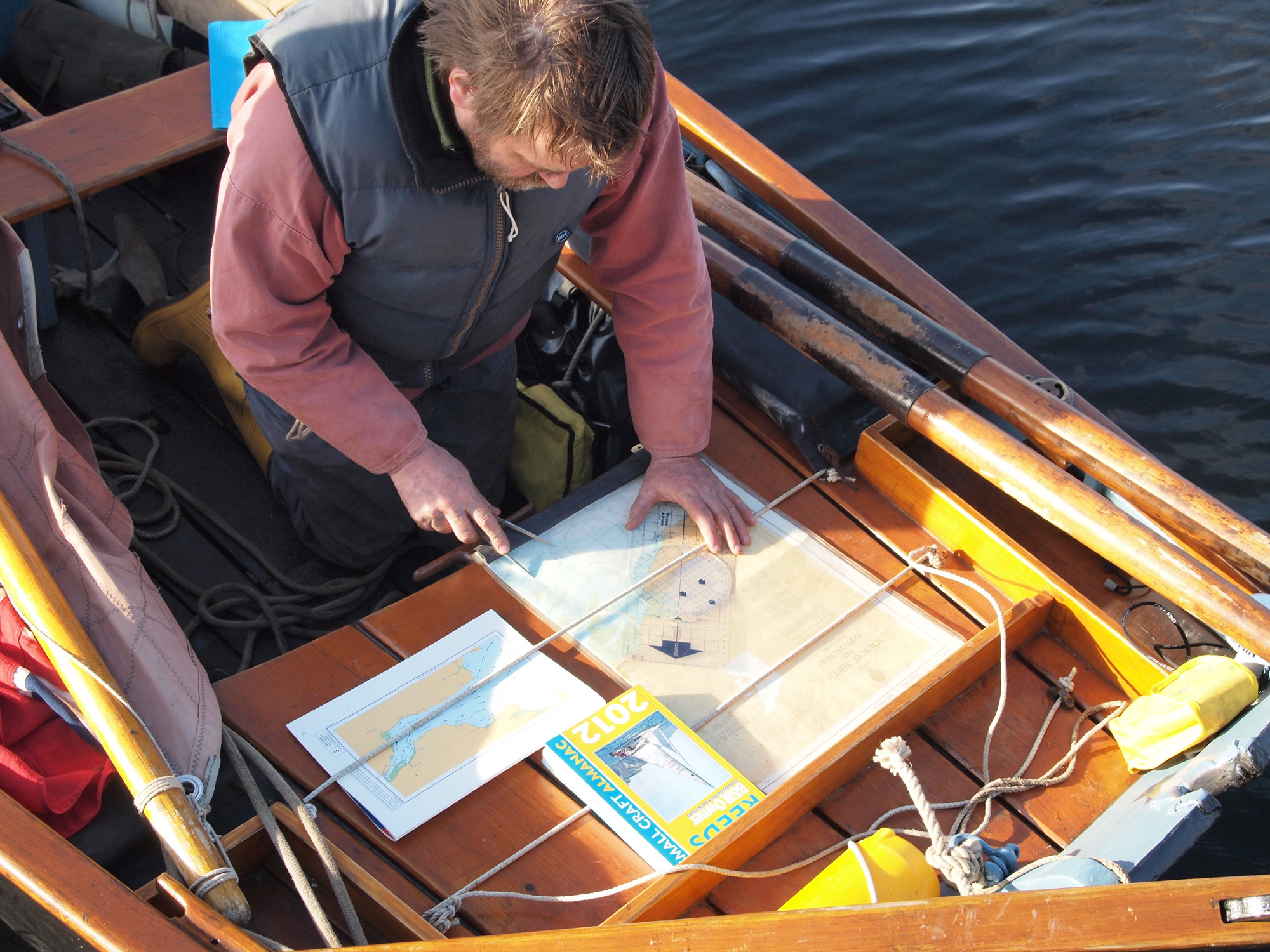
On AVEL DRO in 2012, the sternsheets double as Roger’s chart table. These days he still plots courses on a paper chart and consults local almanacs for tide and current information, but he also carries a GPS chartplotter.
“It was one more thing to think about,” he says. “One more expense. I was living in Bristol, in the west of England at the time, and while it was an inexpensive place to keep a yacht, even if you run it cheaply a yacht is never cheap. So, after I moved back to the northwest of England, I sold it where it was lying on the River Wyre and dragged BAGGYWRINKLE out of my friend’s shed in Lancashire.” The old Tideway was horribly dried out, but Roger got it back into usable shape and set off for Brittany and, specifically, La Semaine du Golfe, a traditional boat gathering in Morbihan.
Thinking back to that week a quarter century ago, Roger becomes almost wistful. “I’d never been to La Semaine before. It was extraordinary. There were about 800 boats, grouped into fleets of roughly similar sizes. There were very strong tides, and really challenging sailing conditions, and the French thought nothing of it. I rediscovered the joy of dinghy sailing and, most especially, the way people make friends with you when you’re in a small boat.
“Other people in small boats are quick to chat, and from people not in boats there’s intrigue. They want to know who you are and where you’ve come from. They’re curious and often amazed. If you turn up in a dinghy somewhere—anywhere—someone will come down to the quayside and get talking, and then they’ll invite you back to their place. That doesn’t happen in a yacht. In a yacht you’re perceived as self-sufficient.
 Ronan Coquil\ Courtesy of Roger Barnes
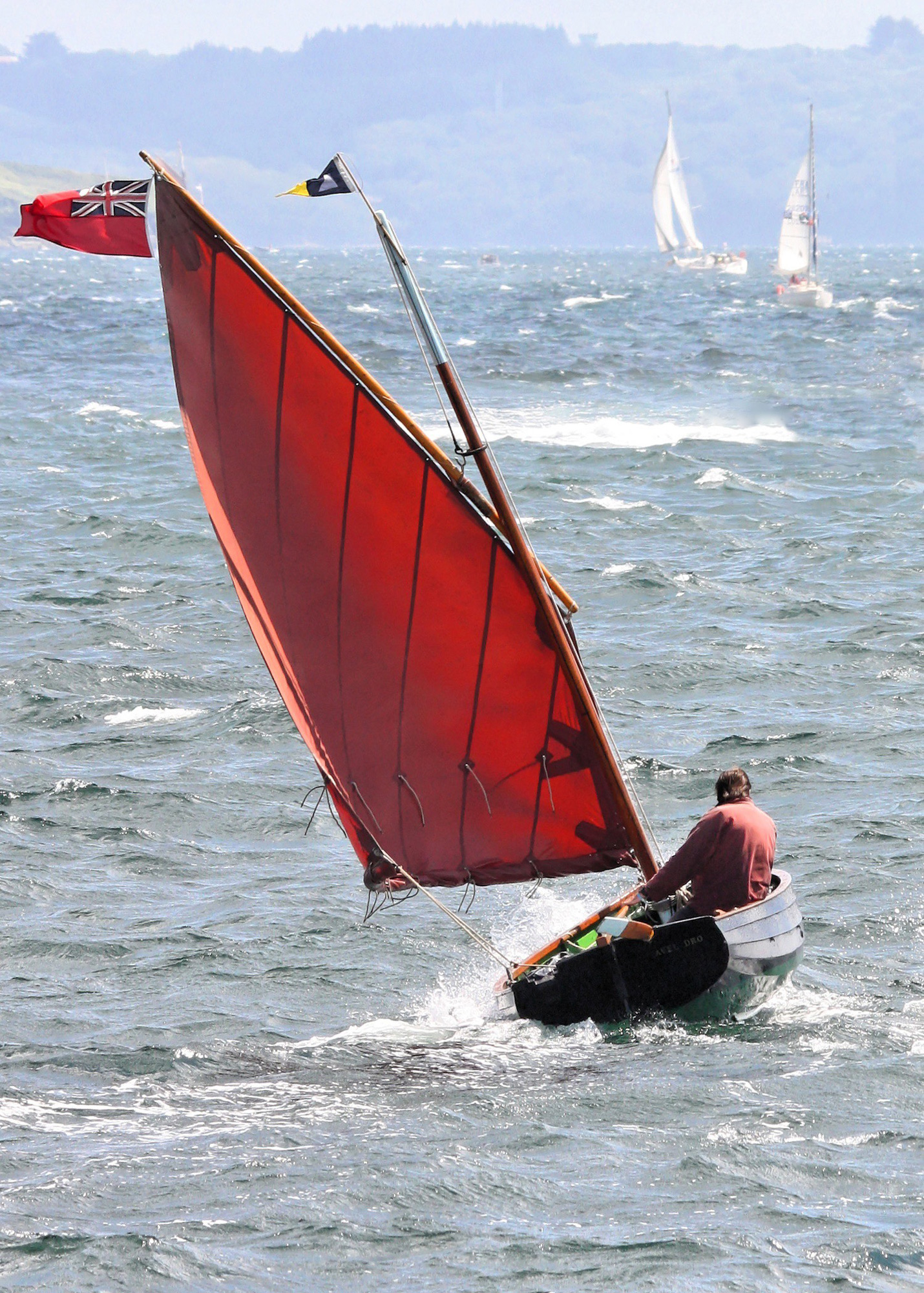
The Ilur’s 131-sq-ft sail area is similar to that of the Wayfarer dinghy but all in one sail. It took Roger some getting used to and, at times, might seem like a lot to handle, but with three rows of reef nettles the sail can be significantly reduced, allowing Roger to continue sailing even when much larger boats might have returned to harbor.
“When you’re in a small boat, people are just nice to you. I once sailed AVEL DRO to St. Michael’s Mount in Cornwall. I moored up along the wall, and walked into the harbor office. There was a guy in a blue sweater sitting behind a desk; he was clearly the harbor master. I said ‘I’m in the dinghy over there against the seawall. I’m going to stay the night. What do I owe you?’ The chap looked up with a glint in his eye and said, ‘The harbor master’s really tough; if you meet him he’s bound to charge you, but he doesn’t seem to be around… I’d see if you can get away with it.’ He went back to work and I went back to the boat. If I’d been in a yacht, that wouldn’t have happened.”
While 2003 was the first year that Roger had taken part in La Semaine, it wasn’t his first foray to the maritime festivals of Brittany. In 1992, he had trailered his Tideway via ferry across the English Channel to take part in Brest 92, a festival of some 2,000 boats hosted in the naval and commercial docks of Brittany’s largest port. He remembers that it rained and was quite stressful, but as the Brest festival wound down, he joined the flotilla sailing around the Crozon peninsula for the continuation of festivities in Douarnenez, some 33 miles to the south. And he was hooked—by small-boat cruising and by Brittany, where he now lives. After 1992, he became a regular at the maritime festivals. First in the Tideway, then in the Harrison Butler, and then back in the Tideway.
 Amy Edelman/ Courtesy of Roger Barnes
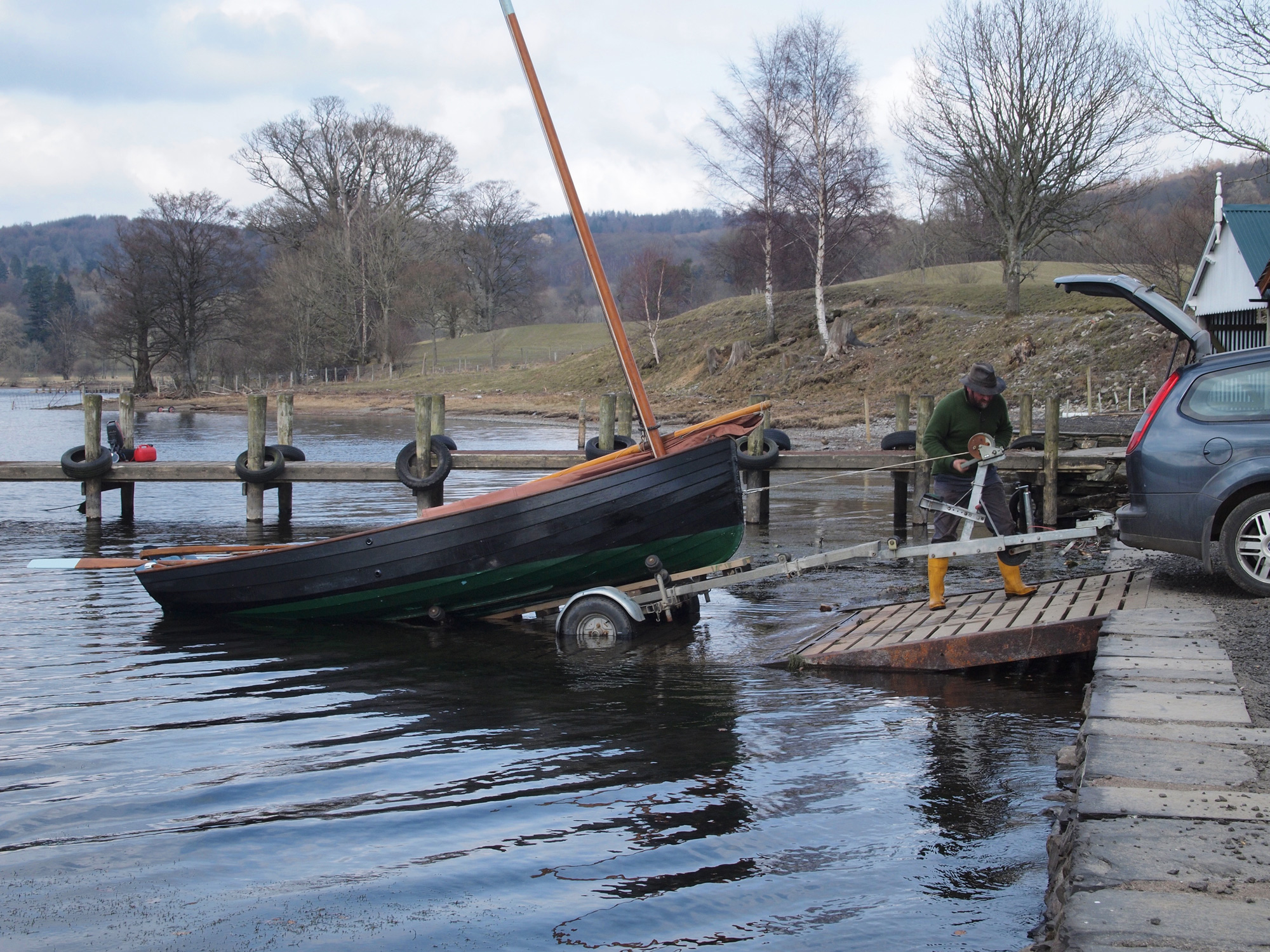
With AVEL DRO Roger has always been self-sufficient. On the trailer, two long boards either side of the keel help guide the boat up onto the rollers so Roger can focus on the winch and not worry that AVEL DRO may be swinging away from center.
But it was his visit to Morbihan that confirmed he was truly a small-boat sailor at heart, and it highlighted that serious dinghy cruising would require a bigger boat—preferably one that didn’t leak. He settled on the François Vivier–designed Ilur. “I didn’t look at every available cruising dinghy and make a sage and reasonable choice,” he admits. “But I kept seeing Ilurs at the Breton festivals and it seemed like a good boat. It was beamy, had an unstayed mast right up in the bows, and a wide flat floor for sleeping.” Writing about his choice at the time, he acknowledged that he had been “rather worried about the rig—a single lugsail with very traditional gear—and wondered how practical it would be for serious cruising, compared to the much more conventional gunter rig of the Tideway. But surely generations of Breton fishermen could not be wrong?”
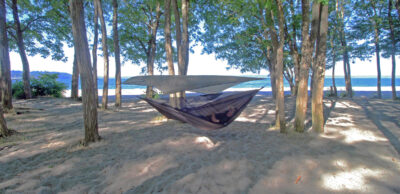
With the help of local friends, Roger found an Ilur in Saumur on the Loire River. It had been professionally built and, despite some minor ill-found alterations that he soon fixed, was in decent condition. He bought the boat and retained her old name, AVEL DRO, Breton for whirlwind. He quickly set about making her ready for cruising. Up forward would be the space for an anchor and mooring lines, a bucket and muddy boots. He constructed two plywood boxes—one for the alcohol stove, pots, and pans, the other for food—that fit under the forward thwart on either side of the centerboard trunk; his mattress and sleeping bag would be laid out on the port side beneath and aft of the center thwart. Finally, he made a simple tent using a poly tarp draped over the yard as a ridgepole. That original tent was eventually replaced by a custom canvas tent, but AVEL DRO’s general arrangement has remained unchanged for more than 20 years.
 Sophie Morice-Couteau/Courtesy of Roger Barnes
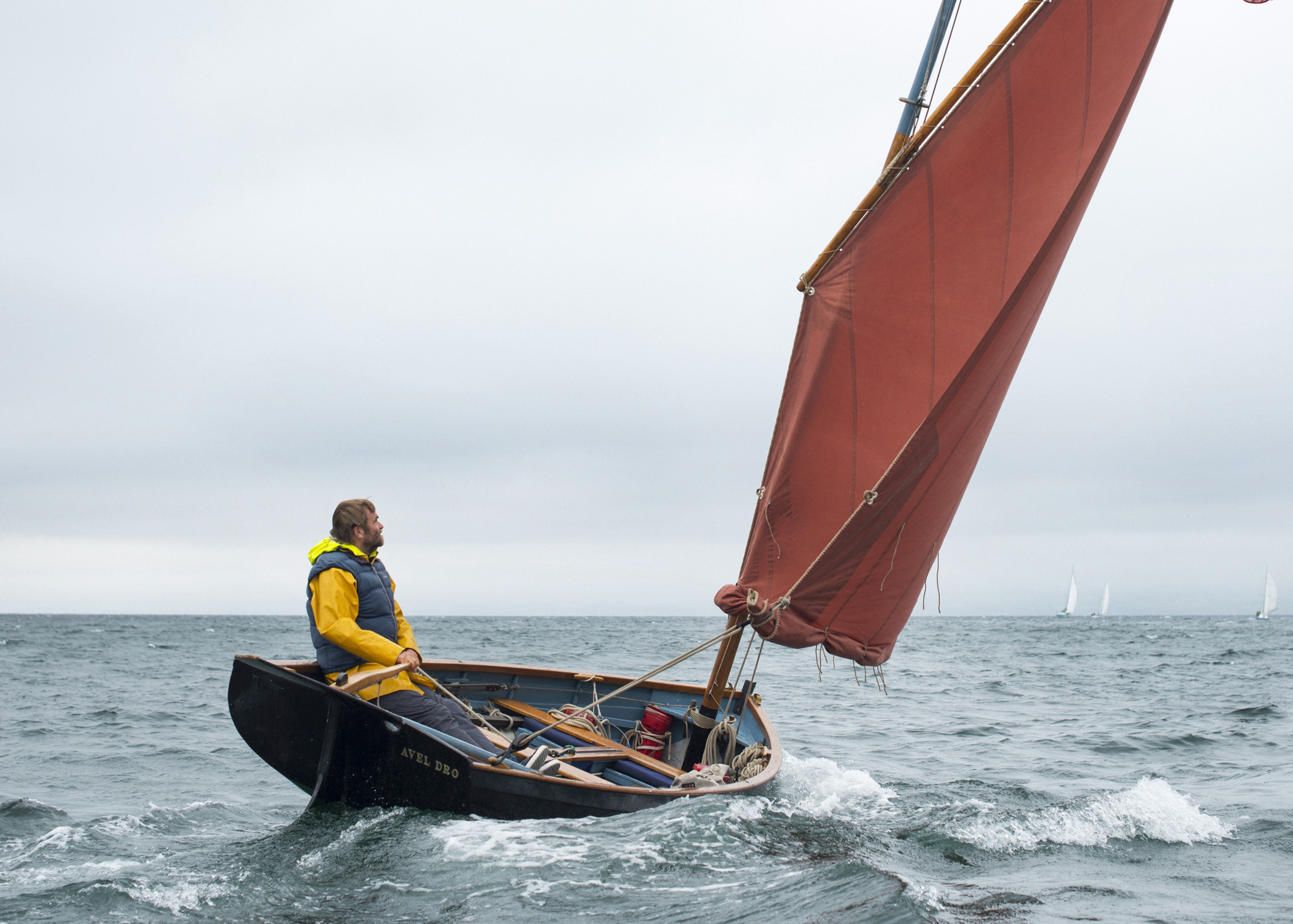
In strong winds Roger holds the mainsheet straight from the block, which has its strop loop tucked over a thumb cleat set on the gunwale cap just forward of the transom. In a sudden gust he can quickly let the sheet go so that the sail will immediately fly forward as the boat rounds up into the wind.
Then there was the rig. “It was one thing setting the boat up, it was another learning how to sail her,” he says. “The Ilur’s rig is the size of the Wayfarer’s, but all in one sail and there’s no mechanical advantage… just a lot of pull. When you tack or jibe you unhook the sail from one side and rehook it to the other. I quickly figured out that tacking is okay because the sail spills the wind as it goes through, but when you’re jibing you have the splittest of split seconds when the leech of the sail is facing the wind. It’s all about timing. If you don’t get it just right, the sheet gets ripped out of your hand and the sail flags away in front of the boat. It’s not disastrous… the boat will naturally settle beam on to the wind and you can go forward, grab the foot of the sail, and work your way along to the clew and the sheet. Then you can bring it back, rehook it, and get going again. But it loses a lot of time, and it’s embarrassing. You also have to sheet in before a jibe; if you don’t, the sail will wrap around the top of the mast and all sorts of things will happen. It’s a skill that has to be learned—it took me nine months to master it—but once you’ve got it, you have that feeling of empowered knowledge.”
Roger has learned many skills through the decades, and he will tell you—with all sincerity—that he is still learning, still messing up. But he gets great satisfaction from knowing he has abilities gained through experience and perseverance. And he appreciates having a glimpse into the past and an understanding of skills largely lost. “Many modern rigs,” he says, “have extra fittings to make things easier. We use technology across our lives to make them easier, but because of that we’ve lost the ability to do things for ourselves. Sailing an Ilur is like returning to a past age; you have to know how to sail it, it’s not going to help you.
“It’s the same with sailing without an engine. There are many reasons for doing that, but for me the big one is that you’re forced to use the wind and tide, to think about the wind and tide…. If you have an engine you can say, ‘I’m going to start here and go there, and if my speed drops below a certain level, I’ll turn on the engine.’ If you don’t have an engine and your water speed drops, you can always start rowing. But am I going to row for another four hours to get to that place I wanted to visit? No. I’m going to look for somewhere else nearer. Often you’ve done some passage planning and identified some ‘outs,’ but just as often you get the chart out and take a look. ‘Ah, look, there’s a little creek, I wonder what happens up there…’ It won’t be in the yachtsman’s pilot, because it won’t have pontoon berths and docks. But often, if you go up that funny little creek, you’ll discover that it was used as a harbor in the past; there’ll be something there, maybe a few local fishing boats, maybe an old quayside. The number of places I’ve found via the happenstance of sailing without an engine is quite extraordinary. I think it’s beautiful to sail like that.”
 Ronan Coquil/Courtesy of Roger Barnes
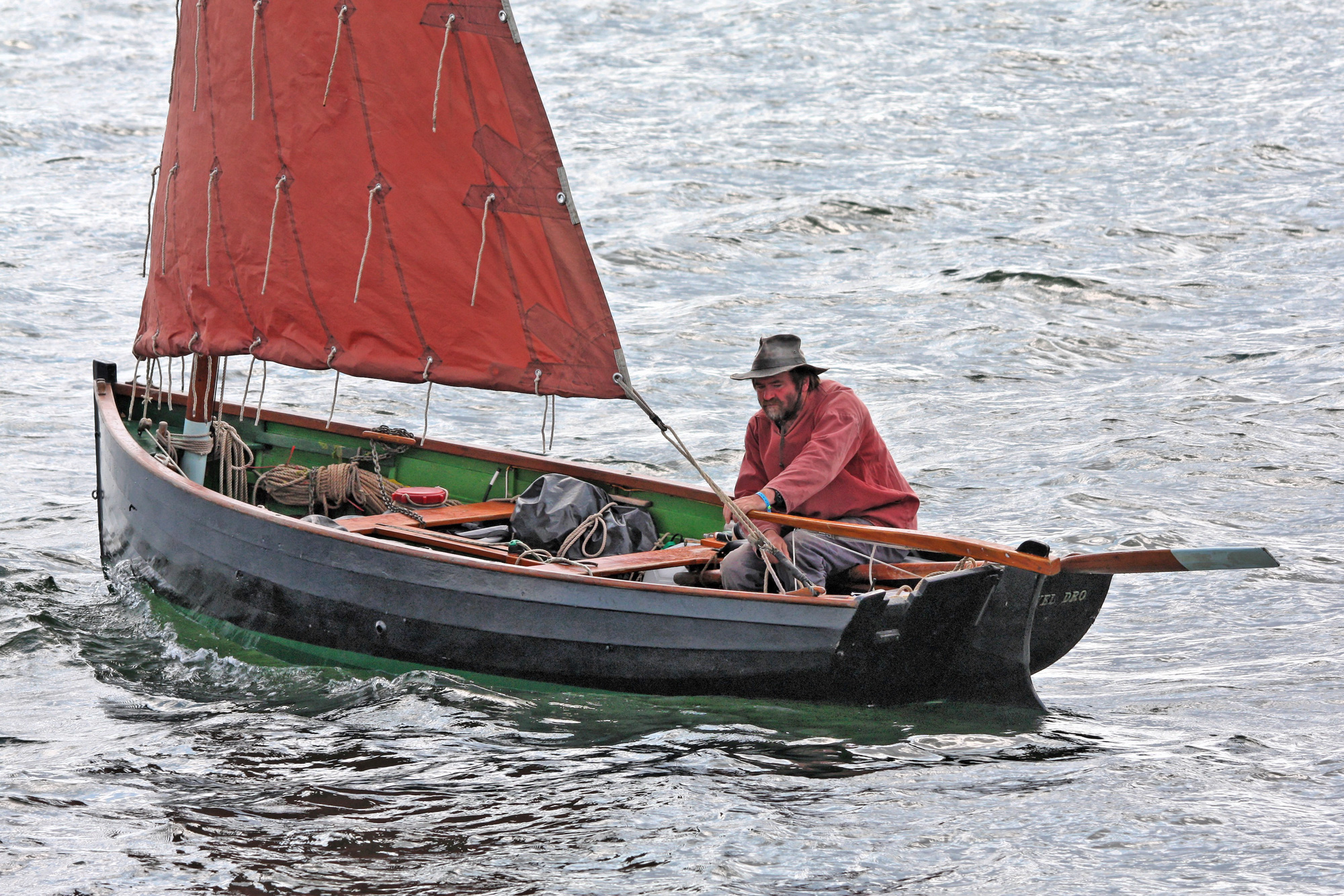
With water jugs, sleeping kit, a boat cover, and all the paraphernalia that comes with beach cruising, AVEL DRO might appear cluttered and disorganized, but everything is in its place—down to the ever-present sculling oar ready for use if needed, and the anchor with its coiled warp at the ready, held out of the way against the side of the hull by a quick-release slip knot.
He pauses to take a swallow of coffee while considering his next thought.
“I’m not against outboards,” he says at last. “I just prefer to sail without. People think it’s crazy. But when you turn on an engine, you re-enter the modern world. I live in the modern world. I live in a house with a television, and a car, and a cellphone. But when I go out on the boat for a weekend or longer, I’m in a different environment and in a different mode of thought. Even if you’ve had a really stressful week at work, you stop thinking about it the minute you set foot in your engineless boat. Now, you have to think about the wind and the weather and the tide. You can be as adventurous as you like, push it as far as you like, take on big challenges like Frank Dye did. I prefer not to, but it’s still really living in a way that your normal everyday life just isn’t.”
Despite his appreciation for slowing down and escaping the restrictions of the modern world, Roger is, first and foremost, a realist. His adventures in AVEL DRO, rarely more than 2 miles from a coast, might look tame to some but, he says, “You’re in the wilderness, you’re relying on yourself.” And part of that self-reliance is being smart. At all times, when cruising, Roger now carries a VHF radio, a GPS chartplotter, and a PLB (Personal Locator Beacon). “If the worst comes to the worst, I can call for help. But you can never be absolutely sure that someone will come. It can’t be part of your plan.”
He has put out a rescue call once, off the north coast of Devon. He was living in England at the time and had been visited by a journalist from the French magazine, Le Chasse-Marée. They had planned to go sailing, but the weather was foul and it appeared they might have to cancel. “And then there was a slight weather window forecast, so we decided to go for it.” They launched from Appledore, a small village harbor up the Taw-Torridge estuary, and sailed out into Clovelly Bay, heading southwest into a rising Force 6. As the afternoon progressed, the weather deteriorated and, rather than return to Appledore and attempt to cross the Bideford Bar—a notorious stretch of water at the mouth of the Taw-Torridge—they decided to tuck into Clovelly for the night. “It was a horrible night,” Roger grins. “It rained, solidly.”
 Mary Dooley/Courtesy of Roger Barnes
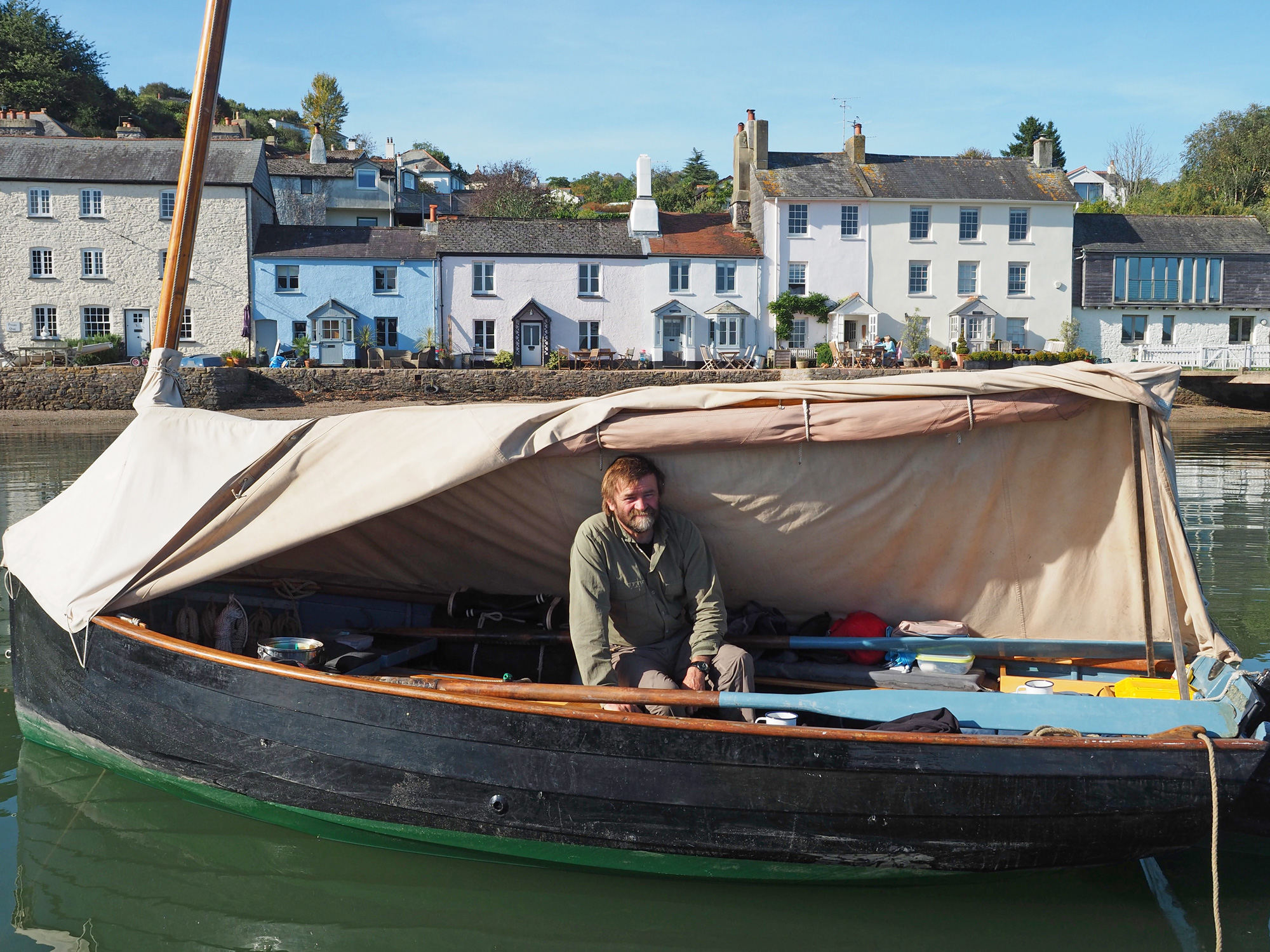
On a quiet morning in an English harbor, Roger Barnes looks out from beneath the boom tent on AVEL DRO.
The following morning, they chatted with the Clovelly lifeboat crew. “They said we’d probably be fine to get across the bar, so we set off.” When they reached the estuary, the situation was bleak. Across the bar, the waves had built to 16′ or more. But with no obvious alternatives, they decided to go for it. “We were running downwind. Straight ahead of us was a beach where the waves were breaking, but if we went to the right we’d be okay. We weren’t quite stern-to to one of the waves when the boat tripped up and tipped us in. AVEL DRO righted herself, but we were in the water.”
The two men scrambled back on board. “Soon we were planing down the waves, the whole boat vibrating, stopping dead in the bottom of a trough, rising up the next crest, flying forward, then sinking back down. At the bottom of one trough the boat filled up with foamy water, and all the while the beach with the breaking waves was getting ever nearer.”
As he struggled to keep control of the bucking boat, Roger was thinking through the possible scenarios: if they were lucky, they’d be able to turn to the right beyond the bar; if not, they would end up on the beach, and would have to jump into the water. The boat would be smashed up but they would survive in their buoyancy aids. Nevertheless, he decided, if the worst did happen it would be nice if there were a lifeboat on hand. He sent the MAYDAY call. Within 15 minutes, he says, two lifeboats were on the scene. But, by then, AVEL DRO was across the bar and the two men, while shaken, wet, and cold, were safe. “The smaller of the lifeboats stayed with us and escorted us up the channel, which they didn’t need to do… but it was nice.”
 Courtesy of Roger Barnes
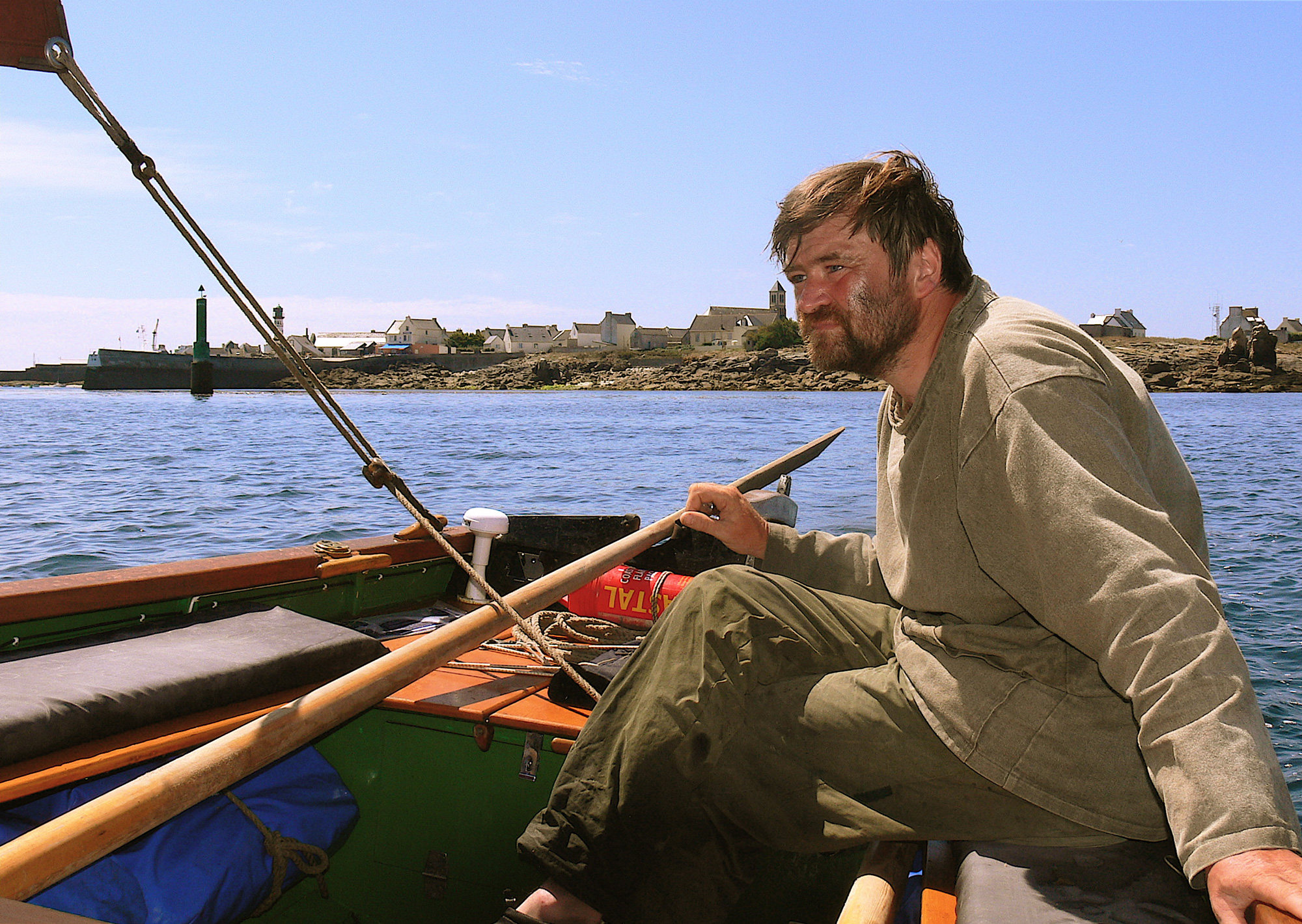
In 2005, the year after he bought AVEL DRO, Roger sailed by the Île de Sein, a little more than 3 nautical miles off Finistère, Brittany.
Roger pauses, pondering that day, so long ago, when it all nearly went terribly wrong. “The point is,” he says, after a moment’s silence, “the most important phrase on a small boat is ‘What if?’ In a small boat, you’re not in this moment as much as you’re anticipating the next one. That’s not something you can teach; it comes with experience, and as you gain that experience it becomes second nature to think ahead. It’s what separates the skilled sailor from the new.”
Small-boat cruising may not be the most important part of Roger’s life, but it is surely one of them, and one that he appreciates for its simplicity and possibility rather than any life-threatening excitement. In AVEL DRO, he says, he has experienced “the sense of utter freedom that comes from taking a small boat out to sea. It’s a freedom you rarely experience on land.”
Breakfast at an end and duties calling us both back to the boat show, we leave the restaurant together. As we stop on either side of the car, Roger looks across at me and finishes his thought: “In a boat, you’re in your own little world, self-reliant and autonomous.”
Jenny Bennett is editor of Small Boats.
Roger Barnes’s first book, The Dinghy Cruising Companion, was published in 2014. The second edition, published in 2022, is available from The WoodenBoat Store, $24 plus shipping. His second book, Sailing the Shallows, published in 2025, is also available from The WoodenBoat Store, $24 plus shipping. His YouTube channel, @RogerRoving, has 102 videos.
If you have an interesting story to tell about your adventures with a small boat, please email us a brief outline and a few photos.
For other small-boat adventurers with innovative ideas, see:
In Stevenson’s Wake, Donatien Garnier follows the route described by Robert Louis Stevenson in An Inland Voyage.
Standing up to the Big Muddy, Scott Mestrezat tackles 2,300 miles of the Missouri River on a paddleboard.
Across an Ocean, how Christophe Papillon rowed solo across the Atlantic.

I’ve admired Roger Barnes for several years now; his obvious skills with a small boat, his poetic eloquence, playful nature, and willingness to share all he knows and does makes for tremendous entertainment. A minor addition to the article would be to point out that he replaced his original tarp with a tent that he fabricated himself, another aspect of the man I admire: that all that he has done smacks of the everyman sensibility, that everything he has shared with us all is within grasp of any man with the wherewithal, not just those with seemingly limitless budgets.