In the years following the Second World War, numerous new classes of sailing dinghies intended for plywood construction were introduced in the U.K. Plywood had been available for a long time, but wartime developments in adhesives had made the material suitable for boatbuilding.
One designer, Ian Proctor, had already enjoyed considerable racing success with his designs for Merlin Rockets and National 12s, and in 1957 he designed the Wayfarer. His intention was to create a one-design boat that was not only suitable for racing, but would also be stable enough for teaching and cruising. The double-chined hull made his new design ideal for plywood construction, both by professionals and amateurs. Two British companies in particular, Small Craft and Porter Brothers, produced plywood boats, the last in 1994; and in 1965 fiberglass Wayfarers were introduced, with Porter Brothers and Moore & Sons among the builders. In 2007, copyright of the Wayfarer design was transferred from the Proctor family to Hartley Boats in the U.K., now the sole builders.
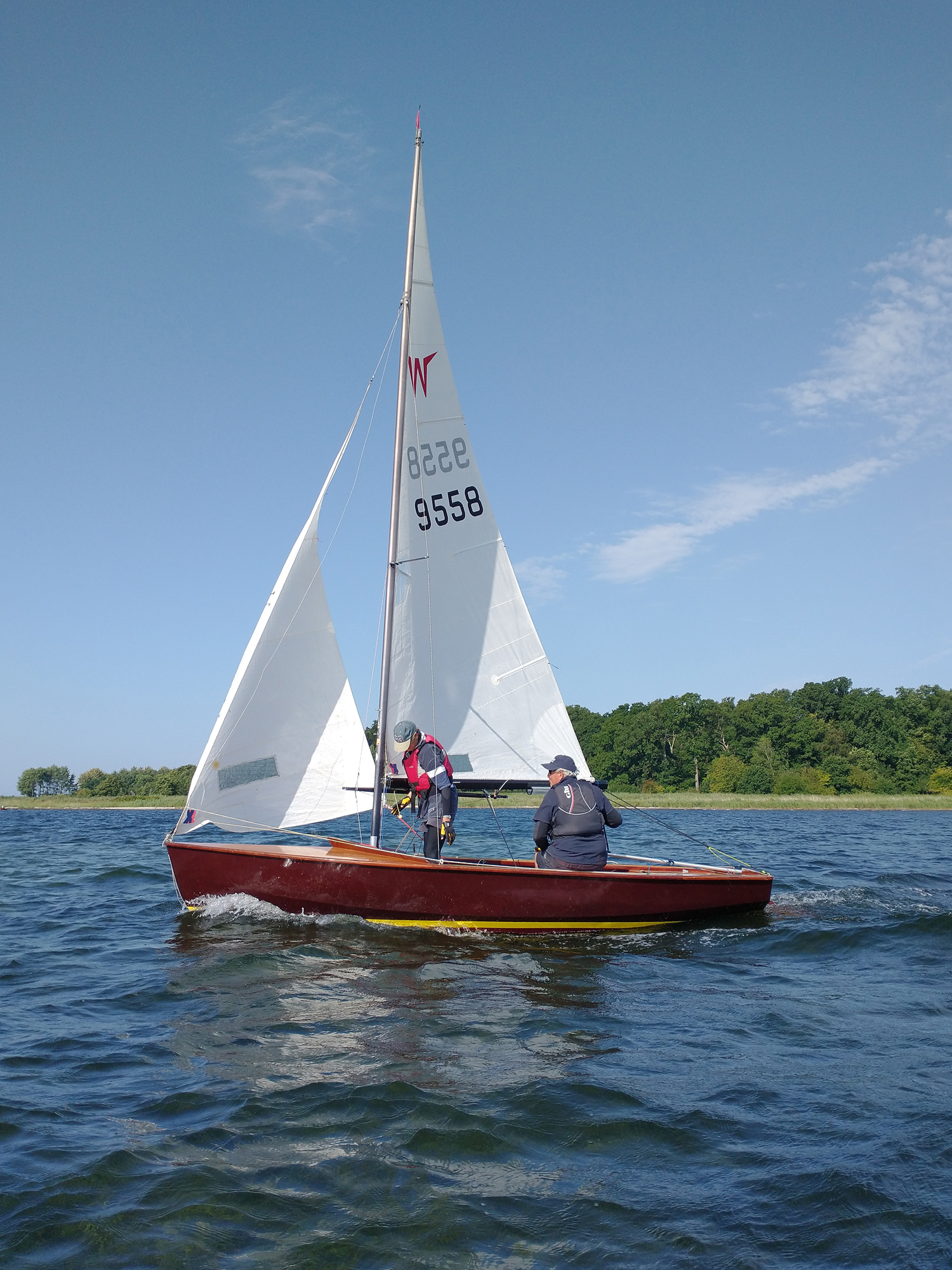 Courtesy of the U.K. Wayfarer Association
Despite modifications and a variety of models, original Wayfarers have remained popular for cruising, daysailing, racing, and teaching.
Over the years, Wayfarers have been sailed on numerous adventurous voyages, most famously by Frank Dye. From the early 1960s, with various crew (including his wife Margaret), Dye sailed his Wayfarer, WANDERER, from the U.K. to Norway several times—on one occasion encountering a Force-9 gale and suffering multiple capsizes—as well as to the Faroe Islands and Iceland. He subsequently sailed a borrowed Wayfarer singlehanded up the length of the U.S. East Coast. Since then, British adventurer Steve Clarke-Lens has sailed a Wayfarer over about 4,000 miles in the eastern Mediterranean and up the Nile as far as Aswan; Ralph Roberts, longtime Wayfarer sailor and secretary of the Wayfarer International Committee, has sailed across the North Sea at least five times, and on one occasion as far as Helsinki, Finland; and in the past 10 years, Wayfarers have circumnavigated Great Britain at least five times.
The evolution of the Wayfarer design
While the Wayfarer interior has seen several modifications since 1957, the original hull design has remained unchanged. A dinghy of 15′ 10″ length and 6′ 1″ beam, it can carry as many as six people but be sailed by one. Its chined hull deflects choppy seas and its stability, relatively high boom, and ample seating have made it the boat of choice for sailing schools across the U.K. and beyond. For cruising, the boat has multiple storage options, including an optional stern locker large enough to carry a small outboard and kit, and a designed-for-purpose boom tent. The sloop rig includes a jib or genoa as well as an asymmetric or symmetric spinnaker. To date, some 11,000 Wayfarers have been built in wood or fiberglass.
 Courtesy of the U.K. Wayfarer Association
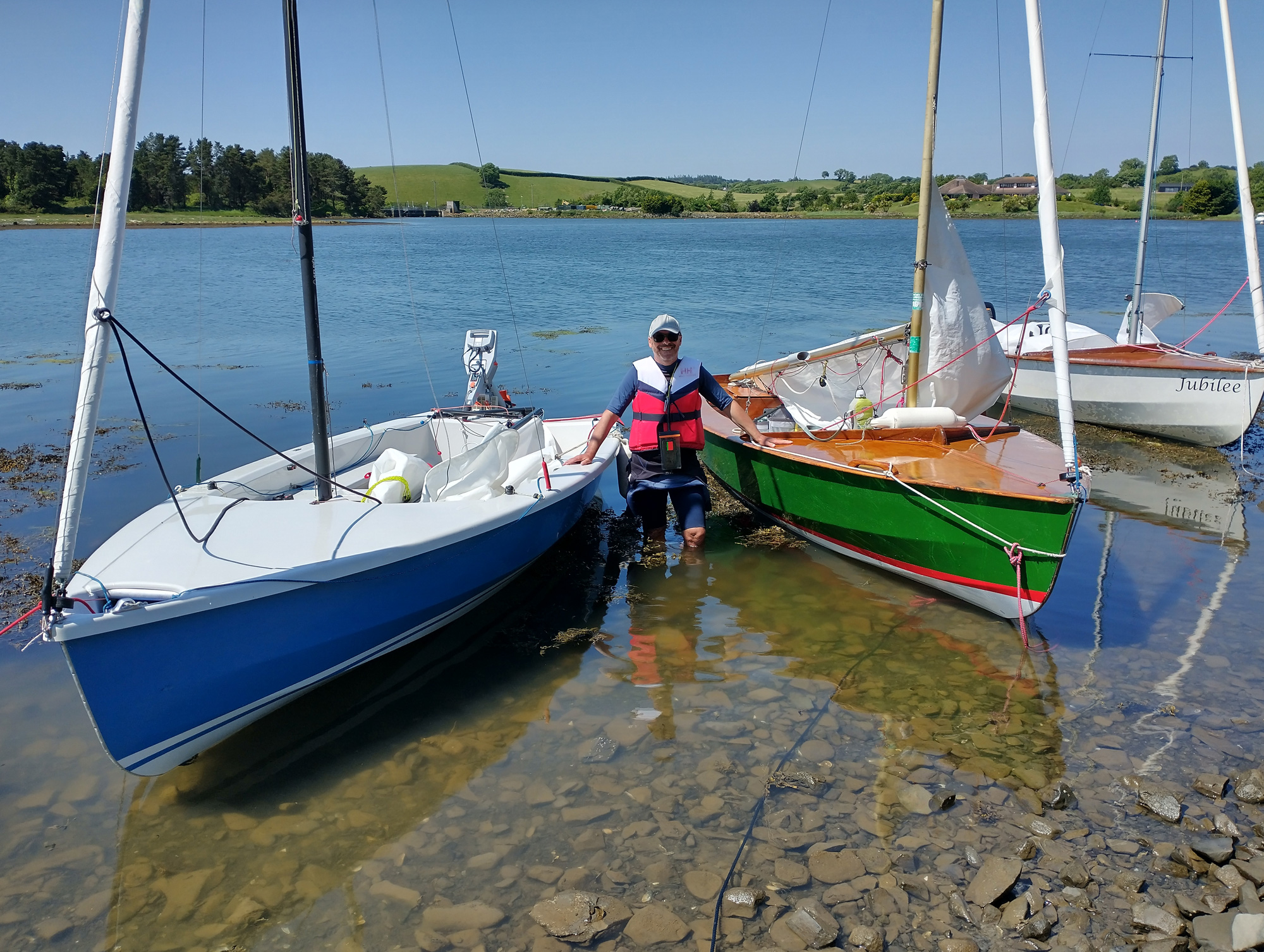
Two older plywood Wayfarers (center and right) contrast with the latest fiberglass Mark IV model. The hull shape remains unchanged, but a spinnaker chute has been added to a now-cambered foredeck, and the fixed wooden seats have been replaced by removable fiberglass ones.
Up until 2006, fiberglass Wayfarers had been produced in three different versions, the most recent being the Wayfarer World, introduced in 1997. But then, Hartley Boats commissioned Phil Morrison to update the design. The result was the Wayfarer Mark IV, which, while respecting the one-design principle from the point of view of sailing performance, included a number of improvements. When the Wayfarer World (Mark III) had been introduced, the wooden sole boards of the Mark II were replaced by an internal molding that raised the cockpit sole by a couple of inches. Morrison devised a new molding that brought the sole back to its original height while simultaneously providing more headroom beneath the boom. It also provided greater comfort and space for the crew, as did other subtle modifications such as the lowering of the centerboard trunk, moving the thwart slightly aft and narrowing it a little, to give the crew more room. The addition of a concave scallop profile molded into the aft edge of the foredeck also gives the crew more room and, in light winds, a more comfortable place to lean. Furthermore, for those who prefer a traditional spinnaker arrangement rather than a chute, it gives more room for a spinnaker bag.
The cockpit’s self-drainage was improved so that, after righting from a capsize, most of the water exits via tubes in the transom, with only a minimal amount left in the bilge for the self-bailers to cope with. A spinnaker chute was added, and the old wooden seats and lockers at the stern were replaced by fiberglass ones that are optional and removable. “Furthermore, we dealt with the cosmetics to make the boat look more modern and appealing in today’s market,” said Hartley Boats’ Mark Hartley, “and we optimized the hull to the point that a Mark IV has won the U.K. Championship every year since 2008 and every International Championship since 2010. It’s now perceived as being as quick as you can possibly get.”
 Courtesy of the U.K. Wayfarer Association
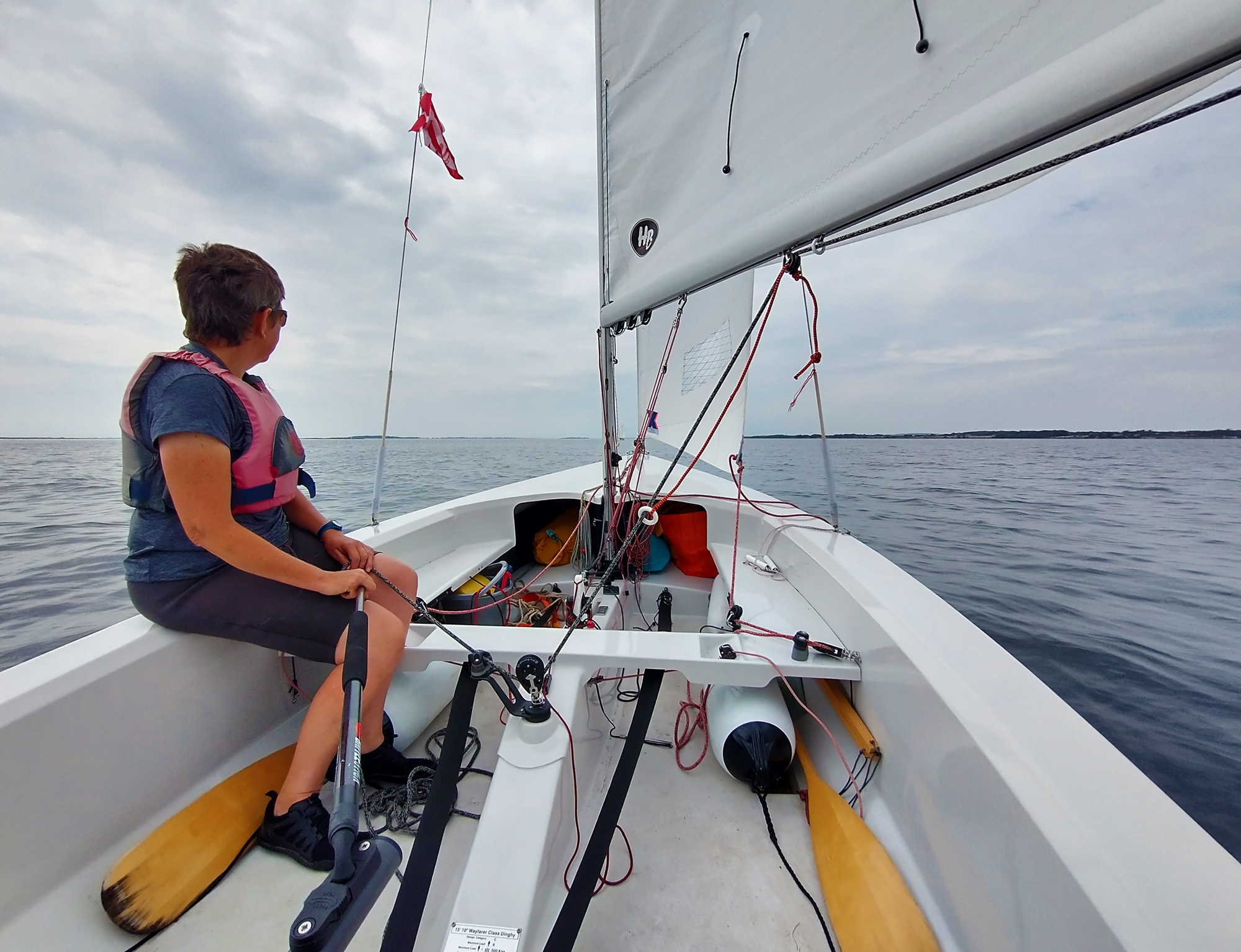
The Wayfarer Mark IV’s interior is uncluttered but will be familiar to most Wayfarer sailors. The seating accommodations are optional; a scalloped molding in the foredeck facing creates a comfortable backrest for a passenger on a quiet day; and jibsheets are led inboard for improved upwind sail trim and easy control for singlehanding. As in the original Wayfarer, there is generous storage volume beneath the foredeck. This is a Weekender, the most recent of the Mark IVs.
Hartley Boats has built more than 1,000 Wayfarer Mark IVs, in four different versions: Racer, Weekender, Cruiser, and Trainer. While the Cruiser and Trainer are both built of solid fiberglass (the latter with a heavier layup to cope with the extended use and abuse typically experienced at sailing schools), the other two models are of foam-sandwich construction. The Weekender’s centerboard, which is the same profile and section as the standard design, is made of solid cast iron and weighs 60 kg (132 lbs). By comparison, the Racer has a foam sandwich board weighing about 5 kg (11 lbs) and the Cruiser and Trainer have solid boards weighing about 7 kg (15 lbs). This extra weight necessitated the introduction of local stiffening but great efforts have been made to save weight elsewhere, not least by replacing a structural frame with foam bulkheads, so that the overall weight is only 18 kg (40 lbs) more than that of the Racer. Modifications have also been made to the rig: the boom has been raised 6″ to allow clear headroom for anyone sitting on the thwart; the mainsail has provision for slab reefing; the jib has roller reefing; and an asymmetric spinnaker is included.
In recent years, about half of the Wayfarers built by Hartley have been Weekenders. “The weighted centerboard makes the boat sail a little bit more like a yacht,” said Mark. “It gives people the confidence to sail in conditions in which they might normally be thinking they shouldn’t be out, or they’d be massively reefed.”
 Courtesy of Chris Yerbury
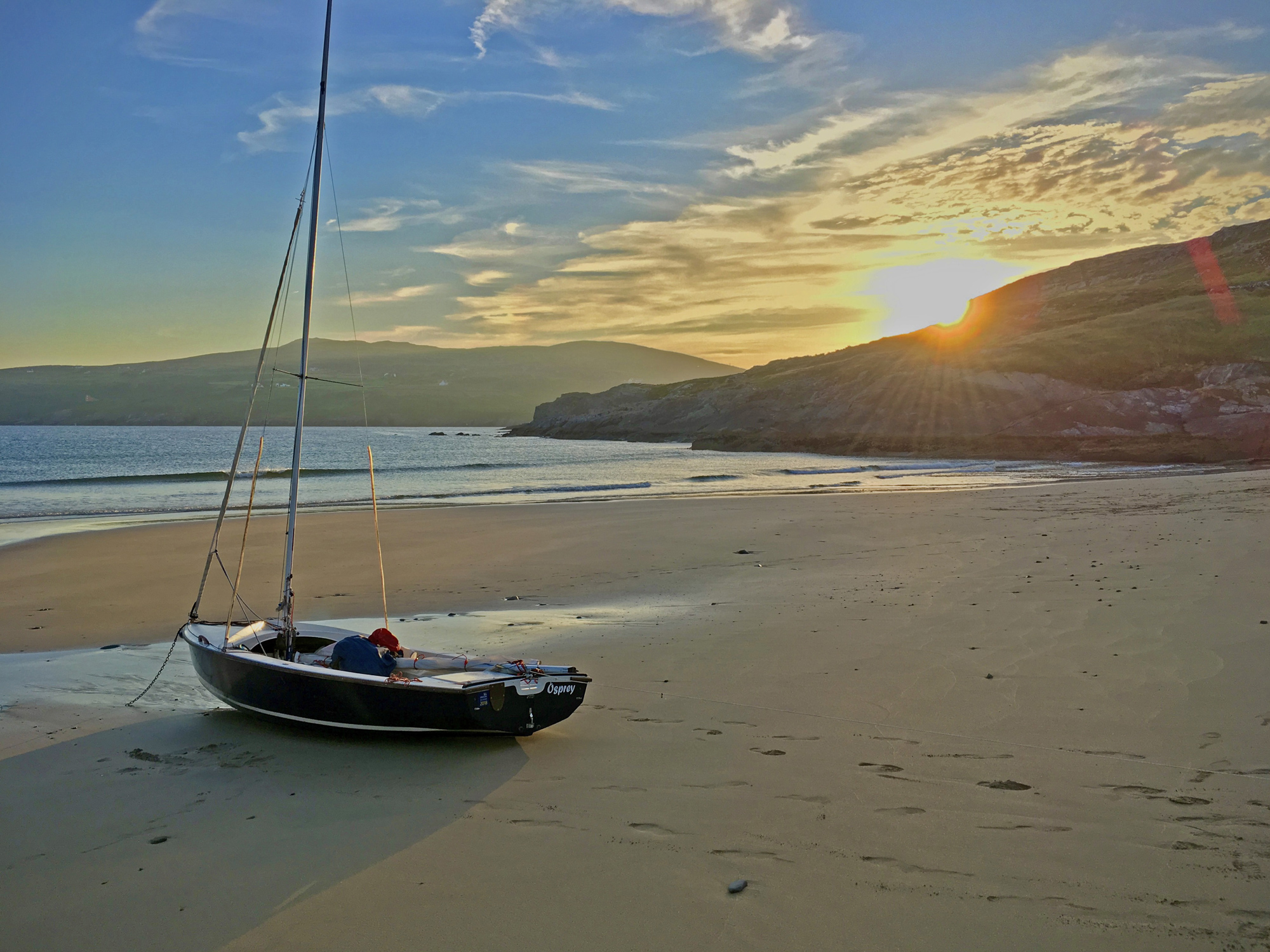
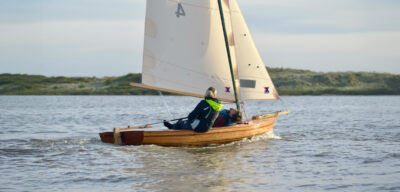
The hull’s shape allows the Wayfarer to sit upright when beached—a positive trait when using the boat for beach-cruising.
Wayfarers of any version are famously difficult to capsize, and the Weekender is, not surprisingly, even more so. Mark says that when a Weekender does capsize it is “almost self-righting,” and a description on the UK Wayfarer Association website states that when forced over the Weekender will not invert but will, in fact, right itself or, at most, will require a little help with one hand on the centerboard.
Monica Schaefer, a highly experienced Irish dinghy sailor who “sails anything that floats,” has raced and cruised Wayfarers for more than 20 years. She has been sailing a Weekender for a couple of years and is impressed by the boat’s stability and performance. On one occasion, she and her crew capsized the boat on purpose.
“It was quite difficult,” she said. “We both stood on one side, pulled the mainsheet in and pulled on the shrouds, and eventually we capsized. But as soon as we were in the water and let go of the mast, it came straight back up again! So the boat is really appealing to people who are getting to the end of their dinghy-sailing careers, and are no longer as agile as they used to be.” Schaefer frequently takes novices sailing and has been much more confident to do so in the Weekender. Although class rules prohibit the Weekender from competing in championship events, Monica frequently races her boat at her home club and has found that, while the Weekender is a little slower downwind, there is little difference in upwind performance.
 Courtesy of the U.K. Wayfarer Association
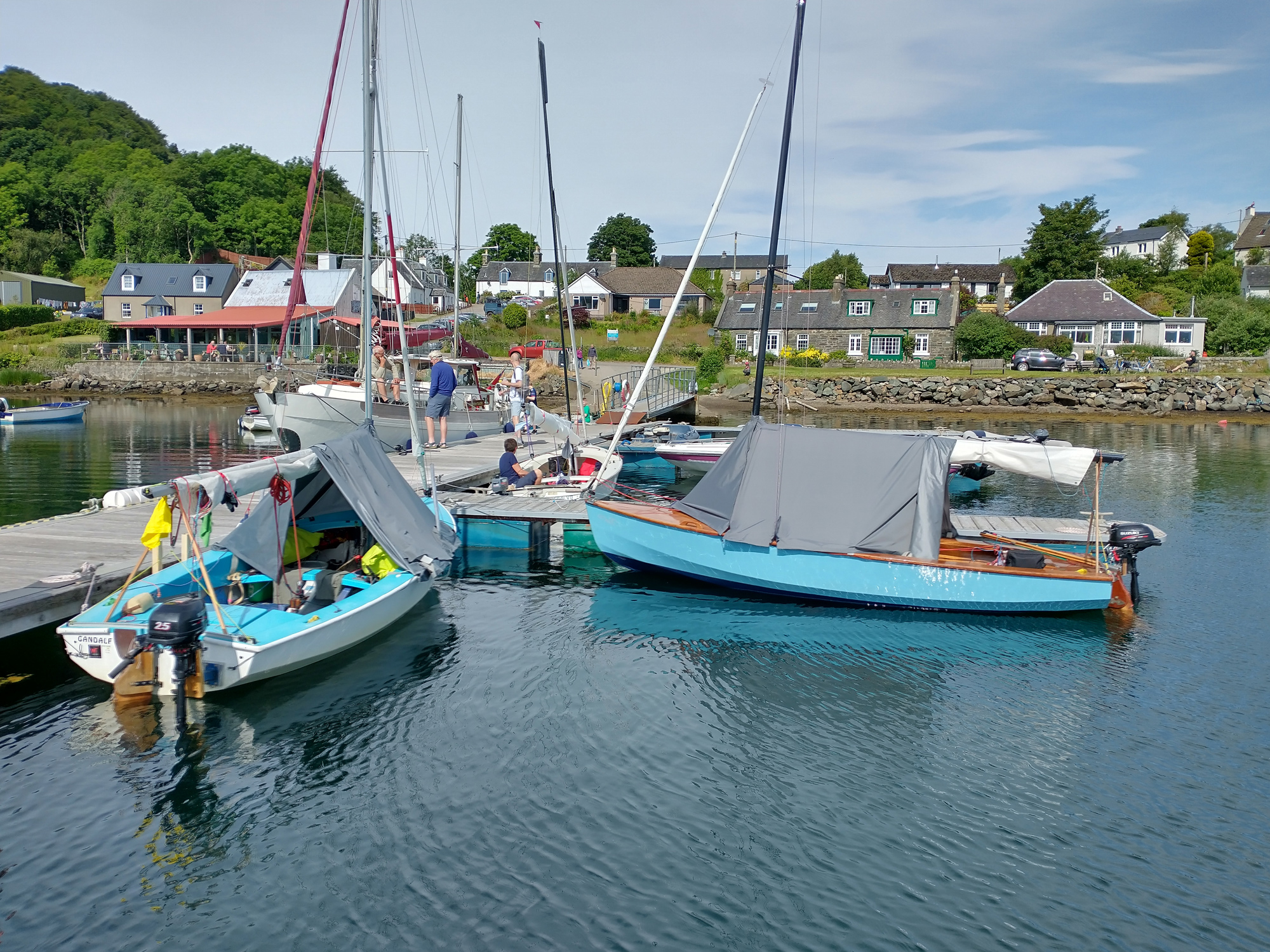
The custom-fit boom tents, which wrap around the mast and protect the interiors from the weather, are easily set up with Velcro straps that hold the sides snug to tent bridles fitted beneath the gunwales. In addition to the storage beneath the foredeck, there is ample space for equipment, food, and clothing in removable aft compartments.
The Wayfarer International Championship is held every three years and is normally followed by the International Cruising Rally in the same area. In 2025, the two events were held in Denmark: 36 boats raced at Skive Sejlklub, and then 70 people from 10 countries—Canada, Denmark, Germany, France, Greece, Ireland, The Netherlands, Switzerland, the U.K., and the U.S.—cruised in company in some 20 Wayfarers in the South Funen archipelago.
Sailing the Wayfarer
On a beautiful day in May of this year, my niece Harriet and I had the opportunity to sail a Wayfarer World that belongs to the St. Mawes Sailing Club in Cornwall. The fiberglass boat was built in 1994 by Porter Brothers and has been owned by the club—where it is used as a training boat—for a couple of years. Kept on a swinging mooring, its stability was immediately apparent as we stepped aboard from our tender, and I was struck by its continued stability, no matter what we did: while hoisting the sails, while Harriet was on the foredeck casting off, and all the time we were sailing.
 Warwick Baker/Courtesy of the U.K. Wayfarer Association
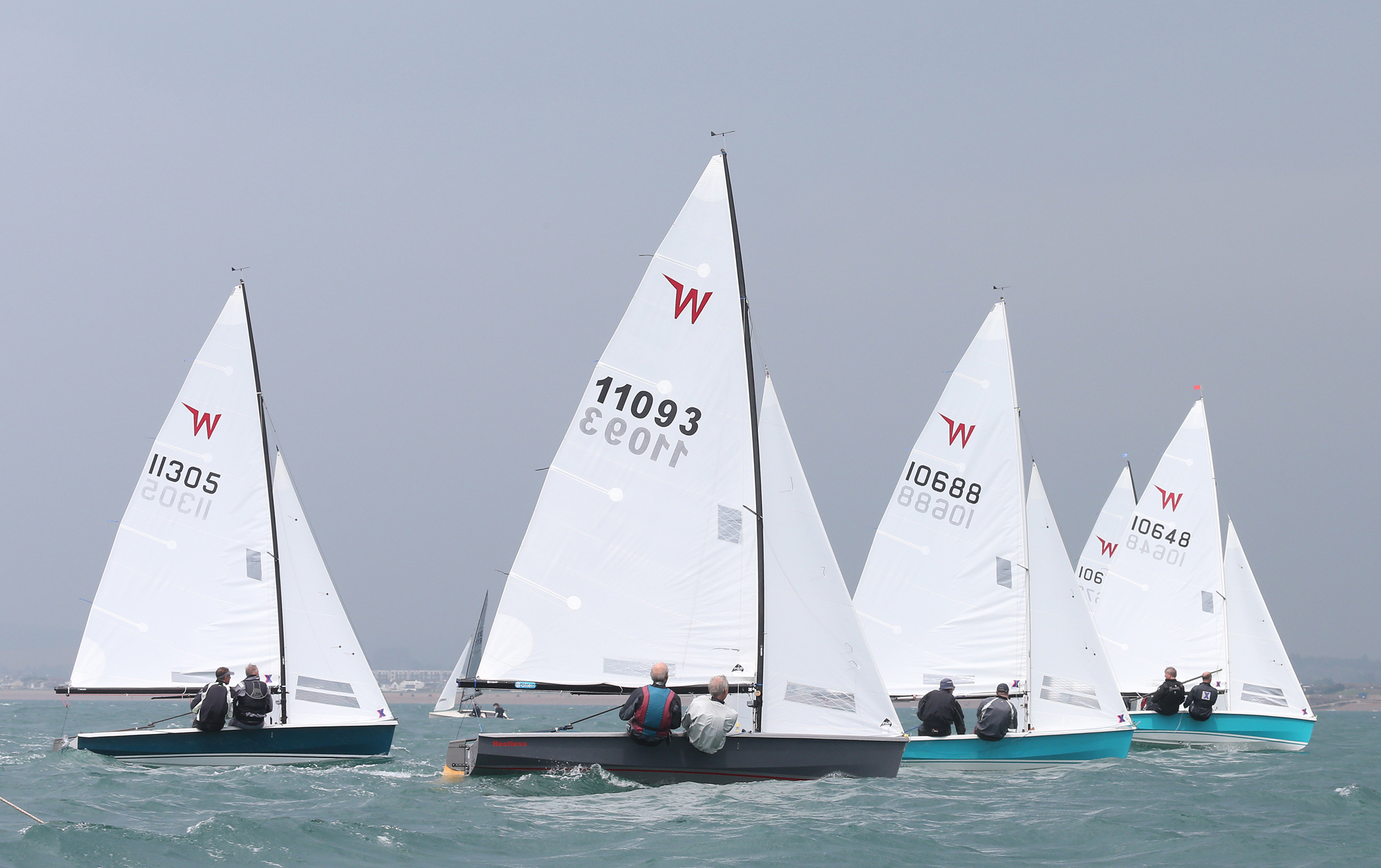
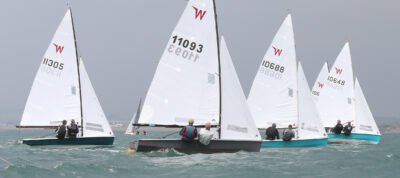
Thanks to the strict one-design rules, Wayfarer racing continues to be competitive and attracts large fleets to both local and international regattas.
With the wind in the east in our west-facing estuary, it was inevitable that the breeze would be variable in both strength and direction. But despite frequent sudden gusts, unpredictable calms, and multiple wind shifts that headed us and lifted us in turn, we never needed to quickly shift our position to avoid a capsize or other mishap—a refreshing change from the sailing dinghies we have been used to. And although this boat doesn’t have as much cockpit space as the Mark IV, there was plenty of room for the two of us, and we could have accommodated two or more other people comfortably. The boat carried a little weather helm when heeled (and this may have been because it wasn’t particularly well tuned), but it was otherwise easy to steer and maneuver in tight spaces.
As the Wayfarer design nears its 70th anniversary and continues to be sought after on the new and secondhand markets, there can be no doubt that the goals set out by Ian Proctor in his design brief—suitability for racing, cruising, and teaching—have been well and truly met.
Nigel Sharp spent 35 years working in the boatbuilding industry before starting to write about nautical matters in 2010. Since then, he has had numerous articles and eight books published.
Wayfarer Particulars
Length: 15′ 10″
Beam: 6′ 1″
Draft
centerboard up: 8″
centerboard down: 3′ 10″
Sail area
Mainsail: 95 sq ft
Jib: 30 sq ft
Genoa: 46 sq ft
Spinnaker: 145 sq ft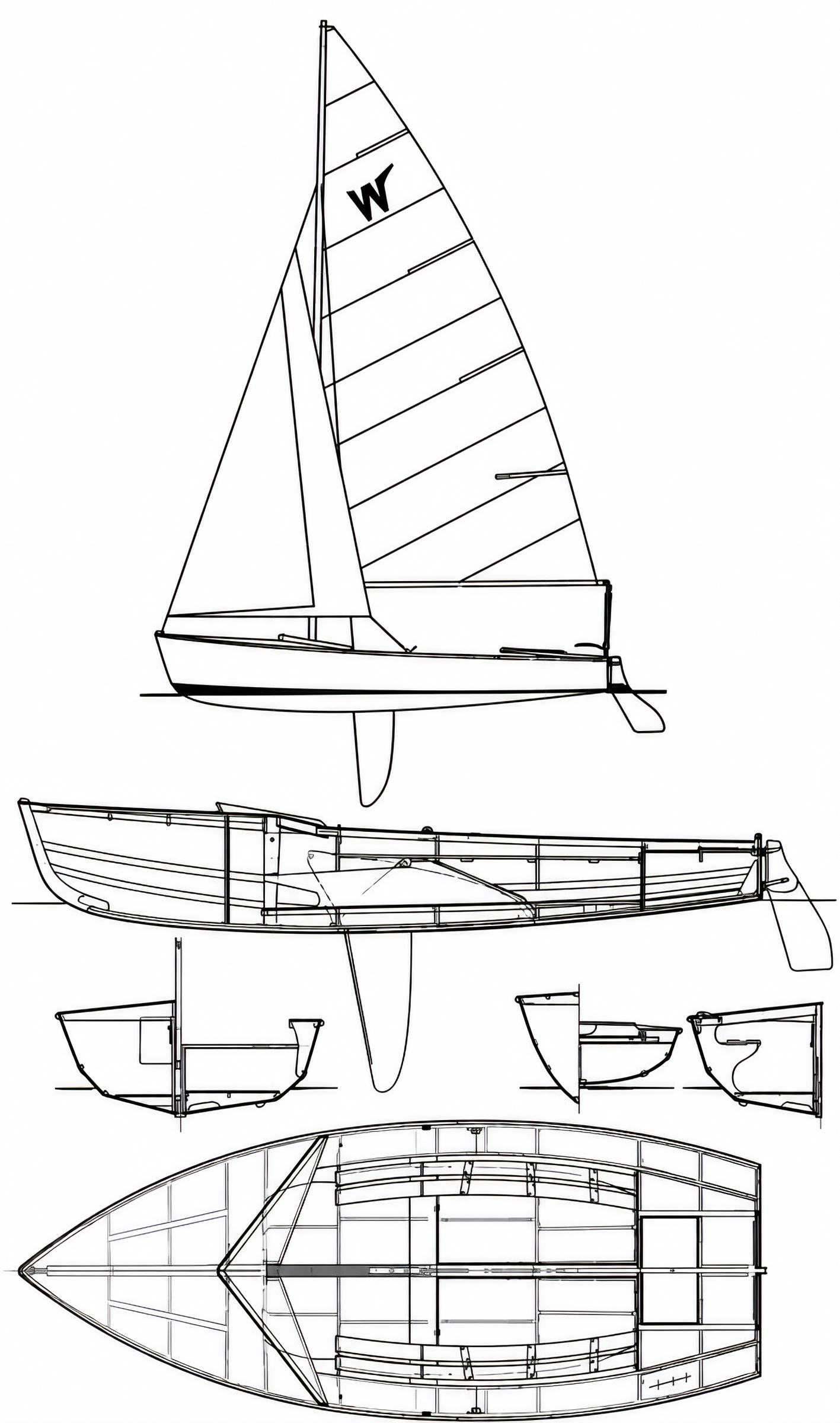
New Wayfarers are built in the U.K. by Hartley Boats, which currently offers the Trainer, Cruiser, Weekender, and Racer. Starting prices, including sales tax, range from £7,497.50 for the Trainer to £15,995 for the Weekender. There is currently no licensed builder in the U.S., but there are more than 1,000 Wayfarers sailing in the U.S. and a further 800 in Canada. Used boats for sale can be found through various online markets and on the U.S. Wayfarer Association’s Wayfarer Market page.
Is there a boat you’d like to know more about? Have you built one that you think other Small Boats readers would enjoy? Please email us your suggestions.
For more long-lived one-design sailboat classes see:
The International Optimist Dinghy, a sail-training-cum-racing dinghy for kids.
The Rhodes 19, a one-design keelboat designed by Phillip Rhodes.
Turnabout/N10, a much-loved kid-friendly, family dinghy from New England.


Join The Conversation
We welcome your comments about this article. To include a photo with your remarks, click Choose File below the Comment box.