Talk to anyone who has spent time working on small boats, and you will eventually hear the adage that you can never have enough clamps. We have our shop favorites and have learned that beyond quantity, clamp quality is essential. Many decades ago, we were given two Jorgensen Steel Bar Clamps, and from those we have slowly grown our collection to about 30 clamps from Jorgensen—now named Pony Jorgensen.
The Adjustable Clamp Company was founded by Danish-American inventor Hans Jorgensen, Adele Holman, and Marcus Russ in 1903, and has been making clamps and other hand tools ever since. The Pony Jorgensen Steel Bar Clamp has earned a favored spot in our shop because it offers a good balance of strength, speed, and reliability.
 Photographs by the authors
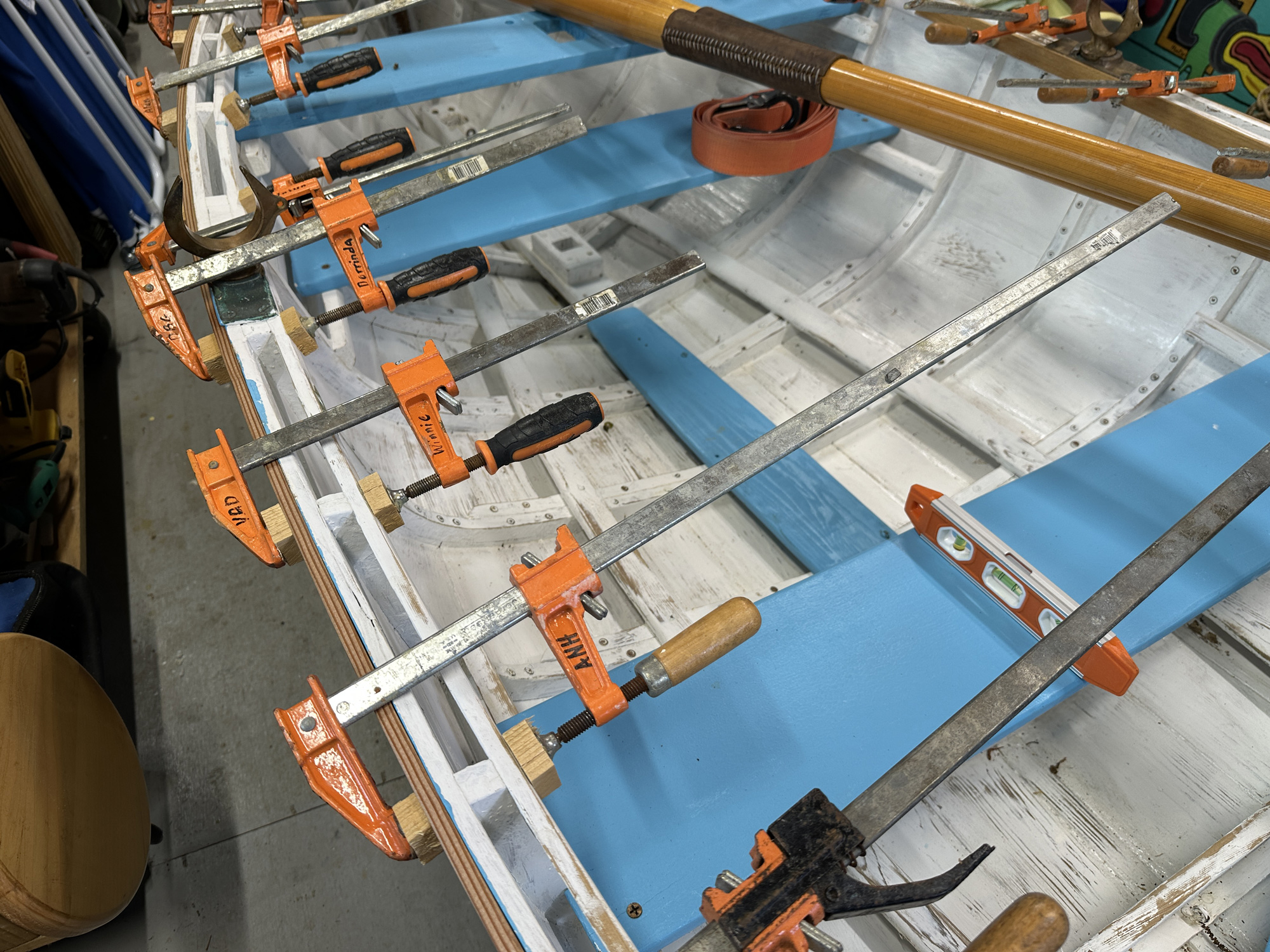
The Pony Jorgensen steel bar clamps come in light-, medium-, and heavy-duty ranges and in a variety of lengths. While we have clamp opening lengths from 6″ to 36″, all are in the medium-duty range with a maximum clamping force of 600 lbs. The two wood-handled clamps, nearest the camera, are older Jorgensen clamps; beyond the handles, little has changed between the old and the new, and we continue to be happy with the tools.
Pony Jorgensen Steel Bar Clamps come in Light-Duty, Medium-Duty, and Heavy-Duty, and range in size from the smallest Light-Duty with a maximum opening of 4″, a reach of 2″, and a clamping force of 300 lbs, to the largest Heavy-Duty with a maximum opening of 36″, a reach of 3″, and a clamping force of 1,000 lbs. We use clamps in the Medium-Duty range, which have a maximum opening ranging from 6″ to 36″, a reach of 2 1⁄2″, and a clamping force of 600 lbs. The shorter clamps tend to get more use as they fit into tight spots and don’t create an overhang hazard in the shop, but from time to time we need a longer bar to span a gap. The Medium-Duty clamping force is more than enough for our laminating with modern thickened adhesives, which work best when not glue-starved by excessive pressure.
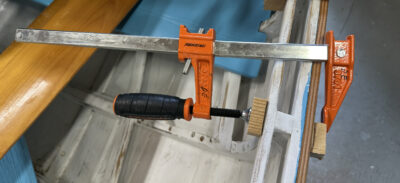
The clamps are solidly built with a high‑carbon steel bar, and a cast‑iron jaw and arm powder-coated in Pony Jorgensen’s customary orange. They provide rigid, dependable pressure when pulling joints together. In all the clamp sizes, one edge of the bar is notched along its entire length with small ridges. These provide grip for the spring-loaded, hardened-steel multiple-disc clutch plates that lock the sliding arm securely in place when clamping pressure is applied. When laminating frames or clamping parts together, we have confidence that nothing is going to shift once the clamps are tightened, and we rarely have reason to use the full clamping force. The head of the sliding arms accommodates a cold‑drawn acme-threaded steel screw that has a large easy‑grip rubber handle and swivel pad.
Of course, brute force isn’t everything. Much of our work on small boats involves curved surfaces, awkward angles, and pieces that require some light pressure while an adhesive sets or a permanent curve takes shape. At such times, the swivel head and spring-loaded clutch really help. We can quickly position the clamp and tighten it down without fuss. We have come to appreciate this efficiency, especially when using thickened-epoxy adhesives, when working time is limited.
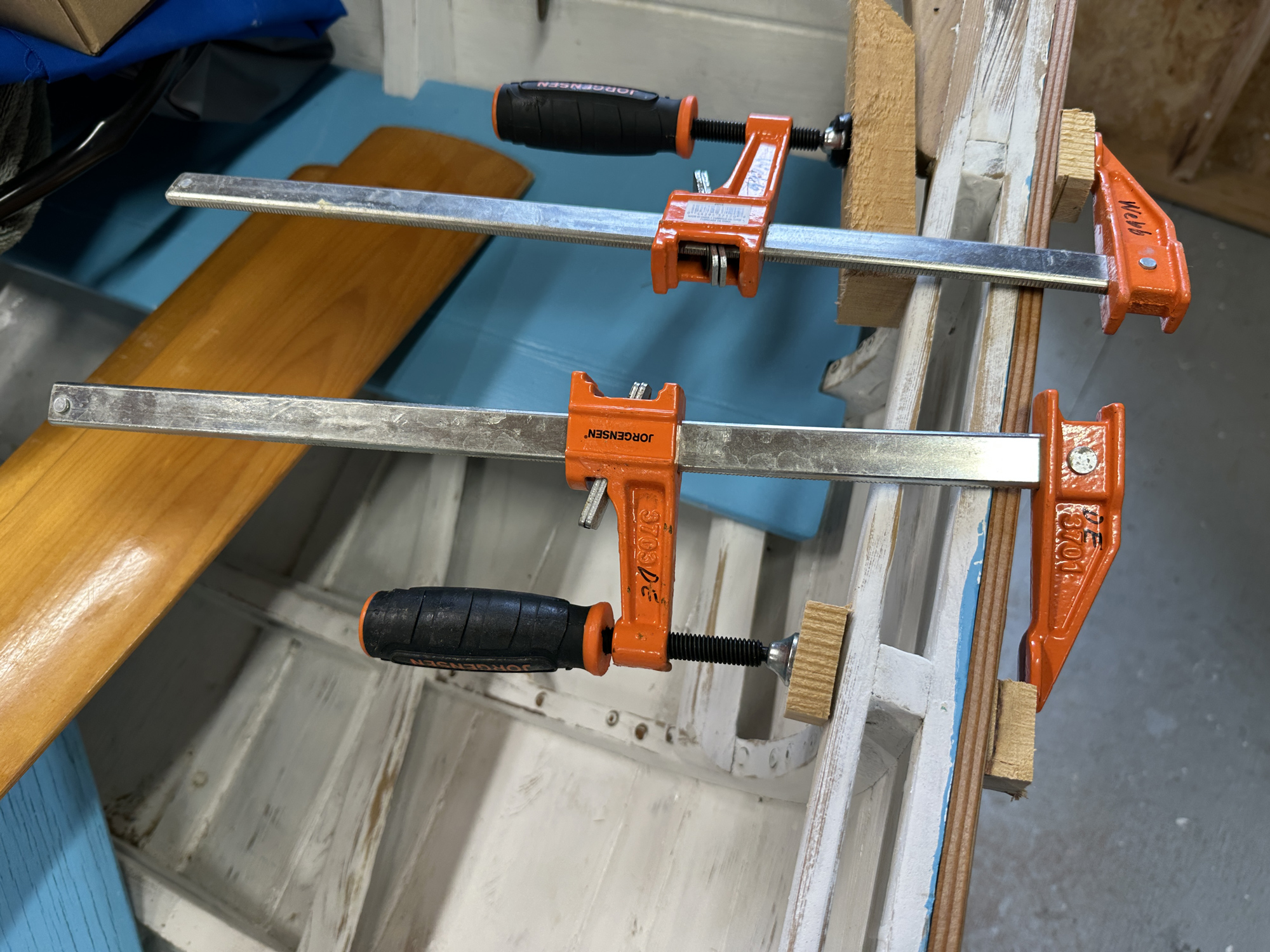
The Pony Jorgensen clamps come with removable (and replaceable) plastic swivel pads, as can be seen here on the top clamp. These pads protect surfaces being clamped and prevent adhesives from bonding the clamp to the surface. However, even when we have the pads in place we still use scrap-wood pads to protect our work.
Clamping often presents the challenge of needing a third hand: two to operate the clamp, one to position and stabilize the parts to be clamped. However, with practice, the Jorgensen clamps can be operated with one hand so that a lone worker can both tighten the clamp and hold the pieces to be secured. When clamping a long piece—such as a gunwale—we have found that best practice is to loosely stage multiple clamps along the joint and then tighten them gradually to spread the pressure evenly. The latest generation of Pony Jorgensen clamps have swivel pads protected by removable (and replaceable) heavy-duty plastic, which helps to avoid damaging softer woods and prevent epoxy adhesives from bonding the clamp to the boat. Our older wooden-handle versions of the clamps have no such protection, so we are in the habit of placing scrap pads or thin blocks between the clamp’s metal pad and the work—a simple step that prevents damage to the wood’s surface.
We have found these clamps most useful when working with straight or moderately curved assemblies, such as gunwales, bulkheads, and frames.
Overall, the Pony Jorgensen Steel Bar Clamps are dependable tools for a reasonable price. They are versatile and strong, and fit perfectly into the day‑to‑day adventure of small-boat repair and construction.
Audrey and Kent Lewis mess about with small boats in the Tidewater region of Virginia. Their clamping adventures are logged at smallboatrestoration.blogspot.com.
Pony Jorgensen Steel Bar Clamps are available from multiple online outlets and hardware stores. They range in price from $9.98 for a single 4″ Light-Duty clamp to $64.99 for a two-pack 36″ Heavy-Duty clamp.
Is there a product that might be useful for boatbuilding, cruising, or shore-side camping that you’d like us to review? Please email your suggestions.
Looking for a different type of clamp? How about:
4-Way Clamping System, a system that saves time on wide glue-ups, reviewed by Josh Anderson.
PVC Spring Clamps and a Tool for Applying Them, simple clamps made more useful with reverse-action pliers, described by Christopher Cunningham.
A Cam-Lever Planking Clamp, a new take an old tool, devised by Christopher Cunningham.




Join The Conversation
We welcome your comments about this article. To include a photo with your remarks, click Choose File below the Comment box.