When Kippen Briggs was 10, he took sailing lessons on Schwatka Lake near his home north of Whitehorse, Yukon. Once a week through the summer, he and his friends would go out in Optimists (and later Lasers) to learn the basics of sailing. By the end of the season, he had decided he wanted his own boat—something large enough to hold a couple of people comfortably and with some space for storage. It should be a sailboat but a sailboat that could be rowed and take a small outboard motor. He had been reading Jim Michalak’s book, Boatbuilding for Beginners (and Beyond), and thought the Mayfly 14 would suit his needs. It’s a simple hard-chined flat-bottomed boat designed to be built out of five 4 × 8 sheets of plywood on a temporary form with two plywood bulkheads, solid-wood stem, chine logs, and gunwales. He brought the idea to his grandfather, Ken.
 Photographs courtesy of the Briggs family
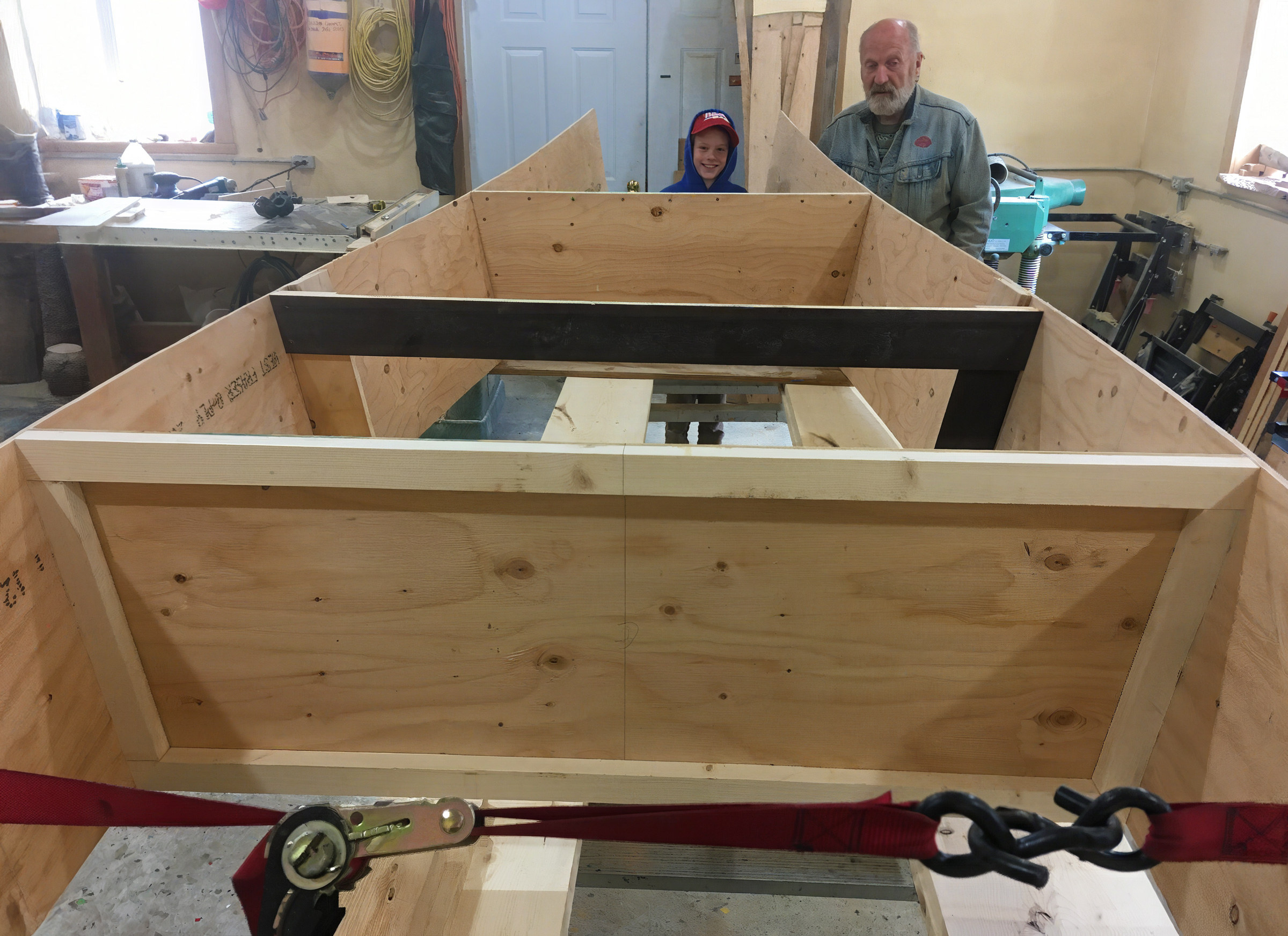
The two side panels were temporarily screw-fastened to the central form, and then glued and screwed to the forward and after bulkheads. To bring the panel ends into the stem and transom, Ken and Kippen used a ratchet strap.
Ken has always enjoyed building—he and his wife have built multiple log houses and have lived in one of them since 1975. He has passed his love of woodwork on, first to his son Bernard (Kippen’s father), for whom Ken built a lathe, and then to Kippen who was about nine when he started using the lathe with Ken. “He makes small wooden gifts for the family,” says Ken.
“We discussed the boat over the winter of 2023,” Ken continues. “It would be a weekend project. It was Kippen’s boat—he was then 11 years old—and I made a point of not doing any part of the build completely on my own.”
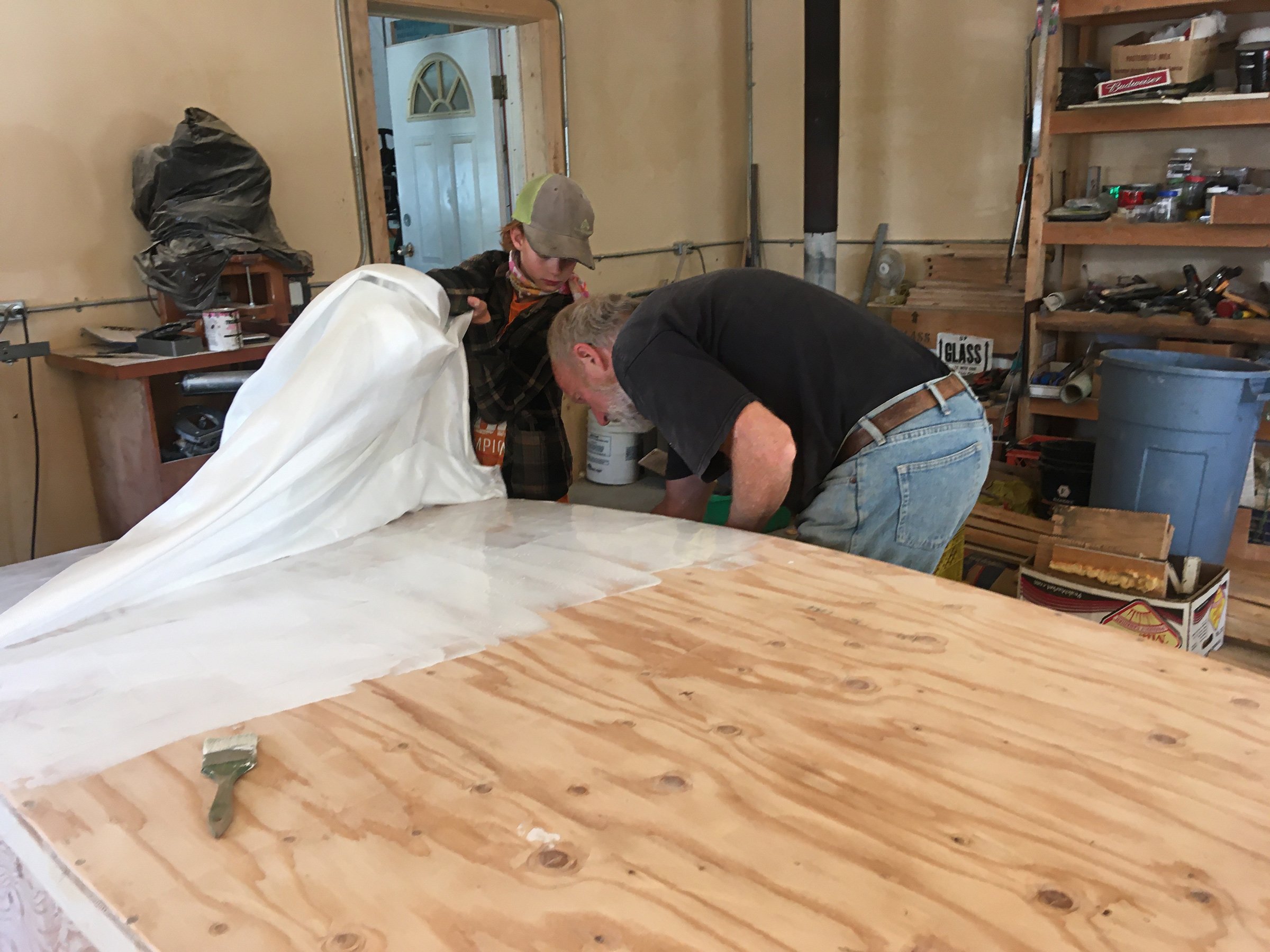
The bottom was fashioned out of two plywood sheets butted together. It was finished with a layer of epoxy-saturated 12-oz fiberglass cloth.
Ken and Kippen worked together through the setup. “We started by purchasing a new 10″ cordless miter saw. I figured that if Kippen was going to use it, he might as well take it out of the boxes and put it together. I planed some rough lumber while he figured it out and got it operational, and then he cut some lengths of 1 × 8 boards that he would mark out for the forms.”
Cutting the wood and plywood, says Ken, was fun; checking and rechecking the plans less so. Ken stressed the importance of accuracy but allowed Kippen the experience of working through trial and error. He laid out the five forms—two temporary, two permanent bulkheads, and the transom. It took four attempts to get it right. “He wasn’t too discouraged when we sanded off all his pencil marks and started again,” says Ken. “And in the end, he laid out near-perfect lines for the wood forms.” To cut out the parts they used a bandsaw. It was another teaching opportunity for Ken: “Kippen learned to cut close to the outside of the line and then to take the wood down to the line with a disc sander.”

Once the bottom had been finished, the gunwales and chine logs fitted, the boat was returned to upright. Ken and Kippen took a moment to admire their work before moving on to constructing the decks. In hindsight, says Ken, they should have painted the boat’s interior at this stage, when it was all still open and easily accessed.
The simple boat demanded simple materials. For the hull panels Ken and Kippen agreed on construction-grade plywood. They would sheathe the bottom panel with fiberglass cloth and epoxy, but the rest of the boat would be simply primed and painted. For the bottom, transom, and deck panels they used 1⁄2″ plywood, while the sides were 3⁄8″. For the dimensional lumber they used locally grown spruce cut into 12′-long 1 × 8 boards on Bernard’s sawmill and then run through the thickness planer in Ken’s shop. The lumber came from the family firewood pile. “Some years ago,” Ken explains, “the Yukon Territory was infested by spruce-bark beetle and many square miles of spruce trees died. I purchased a B-train logging trailer’s worth of 50′ logs, which I cut as we need them to heat our home and fire the cookstove. We’ve also used them to build things: log cabins, furniture, even a strip-planked canoe. Now Kippen was using the wood for his boat, spars, and oars.”
Construction started right-side up so that Ken and Kippen could see the true shape of the hull as it came together. They had cut all the parts, marking the centerline on the forms and bulkheads, and the form locations on the side panels. Now, they clamped one of the side panels to the ’midships form, then temporarily screwed it top and bottom before repeating the operation with the opposite side panel. They then lifted the three joined pieces onto two sawhorses. Next, Ken and Kippen took a ratchet strap and, looping it around the two facing side panels, pulled the ends into each other—first at the stern, then at the bow. As the ends came in, they glued and screwed the sides to the bulkheads. Finally, the transom and stem were glued and screwed in place. “It went pretty quickly,” says Ken. “We managed to get it done in a weekend; it was exciting.”

Kippen and Ken made the sail out of poly tarp; they reinforced the edges with 1″ ratchet-strap webbing.
With the side panels in place and permanently fastened, Ken and Kippen carefully turned the boat over to install the gunwales, the chine logs, and the bottom—preassembled and cut from two sheets of plywood butted together. While the boat was still upside down, they coated the bottom with 12-oz fiberglass cloth and epoxy resin.
When they returned the boat to upright, Ken says, “it looked like it was almost finished! Little did we know that there was still a lot of work to do.” They mixed epoxy and sawdust for filleting the chine logs and all the interior side-to-bottom and -bulkhead joints; filled all the screw holes, and sanded for hours. They cut the decks to shape and glued and screwed them in place. Kippen cut and installed the raised hatch frames and the covers. “Then there was the leeboard and its framework, the rudder…even the tiller was a good little project. Kippen and I painted the boat together, including the inside of the lockers in the bow and stern. Unfortunately, we didn’t think of painting those until after the decks had gone on. We won’t make that mistake next time!” Kippen decided to varnish the hatch covers and stem and, adding a touch of flare, burned the image of a spruce branch and cone into the forward face of the stem. Over the course of two weekends, they fashioned the mast and spars from laminated 1 × 8 spruce—“a lot of sawing, planing, and sanding.”

The moment of truth: Ken and Kippen launched EMMA on a local pond on a day of light winds, but she performed well under motor, oar, and (ultimately) sail.
Finally, they made the sail. “We used a poly tarp and reinforced the edges with 1″ ratchet-strap webbing. Kippen set grommets where needed. We reinforced the corners and reefpoints—there are eight layers of material. We used Kippen’s mother’s sewing machine and were surprised that it was all we needed. All the seams are zigzag stitched.”
As the project neared the end the family discussed names for the boat. It was Kippen who suggested EMMA. “We had an unstoppable little German Shepherd, Emma. She and Kippen had grown up together and only he could keep up with her. The year we built the boat, she was killed on the highway. We all instantly agreed with his choice.”
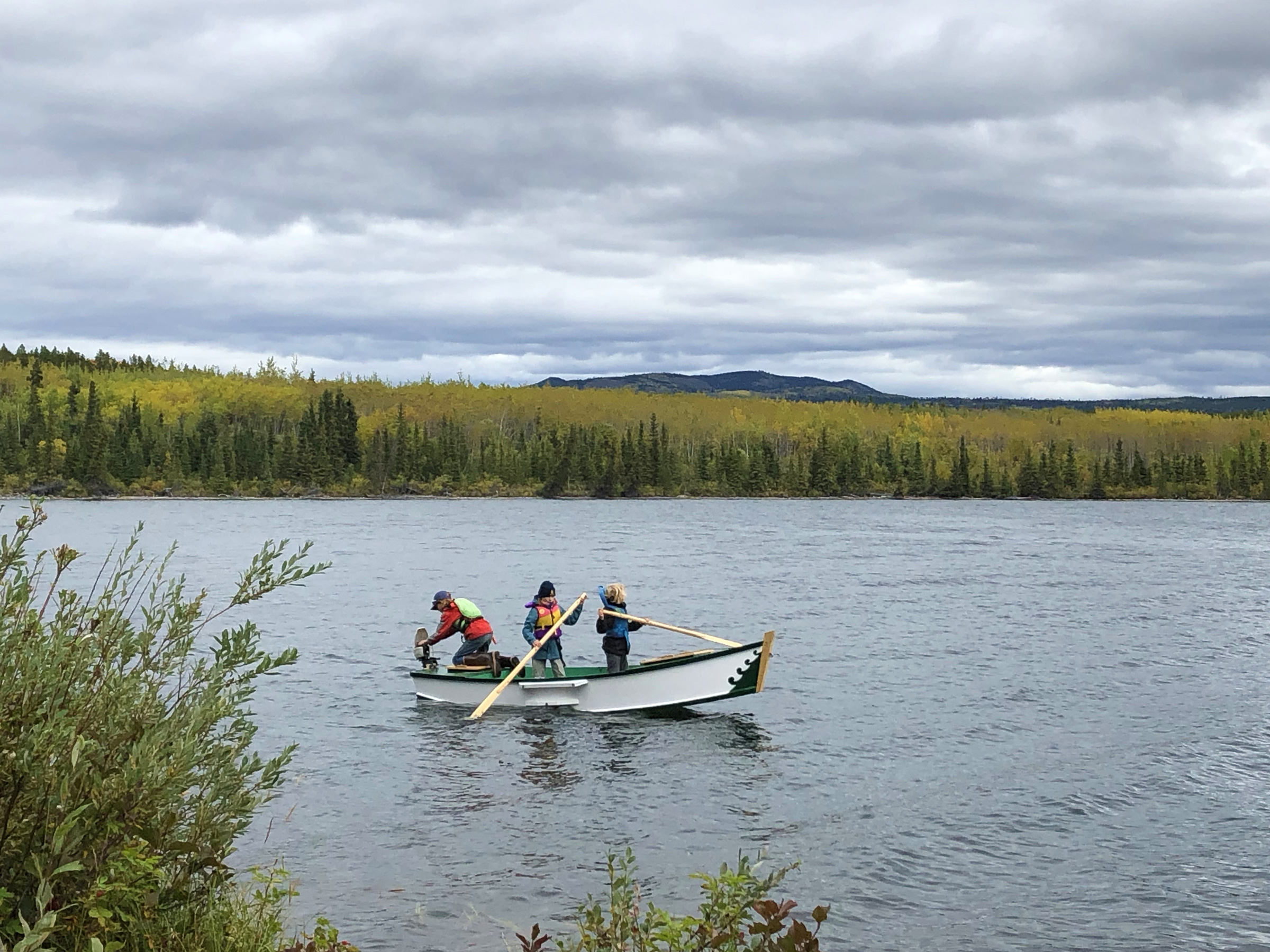
When Kippen saw the Mayfly 14 design in Jim Michalak’s book, he decided it would be the boat for him. The summer after he and his grandfather built EMMA, Kippen and his friends took to the waters of the Yukon and used her just as he had imagined.
EMMA was launched on Father’s Day, 2024, on Shadow Lake. “It’s not much more than a small northern pothole lake, but it served us well for a shakedown cruise. We motored first—Kippen has a 2-hp outboard that he mounts on a board locked into the rudder fittings; he sits on the afterdeck to operate it. Then we rowed—not quite as fast as with the outboard, but it’s good to have oars. And then we sailed.” They reached, came onto the wind, tacked a few times—EMMA coming about nicely—and then ran for home with the sail all the way out to starboard. “We came back with great big smiles,” says Ken. “We’d set out, two boatbuilders; we returned, two sailors.”
Jenny Bennett is editor of Small Boats.
Do you have a boat with an interesting story? Please email us. We’d like to hear about it and share it with other Small Boats readers.
Wonderful story! I am building a Puddle Duck Racer (PDRacer) with 5 of my grandchildren. We are planning to launch as a rowboat this summer. We have finished the oars, sail (out of polytarp) and are working on the rudder, tiller, and leeboard. We still need lumber for the mast and boom.
Great to hear Donald. Good luck with the rest of the build and the launching. Let us know how it goes.