After 33 years in the Canadian Army, Jim Peverley was ready for a challenging retirement project. He had grown up with boats. His father bought the family’s first boat—a 12′ cedar-strip, fiberglassed skiff with oars and a 2-hp Johnson outboard—when Jim was just six, and from a young age Jim was allowed to take the boat out on his own to explore Lake Wendigo, a small body of water in the Timiskaming District of Ontario northwest of Ottawa, where the family had a cottage. The experience introduced a sense of freedom that can only be found by a boy in a boat. Family boats grew in size—first there was a bigger cedar-strip boat, then an aluminum skiff, and somewhere along the line, a houseboat—but the original skiff never left, and, indeed, Jim still has it, albeit stripped of its hardware and definitely no longer seaworthy. But, despite his early experiences, the nomadic life of a career soldier was not compatible with boat ownership until—finally—Jim and his family landed in Ottawa and he realized he was going to be staying for good. That was when he bought his “forever boat”—an 18′ cedar-strip runabout. But before long his thoughts had turned from simply owning a boat to building one.
 Photographs courtesy of Jim Peverley
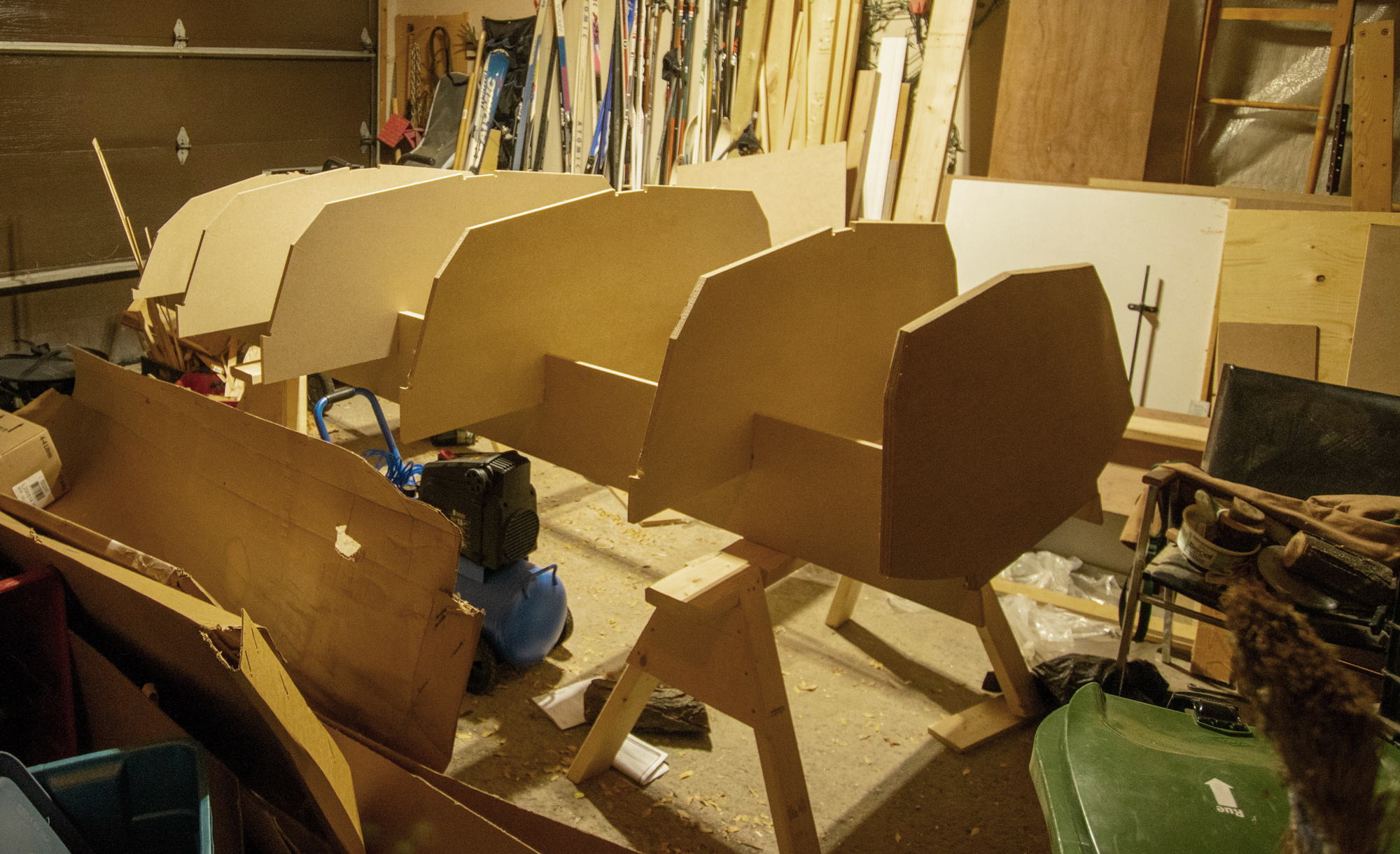
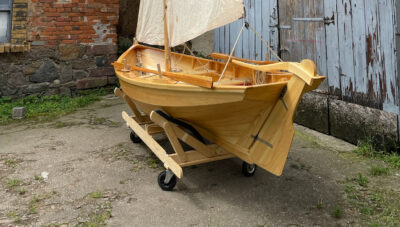
Jim built his Oonagh in the garage. Space was tight but he made it work. The makeshift shop wasn’t heated, so most of the work was done during fall and spring when the temperatures were warmer.
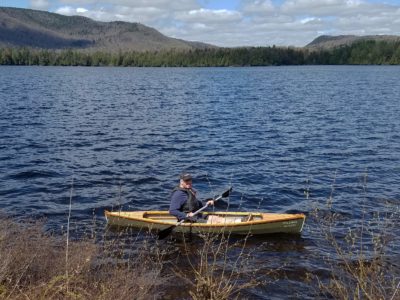
Jim’s first boatbuilding project was a Warren Jordan–designed Newt. An 11′ 3″ double-paddle canoe with a 30″ beam and 40-lb weight, the Newt was an ideal first-time build. But, wanting also to learn to sail, Jim soon added a ketch rig, and created what he describes as a “tiny sailing canoe.” Looking back, he says, “It wasn’t a very good sailboat, but I just wanted to see if I liked sailing. Turns out I did!” Several years later, even as he continued to enjoy the Newt and its somewhat challenging sailing qualities, Jim also built a Dave Gentry–designed skin-on-frame Wee Lassie canoe, stretched from the original 10′ 6″ to 11′ 6″.
Then, in 2020, at the height of the Covid pandemic, Jim began considering a more ambitious build. He was, he says, looking for something more substantial, a boat that wasn’t just for singlehanding but which he could use for family sailing with the grandchildren, maybe even for some camp-cruising on the waters around Ottawa or on Lake Wendigo (where the family still has a cottage). His wish list was neither long nor complicated. The boat must sail, be relatively stable, large enough to accommodate two adults or one adult and two children, but small enough to be built in Jim’s garage. He settled on the Oonagh, an 11′ 8″ lugsail pram designed by Doug Hylan and described on the Hylan & Brown Boatbuilders website as “a fine boat for family sailing, fishing trips, or just an evening row with the kids.” It could have been designed just for Jim.
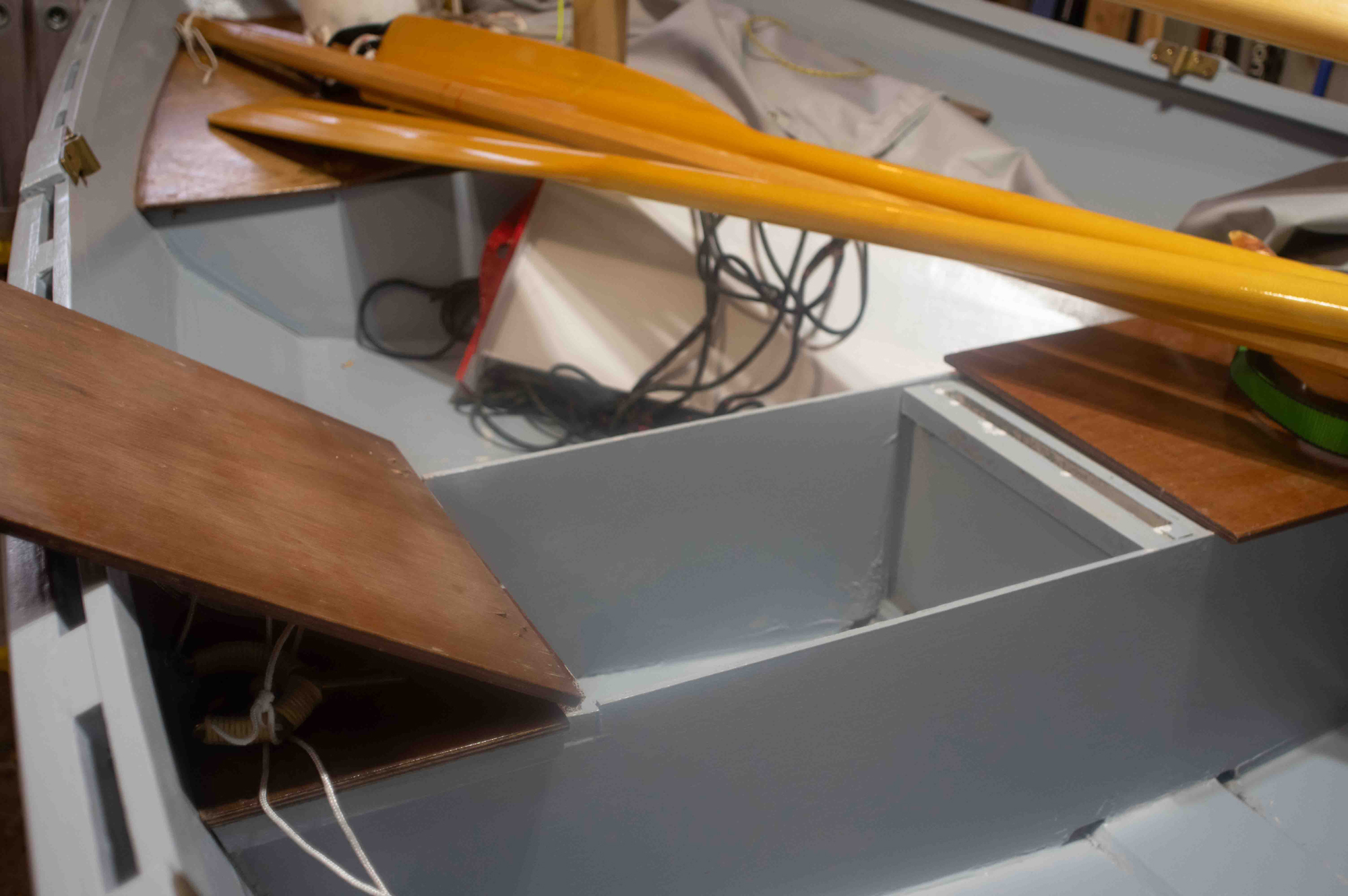
All the seats—foredeck, ’midship thwart, and after deck—double as built-in lockers, giving the boat a good deal of storage space and minimizing clutter. The bow and stern lockers also provide buoyancy. In his first season Jim hadn’t decided how to latch and seal the ’midship seat lids in order to keep everything contained and dry if he should ever capsize.
Oonagh is available for home building from plans or a CNC kit from Off Center Harbor, and there’s a series of how-to videos also presented by OffCenterHarbor.com. Jim decided to go ahead and order the kit, which is when the first complication arose. Because of the pandemic and the associated cross-border travel limitations, Jim discovered he couldn’t get a kit from Maine. He reached out to Off Center Harbor which, in turn, helped him source a Canadian company that could CNC-cut the kit’s plywood parts. Jim placed the order. “The only difference in my kit compared to the Off Center Harbor kit,” he says, “was that I had to cut the bevels for the scarf joints.” Then he discovered that the registration holes that would have been cut in the Off Center Harbor kit, to ensure alignment of the planks, were also missing. The Maine-based company helped out again, and shipped some Mylar patterns that Jim could use instead.
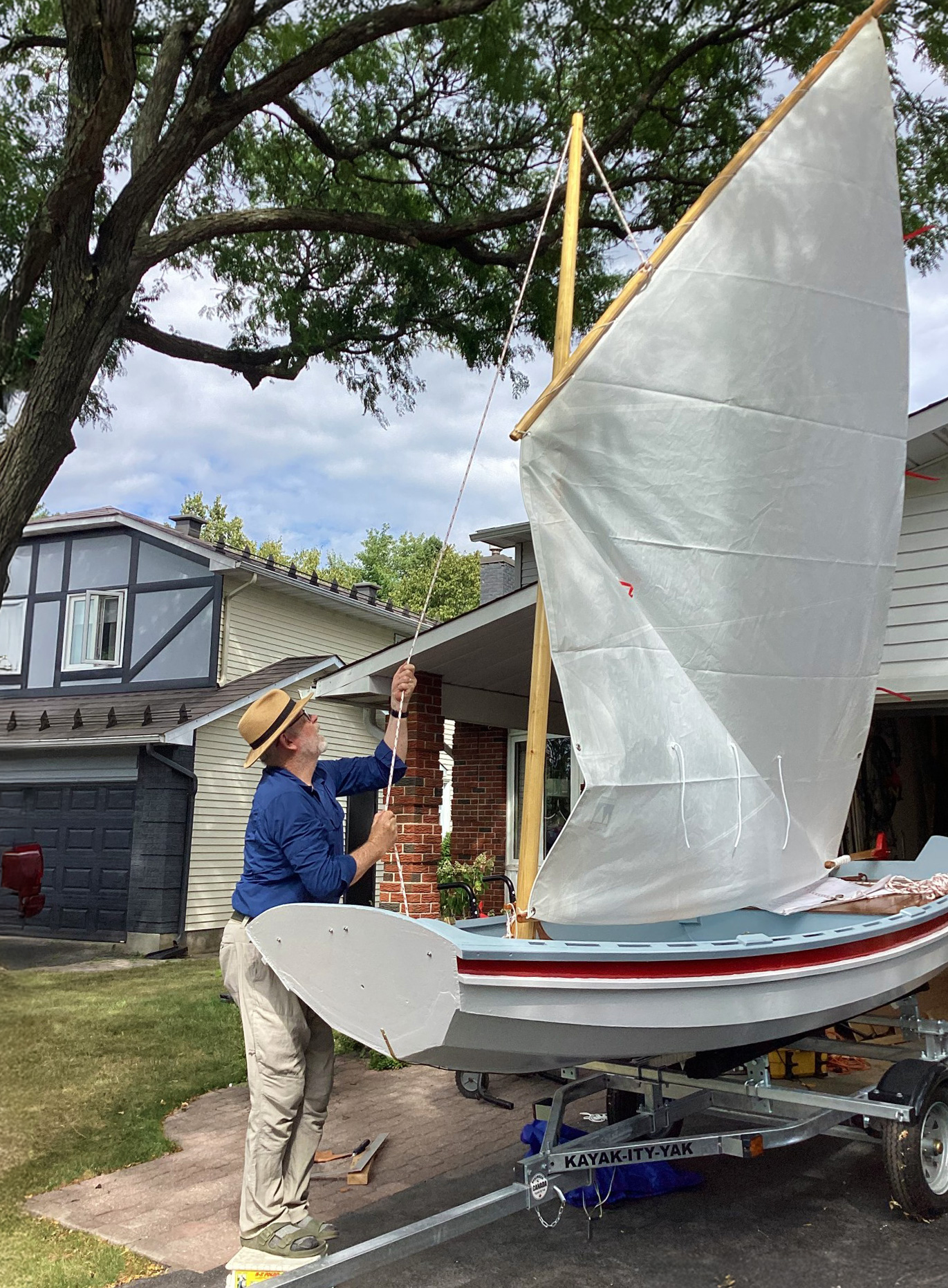
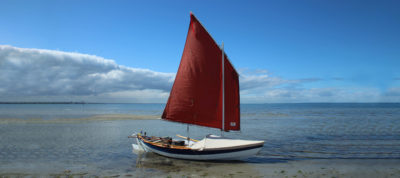
With every build there are milestones: finishing the hull, turning it over, completing the fit-out, applying the paint and varnish, and then the day when a boat first emerges into the driveway. Raising the sail for the first time, Jim keeps an eye on the halyard lead. The standing lug rig has a single halyard, sheet, and downhaul.
A standard Oonagh kit comprises only the plywood elements of the hull; everything else, says Jim, was built from scratch following the plans and using materials he sourced himself. It was, he says, a good hybrid process, but he was grateful for the video series: “I’m not sure my boatbuilding skills would have been adequate without that additional instruction,” he says. And, indeed, he enjoyed the challenge of finding the materials. “It was a pleasant search through many suppliers—Fairwinds Fasteners in Rhode Island for all the fastenings, Douglas Fowler in upstate New York for the sail, rudder-mounting hardware and keel half round from The WoodenBoat Store in Maine, oars and oarlocks from Barkley Sound Oar and Paddle in British Columbia, and the epoxy, paint, and rope from a local marine chandlery. It says something about the boatbuilding community,” he says, “that every supplier was a pleasure to deal with and very responsive to my needs.”
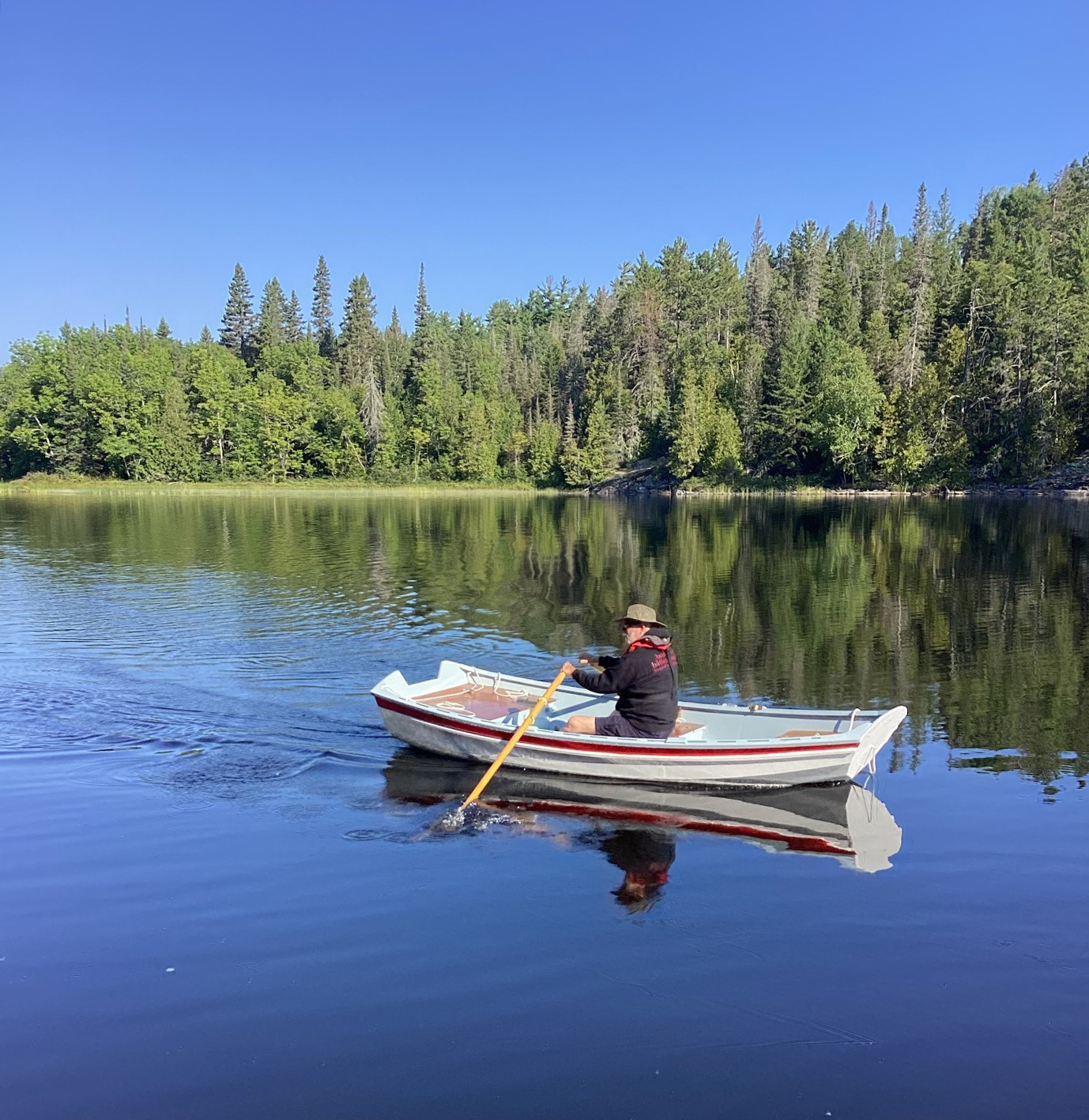
The Oonagh has two rowing positions, making it a versatile boat for multiple passengers. On the day of launching, Jim put THISTLE through all the paces: sailing, rowing, and even doing some rudder-sculling to get her from the public launching ramp to the family dock.
And then there was the wood. For the hardwoods Jim used in the keel, skeg, and rails, he found what he needed at a local specialty lumber store, but for the spars he had to look elsewhere. “Early in the build I started haunting the ‘two-by’ section of the local lumber store in search of pieces long and clear enough to make the spars. One evening I found a piece of spruce 2×10, 12′ long, and almost knot-free. Grabbing that and running for the cash register with my future mast in hand felt like a big win.” On a subsequent visit to the same store he found a 2×12 piece, similarly clear and straight-grained. But, he says, it had “an orange hue, which led me to believe a piece of Douglas fir had found its way into the shipment of spruce.” It would serve for the yard and boom.
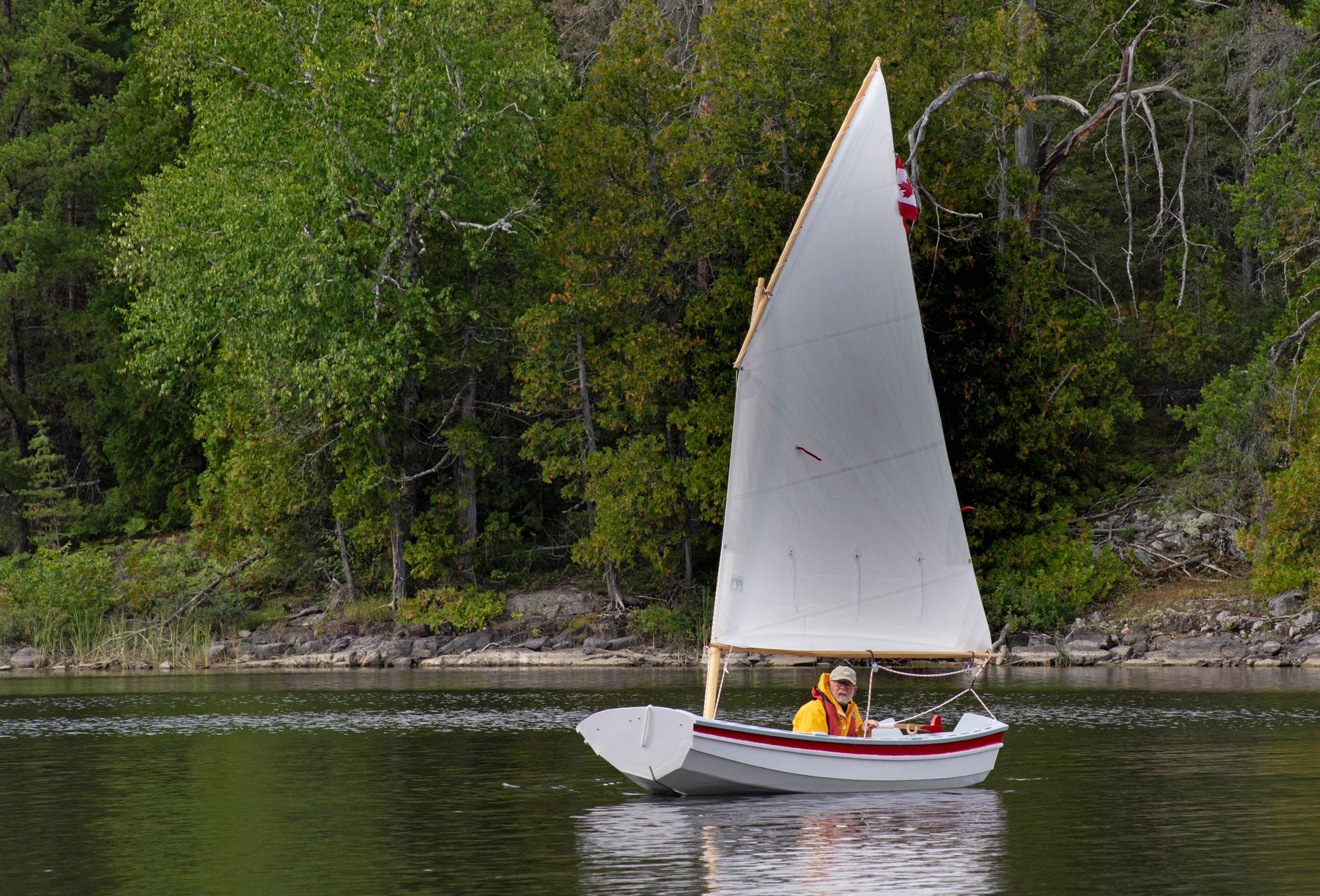
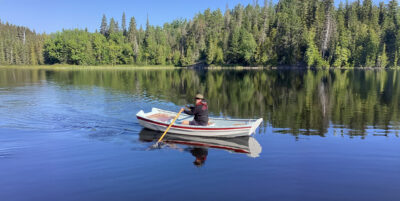
Sailing singlehanded Jim sits in the bottom of the boat aft of the thwart. But, he says, there’s plenty of room for passengers, and he looks forward to going out with his grandchildren this summer.
Jim built the boat in the garage alongside his home in Ottawa. Progress was slow but steady. The project was protracted, he says, partly because having no heat in the workshop during the long, cold Ontario winters meant he could do little between fall and spring. Then came the post-retirement contract work and other distractions that kept him away. And, each summer, he and his wife left Ottawa and headed to the lake cottage to use the boats they already owned. If he’d had heat over the winter months, and no other commitments, Jim believes he could have built the boat in a year. As it was, it would be four years to the day between receiving the kit and launching.
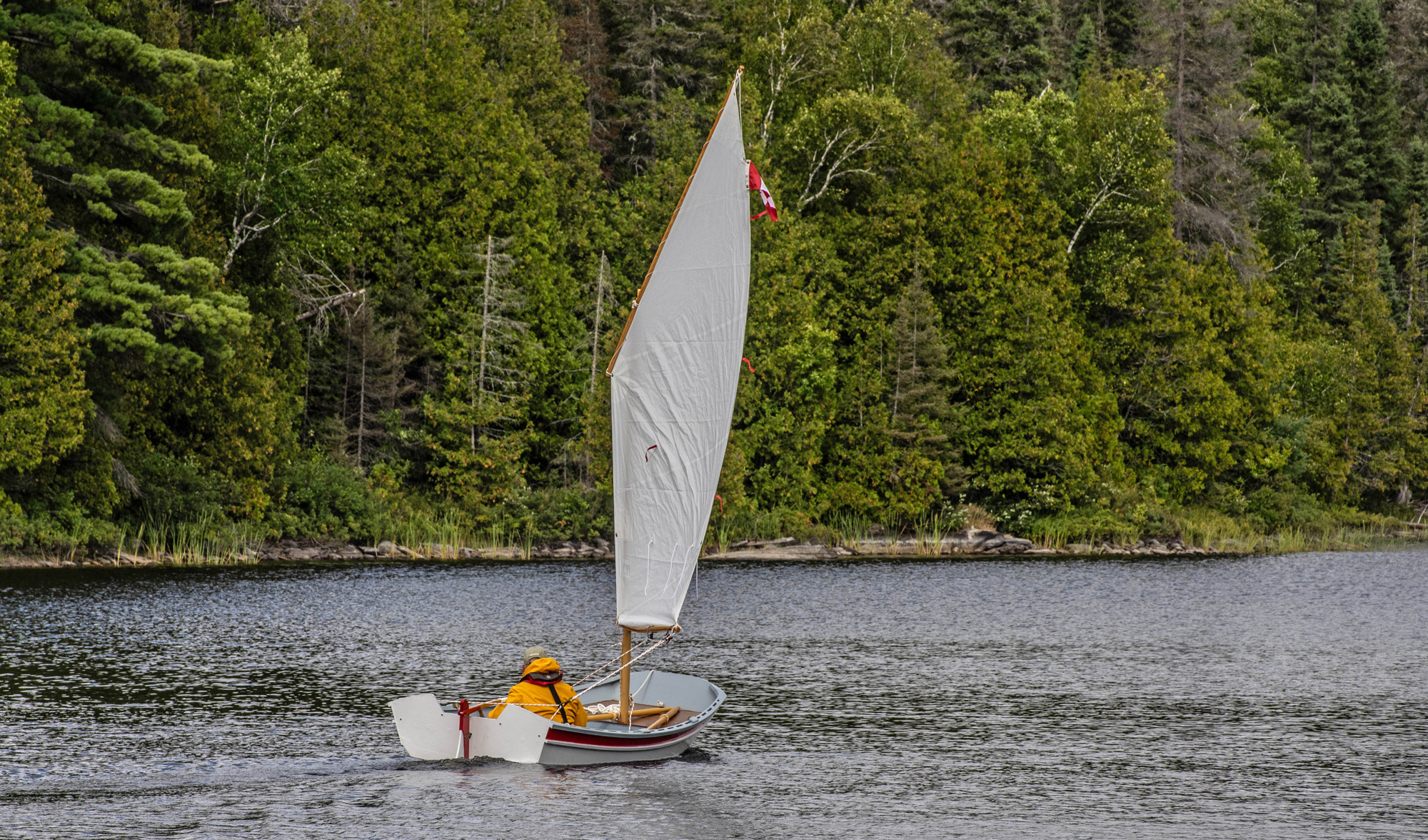
Jim has sailed THISTLE in wind strengths up to 25 knots, and she has handled them all. In light airs she glides along, and if the wind drops too much Jim moves from the bottom of the boat to the ’midship thwart and rows home.
September 1, 2025, THISTLE slipped into the waters of Lake Wendigo. “The weather was glorious, although the winds were a bit on the light side,” recalls Jim. “The trip from the launching ramp to the family dock was in flukey, light airs that required a bit of rowing as well as some sculling with the rudder to get there. But she didn’t leak.” Since that quiet day, Jim has used THISTLE in all kinds of weather. She has sailed, rowed, been out on a day “when the wind was gusting 25 and THISTLE flew along at over 5 knots, according to the GPS on my watch.” He is, he says, thrilled with the results of his labor. “Building a boat is all about correcting the various mistakes you make along the way. I didn’t build THISTLE to yacht-like standards, but she’s sturdy and pretty and will see much use in coming years both for myself and for my granddaughters. I discovered that building the boat was itself a fun and challenging journey that, in retrospect, was as rewarding as I anticipate sailing her will be.”
Jim’s glad he didn’t build from a more complete kit, as it allowed for some individual additions—somewhere in THISTLE is a bronze screw taken from the boat his father bought when Jim was six—but he’s already talking about building a second boat and isn’t averse to the idea of a kit. “I have the plans for a Footloose sailboat from Jordan Wood Boats, but there are also a couple of kit boats that I like the look of, like Bill Thomas’s Fox Canoe. So, who knows? There are so many boats!”
Jenny Bennett is editor of Small Boats.
Do you have a boat with an interesting story? Please email us. We’d like to hear about it and share it with other Small Boats readers.
For more designs from Hylan & Brown, see:
Beach Pea, a double-ender based on the Maine peapod type, by Matthew P. Murphy.
The Point Comfort 18, a marine-plywood outboard skiff with the lineage of a Chesapeake deadrise skiff, by Robert W. Stephens.
The Ben Garveys, a range of stable, marine-plywood boats for work and play, by Mike O’Brien.



Nice!