To build a boat is truly a breathtaking achievement, mastered by a special breed of people. But when I reached the point in life when I wanted to “build” my own boat, I quickly seized upon the benefits of innovation and the technology of precision-cut CNC components brought together by epoxy and the stitch-and-glue process. I would assemble a boat rather than build one.
After months of intermittent reading and ruminating, I settled on the Chesapeake Light Craft (CLC) Annapolis Wherry Tandem. The boat can be used for fixed- or sliding-seat rowing, can accommodate a single rower or two, and is beautiful in all respects. The design is based on the 19th-century working livery wherries of England’s River Thames, and the folks at CLC produce CNC-cut planks of marine-grade plywood to echo the originals’ lapstrake hulls. CLC’s interpretation is a safe and swift boat in which to stay fit on the water, and to carry a passenger for the day or gear for a week. CLC’s owner and designer, John Harris, has refined the wherry design into a true masterpiece of precision parts ready for assembly.
 John Carey
 The Wherry’s length of 19′ 10″ does mean that it overhangs an average family car, but its hull weight of 90 lbs makes it suitable for car-topping. A canoe loader/support mounted in the trailer-hitch receiver provides more stability and support for the Wherry than the car’s closely-spaced factory roof racks can.
When searching for a boat to build/assemble, if at all possible, try an example before you write the check. Yes, you can read endlessly, and you should. But the rowing community is out there and often willing to meet up. I have had my boat for seven years and have encouraged many interested people to take it for a spin. CLC understands this. When I was still looking, I stopped by their display at that year’s WoodenBoat Show in Mystic, Connecticut, and they allowed me to “test-drive” several boats. The first few strokes in the harbor and the first slow row out to the drawbridge and back in an Annapolis Wherry sold me. All I needed to do was purchase an Annapolis Wherry Tandem kit, which could be loaded onto my car’s roof rack.

The all-inclusive kit
Unpacking the kit from its neatly arranged 8′-long box was the beginning of discovering a thoughtful design. With the exception of finishes and epoxy, everything is provided. No tools are needed beyond the basics—quite a few 3″ spring clamps, a palm sander, jigsaw, drill, and a flexible Japanese ryoba saw. The construction manual is superb, one of the best pieces of project documentation I have seen. It is a well-written sequenced narrative with useful photos, and lists of parts and materials; its pages are sturdy and spiral-bound. Who wants to refer to a tablet screen in the shop, or shuffle a pile of printed sheets while your warming cup of epoxy is waiting?
The CNC-cut okoume-plywood planks are in three pieces, each ending in a curvy puzzle joint that matches its corresponding mate. These joints are glued together to create the full-length planks and bottom panel. The frames, transom, and forward and after flotation-chamber panels are all cut with extreme precision and include tabs and slots for aligning the bulkheads’ angled joints, tiny holes for copper-wire stitches, and curved profiles. The assembly is straightforward and requires almost no fastenings. The planks, bottom, and transom are stitched together with a hundred or so copper-wire twist-ties—enough for the entire hull. While the original Annapolis Wherry was designed with a skeg and garboards that curve upward to meet the transom, the Tandem’s garboards are “boxed”; that is, they run straight to the stern and twist in their ends to meet each other vertically beneath the transom. The arrangement is self-aligning, adds volume and buoyancy, and gives the hull a tracking ability much like that of a double-ender. A small skeg on the Tandem further enhances the tracking and protects the garboards. The overlapping plank lands are filled, inside and out, with epoxy mixed with wood flour, to create extremely strong bonds when cured. When all the epoxy has cured, the wire ties are snipped away, and below the waterline the hull is sheathed, inside and out, in 6-oz fiberglass cloth and epoxy.
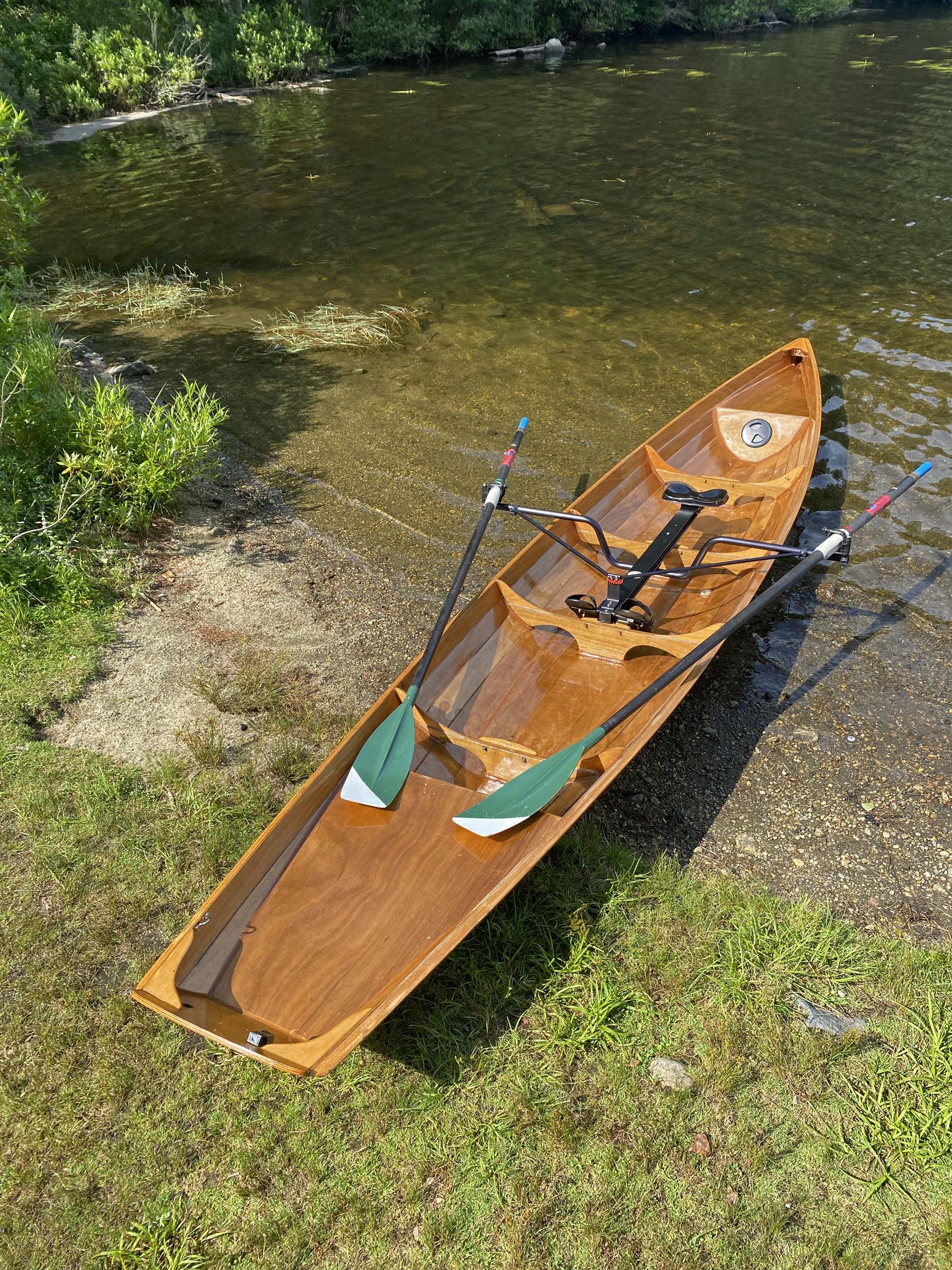
The only design decision that has to be made prior to installing the four structural frames is how you wish to row. While the frames are cut and profiled for specific locations, additional blocks must be installed to accommodate a sliding-seat rig. My wherry, NELI, has a drop-in Piantedosi rowing station (I borrow a second whenever I am joined by a rowing partner) that elegantly attaches to two cleats with two stainless-steel bolts and wingnuts. Many Annapolis Wherry builders opt to construct fixed-seat rowing stations with stretchers. The 119-page manual includes clear narrative and photographs on the steps required to accommodate either sliding-seat rigs or fixed thwarts.
 John Carey
The frames are cut for specific locations, regardless of whether the ultimate use will include fixed-thwart or sliding-seat rowing rigs. An extra block is attached to the forward face of each frame to accommodate the sliding-seat rig. Here, the Tandem Wherry is set up for a single rower. When two are rowing, this rig moves forward to the front two frames and a second is installed between the after two frames.
Closely following the manual and sticking to the described process rewards the builder with a boat ready for finish and hull paint. From unpacking to completion, the assembly took me 58 hours over the course of a month.
Moving the boat from the barn to home strapped to a station-wagon’s roof rack was a harbinger of great things. The bare boat without the Piantedosi drop-in unit weighs 92 lbs. Fully rigged with the unit installed and carrying carbon-fiber Macon-blade sculls, the wherry tips the scales at 114.5 lbs. Though I have carefully balanced and walked the boat on my (padded) head, and rolled it into knee-deep water a number of times, there always seems to be a person around who is glad to put hands on the stern and walk it to the water’s edge with me. CLC also sells a lightweight aluminum Trailex trailer, which is the perfect size for the boat. For now, my aim is cartopping to ponds, rivers, and shorelines, and garage storage on a custom-built wall rack. In my older years, I’ll spring for the trailer and cover.
The Annapolis Wherry in action
Having built the Wherry as a simple sliding-seat boat for one or two Piantedosi stations, I use the open space in bow and stern to carry gear. A cooler, PFDs, and a small battery-operated bilge pump—useful when rowing in ocean swells—are among the items I’ve carried. The two flotation compartments are large, and I installed a standard round hatch with cover in the bow compartment so I can use it for dry storage of the essentials. A similar hatch could be installed in the stern, but for now I have left it enclosed. Many owners create clever and comfortable passenger setups in the stern—and there is plenty of room to do so.
 Robert Englehardt
I am 6′ 5″ and weigh more than 200 lbs but have found rowing the Wherry comfortable and stable. While rowing with a smaller partner—as I am here with University of Massachusetts varsity oarsman Luke Shamaly—the Wherry is best trimmed if I row stroke.
At 19′ 10″, the boat has the length to maintain speed without porpoising as the rower’s weight shifts back and forth on the slide. I am 6′ 5″, weigh 207 lbs, and have a long stroke; in shorter rowing boats porpoising has sometimes been an issue. Though I’ve never measured it, I trust CLC’s published cruising speed of 5 to 6 knots. Compared to most sport-sculling or racing shells, the boat is rock steady, requiring no effort to set (or keep on) an even keel during each recovery when the oar blades are not in the water and the hull alone provides the stability. When rowing with a skilled partner, I agree with CLC’s own description: “With two rowers aboard, top speeds are definitely in the ‘racing’ category.” Indeed, I have raced NELI with a partner three times in the 20-mile Blackburn Challenge; each of us weighs more than 200 lbs, and she slips confidently along; her specified carrying capacity is 650 lbs. Our best estimate with this year’s finish time of 3 hours and 20 minutes, was an average speed of 6 knots given the course steered; the conditions were near-perfect. In 2024, the conditions were less than perfect—2′+ swells and an 8-knot breeze—and we had to bail frequently.
Mostly, however, the sharp entry seems to help the boat track its course, and the flare in the bow knocks away spray. The boxed garboard and wooden skeg are adequate for tracking.
 Robert Englehardt
The Wherry’s sharp entry assists with its tracking, while the flare in the bow deflects spray away from the boat in most conditions. When rowing through 2′ swells and into a headway—far from optimal conditions—my partner and I did need to bail.
With a bright-white hull and varnished interior, gunwales, and breasthook, the Annapolis Wherry Tandem is a head-turner. From astern, abeam, on the water, or dragged up on a beach, complimentary commentary from strangers is a constant. The functional beauty of a gentle and traditional sheer above a lapstrake hull takes the mind and heart somewhere else. “Just look at it,” said a passerby recently. With time and space, perhaps a partner to work with, some drive, and a little courage for the first-timer (like me), you, too, can assemble a truly fine boat.
John Carey has rowed competitively and recreationally for 38 years, coaching high school and college crews. He is an educator at a technical high school in western Massachusetts and was inspired by his students to build his first boat.
Annapolis Wherry Tandem Particulars
LOA: 19′ 10″
Beam: 38″
Hull weight: 90 lbs
Max payload: 650 lbs

The Annapolis Wherry Tandem complete kit from Chesapeake Light Craft is $1,935; plans and manual are $139.
For information on the Annapolis Wherry Solo, go to The Annapolis Wherry by Mike O’Brien.
Is there a boat you’d like to know more about? Have you built one that you think other Small Boats readers would enjoy? Please email us your suggestions.


Join The Conversation
We welcome your comments about this article. To include a photo with your remarks, click Choose File below the Comment box.