 François Vivier
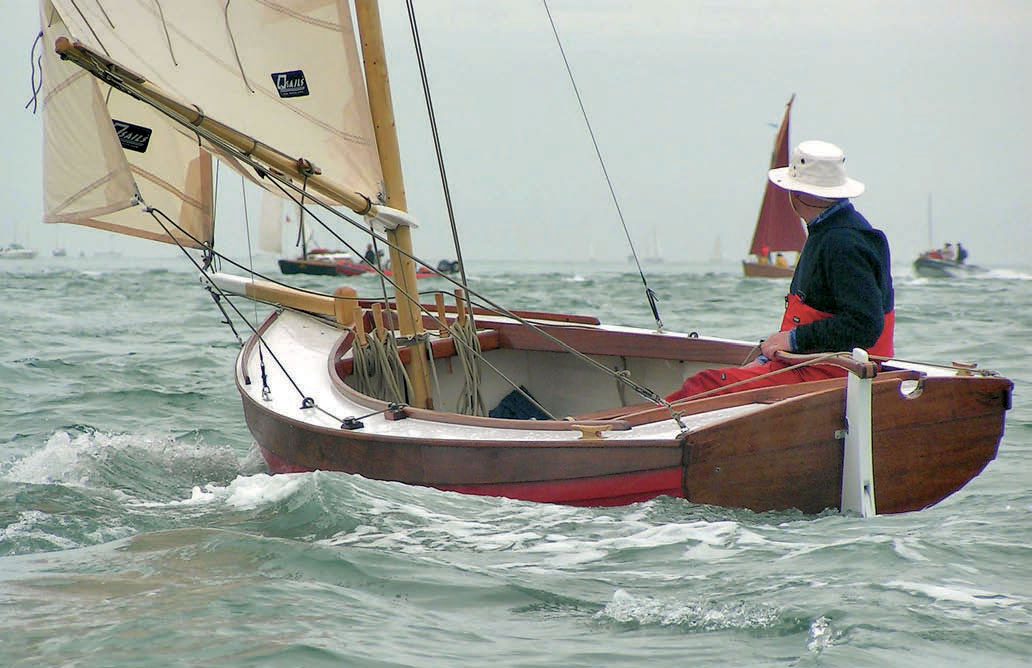
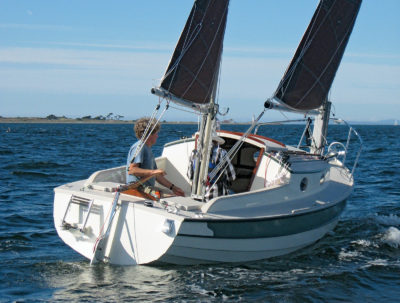
Inspired by the workboats of Brittany, France, François Vivier designed Beg-Meil as a safe and seaworthy daysailer. She can be singlehanded even in windy conditions.
The latest design by French small-craft designer François Vivier (see WoodenBoat No. 212) is called Beg-Meil, a name that derives from a famous fishing village in Brittany, a region whose historic work-boats have deeply inspired the designer over the years. The design is not completely new—it inherits the same hull lines and dimensions of Vivier’s earlier Ilur, of 1988—but it fulfills a very different purpose.
Ilur was designed as an elegant and seaworthy day-sailing and rowing boat, inspired by the traditional lines of small fishing boats of Brittany. The design has proven to be Vivier’s most popular. Nearly a thousand plans have been sold, some of them for use in places as far-flung as lakes in the Alps and islands in the Pacific. Her generous freeboard makes her very able in choppy seas, and her seaworthiness has been demonstrated by some tremendous passages (which the designer does not recommend!) along Brittany’s coastline, which is renowned for rough seas. With 55 gallons of built-in flotation, the boat is unsinkable—but it is still an open boat, without any decking.
Beg-Meil, instead of merely copying Ilur, builds on the earlier design’s concepts of safe and seaworthy sailing but takes them a bit further. To begin with, the new design’s half-decks make it less prone than Ilur to taking on water in rough seas. At the same time, the volume of built-in flotation has been increased to a hefty 100 gallons. The flotation is divided between one water-tight compartment at the stern and a second one at the bow, which leaves room forward of the mast for a locker.
Greater sailing safety was also Vivier’s objective in reconfiguring the centerboard. Instead of the light laminated plywood centerboard of Ilur, Beg-Meil uses a 97-lb steel plate that functions effectively as ballast, not only increasing the boat’s stiffness and stability under sail but also improving her windward sailing abilities.
 François Vivier
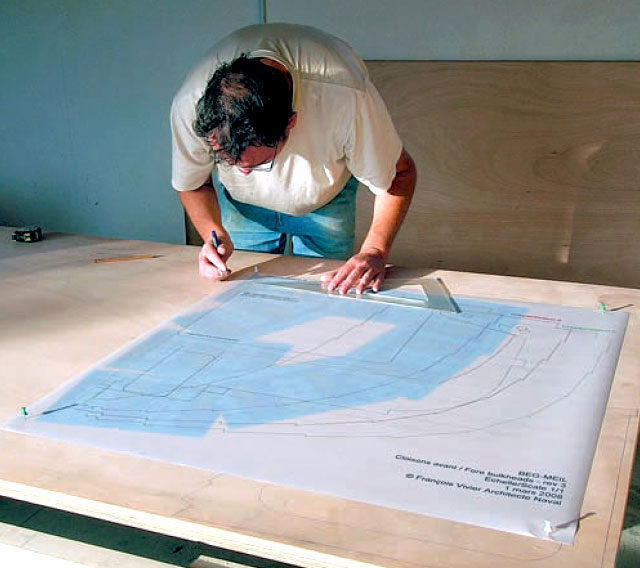
The designer has the amateur builder in mind. An option for full-sized mold patterns in the plans set allows the builder to bypass lofting, the otherwise necessary task of drawing the plans out full-sized.
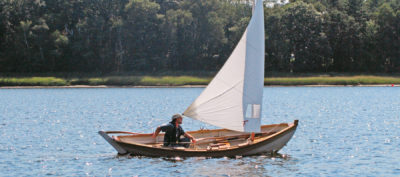
The Ilur sail plan, honing closely to her Brittany roots, has always been a variation on traditional lug sails common in France: standing lug (without a boom) or balance lug (with a boom), sometimes in combination with a jib. The standing-lug version became very popular because of its simplicity and efficiency: it has one freestanding mast, one halyard, and only one sheet to handle.
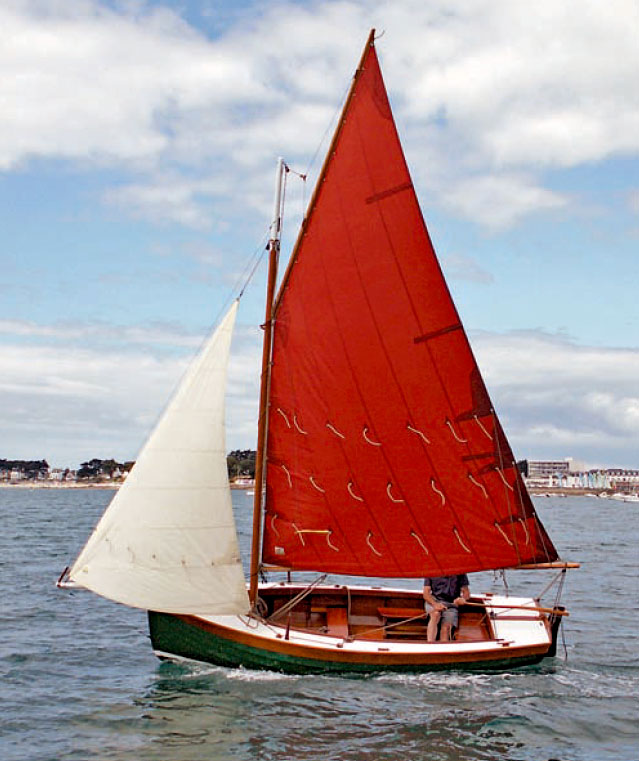
There is no boom nor standing rigging to take care of when sailing with a family or going fishing, although a whisker pole is useful when running downwind. In comparison, Beg-Meil’s sail plan is a gaff sloop rig, and although it offers greater sail area it has a bowsprit and standing rigging supporting its mast, taking it further away from her distant French working-boat origins. The boat has a more “yachty” appearance in comparison with her elder sister. As usual, the penalty for this luxury comes with greater weight—110 lbs more than the earlier design. The free-standing mast of the lug rig also has the advantage of being easily struck to lessen windage under oars—an option not available to the gaff rig, with its shrouds and forestay.
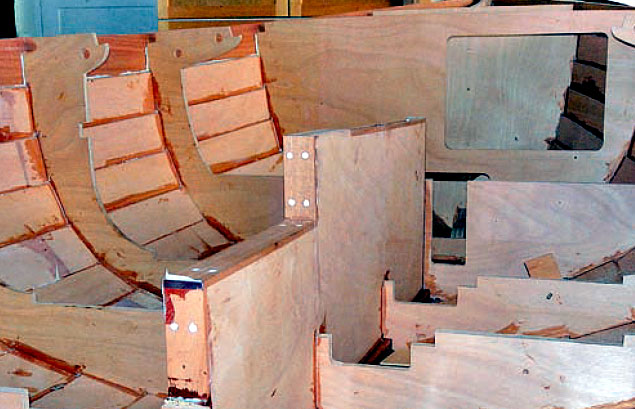
As with most of Vivier’s designs, Beg-Meil, like Ilur, was designed with amateur construction in mind. Both call for either strip-planking or glued-lapstrake plywood construction, in either case with the extensive use of epoxy throughout. Structurally, however, instead of following traditional practice of having steam-bent or laminated frames, Beg-Meil’s planking is glued over plywood bulkheads. Since it is designed to be quite full, the hull has convex outboard surfaces throughout, with no hollows in the forefoot or in her run. This shape makes the planking work comparatively simple, requiring only moderate twist in the planks or strips during installation.
 François Vivier
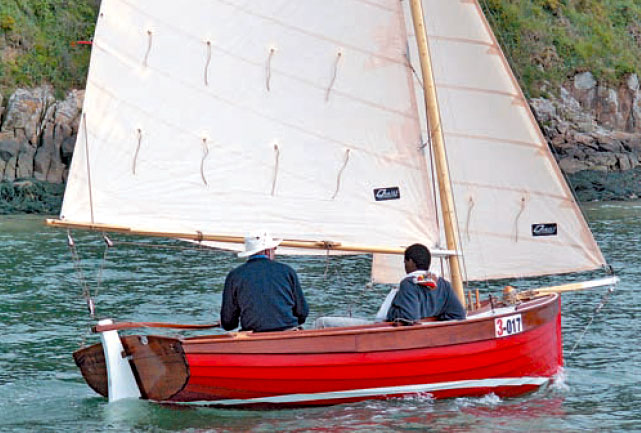
With a high-peaked gaff rig, Beg-Meil looks and handles more like a small yacht than like the workboats that helped inspire her hull design.
To avoid the intricacies of lofting—that task of drawing out the hull lines full-sized, which can sometimes prove daunting to amateurs—Vivier’s plans offer optional full-sized patterns, computer-drawn on very stable polyester sheets. These address critically important shapes, such as the forms of the stem, transom, bulkheads, and many other structural parts, including their bevels. For the plywood-lapstrake version, extremely accurate profiles of every strake are also
drawn out full-size, leaving enough length so that their ends can be trimmed during final installation.
Vivier was one of the founders of Le Chasse-Marée, and that French maritime magazine’s catalog has been carrying his building plans for more than 20 years. He has himself built boats to several of his own designs in order to fully understand the needs and limits of amateur builders. Because of their limited experience, these builders often need more technical and practical information than professionals. By building the boats, Vivier has learned to refine his plans and supplement them with numerous detailed drawings and instructions—for example, details on building the centerboard trunk. Various additional resources, such as a chronological guide, a list of materials and fittings, and step-by-step instruction booklets, help guide beginners safely through to launching day. Vivier also offers help, advice, and consultation by telephone or e-mail without charge.
 François Vivier
Hull framing consists entirely of athwartships bulkheads made of plywood. The shallow cutouts alongside the centerboard trunk allow oar stowage below the floorboards.
Beg-Meil is among a number of Vivier designs also available in kit form. The suppliers are various, including Icarai and Grand-Largue in France; in the United States, the supplier is Clint Chase Boat Builder in Portland, Maine; and in Australia, it is South Pacific Boat Company. All kit parts are cut out of marine plywood panels by computer numerically controlled (CNC) routing machines. In addition to plywood pieces, kits can be shipped (based on the individual builder’s preference) either with or without the necessary solid-wood pieces, epoxy resin, sails, and fittings. Plans and instructions sheets have to be ordered separately. The pieces are marked—for example, specifying the plank overlap in the case of lapstrake construction—or they have specific joining systems to aid positioning and alignment. Some scarf joints, however, have to be made on site. Epoxy and paint quantity calculations are based on average estimates. Substitutions for such things as the type of wood used can be made on request.
 François Vivier
The “yacht” influence in Beg-Meil’s rig can certainly be taken through her appointments and finishes—which in this instance are far from her workboat roots.
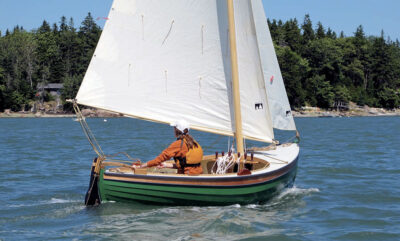
On the water, Beg-Meil inherits all of Ilur’s seakeeping abilities. She’s an excellent choice as a family boat for sailing a few miles for an island picnic or for crossing a bay under oars when the wind dies. She is light enough to be launched and recovered effortlessly from any launching ramp.
She is easy to sail, even singlehanded. Instead of reefing the jib with reef nettles, a roller-furler could be fitted, and the transom can accommodate a small outboard motor if desired. Purists will certainly favor rowing or sculling, and a pair of oars can be stored under the floorboards on each side of the cockpit. The centerboard’s span helps the boat point well to windward when sailing closehauled, and the board lowers easily on a pivot to adjust to any point of sail. Instead of using a steel plate—which is simple but not too hydrodynamically efficient because a flat plate provides little additional lift—the rudder and centerboard both could be given foil cross-sectional shapes. The much higher lift of centerboards so shaped provides better maneuver-ability under sail, more speed in high wind, and less drag in light air.
 François Vivier
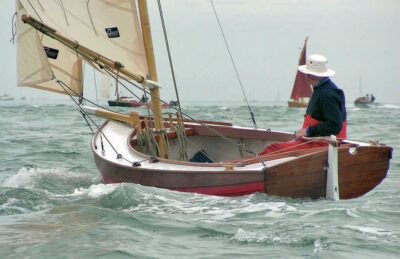
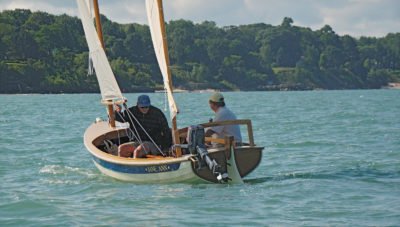
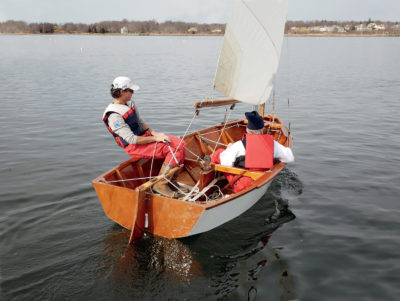
Beg-Meil sails well on all points of sail, and her rig is easy to reef when the wind pipes up.
Beg-Meil is a perfect companion for all-around navigation. The design promises an affordable little yacht that will still please the eye of a traditionalist. Bronze fittings and varnished coamings may distance her from the working boats of her inspiration, but finished out that way she will have a lot of appeal to anyone with an eye for a boat.
François Vivier Architecte Naval, 7 avenue des Courtils, 44380 Pornichet, France; +33 (0)2 28 54 97 86; www.vivierboats.com.
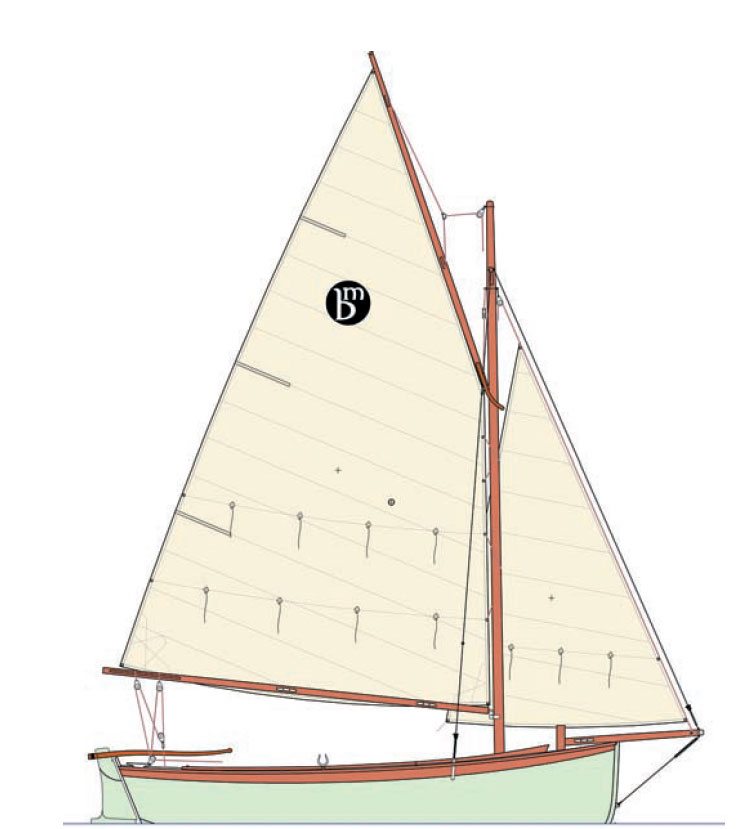
Beg-Meil Particulars
LOA: 14′ 7″ (4.46m)
Beam: 5′ 6″ (1.68m)
Draft
centerboard up: 10″ (0.25m)
centerboard down: 2′ 10″ (0.86m)
Weight: 772–860 lbs (350–390 kg)
Sail area: 10.76 sq ft (14.3 sq m)
 François Vivier
With a generous flotation in chambers, a steel centerboard in effect adding ballast, and ample freeboard, Beg-Meil is intended as a safe and seaworthy all-around daysailer.
 François Vivier
The seafaring traditions of Brittany are attractively echoed in the design, but her construction, materials, and performance are all modern.
Is there a boat you’d like to know more about? Have you built one that you think other Small Boats readers would enjoy? Please email us your suggestions.



I have just read the article on Beg-Meil. I would like to visit Francois Vivier’s boatworks, and would appreciate information on how to contact him.
Thank you.
You can reach François Vivier at:
François Vivier Architecte Naval, 7, avenue des Courtils, 44380 Pornichet, France
email: [email protected]
mobile: + 33 (0)6 74 54 18 60
His website address is: https://www.vivierboats.com/en/
A minor point, but I suspect that while the assessment, near the end, that a fully foil-shaped rudder and centerboard would give “better maneuverability under sail, more speed in high wind, and less drag in light air” is probably true, the claim that such shapes would give “much higher lift” is a bit overstated in the context of sailboat rudders and centerboards. With water being so much more dense than air, the lift coefficient required from the foils in the water is usually pretty low, so almost any shape will do — the main thing needed is just to avoid having them stall at low speeds. Stalling is certainly to be avoided — small rudders such as on Lasers are known for stalling if swung too sharply, and once in a crowded anchorage and with especially light air it was disconcerting for me to have a Lightning start drifting sideways when its centerboard stalled and “let go” of the water (when our speed had dropped to about one foot per second) — but these are extreme cases. If I had blades for these foils that were made of flat plate stock, I would certainly grind or mill the leading and trailing edges to be somewhat streamlined, to reduce drag and the risk of stalling — but thousands of sailboats work just fine with no more shaping than that.