One of the hallmarks of the annual WoodenBoat Show in Mystic, Connecticut—which celebrated its 34th anniversary this past weekend—is the wide range of boats on display. As ever, this year there were the awe-inspiring larger vessels lining the docks, brightwork gleaming in the sun, oiled-teak decks smooth underfoot, flawless topsides reflecting every ripple in the water below. There were, among them, classic yachts from world-famous designers, exquisitely maintained motoryachts, and even two beautifully restored sardine carriers.
But, as splendid as the eye-catching fleet on the water was, there was also plenty to inspire and impress on land. Here, the exhibits were smaller but even wider in variety, ranging from professional builds to amateur restorations, from commercial kit builders to paint and tool suppliers, and from associations to educators.
 Jenny Bennett
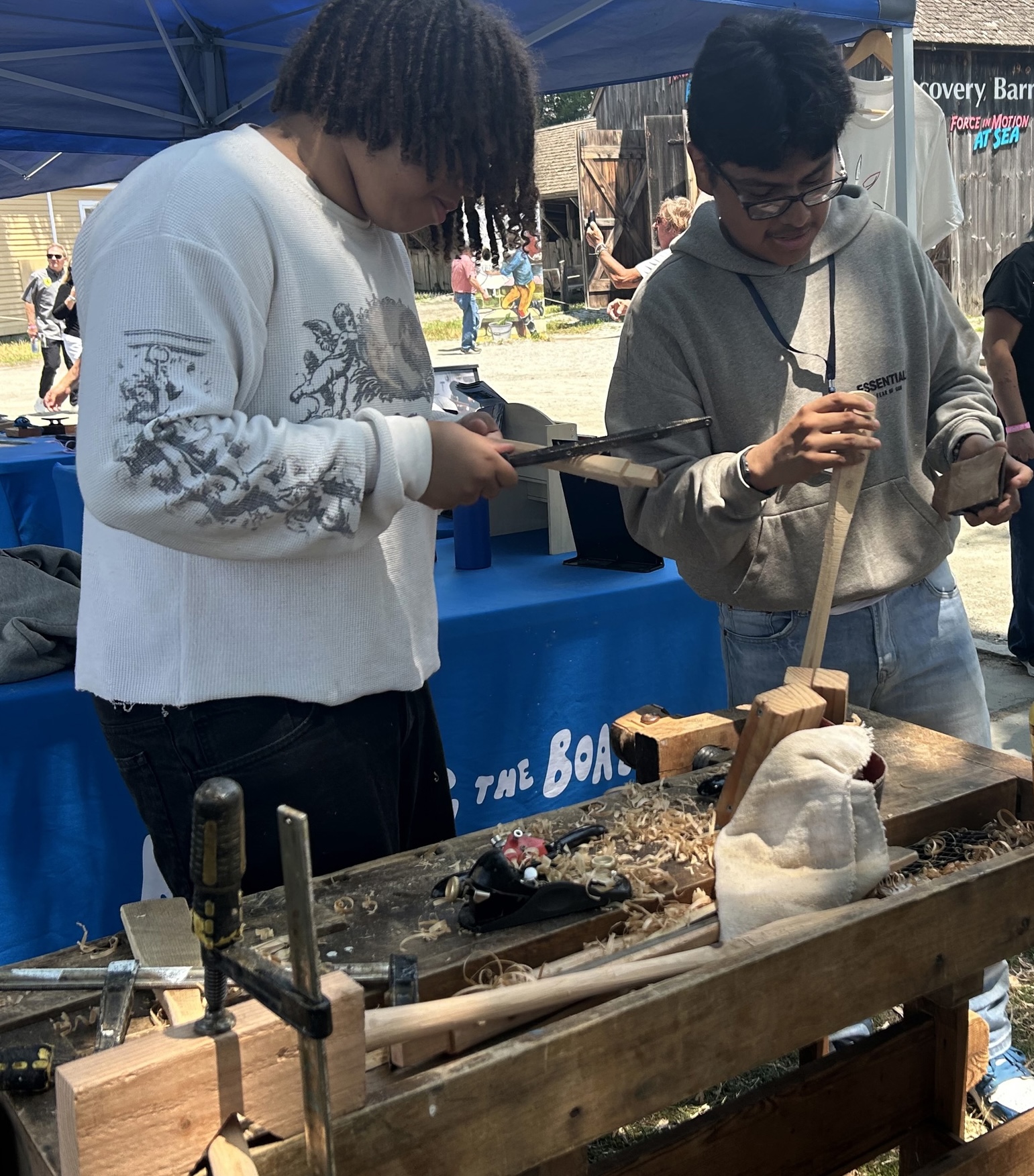
At the Rocking-the-Boat booth, students from the New York City program helped visitors to shape cedar pieces into miniature paddles.
Among the last were two educational programs. Rocking-the-Boat began a boatbuilding program for the East Harlem Junior High School in 1996. For 30 years it has offered multiple programs in New York and San Francisco, in youth development working with high-school teens—200 per year in New York alone—as well as public after-school and summer programs in sailing, boatbuilding, and on-water environmental classes. At the show, several young Rocking-the-Boat students enthusiastically shared their stories and helped young visitors turn pieces of cedar into miniature paddles.
 Jenny Bennett
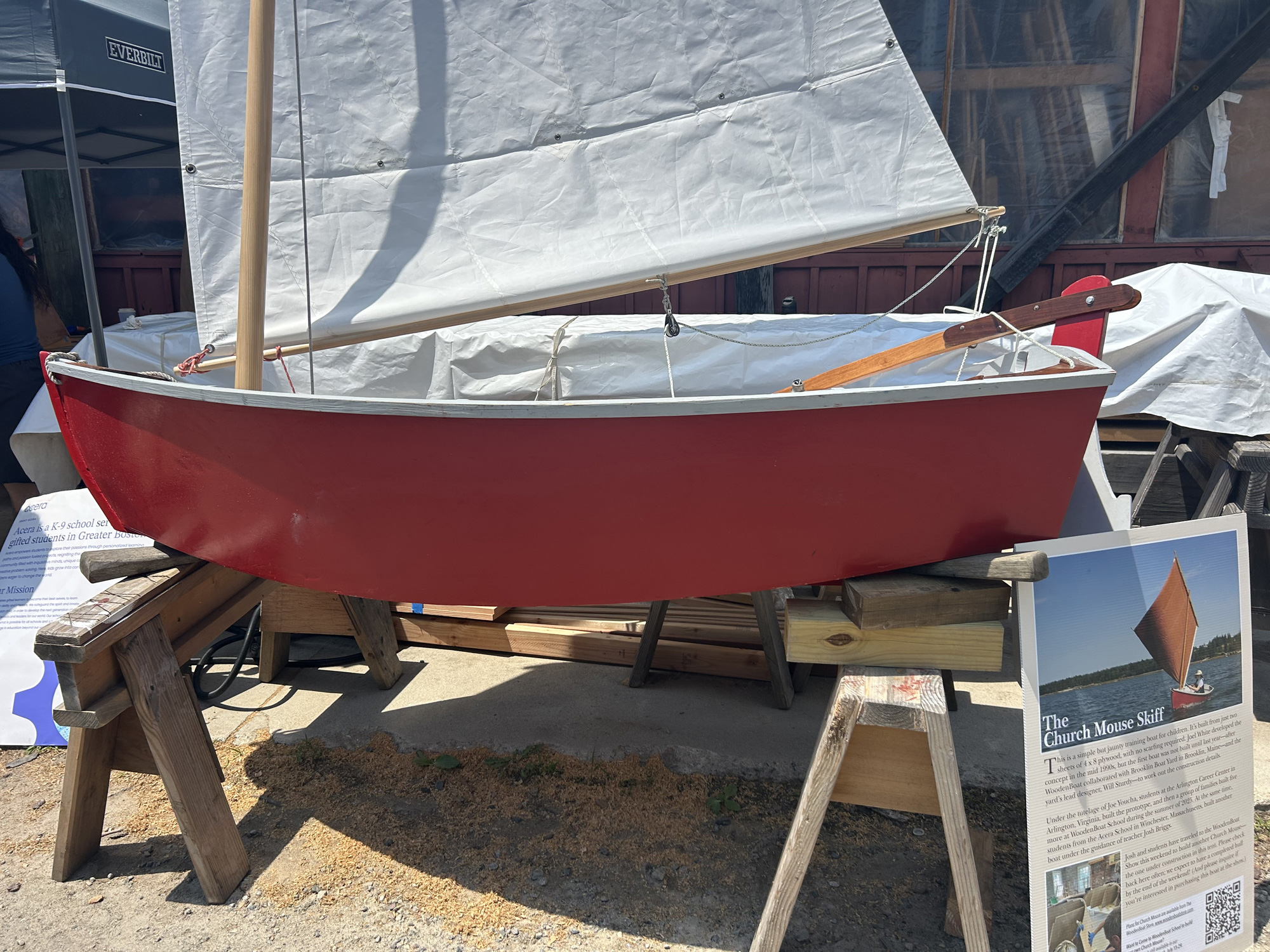
This Church Mouse skiff—a Joel White–design from the mid-1990s—was built by students of the Acera school in a two-trimester class with teacher Josh Briggs.
At the other end of the show grounds, Acera, a K-through-ninth-grade school for gifted students in Winchester, Massachusetts, was also represented by a group of spirited youngsters. Under the watchful eye of Josh Briggs, the school’s engineering, woodshop, and math specialist teacher, they were building the first from-kit version of the Church Mouse skiff. An earlier Church Mouse—designed by Joel White in the mid-1990s—was built from plans earlier this year by Acera students in a two-trimester class, aimed at developing skills in design thinking, precision craftsmanship, and of course, boatbuilding.
The kit for Church Mouse was created by Hewes and Co. of Blue Hill, Maine, with help from Josh, and Joe Youcha of the Teaching With Small Boats Alliance. Hewes was among several commercial kit suppliers at this year’s show, which included Chase Small Craft, Newfound Woodworks, and Chesapeake Light Craft.
 Jenny Bennett
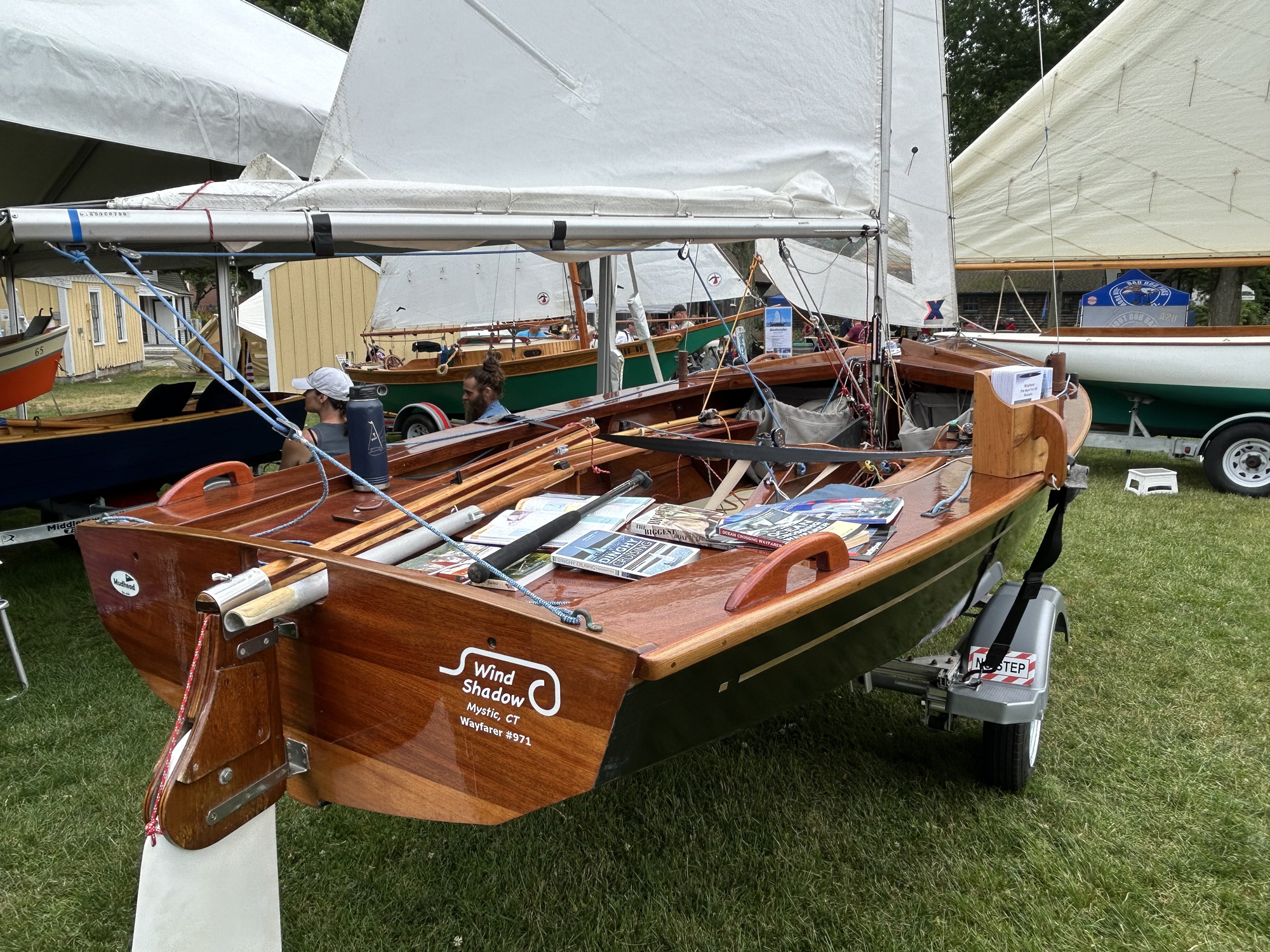
WIND SHADOW, Wayfarer Nº 971, was built in Canada in 1964. After a substantial rebuild in 1982, she spent the next 40 years in storage. Recent work by owner Paul Miller has included replacing the deck and seats.
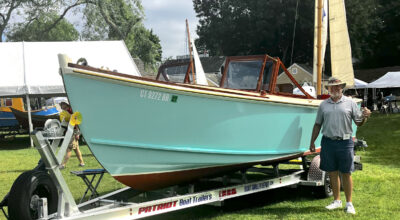
Several adult first-time boatbuilders mingled with old-timers in the I Built/Restored it Myself (IBRIM) area of the show, where tips and ideas were freely shared back and forth across the green, boats were assessed and admired, anecdotes were swapped. The IBRIM boats were many and varied and included the humble FLASH, a 16′ plywood Barnaby cabin cruiser designed by Henry Clark, and built by an amateur between 1960 and 1970. On completion, FLASH was used just a few times before being laid up on a trailer in a barn until 2010, when she was bought by her current owner, Jerry Middleton. Jerry did just a little restoration—including, he says, finishing a few things the builder never got around to—but for the most part FLASH has been maintained in her original state.
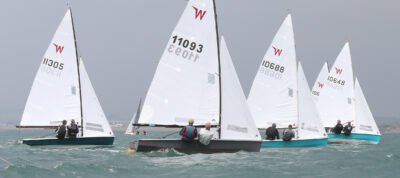
Rather more comprehensively restored was Wayfarer Nº 971, WIND SHADOW, a sailing dinghy built from a kit in Canada in 1964, and rebuilt in 1982. Like FLASH, WIND SHADOW sat in a barn for almost 40 years. Her current owner, Paul Miller, who races and cruises WIND SHADOW extensively, replaced the deck and seats, and restored her finish to as-new condition.
 Jenny Bennett
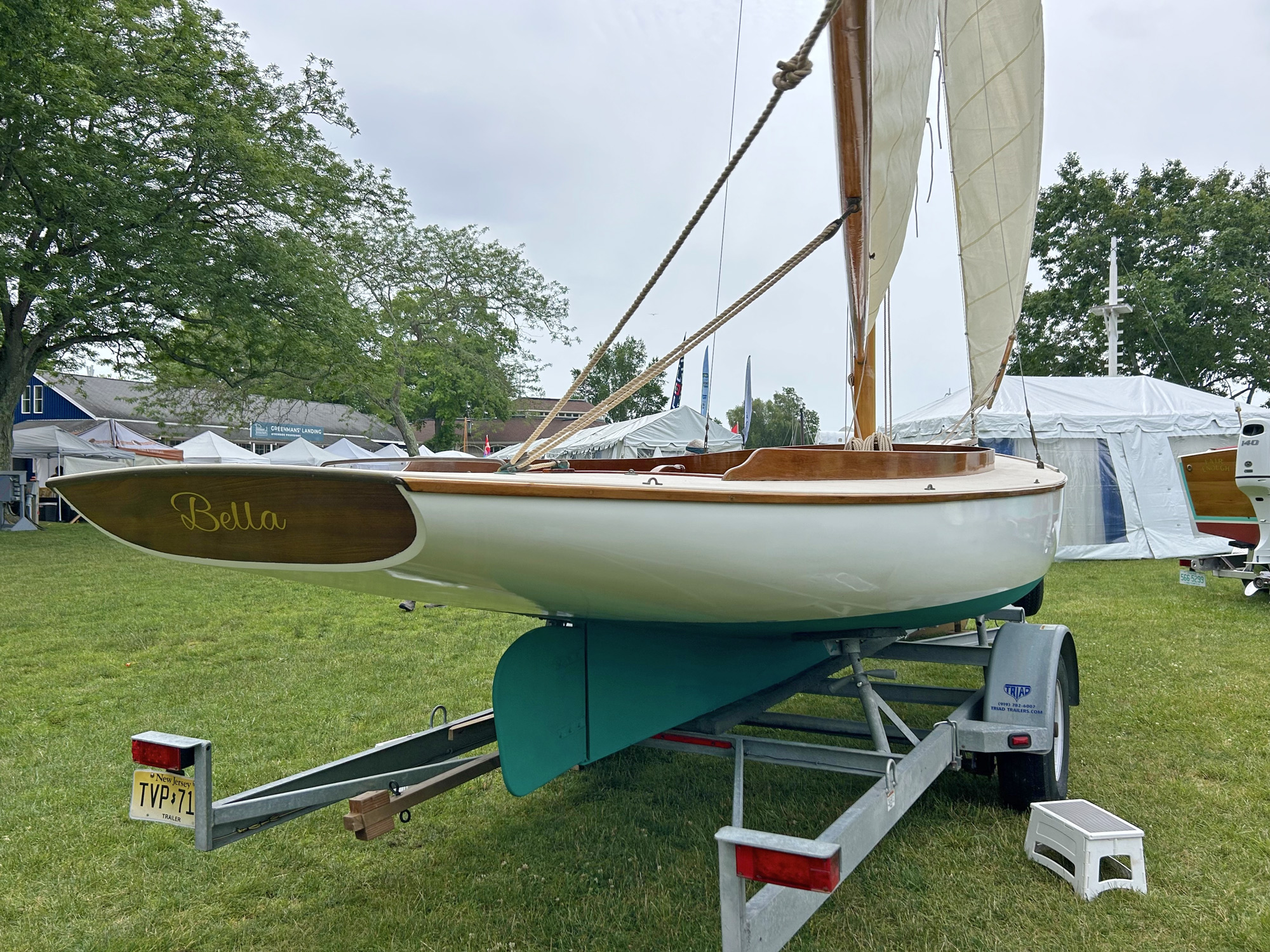
BELLA was built by Harold Bernard between 2016 and 2019 to a 1901 B.B. Crowninshield design. The original boat was cat-rigged but Bernard adapted the design to a gaff sloop.
One of the older designs (but not an old build) was the 22′ 6″ × 8′ BELLA, designed by B.B. Crowninshield in 1901. Built in 2016–19 by Harold Bernard, BELLA’s design was modified from the original catboat rig to a gaff sloop by moving the mast aft and adding a bowsprit.
 Justin Jamison
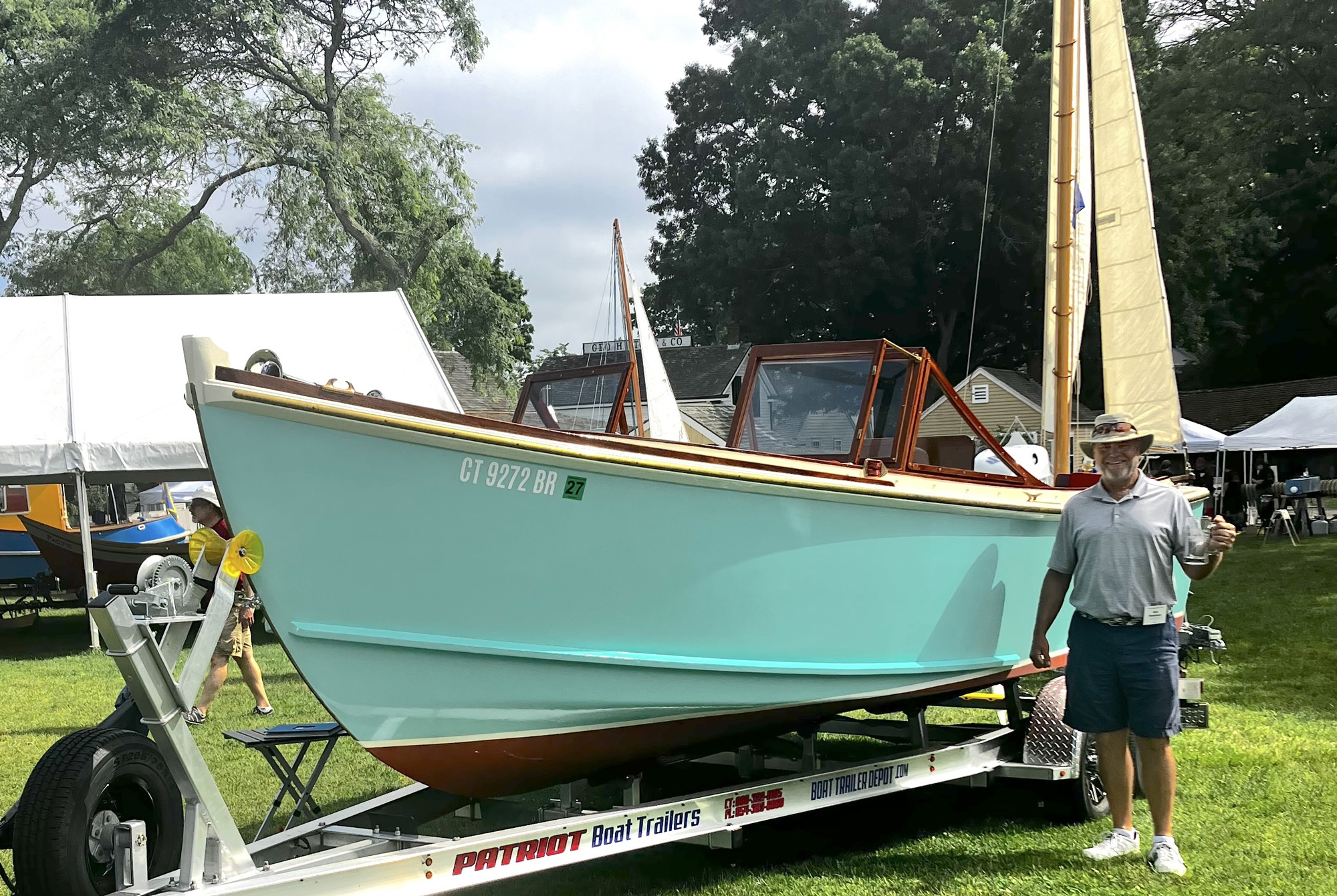
FAIR ENOUGH was designed and built by first-time designer/builder Gary Sweetman—seen here holding his glass beer-mug award for “Honorable Mention—Owner Built, Power.”
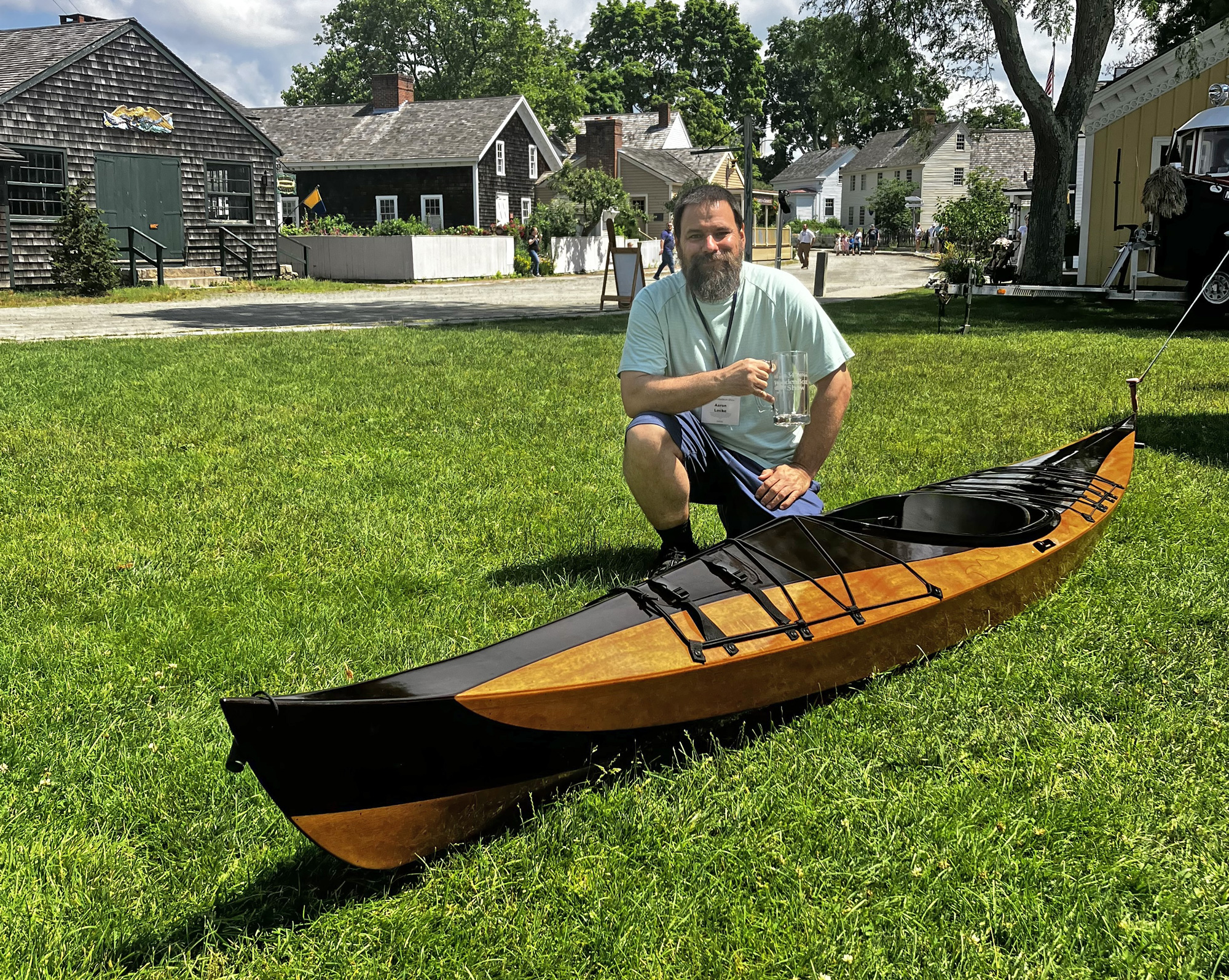
There were builds from new designs, too, among them Gary Sweetman’s FAIR ENOUGH, a 22′ outboard runabout, and Aaron Locke’s two stitch-and-glue okoume-plywood kayaks—one 14′, the other 17′. Both Sweetman and Locke are self-taught and not only built their own boats but also designed them.
 Justin Jamison
Aaron Locke’s stitch-and-glue kayaks are home-designed and -built. Aaron won the etched-glass award for “Honorable Mention—Owner Built, Manual.”
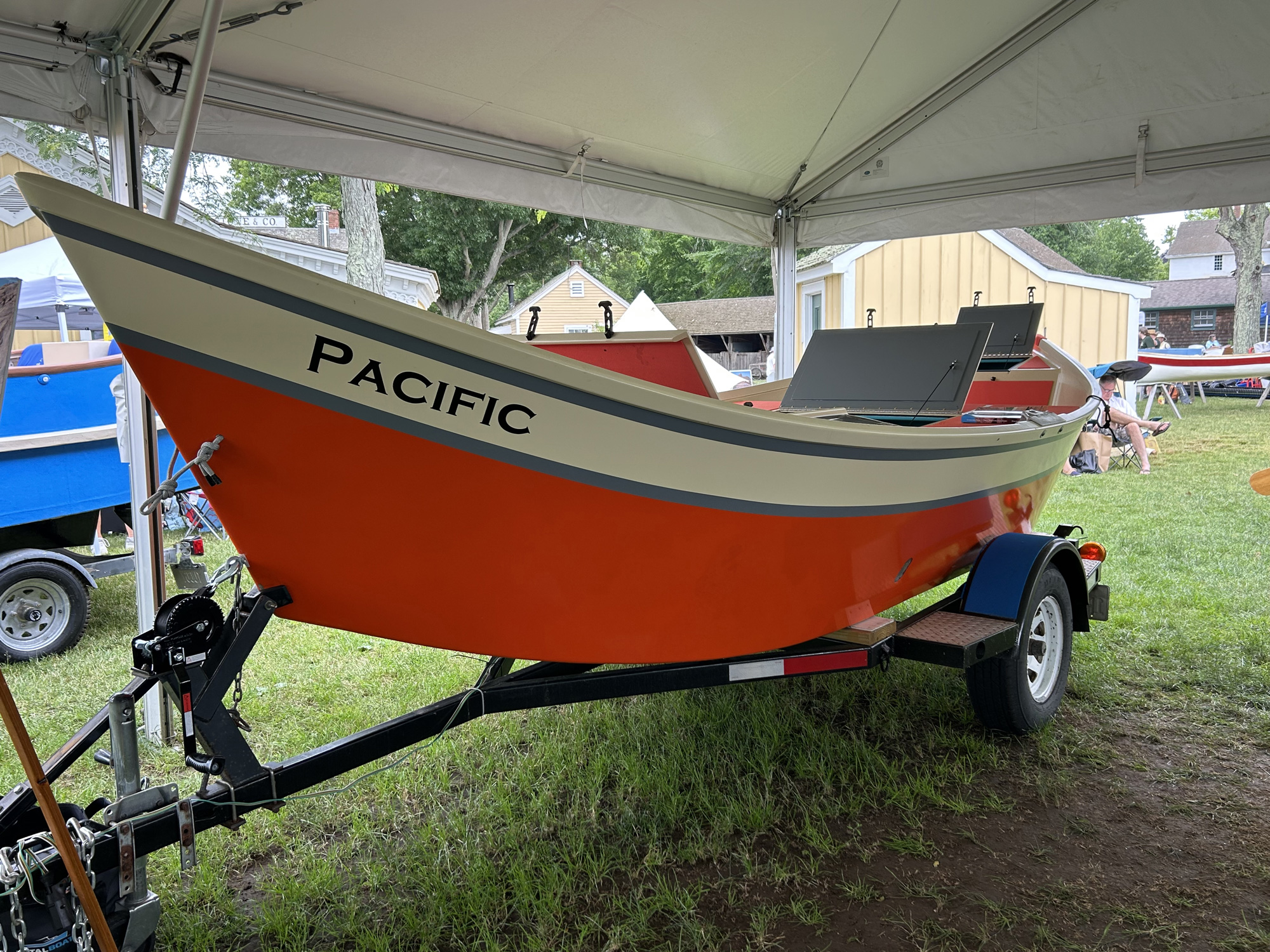
Another builder with two boats was David Sianez, who brought along two rowboats of very different pedigree: HONU, a 12′ 6″ double-ended bateau he described as “a minimalist rowboat for fishing and hunting,” designed in about 1940 by Walter McInnis; and PACIFIC, an 18′ 6″ river dory designed by Jerry Briggs in the 1970s. David built his first boat, a drift boat, in the early 1990s and used it on the Kenai River in Alaska. But for about 15 years, life got in the way of boatbuilding until now—David teaches at Central Connecticut State University, where his classes build between one and three boats a year.
 Jenny Bennett
The river dory, PACIFIC, won the award for “Owner Built, Manual.” Designed by Jerry Briggs in the 1970s, she is 18′ 6″ long, with a maximum beam of 54″ in the bottom and 86″ at the gunwale. With plenty of volume, PACIFIC can carry four people, plus the oarsman and all the gear they might need.
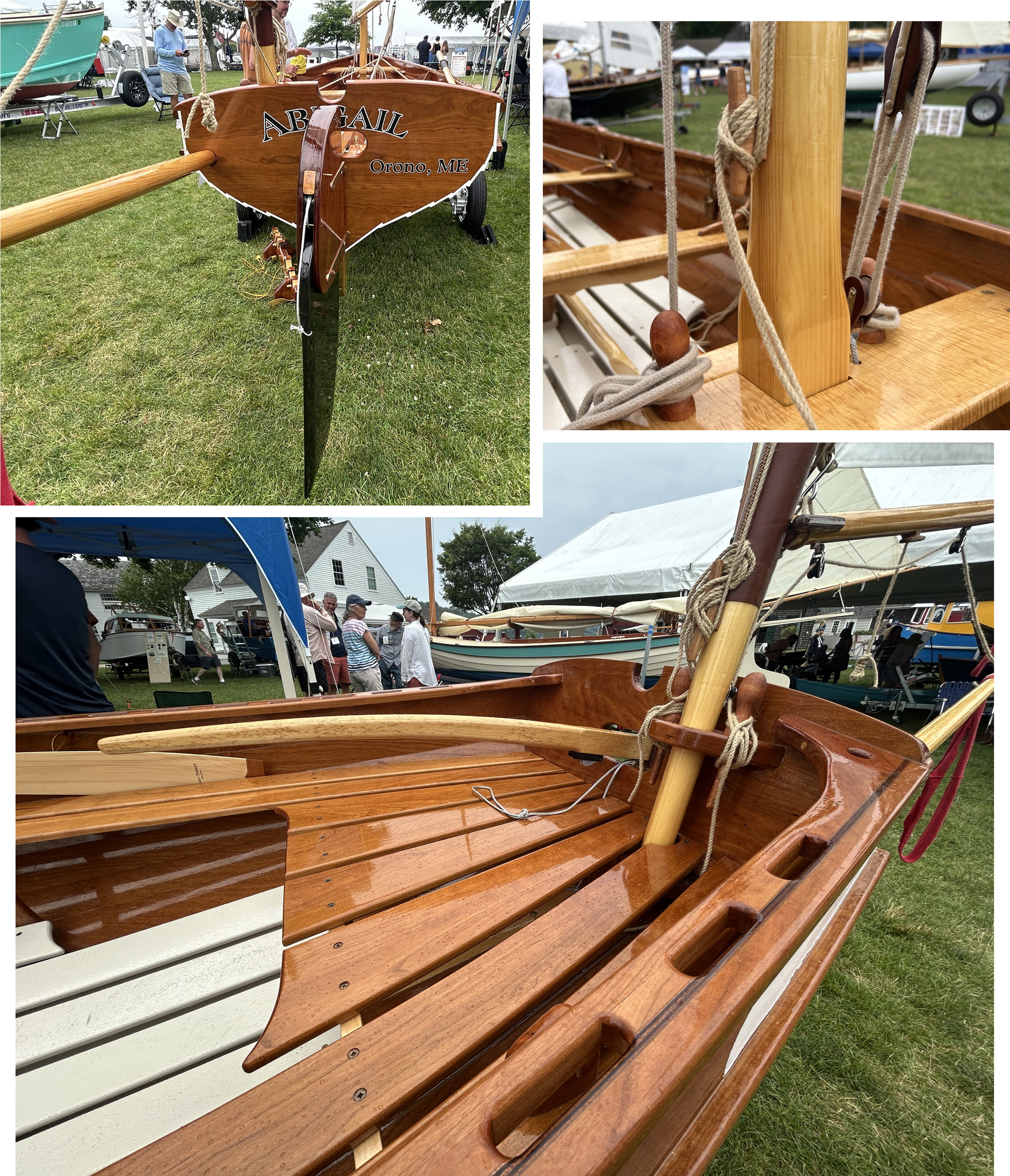
Other professionally designed boats among the IBRIM exhibitors included the Iain Oughtred–designed Tammie Norrie, ABIGAIL, built by first-timer Steve West. Steve not only brought many of his own innovative and thoughtful details to the boat, but also paid great attention to maintaining a traditional appearance with a good deal of solid wood, bronze and Tufnol hardware, hand-crafted leatherwork, and Hempex and Sta-Set running lines.
 Jenny Bennett
ABIGAIL is Steve West’s first build. She is an Iain Oughtred–designed Tammie Norrie and was launched last year. Steve chose the Tammie Norrie because he wanted a quality rowboat that could sail well…or maybe a quality sailboat that could row well. In the Tammie Norrie he believes he has the best possible performance in either configuration. ABIGAIL’s planking is sapele, her transom, gunwales, knees, risers, breasthook, and sternsheets are black cherry, her thwarts are tiger maple, floorboards are white ash, and her spars are white pine.
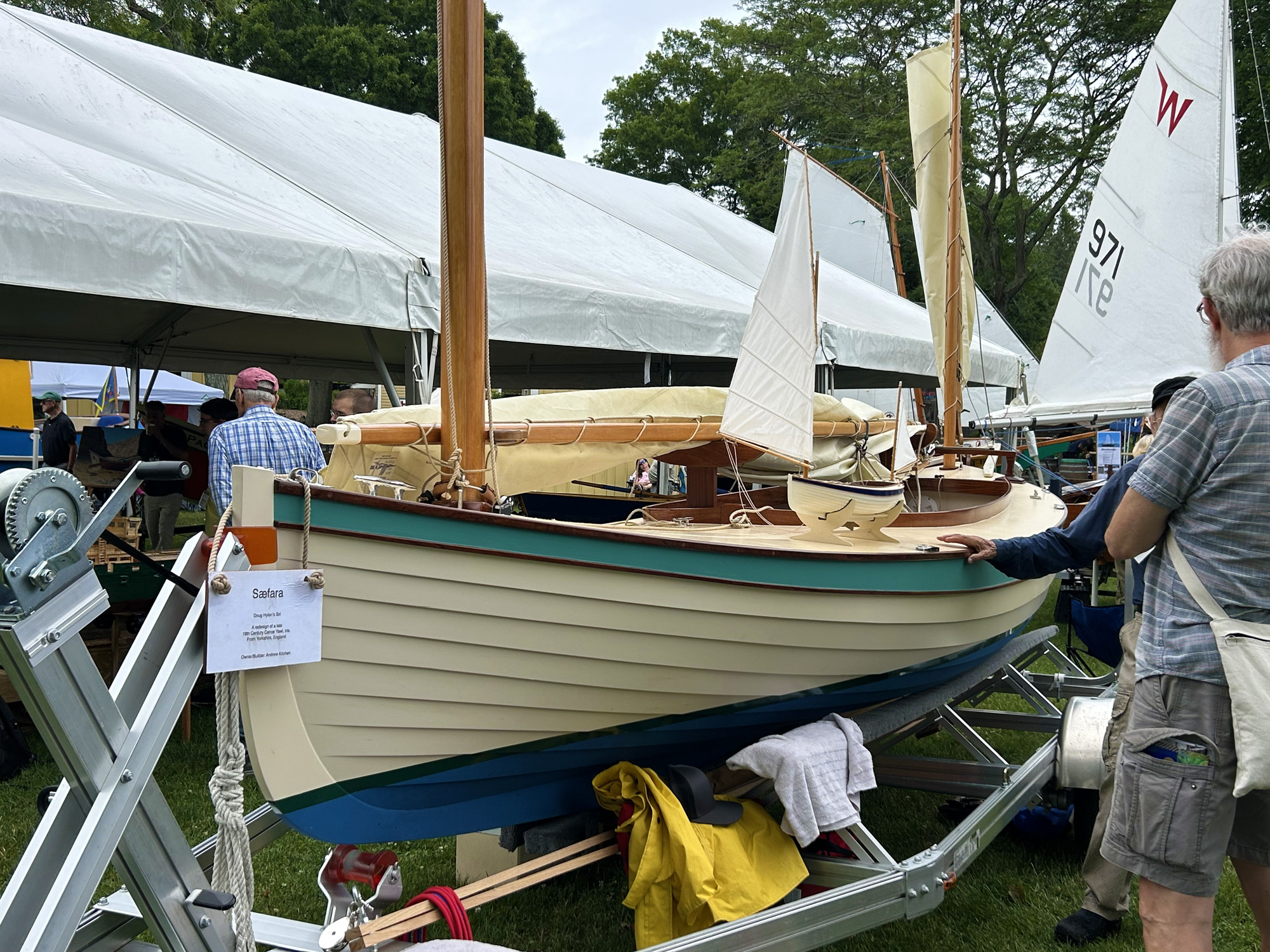
Also present were PERMILLIE JANE, a 12′ 6″ William Garden–designed Tomcat built by Greg Stoddard under the mentorship of boatbuilder Bob Emser; and the glued-lapstrake SÆFARA built by Andrew Kitchen to Doug Hylan’s Siri design, a modern interpretation of IRIS, a canoe yawl published in Forest and Stream magazine in 1888.
 Jenny Bennett
SÆFARA, built by Andrew Kitchen, was designed by Doug Hylan of Hylan & Brown as Siri, a modern interpretation of the canoe yawls that were popular in the late 1800s in both the U.S. and the U.K.
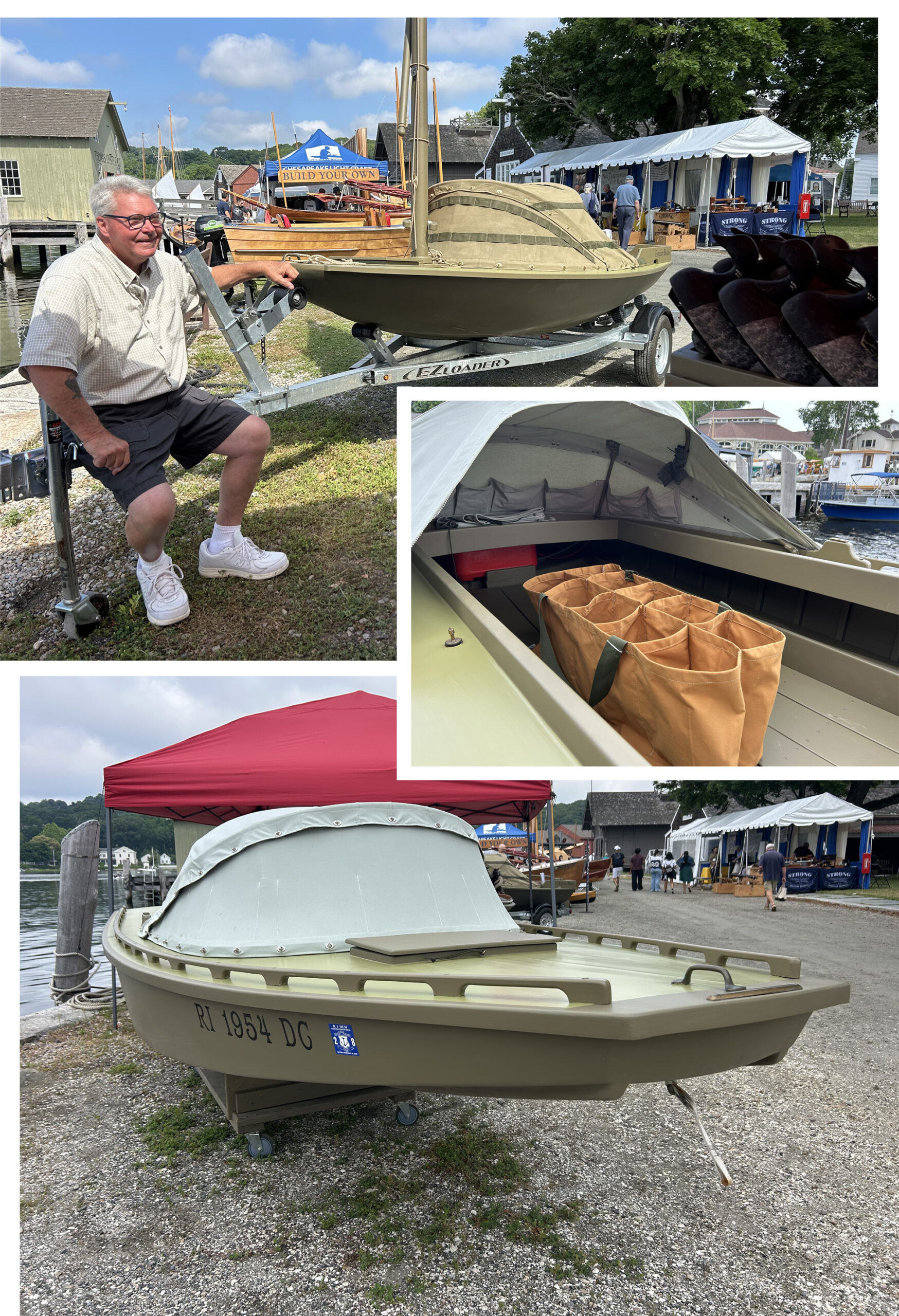
Away from the IBRIM boats on Mystic Seaport’s village green there were many commercially built boats, most with gleaming varnish and high-gloss finishes. But, unusual among them were David Clark’s duck-hunting boats. David started boatbuilding as a hobby to meet his own needs but, since the mid-1990s, has built 142 boats—some carvel-planked, some strip-planked, some with fiberglass hulls and wooden decks, some hard-chined, some with round-bottomed hulls. He had brought three boats to the show: an Estuary III, a hard-chined 15-footer based on a Carl Adams original; a 12′ Barnegat Bay Sneakbox; and a 13′ 4″ Estuary.
 Jenny Bennett
David Clark of Estuary Boats (top left) has used and built sneakboxes and duckboats for 50 years. He is also a canvas goods maker of 40 years and makes all the accessories—from dodgers to covers to gear bags—for his boats. The cover on his strip-planked Estuary (top) has webbing strips stitched at intervals to create loops into which a duck hunter can stick grasses in order to camouflage the boat. On the Estuary III (bottom) the so-called grass or thatch rails along the perimeter of the deck are used for the same purpose. Recently David has adapted his original decoy-bag design (middle) to make bags for carrying bottles of wine—he still makes decoy bags for hunters. Inside the Estuary III’s cover (middle) he has sewn extra pockets forward for stowing small tools and other personal effects that need to be kept close at hand and dry.
David’s association with duckboats began in 1976 when he bought a 12′ sneakbox for $75. He hunted with it for some 20 years in the Rumson area of New Jersey, but when he moved to Barnstable Harbor on Cape Cod, where the tidal range can exceed 12’ and the winds are often more than 25 knots, he realized he needed something larger to get across the bay to the hunting marshlands, so he built his first Estuary—a 13′ 4″ cedar-planked sneakbox with a 64″ beam. Since then, David has built several boats a year, some to stock designs, others as one-off custom boats, none of them big, and all painted in subdued matte colors as befits their purpose.
There is no question that the gleaming classic beauties on the outer docks are the showstoppers, but for me it’s the smaller boats, the ones built over the course of years in a garage, or designed and constructed to be used without sentiment in cold marshes in the early hours of a winter morning, or—and perhaps above all—the ones that aren’t perfect but were built by a group of youngsters who, in the process, have probably learned as many life lessons as they have boatbuilding skills. Those are the boats that make The WoodenBoat Show special and will keep me coming back year after year.

Join The Conversation
We welcome your comments about this article. To include a photo with your remarks, click Choose File below the Comment box.