Sailing other people’s boats is a fickle business. It’s bad enough trying to coordinate everyone’s schedules, but then you need a suitable weather window (not too much wind but not too little either, and could you throw in some sunshine please?) and a serviceable tide. A case in point was when I was hoping to sail the Windsong. I’d seen videos of the boat flying along at 12 knots—an outstanding performance for a 14′ lug-rigged wooden dinghy—and was determined to have a go. Then I heard that the first four boats built to the design were gathering to sail together in Norfolk, England, 323 miles from my home in Devon. Undaunted, I got into my car and set off across the country.
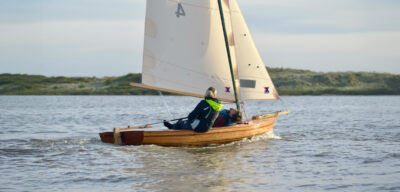
Just after sunrise on a fine April morning, I arrived at the village of Burnham Overy Staithe in time to see four wooden dinghies with varnished hulls and off-white sails aglow in the early-morning sun, drifting down the River Burn. The setting was perfect, the boats were perfect, and the weather was, well, nearly perfect—perfect for a postcard-pretty scene but not so perfect for getting the boats up on plane, for which the Windsong is known, but for which it needs 15 knots of wind, or more. The strongest wind that blew across Burnham Overy Harbour that morning was in the low teens, and I never got to see any of the boats sailing flat out.
Of course, speed isn’t everything, and the Windsong has plenty to recommend it both on plane and in displacement mode. But building a stupidly fast lugger had always been at the heart of the boat’s concept.
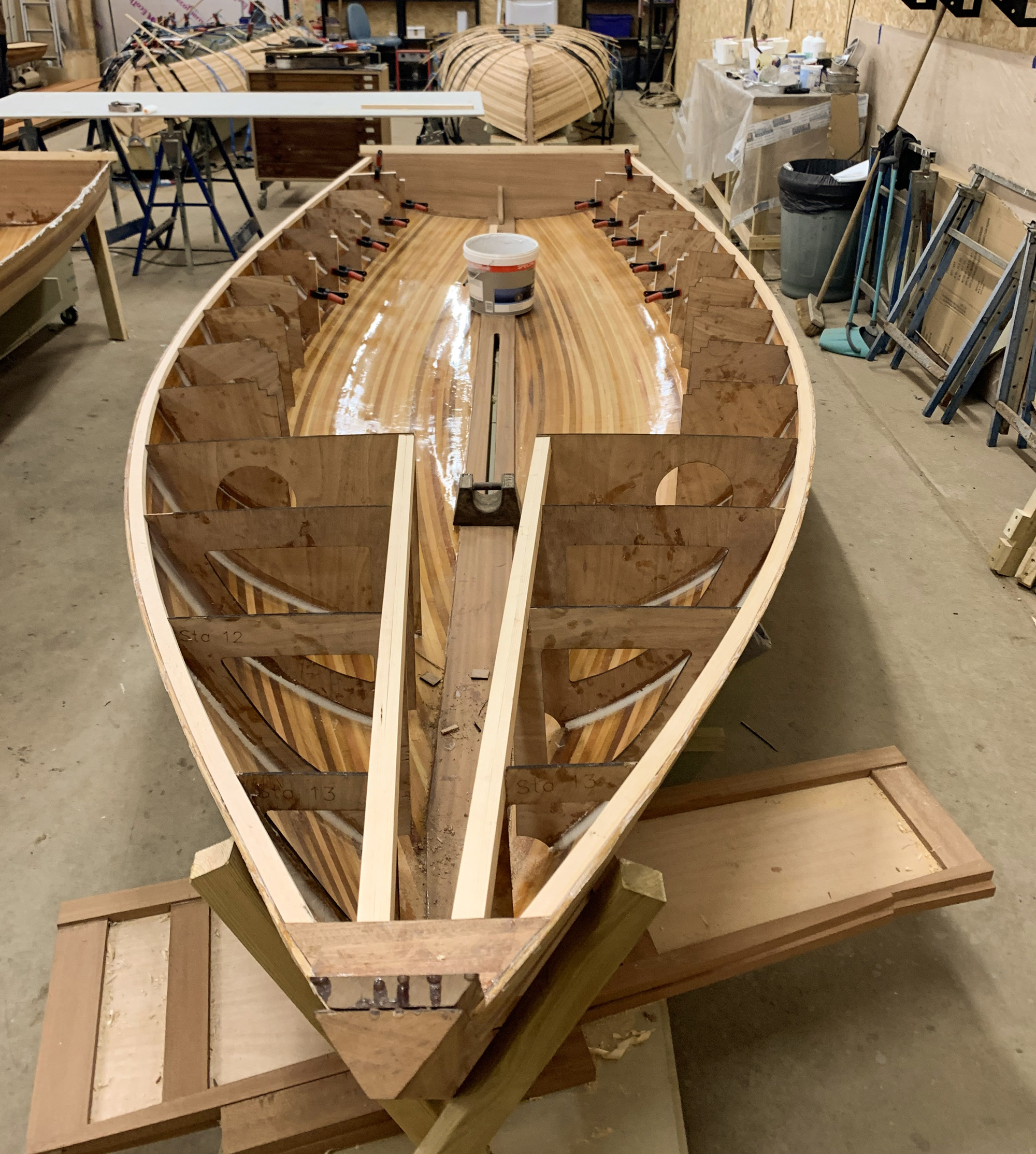 Courtesy of Harry Cory Wright
After the prototype, the first four Windsongs were built side by side, allowing the builders to make the best use of their time. The strip-planked monocoque hulls are strengthened by framing beneath the foredeck and side decks seen here, and later by a single ’midship thwart. The airtight spaces beneath the decks provide good flotation. The open slot in the center of the foredeck will allow the mast to be keel-stepped in two positions: forward for a cat-rig arrangement, aft for the sloop.
A new design
It all started when small-boat designer John Owles became embroiled in a discussion with some rival sailors at an Old Gaffers Association (OGA) Swallows & Amazons weekend about the relative merits of gaff versus lug rig.
“They were saying the lug rig was no better than a bedsheet hung on a broomstick, and that most working boats had switched to gaff as soon as they possibly could,” John remembers. “That might have been the case for boats on England’s south coast, like Falmouth, where they sailed straight into a rich fishing ground. But in places like Loch Fyne in Scotland, boats stuck with the lug rig because they had a big plug to windward before they reached their fishing grounds. The lug rig doesn’t point high, but it’s very powerful and is much more efficient at tacking than gaff.”
John was already familiar with lug-rig dinghies. In the late 1990s he had built a Holmsbu 12 designed by Per Corel in The Netherlands, and gone on to produce it as a solid-timber kit, complete with pre-compressed, hardwood ribs. That was followed by the 15′ Summer, John’s own design based on a Finnish post boat, and the 15′ Windchime, which he describes as a clinker (lapstrake) dayboat “based on a generic type you find in harbors all around the U.K.—ideal for a family expedition up a river or out to an island.”
 Nic Compton
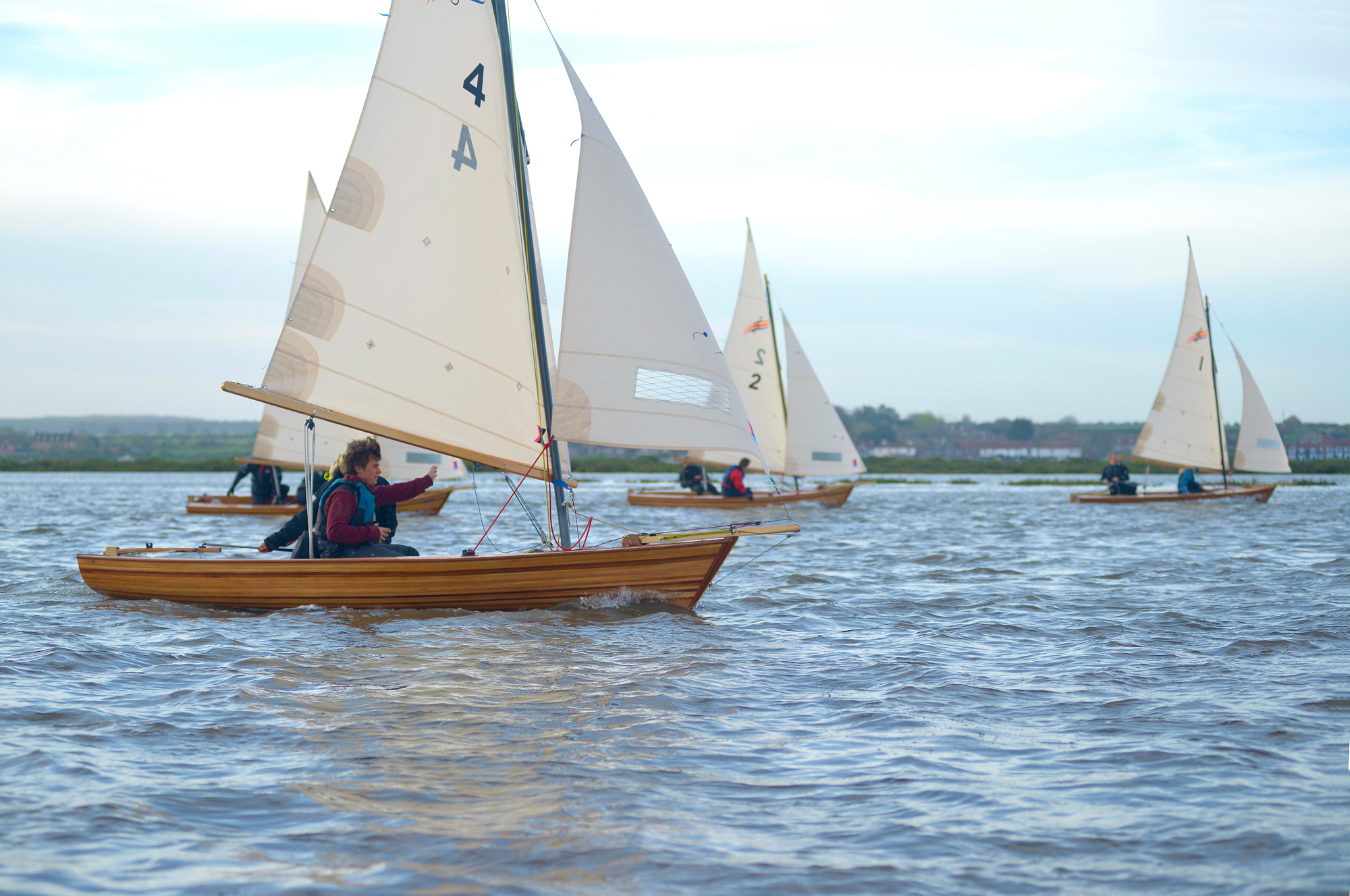
Members of the sailing club at Burnham Overy Staithe were quick to adopt the first four Windsongs for close one-design racing.
All three designs were lug rigged, but none was going to set any speed records. John needed a fresh approach, and he found his inspiration while on holiday in France.
“I started sketching and developing a shape based on a derelict boat I’d seen in the Golfe du Morbihan in France,” says John. “I reduced the hull resistance to as low as possible.”
The resulting boat had a decidedly racy shape—low freeboard, sharp bow, raked stem, and flat planing sections aft—something like a Laser but with a bigger cockpit and, as John suggests, elements of the Uffa Fox–designed Flying 15 around the stern. The high-peaked lug rig draws immediate comparison with the Nigel Irens–designed Roxane and Romilly, with the addition of a bowsprit and a jib.
Norfolk artist Harry Cory Wright happened to see John’s drawing and suggested it might make a nice one-design for Overy Staithe Sailing Club. The club already had a fleet of 25 or 30 classic Twinkle 12 sailing dinghies, which have raced there since the 1950s, but there was a growing consensus among members that the fleet was due for an upgrade. A fundraising campaign raised £15,000 to build a prototype. John’s playful design had clearly struck a chord.
 Nic Compton
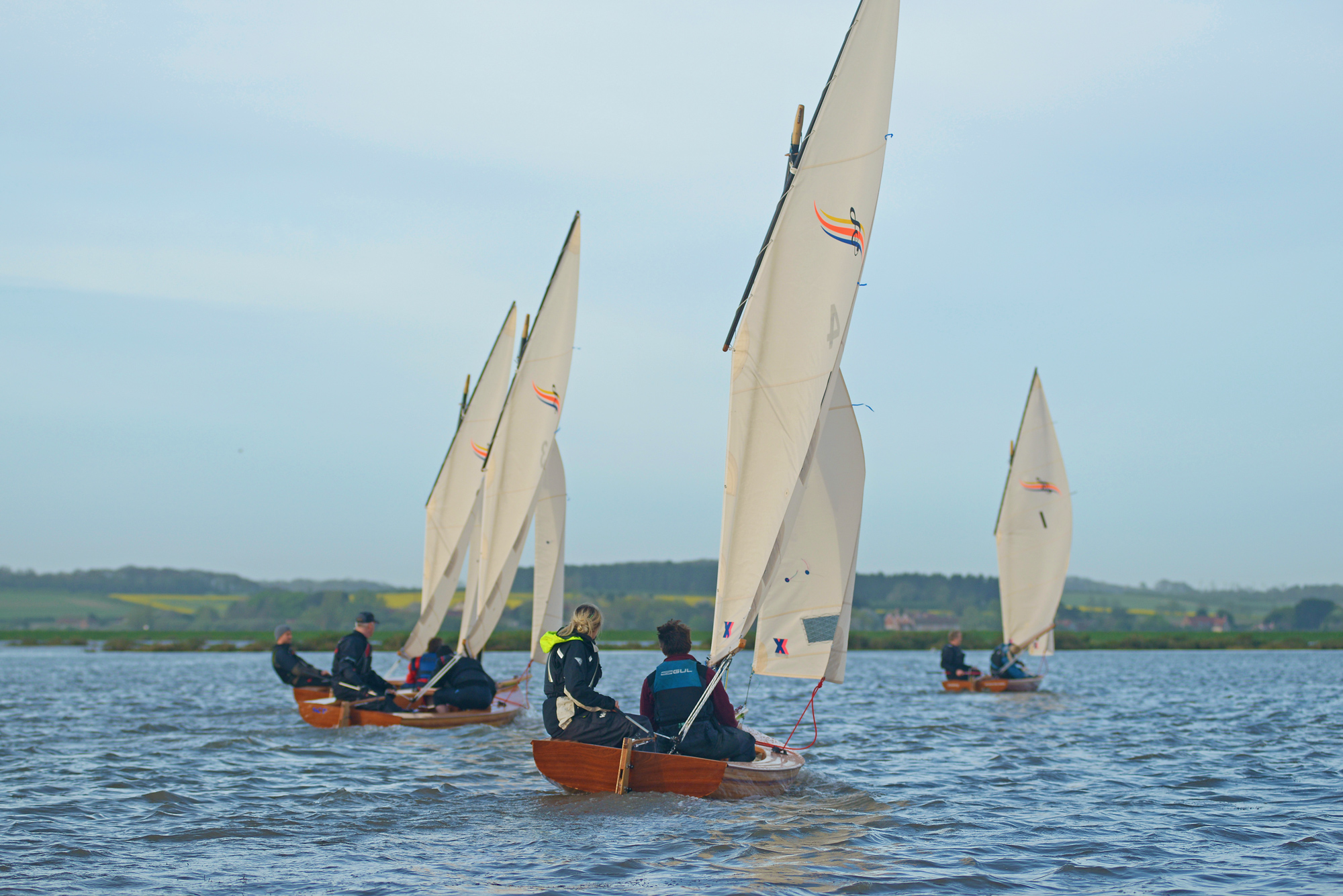
The lug-rigged mainsails are an unusual sight in a modern one-design racing fleet, but the Windsong’s designer, John Owles, is a proponent of the sail plan’s power and efficiency.
The first Windsong was built by John’s wife Maxine during the winter of 2020–21. The hull was strip-planked in western red cedar, fiberglass-and-epoxy sheathed inside and out, with twin buoyancy tanks forward on either side of the mast partners. The mast and yard were in Sitka spruce wrapped with carbon fiber, to produce a lightweight, stiff spar that did not need standing rigging; the boom was box-section Sitka, while the bowsprit was made of solid timber.
Windsong’s sea trials and beyond
The boat’s sail trials were nothing short of spectacular. On its second outing, with sailing instructor Ash Faire-Ring at the helm, the prototype clocked up an astonishing 12 knots in 20 knots of wind. Harry was there to video the scene and later produced some stills, which not only conveyed the boat’s extraordinary speed but also captured the look of delight and incredulity on John’s face as his creation performed beyond even his wildest expectations.
Harry’s videos went “viral” among the local community (population: 134) and John soon received orders for six more boats. A new fleet of one-design dinghies was born.
For the new boats, John made a few alterations based on lessons learned from the prototype. The sheer was raised by 1 1⁄2″ (three strips of cedar). The wood-and-carbon-fiber mast and yard were replaced by locally made carbon-fiber spars, which proved only slightly more expensive and far less bendy than the originals. The boom and bowsprit were made of solid timber, as before. The wooden maststep was replaced by a metal fitting that prevents the mast from jumping out, and a bobstay was fitted to reduce stress on the bowsprit. Last but not least, the self-bailers in the transom were discarded as unnecessary.
Three of the new boats (joined by the prototype) were on the water when I joined them for the inaugural sail. I sailed with Ash on hull #4. Being all bright-finished, the boats are a delight to look at, with gleaming surfaces and complimentary woods in abundance: sustainable West African sapele (transom, thwart, and mast partners), spruce (carlins and inlay in the mast partners), and of course, lots of western red cedar for the hull, and plywood for the buoyancy tanks. The plywood is finished with eight layers of two-part varnish, while the solid timber has six layers of Epifanes microporous varnish.
But, make no mistake: these boats may be beautiful, but they are not confined by tradition. All the running rigging is thoroughly modern with a very efficient-looking mainsheet track running across the thwart and enough dazzlingly bright cordage and fancy blocks to make a racing sailor’s heart sing. The citizens of Burnham Overy Staithe might not aspire to own swanky yachts, but neither do they want their boats to be “cheap and cheerful.”
 Nic Compton
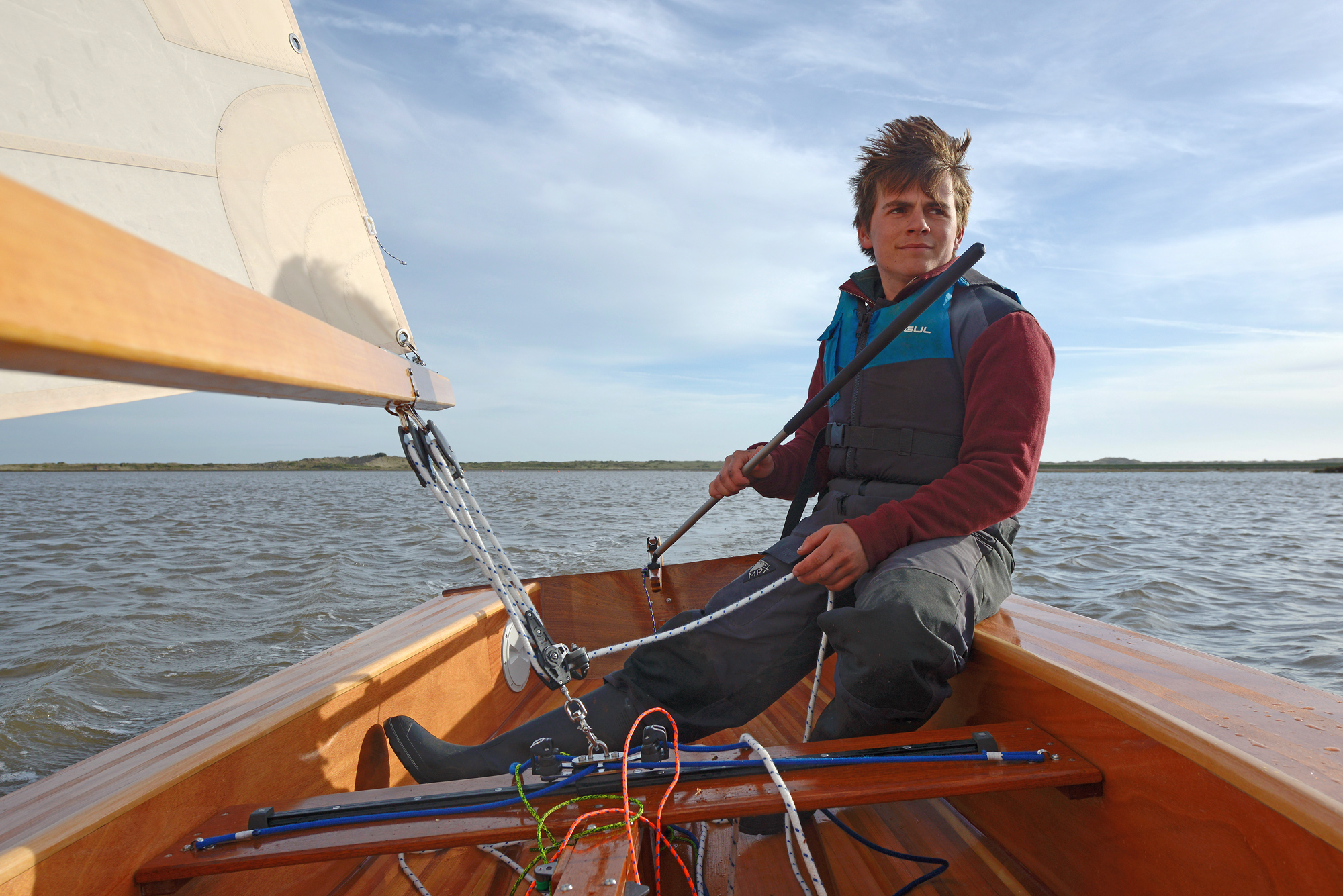
Despite the wooden hulls and standing-lug mainsails—both often perceived as traditional or even old-fashioned—the Windsong is fitted out with modern rigging and hardware from carbon-fiber spars to high-tech blocks and traveler.
In the light airs of that April morning, all four boats were flying jibs to maximize sail area, but the design can be cat rigged by removing the bowsprit and jib and setting the mast in the forward maststep. This allows the boat to sail in stronger winds and to be managed singlehanded without being overpowered.
The mainsail is boomed but loose-footed, which, says John, gives you “a better sail shape, but you do have to control it. It’s all about the clew outhaul and the tack downhaul, which you have to juggle. If there are creases at the throat, you need to tighten the tack downhaul; if there are creases at the clew, you need to tighten the clew outhaul. You set the sail according to the conditions: downwind, you ease off on the tack; if it’s windy, pull in the clew outhaul. You’ll be surprised how quickly she gets on the plane!”
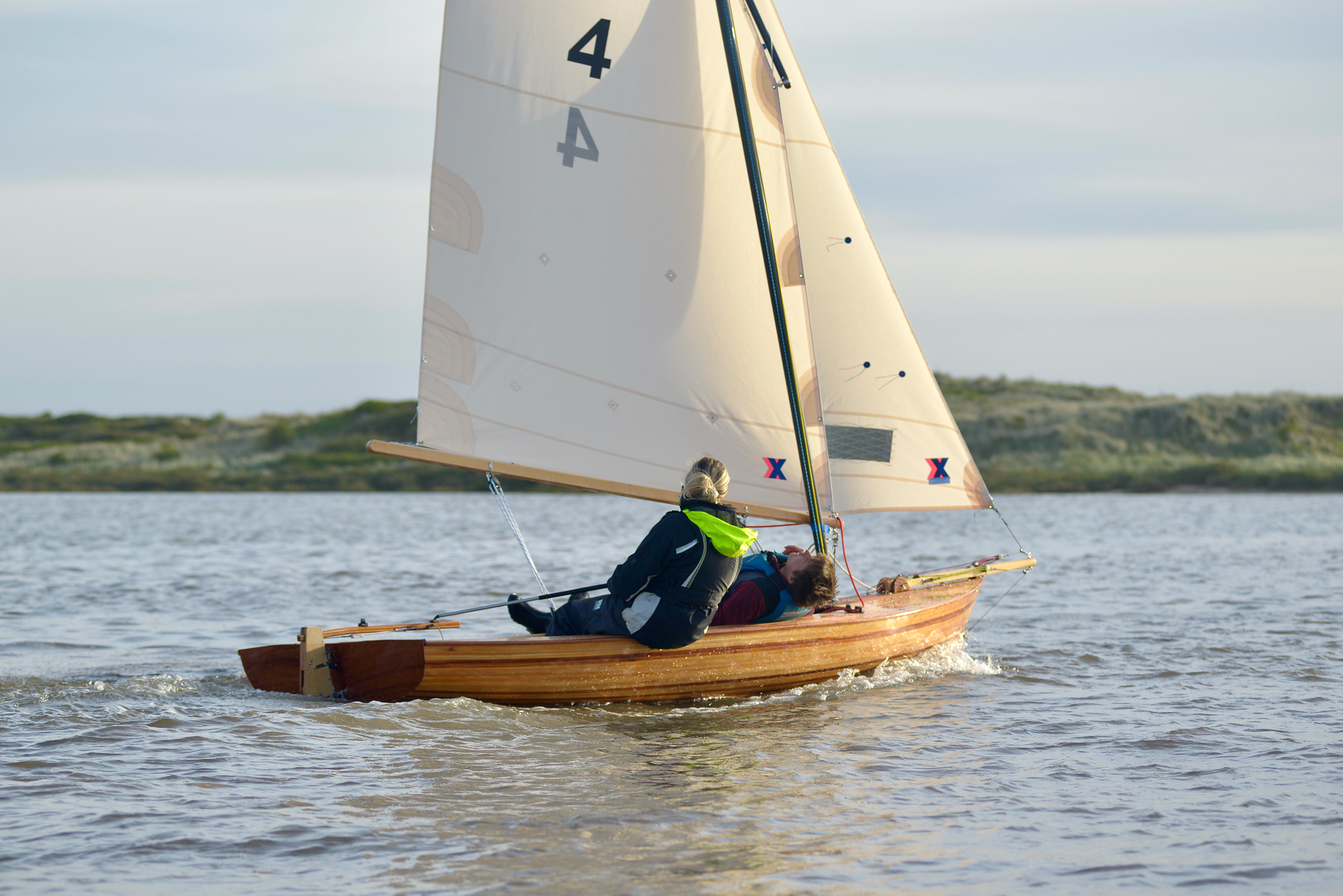
Being designed primarily for racing, the Windsong is very much a boat you sail on rather than in, and even with that extra 1 1⁄2″ of freeboard you wouldn’t want to head out to sea in a chop. Despite the large cockpit, the low boom means that space is a tad restricted and probably best limited to two people. That said, the boat is surprisingly stable, and I was soon dancing around on the foredeck with my camera without causing too much alarm—though such behavior is not recommended by the builders due to the boat’s lightweight construction.
 Nic Compton
Capable of planing and achieving speeds of up to 12 knots in winds of 15 knots or more, the Windsong will also ghost along in almost no wind. Its impressive sailing performance is attracting sailors both young and old to this new class.
Sailing the boat is a joy, as it quickly gathers speed in a breeze. As John puts it: “Usually, you feel a gust coming, the boat tips over, and you adjust to correct it. But this boat doesn’t do that. The hull doesn’t tip over—it just takes off. That’s because the rig’s low center of effort means the wind is converted straight into forward motion instead of heeling moment.”
Since I joined the boats for that inaugural sail, the two remaining boats have been built, bringing the Burnham Overy Staithe fleet up to six, and three more are being constructed by amateur builders in the U.S., two in Wisconsin and one in Florida. What’s more, John and friends are taking two boats on a grand tour of the south coast of England, hoping to spread the word. Something tells me this is just the beginning of things for this unique little boat.
Nic Compton is a regular contributor to Small Boats.
Windsong Particulars
LOA: 15′ 10 1⁄2″
LOD: 14′ 2 1⁄2″
LWL: 13′ 2 1⁄2″
Beam: 5′
Draft
Centerboard up: 4″
Centerboard down: 3′
Approx weight
Bare hull: 138 lbs
Laden: 446 lbs
Sail area
Mainsail: 101.68 sq ft
Jib: 29.97 sq ft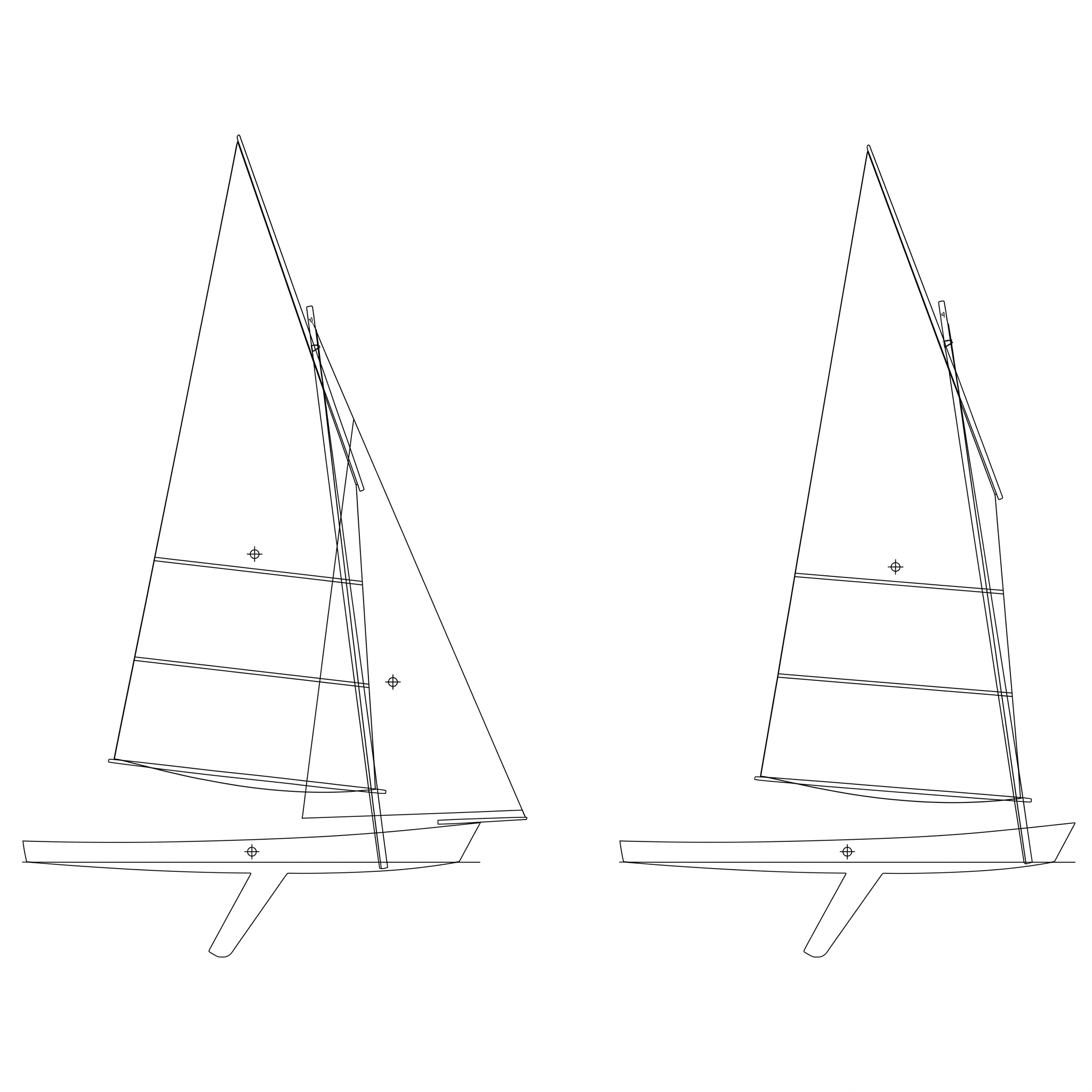 Additional information about Windsong can be found at Windsong Boats Ltd. Finished boats are available in the U.K., and plans can be purchased worldwide: PDF study plans are £25 and full plans, including CNC files for the building jig, bulkheads, and other parts, are £275.
Is there a boat you’d like to know more about? Have you built one that you think other Small Boats readers would enjoy? Please email us your suggestions.
Looking for other lug-rigged sailboats? See:
Morbic 12, a versatile lapstrake dinghy from France.
Periwinkle, a camp-cruiser for oar, sail, and outboard
The Harrier Double-Ender, an eye-catching blend of old and new technology.


Join The Conversation
We welcome your comments about this article. To include a photo with your remarks, click Choose File below the Comment box.