Ten or more men and women dressed in well-worn work clothes sit on wooden benches forming three sides of a square. They chat while sipping on cups of tea and coffee. There is a broad spectrum of ages, but they are clearly at ease with each other. There are several conversations going on, and from time to time laughter breaks out and the chatting stops while everyone turns to share the joke. It’s a typical group of people enjoying a mid-morning tea break. But in today’s fast-paced, high-tech world this is not a typical group: these are the 2026 apprentices and their instructors at The Carpenter’s Boat Shop in Pemaquid, Maine. They have paused, as they do every day at 10 a.m., to enjoy a hot drink, a cookie, and a half hour of relaxation.
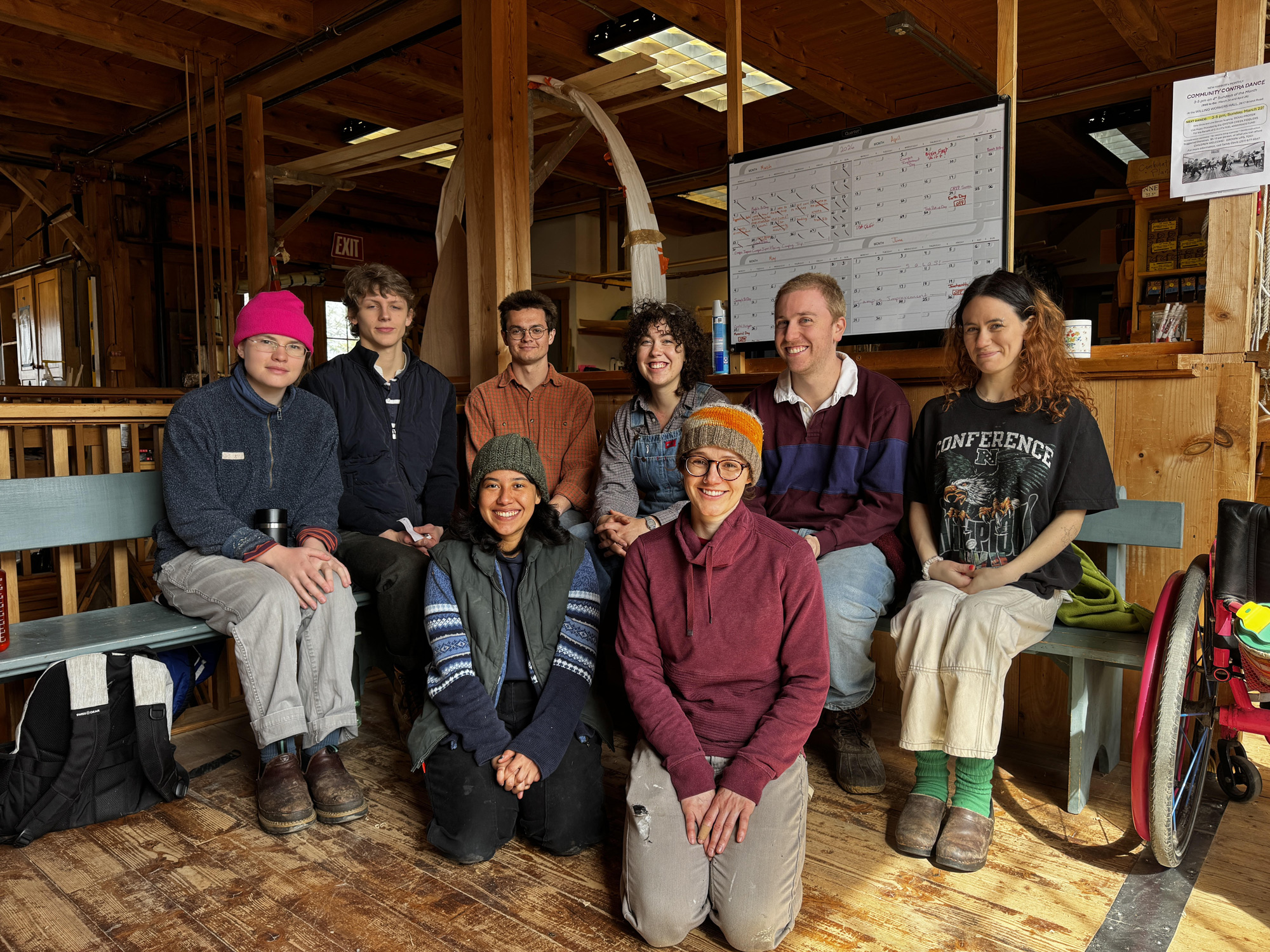 Courtesy of The Carpenter’s Boat Shop
The class of 2026. Back row from left to right: Laurel McLaughlin, Rocco Pumphrey, Chase Weeks-Purdy, Maple Perchlik, Harry Levine, Ruby Joy Baron; front row from left to right: Marisa Rain Rodriguez, Colleen O’Laughlin.
It is late April and I have driven down the peninsula through a light mist to visit for a couple of hours. The apprentices met for the first time when they arrived on campus in March; they will stay together, living and working as a community, through November. In those nine months they will become boatbuilders, learn to sail, help out around the local community, and support one another through a unique journey. Their stay at The Carpenter’s Boat Shop is free—they pay nothing for their board, lodging, and education. But they come armed with curiosity, a willingness to work hard, and an enthusiasm for woodworking and boatbuilding.
The Carpenter’s Boat Shop is one of Midcoast Maine’s best-kept open secrets. Situated down a long side road off a miles-long state road that winds through a rural landscape from Damariscotta to Pemaquid Point on Muscongus Bay, it was founded almost 50 years ago by Robert “Bobby” Ives and his wife, Ruth. For some years, Bobby and Ruth had been living and working as ministers and teachers on Maine islands, first Monhegan Island, then Louds Island in Muscongus Bay. It was on Monhegan that Bobby first came upon the Monhegan Skiff, a small boat that would alter the course of his life. “The island’s fishermen used them to row from the rocky shore to their lobsterboats,” he says. “They were their ‘donkeys of the sea,’ and they were vital to their working lives. I thought they were beautiful, but I had no idea they would become so entwined with my life.”
 Jenny Bennett
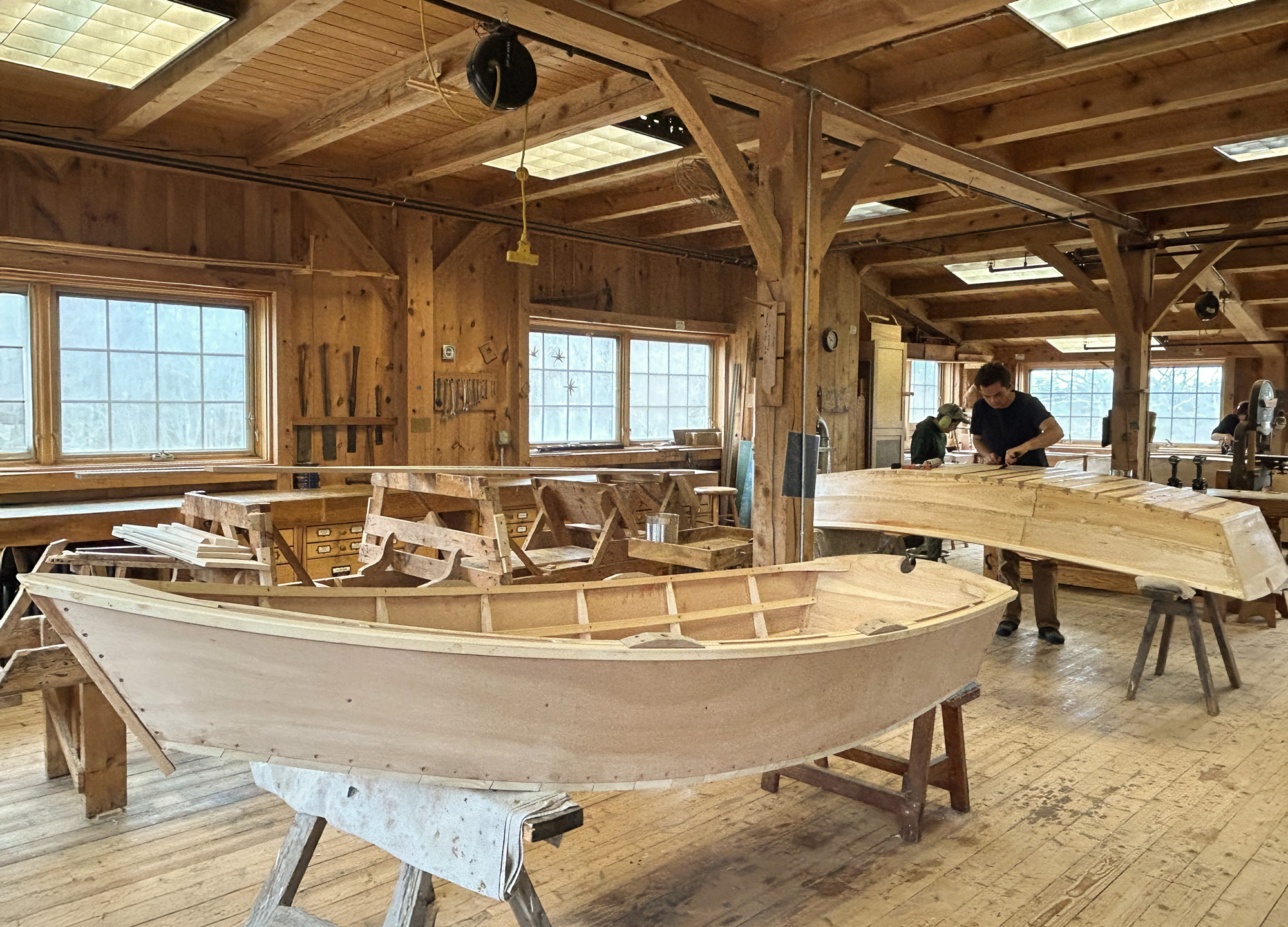
The main workshop is on the second floor of a timber-frame building raised in four days by Amish builders in 2018. After introductory projects—building a toolbox and a footstool—the apprentices work together with Bobby Ives to build a new Monhegan Skiff and then work in groups of twos or threes to build their own skiffs. The skiffs vary in construction: some are all cedar, with planked sides and bottoms; some are all marine plywood; and some, like the skiff in the foreground of this picture, have cedar bottoms and marine plywood sides.
In 1979, Bobby and Ruth and their three children moved back to the mainland, a few miles inland from Muscongus Bay. They had decided to set up an apprenticeship program “dedicated to the enterprise of building boats, nurturing lives, and helping others.” They bought an old farmhouse in Pemaquid and invited a group of apprentices to come live with them and learn how to build boats. Their first was a peapod, their second a Monhegan Skiff.
The Stanley family had been building Monhegan Skiffs on Monhegan since Will Stanley Jr. designed and built the first one in the early 1900s. When Bobby and Ruth were establishing The Carpenter’s Boat Shop in 1979, Will Stanley’s grandson, Ronnie, asked if they’d take on the role of building skiffs for the fishermen when they needed them. Bobby was honored and Ronnie passed on his plans and a bevel board containing all the angles, bevels, and dimensions for the 9′ 6″ and 11′ 6″ skiffs. The Carpenter’s Boat Shop had its keystone.
 Jenny Bennett
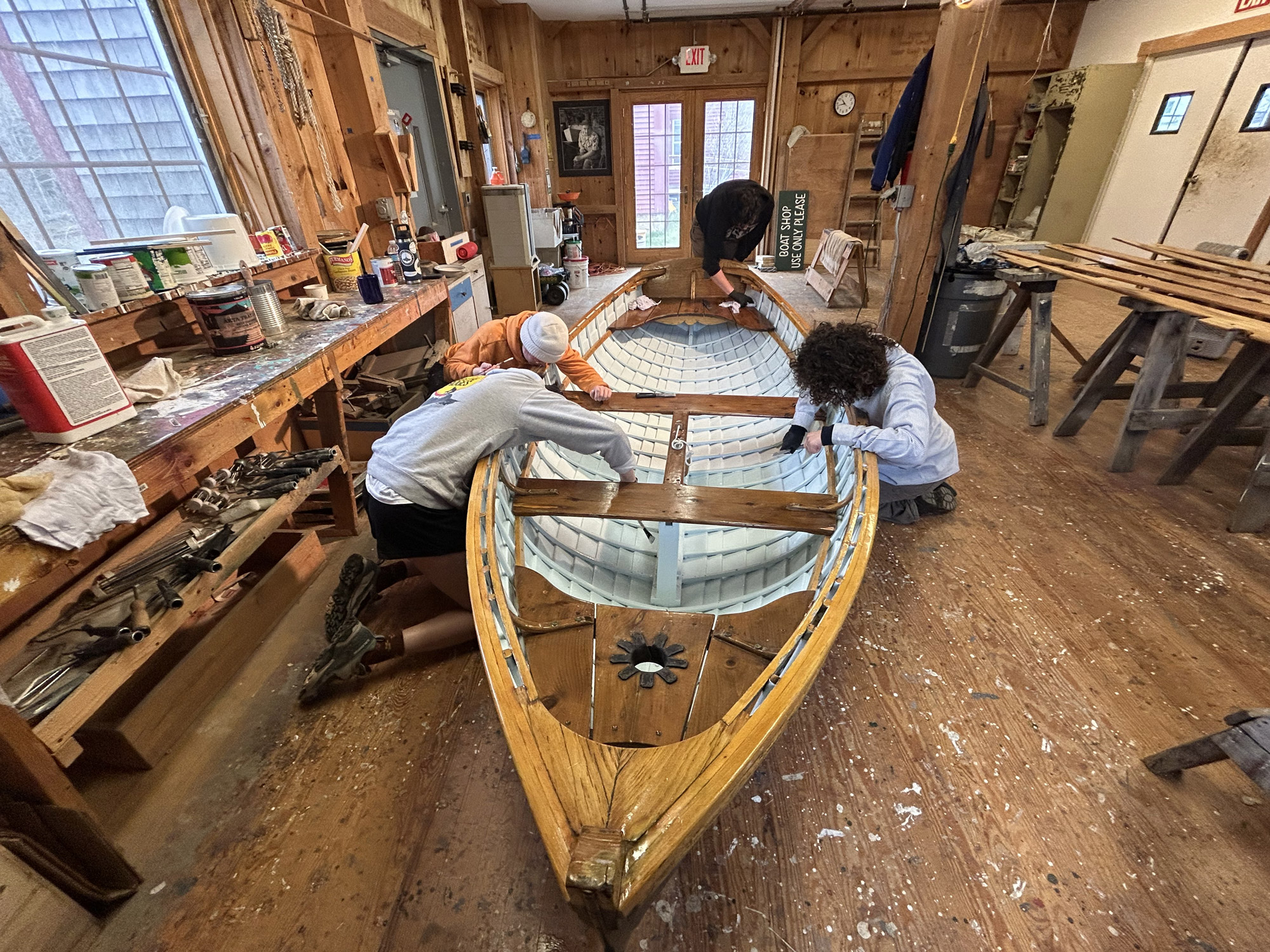
In the paint shop below the main workshop, apprentices and instructor Sozo Pumphrey (at the stern) work on restoring a customer-owned Catspaw Dinghy, readying it for the coming season.
In the early days, apprentices came for two years at a time. They lived with the Ives family, and learned boatbuilding from Bobby and his mentor, retired Norwegian boatbuilder Edvard Salor, with Bobby bringing an element of religious practice to the day-to-day. Over the next 47 years the program and offerings have evolved. Today’s apprentices come for nine months instead of two years, they no longer live with the family—although they do still live on the campus—and, says Interim Executive Director, Luke O’Neill, “the structured religious element has gone but there is still a strong spirituality, a sense of service, community, and mission. Bobby retired from running the shop a few years back, but he still teaches the Monhegan Skiff, and his ethos is still woven into the fabric of the organization. He wanted to create a community of people who came together through working with their hands.”
While the main hands-on focus of The Carpenter’s Boat Shop remains boat building and restoration, the organization has branched out to host artists in residence, and to offer furniture-building classes, open-enrollment woodworking classes, kids’ carpentry classes, and a virtual speaker series, and the doors are open to an ever-evolving group of volunteers who come in twice a week to build Adirondack chairs, kids’ wooden toys, and the occasional boat. There is also the work in the wider community. “There are a lot of folks who don’t always have the opportunity or the means to take care of things,” says Luke. “So we help out. We split, deliver, and stack firewood, we helped a neighbor to paint their barn, we fix things that need fixing. Everyone gets involved—apprentices and staff alike.” And it is that philosophy of giving back and caring for others that has fueled The Carpenter’s Boat Shop for its half century: 90% of the organization’s funding comes through donations.
 Jenny Bennett
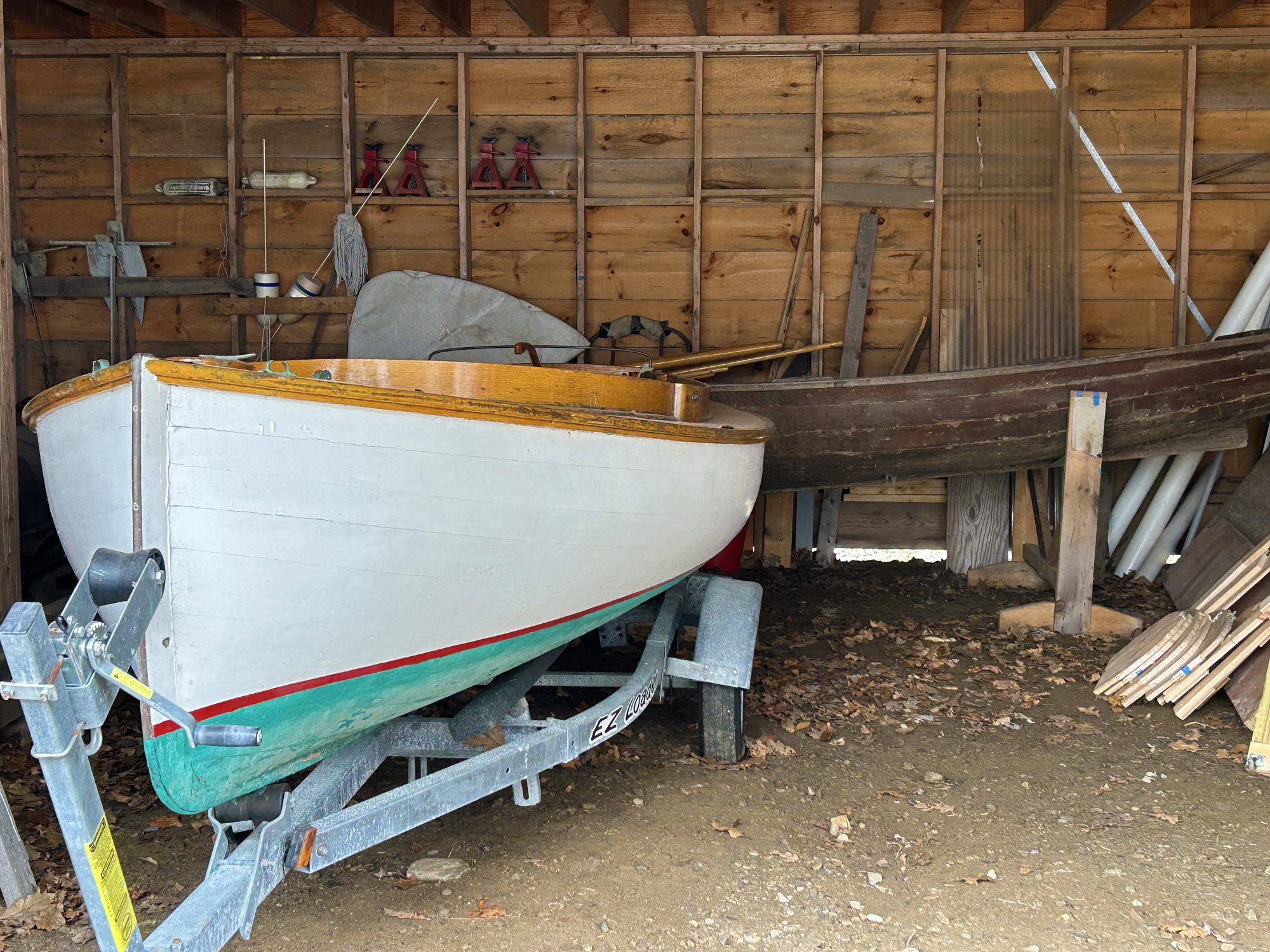
The Carpenter’s Boat Shop stores and maintains a few privately owned local boats over the winter, and accepts donated boats—some to be restored by apprentices, some to be sold as is.
The 2026 apprentices have come from near and far: from New York, Pennsylvania, Virginia, Vermont, Indiana, Maine, and Florida by way of Oregon. Their ages range from 18 to somewhere in their 40s. One apprentice is fresh out of high school; others have been working for many years. All have come to learn. Colleen, a professor of chemistry and biochemistry from Gardner, Maine, looking for a change in direction, came to volunteer, and fell in love with the place. Marisa, from Pleasantville, New York, heard you could “do carpentry and sailing as a duo, and I loved that and the idea of community and working in a shop every day.” Harry, from Brooklyn, New York, “read a book in which Bobby had written a foreword describing The Carpenter’s Boat Shop. I loved how he wrote about the place, it sounded amazing. I was at a crossroads, so I applied.”
The group’s skill level, too, is varied. Some have a modicum of woodworking experience; others, like Harry, have none. “I didn’t even know how to hold a drill or a screwdriver,” he says. “Some of the tools are still a mystery. But I know what cherry looks like now.” He turns to the group for confirmation. “The slightly red one, right?” he says. “Right!” they chorus back. Harry grins. They have been together for only a few weeks, but already they are becoming a family.
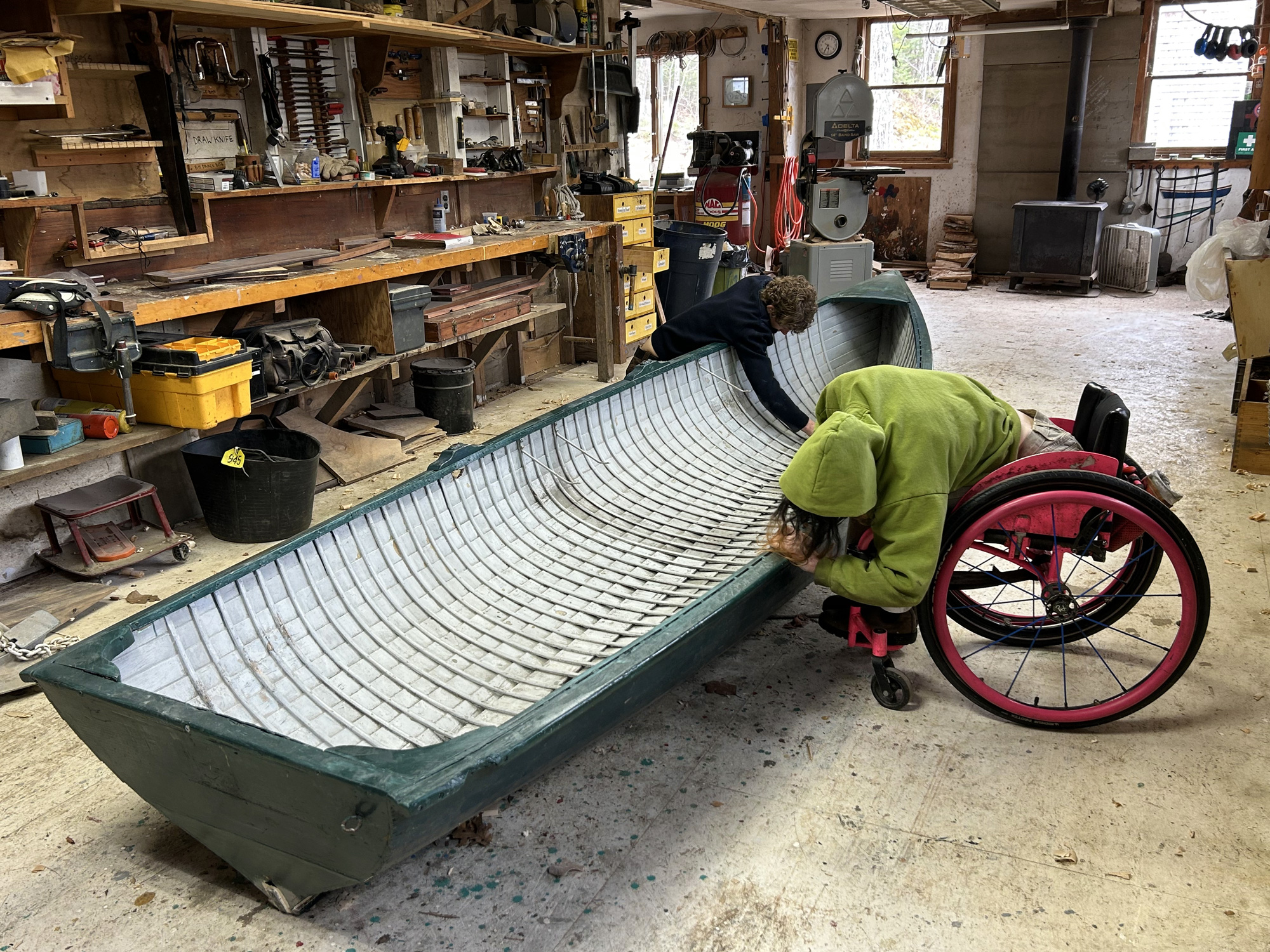 Jenny Bennett
In the restoration shop, apprentices Rocco Pumphrey and Ruby Joy Baron work on an early-1900s Rangeley Lake Boat.
Before Luke took on the role of Interim Executive Director, he asked Bobby to describe what was important about The Carpenter’s Boat Shop. “Apart from the message of community and service, he told me, ‘I want it to feel like home.’ And it does. This place is a home. People return. Past apprentices and volunteers stop by to visit, to share a meal. There’s always a place at the table. Our staff have nearly all been here as apprentices. People come back to reconnect and re-energize. But Bobby’s philosophy is that you can create that for yourself anywhere, you don’t have to come here to get it. You start small, focus on loving, work hard, do something, learn something, work together, and make something beautiful. Beautiful, not perfect. We work hard to build really good boats, not perfect boats.”
Since 1979, The Carpenter’s Boat Shop has built well over 200 Monhegan Skiffs, as well as other small boats of varying types, and many hundreds of toolboxes and step stools—the initial projects for every apprentice. But more than that, it has touched and changed countless lives, and continues to do so.
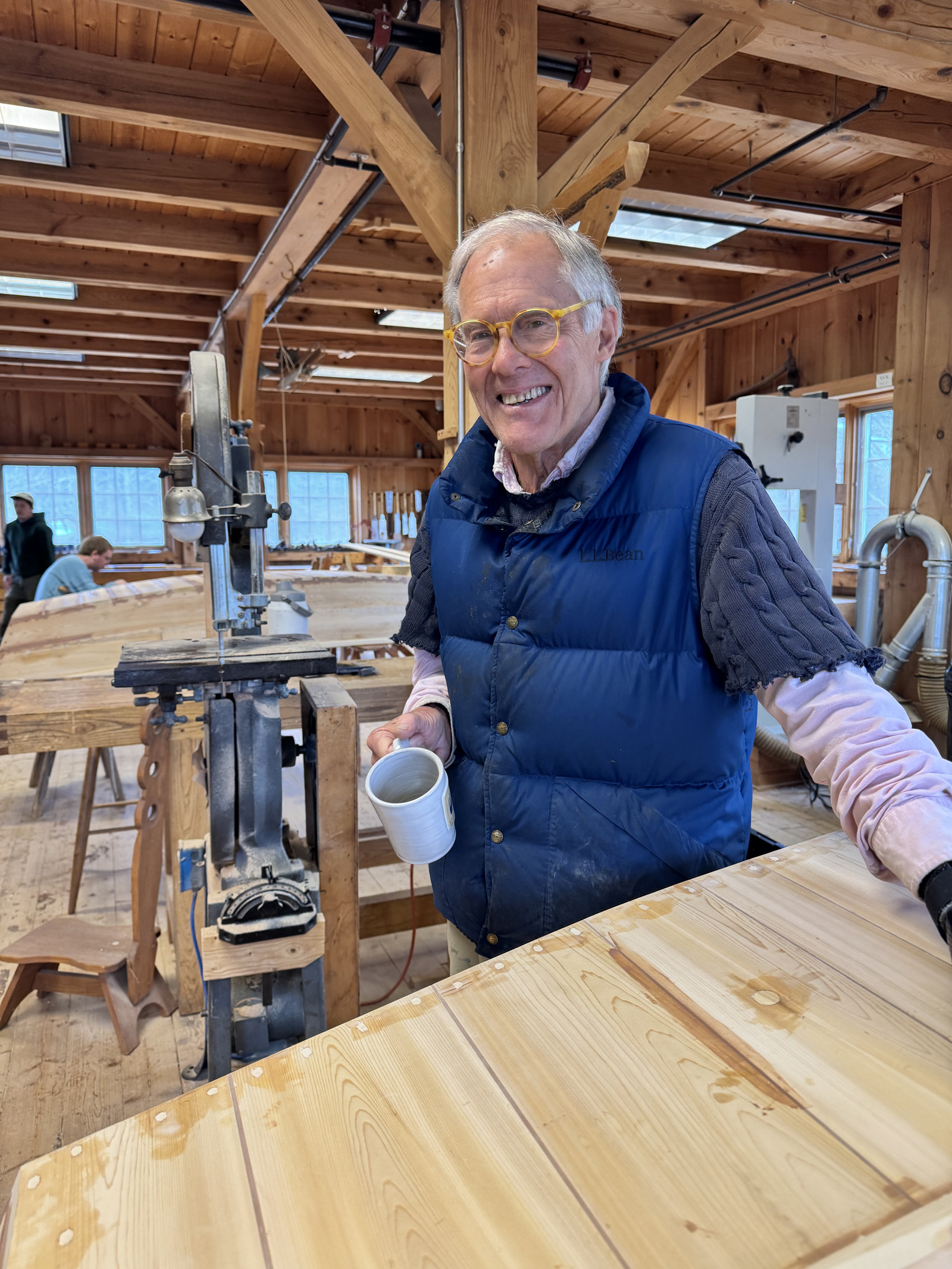 Courtesy of The Carpenter’s Boat shop
Robert “Bobby” Ives, founder of The Carpenter’s Boat Shop, still teaches and joins the crew most days for morning tea.
Ruth Ives died in 2006, at the age of 59, but Bobby, now nearing 80, still teaches at The Carpenter’s Boat Shop, still nurtures the people who come to share his vision and love of boats, and still smiles broadly as he walks with apparently boundless energy through the buildings and grounds of a place that undoubtedly feels like home.
With thanks to the staff and apprentices of The Carpenter’s Boat Shop for sparing valuable time in their busy day.

Thank you for sharing this about the Carpenter’s Boat Shop. It is a very special place – to the apprentices, the many staff that have contributed over the years, the volunteers, and to the community on the peninsula. Its focus on a balance between learning boatbuilding, personal reflection and growth, building community, and service to others makes it a place that people gravitate to – a place that tries to “walk the talk”. I appreciate reading about it here!