If you do a lot of boating, it’s possible, even with the best intentions, to get caught out in the dark—indeed, for adventurers, the dark can be the best time of the day. My family’s sail-and-oar cruiser, TOTORO, has no auxiliary motor power and is 18′ long. To meet U.S. Coast Guard regulations, between sunset and sunrise we are required only to carry a white light, and to exhibit it “in sufficient time to prevent a collision.” But as I’ve grown more comfortable with our local cruising grounds I have found that the ability to boat safely at night opens an entire new world to explore, just past my front door. Proper navigation lights, while beyond the USCG requirement, add an important measure of safety to these outings.
After some research I decided that the Navilight Dinghy Complete light kit from Navisafe was all we needed. The kit comprises two puck-shaped lights: one an all-around white light, the other a tricolor. The illumination for both comes from a ring of 32 LED bulbs that encompasses the center of the puck. Both lights are USCG-approved as visible for 2 miles, and each is powered by three AAA batteries for a claimed 12–72 hours, depending on mode; I have run each light on “bright” for at least 20 hours and have yet to need replacement batteries.
 Photographs by the author
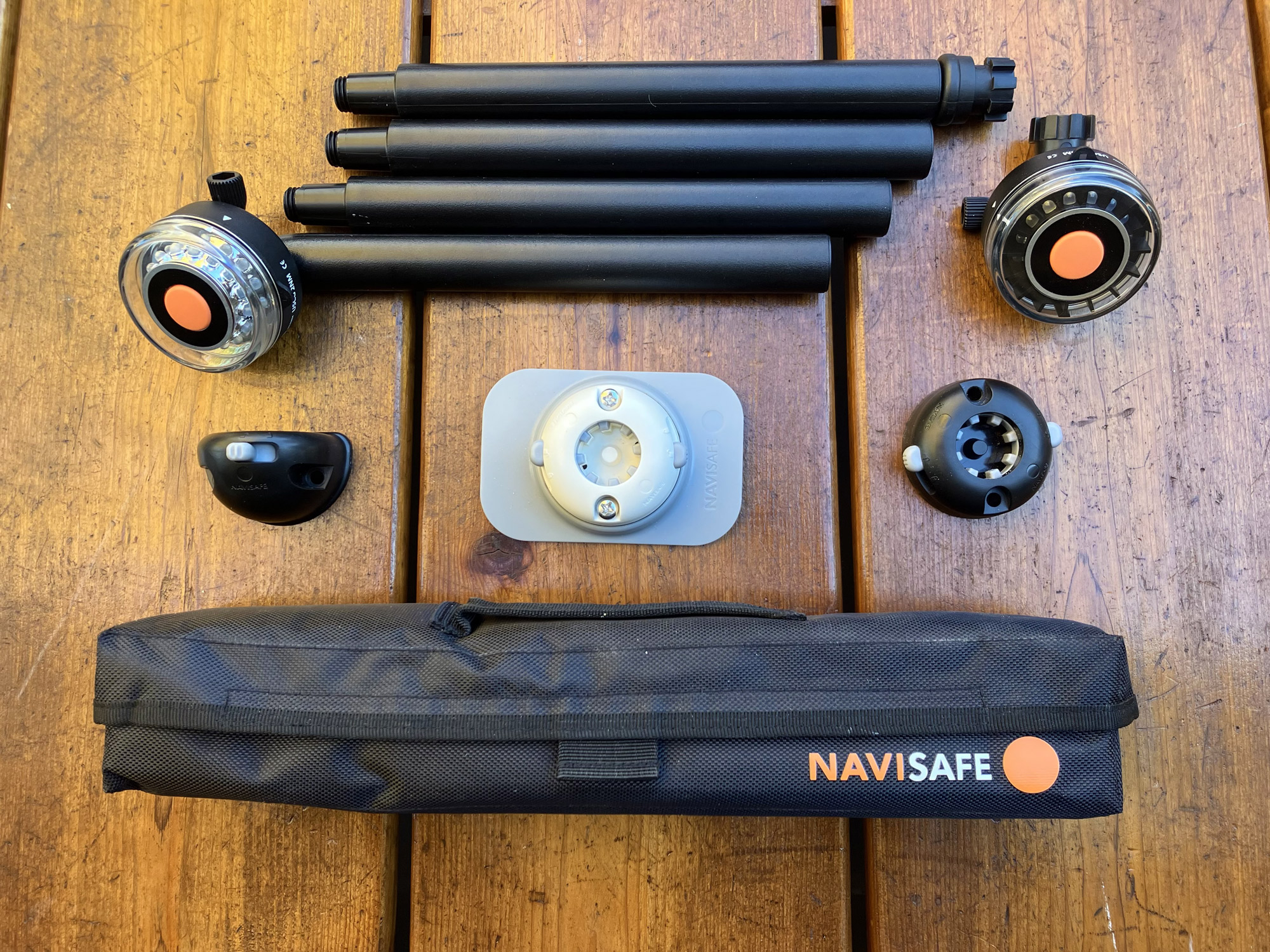
The Navilight Dinghy Complete kit comes in a convenient nylon packing bag and includes the sectioned pole, one tri-color and one all-around-white light, two quick-release horizontal brackets—one for hard-surface installation (right), the other for mounting on an inflatable (middle)—and one vertical bracket (left).
Each light is activated by pressing an orange push-button in the center of the puck. Subsequent presses allow the user to cycle through the different modes: for the white light, there is all-around illumination; 225° or 135° of the circle; a flashing all-around; and a power-saving “cabin light” mode that uses only eight of the 32 LEDs. The tricolor light offers a 120° segment of each of the three lights—red, green, and white—and can be cycled through full tricolor, only red and green, or each color separately.
The Navilight Dinghy Complete set comes with its own mounting kit. There are three Navimount bases offering different application options: a vertical base and two horizontal bases for deck-mounted lights. One of the horizontal bases is flat and can be screw-fastened to a hard surface, while the other has a slight radius and a self-adhesive sticker suitable for attachment to Hypalon, polyethylene, or PVC, making it ideal for use on inflatable boats. Any of these bases can be directly connected to either of the lights, with or without a four-section 1m pole.
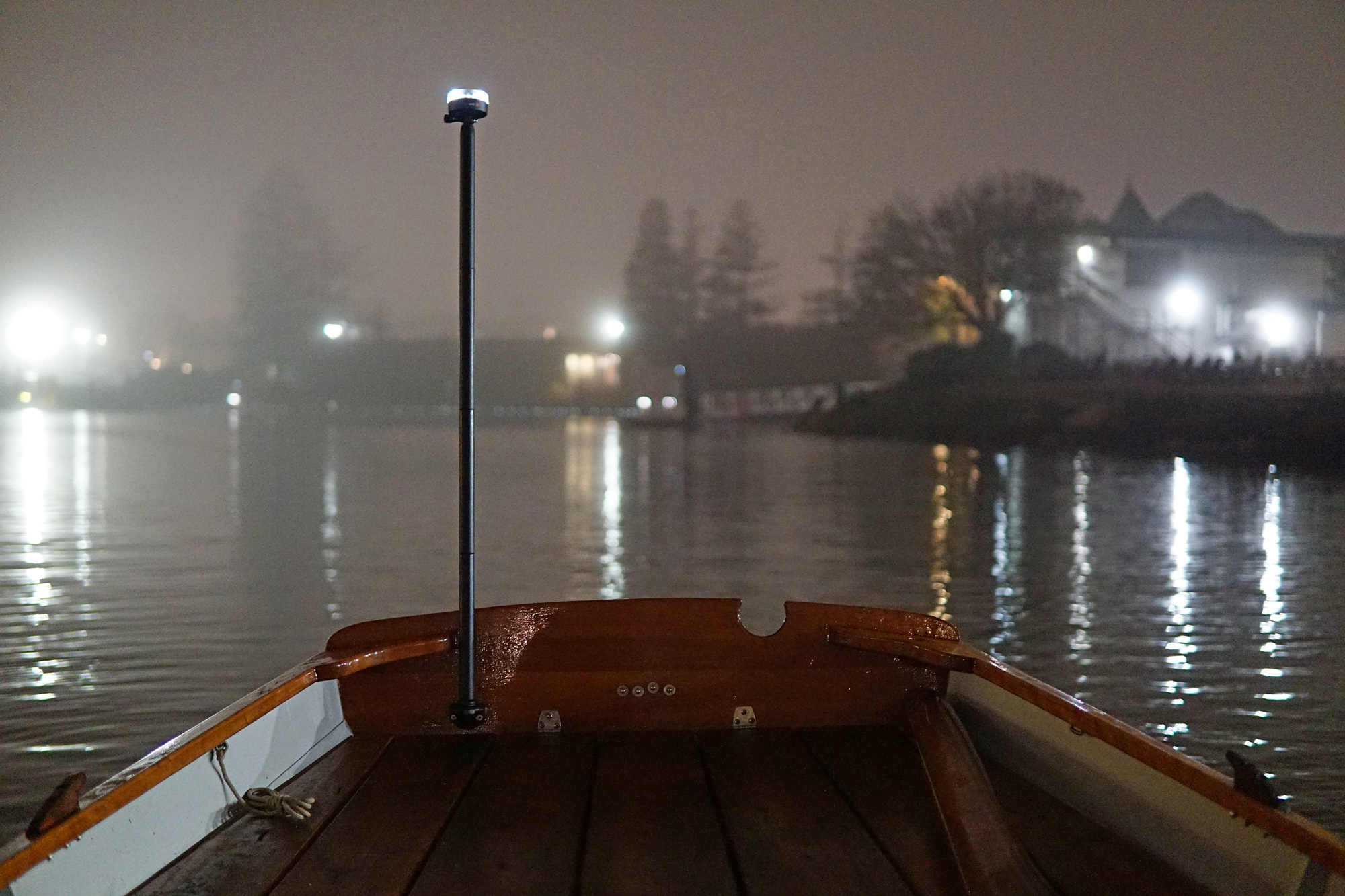
The all-around-white light serves as an anchor light, and as a stern light when underway. Mounted on the 3′-long pole, its raised position makes it more easily visible from a distance. With several distinct modes—all-around flashing, power-saving cabin light, and solid-white light through 360°, 225°, or 135° of the circle—it can be used for multiple purposes.
When not in use, I store both lights in the compact nylon bag that comes with the kit. I leave the tricolor attached to its Navimount connector—a custom fitting that attaches to the underside of the light to slot into the base where it is locked in place by a quick twist of a lever. I store the white light attached to the top pole section. When the stern light is needed, I screw together the four pole sections and lock the lowest into the Navimount base, which is mounted on the interior face of my transom, off-center so that the pole does not impede the full swing of the tiller. When sailing or rowing, I run the bow light in red/green mode and the stern light with 135° illuminated, facing aft. Because the stern light is elevated above head level, it is much more visible to traffic and less harmful to my night vision. At anchor, I turn off the bow light and convert the stern light to an all-around anchor light.
On the company’s website, Navisafe says that both lights, while rated at IP67 (submersible to 1m for 30 minutes), are “waterproof by design, submersible to a depth of 20m (66′), and float with the light facing upwards.” When I tested them I found that both lights did, indeed, float upright in fresh water. However, the poles did not float, while a light mounted on a single pole section just floated with the light on the water’s surface and the pole beneath. After submerging the lights, I saw no sign of any water ingress.
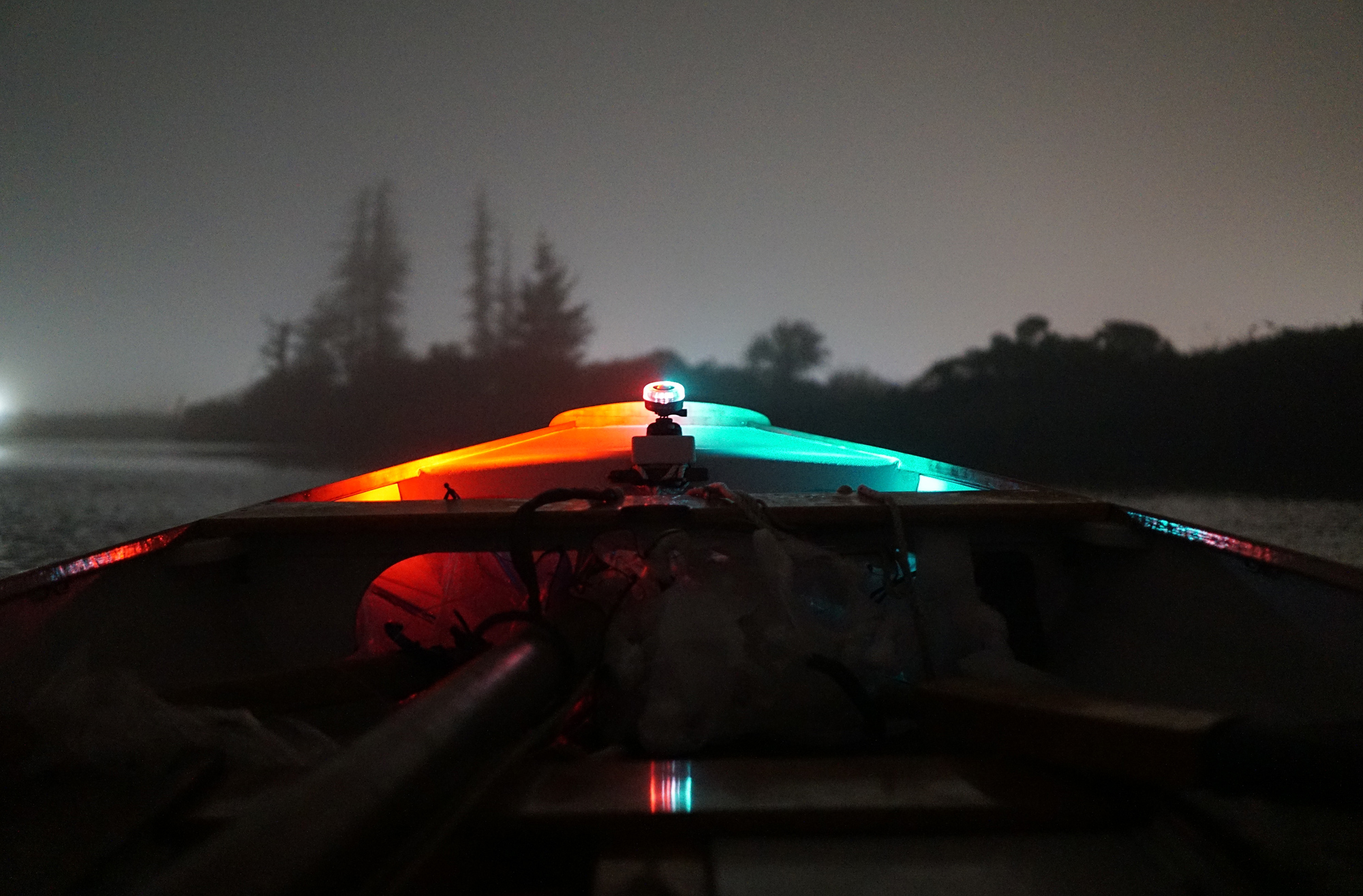
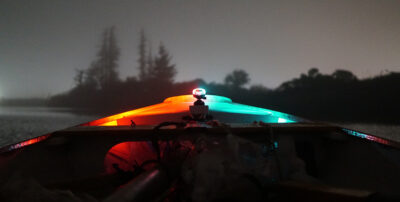
I have the tricolor mounted on a removable block on TOTORO’s foredeck. Like the all-around white light, the tricolor has various modes and can be cycled through tri-color, red and green together, or each color separately.
The website recommends only non-rechargeable batteries. I avoid using disposable batteries, so reached out to Navisafe to ask about this recommendation. I was told that, in order to be USCG and EU MED (Marine Equipment Directive) certified, the lights must maintain a visibility of 2 nautical miles. The Navisafe lights achieve this when tested with, specifically, three non-rechargeable 1.5V batteries to provide a 4.5V power supply. Because rechargeable batteries can provide a lower voltage per cell, the total supply could fall below the required 4.5V, which can cause the light intensity to drop below legal safety limits.
The Navilight Dinghy Complete lights are by no means the least expensive small-boat lighting option on the market. But they are well constructed of high-quality material, their design is extremely user-friendly, and their illumination is powerful. Also, Navisafe’s customer service is impressive. When I contacted them about the batteries, they replied with a comprehensive answer within 24 hours. I have wasted a fair amount of money and time on poorer-performing cheaper alternatives, but am confident that money invested in the Navilight Dinghy Complete lights has been money well spent.
James Kealey is a teacher and avid outdoorsman living in Richmond, California.
The Navilight Dinghy Complete is available from multiple online and marine outlets and direct from Navisafe, price $237.
Is there a product that might be useful for boatbuilding, cruising, or shore-side camping that you’d like us to review? Please email your suggestions.
For other light sources, read these reviews:
Small Boat Navigation Lights, lights for kayaks and other small boats
ResQFlare, a USCG-approved substitute for pyrotechnic flares
AR-Tech LED Flashlight + Lantern, a floating waterproof light with five functions including a red light.





I make my living on tugboats in NewYork Harbor. I used to be involved with a boat building group in Manhattan called Floating the Apple. From the perspective of a wheelhouse 30’ in the air lights that are mounted low on small boats are useless. Wind on tide and a chop of a couple of feet use k mounted lights on a rowboat disappear in the troths . The kayakers with lights on their heads have a death wish. Lights should all be at least six feet above water .