Camping onshore is one of the pleasures of small-boat cruising, but it’s not uncommon to land somewhere that has no established campsite. If there’s no surface suitable for pitching a tent, sleeping can be very uncomfortable. A camping hammock, equipped with mosquito netting and a rainfly, can provide comfortable overnight shelter on many inhospitable shores. I’ve spent pleasant nights in a hammock in many places well off the beaten path: a dilapidated house with rainwater pooled on the floor and bats hanging from what was left of the ceiling; a small clearing in dense thicket littered with rusty cans and broken bottles; a wooded shore so steep it had to be scaled on all fours; a boulder-rimmed cove; even a tropical island where there were so many nocturnal crawling things that their tracks obliterated all of my footprints in the sand.
My favorite camping hammocks are made by Hennessy Hammock of British Columbia. Founder Tom Hennessy, an industrial designer, brought his first hammock to market in 1999. I met him the following year when he was exhibiting at a sea-kayak symposium in Port Townsend, Washington. I was impressed by the hammock’s simple setup; the novel bottom entry; the comfort; the protection from wind, rain, and insects; and the compact size of the stuff sack. I bought four of them, one for every member of my family. When I got home, I did a strength test: the hammock’s stated weight limit was 250 lbs, yet with three of us aboard—a combined weight of 435 lbs—no damage was done and, surprisingly, while we were undoubtedly crowded, we were comfortable.
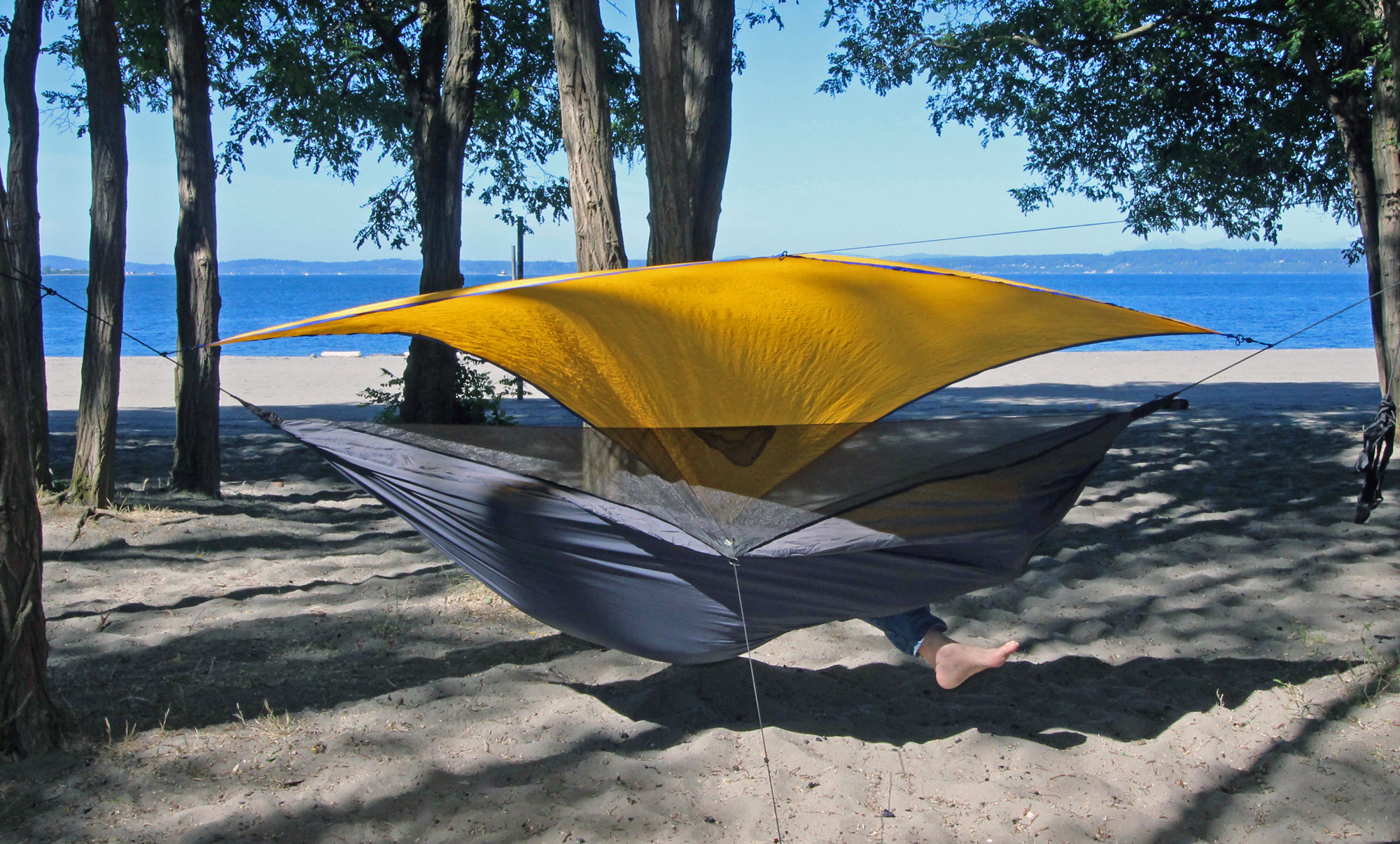 Photographs by the author
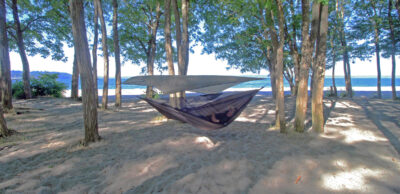
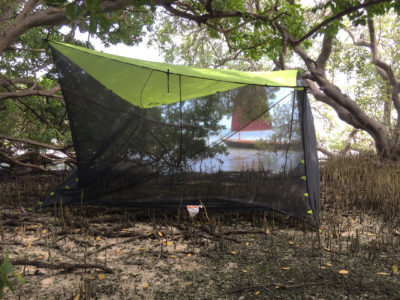
A bottom-entry Hennessy hammock offers well-balanced quick entry, and, as a result, a minimal risk of allowing mosquitoes in. The opening closes after the second foot gets through. Here, the near corner of the fly is elevated, but it can be lowered if sheltering from the wind is preferred to having a view.
I now have four more recent models of the Hennessy hammock of which three, like the original, are bottom entry. At the foot end, there is a reinforced 4′ 6″ slit in the fabric through which you enter head-first, before turning around to sit in the middle of the hammock and then draw your legs inside. The tension of your weight brings the edges of the slit together and a hook-and-loop fastening holds them closed. My one side-entry hammock has a full-length zipper between the mesh and the hammock fabric on one side.
Setting up a Hennessy hammock is easy. The ends are secured to a ridge line so that the distance between them is fixed and the hammock is held in the right configuration no matter how far apart the support trees may be. Webbing straps wrap around the trees and protect their bark, and support ropes tied to the straps center and tension the hammock. The rainfly clips into prusik-hitched loops around the support ropes, and guys spread the tarp and hammock sides. It takes me about 3 1⁄2 minutes to set up the hammock, and 2 1⁄2 minutes to take it down again, including getting both hammock and fly back into the stuff sack.
Sleeping in any unfamiliar bedding takes some getting used to, and hammocks are no exception. With the bottom-entry design I have to get into the hammock, then work my way into my sleeping bag and onto my insulating pad—a process made difficult by the lack of friction between the nylon material used for hammock, sleeping bag, and pad. With the side-zipper access it is possible, at least, to arrange the bedding before you climb in. Hennessy has further simplified the setup by offering optional insulating systems that either hang beneath the hammock or are anchored inside it.
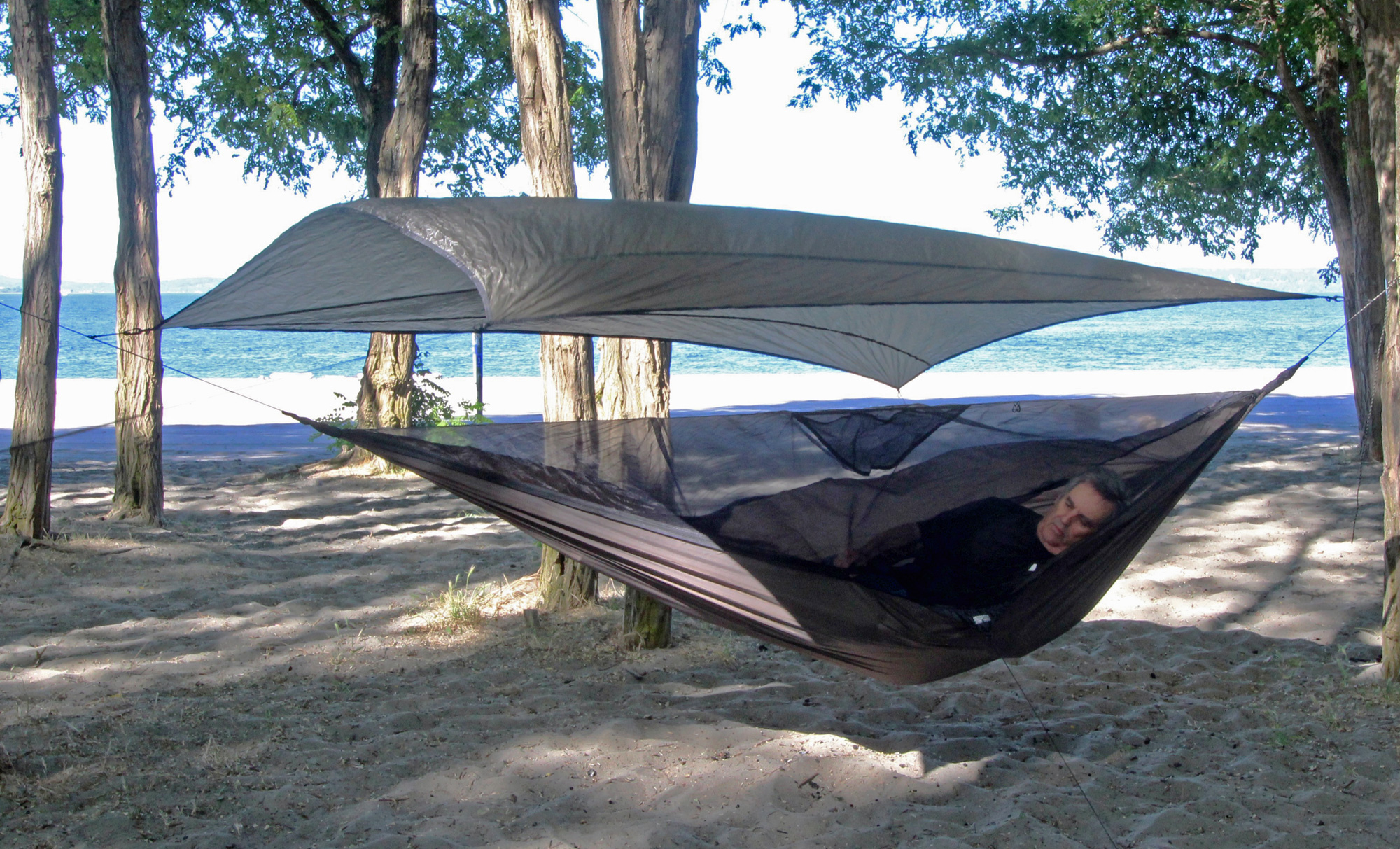
Having just entered a side-entry Hennessy hammock, I’m about to zip up the mosquito net, and will then settle into the hammock on a diagonal to get a straight back-friendly sleeping position. Note the mesh bag hanging from the ridgeline, providing a handy place for keeping glasses, flashlight, and any other night-use equipment.
The hammocks are designed for sleeping on a diagonal, with your feet off to one side of center and your head and shoulders to the other. This provides a nearly straight, horizontal line of support, making it comfortable, especially for side sleepers.
Hennessy now offers 25 different camping hammocks in five different sizes to fit anyone, from users under 5′ 4″ and 120 lbs to adventurers up to 7′ tall and 350 lbs. All have the asymmetric shape for sleeping comfort, the structural ridgeline for quick and consistent setup, and either bottom or side entry. There are Jungle and 4Season models with two-layer bottoms to accommodate optional reflective bubble pads or even spare clothing for insulation. The weights of the hammocks range from the 28-oz Hyperlight Backpacker with its lightweight silnylon (silicone-impregnated nylon) fly to the 4Season Survivorman Zip XL that weighs 5 lbs 9 oz and has a large hexagonal rainfly, double bottom, and survival kit.
The original hammock, now called the Expedition Classic, is still available. The four I bought 26 years ago are still in good shape, as are the other four models I own, and I have spent many pleasant nights feeling both comfortable and well-protected in my Hennessy cocoons.
Christopher Cunningham is editor-at-large of Small Boats.
Hammocks and accessories are available directly from Hennessy Hammock in prices ranging from $99.95 for their smallest kid’s hammock to $359.99 for the 4Season Survivorman Zip XL. Some Hennessy hammocks are also available from outdoor-equipment retailers.
Is there a product that might be useful for boatbuilding, cruising, or shore-side camping that you’d like us to review? Please email your suggestions.
Interested in other great camping gear? See:
Flextail Max Shower, when all you really want is a fresh-water shower at the end of a long day on the water, reviewed by Chris Cunningham.
Smart Bottles, flexible, collapsible water containers, reviewed by Ben Fuller.
Mantus Headlamp, a submersible, rechargeable, durable headlamp for using on board or around the camp, reviewed by Anne Bryant


Join The Conversation
We welcome your comments about this article. To include a photo with your remarks, click Choose File below the Comment box.