Clint Chase of Portland, Maine, is far from the first small-craft designer to find inspiration in the marvelous “faerings,” or four-oared boats, of Scandinavia, and he certainly won’t be the last. But with his Drake rowboat design of 2009, he seems to have captured the point of the ancient workboat type in a way that works especially well for a particular kind of recreational user today: the oarsman.
He does so by making no pretense of trying to make the boat something that it is not. This boat isn’t going to sail well to weather. Period. The key to successful enjoyment of the type is to refrain from asking or demand- ing that it do so. Trying to graft a modern racing sloop capable of tacking through few compass degrees onto the historical roots of a faering has rarely worked well, and the attempt often merely corrupts the virtues that draw our attention to such fine craft in the first place. This design is for someone who is not at all afraid to break out the oars, since it is, first and foremost, a rowing boat.
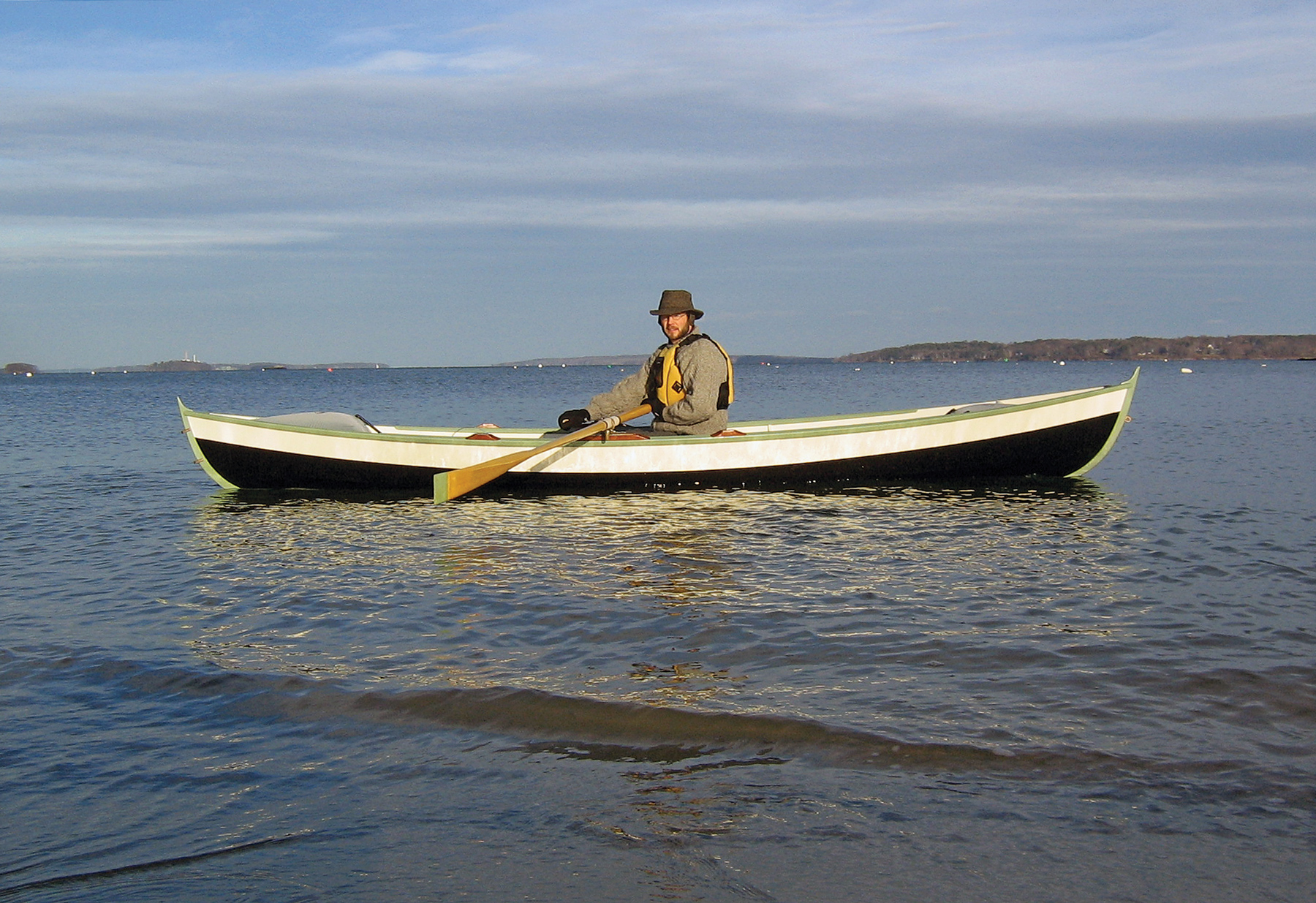 Photo by Jake Chase/Jellyhawk Studios
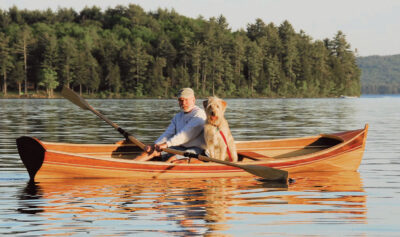
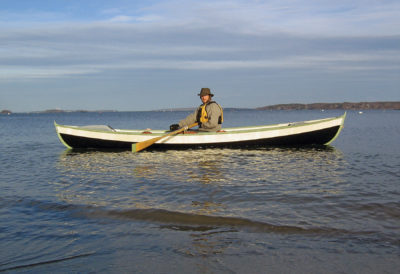
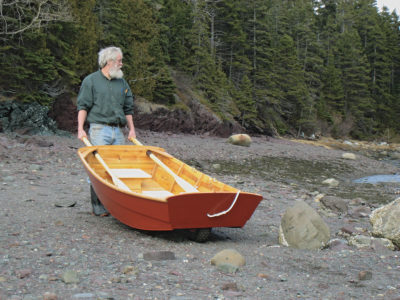
Looking for a seaworthy boat suitable for fast solo or tandem rowing in open water, Clint Chase found his inspiration, as many small-craft designers do, in the faerings of Scandinavia. His lightly constructed plywood-epoxy Drake rowboat moves well under oars, but a small lugsail can be shipped for downwind sailing.
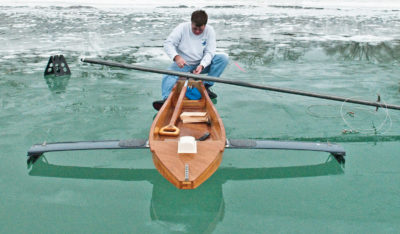
Drake is an uncommonly good rowing boat. By providing a fast, comfortable, and enjoyable rowing platform, the boat succeeds in taking advantage of its lean hull shape and long waterline length to do what it does best. Like many good rowing craft, it is probably at its best set up for solo rowing—which some of us take to be an essential of rowing anyway. For going it alone, Drake has bronze outrigger oarlocks that flip out over the gunwale and lock into place, effectively increasing her 4′ 1″ beam by about 10″. Clint uses light and lovely 9′ spoon-bladed oars when rowing alone, with a lead pour in the inboard end serving as a counterbalance. For tandem rowing with his wife or a friend, he has installed four standard top-mount oarlock sockets on pads at the gunwale and uses 7′ 6″ oars.
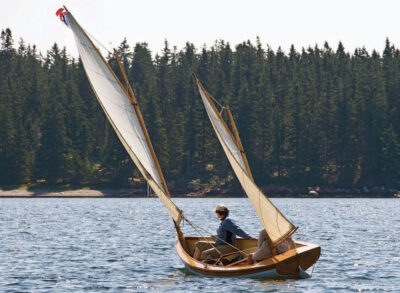
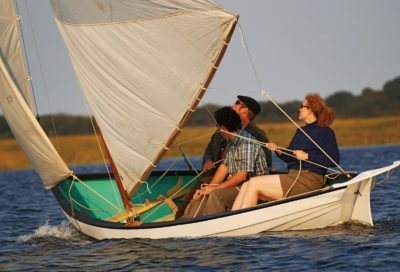
The boat is open stem to stern, and remarkably clear of obstructions. The forwardmost rowing thwart is fixed and also serves as a mast partner. Two other thwarts—one a little forward of amidships and the other farther aft—are easily removed. The aftermost one comes out when Clint is rowing solo from the center thwart. When rowing in tandem, the crew installs the after thwart, then removes the center one to allow rowing from the forward fixed thwart after the rig has been taken down. In both cases, the boat trims very well fore-and-aft. The thwart transitions are easy, too, since each removable thwart is held by a simple turnbutton on each side. Both removable thwarts come out for sailing, providing a comfortable seating position on the floorboards, which—as is right and proper for a boat of this kind—run athwartships.
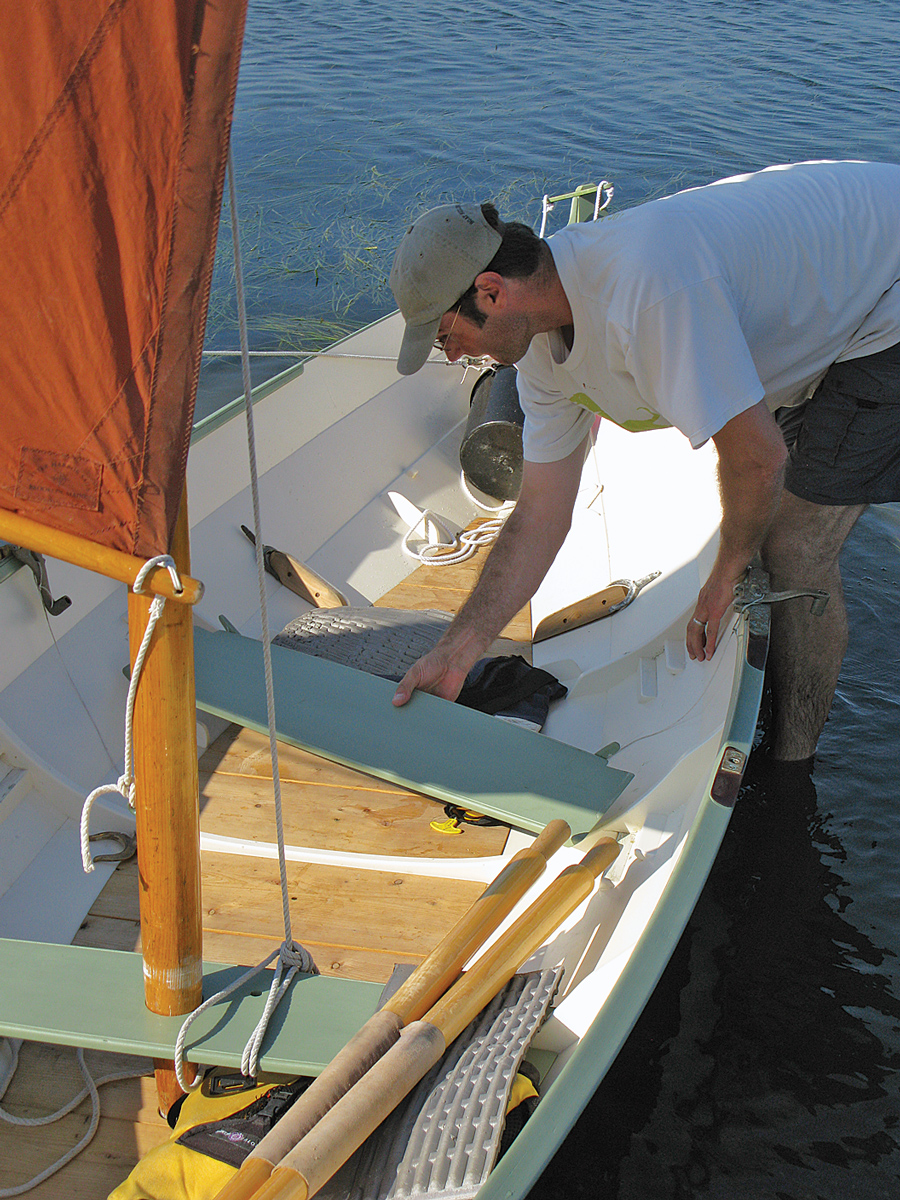 Photo by Tom Jackson
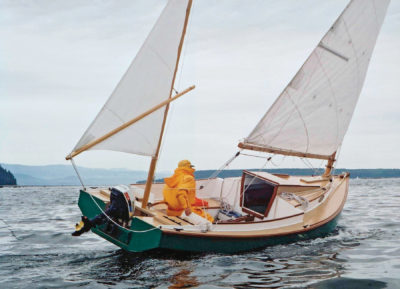
Two of Drake’s thwarts are easily removed to clear the cockpit for sailing.
Clint and I went for a tandem row in Great Cove, off WoodenBoat’s waterfront, one fine summer day, and I found the rowing to be easy and the boat very quick and responsive indeed. Rowing in a boat that moves so well always brings a smile to my face. I am convinced the reason people shun rowing in favor of such abominations as inflatable outboard dinghies is that they row boats that are poorly set up, badly designed, or both. It’s the same feeling as using a dull and thoughtlessly tuned hand plane to try to run a fine, fair curve on a plank edge of beautiful wood. The difference is between joy and misery. Rowing Drake counts on the joy side of that equation, and shaping a long, easy turn by merely pulling slightly harder on one side is akin to running the length of a plank with a comfortable block plane. We crossed the half-mile from WoodenBoat to a beach at Babson Island in what seemed to be no time at all.
Drake makes no pretense of being a good upwind sailer, however. The whole idea of these boats in the fjords of Norway was that when the wind was on your nose you’d always be better off getting the rig down and breaking out the oars rather than beating yourself up on tack after tack in narrow confines. What made the combination possible is that the old-time faer- ings not only rowed very well but also sailed well off the wind, too. Whatever their business was out of the fjord (fishing, mostly), the crew knew they would have a sleigh ride home with the westerly wind behind them. Simplicity was the key: often unstayed, their rigs used square, lug, or sprit sails that could be struck quickly and stowed inside the boat. And when the time came, the rig could be set up quickly to take advantage of a favorable breeze, upon which they would sail handily on any point of sail from a reach to dead downwind. In Drake, as no doubt in other faerings and derivatives, the sailor will always be tempted to test the boat’s ability to sail to windward—and then be well-advised to accept it as it is.
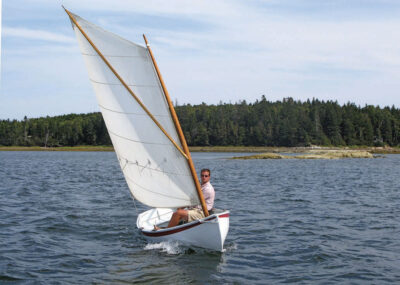
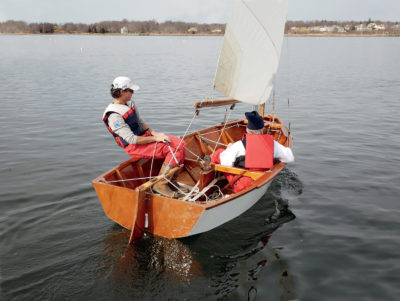
Drake’s sailing rig could not be simpler. Clint has merely specified a Shellback dinghy standing-lug sail of 58 sq ft. Shellbacks are ubiquitous and well known, so sailmakers can easily track down specifications if they don’t know them already. Not only that, but sails themselves are readily available—they can even be ordered right off the shelf at The WoodenBoat Store. The hollow spars that Clint has specified are uncomplicated, too. Plus, if you happen to already have a Shellback dinghy—maybe by having built one of the boats from a kit, for example—then you wouldn’t even have to buy another sail. Just transfer the bundled sail, mast, spar, and boom from one boat to the other, and away you go. The rig from a Nutshell pram (especially the larger 9′ version), though a little smaller, would work just as well, and that’s the sail we ended up borrowing on the day of our outing.
Consider Drake’s rig as providing a kind of dessert— a downwind bonus for having gotten your exercise for the day. “The idea is to blast to windward and come back under sail,” Clint says. “It’s the most perfect way to get on the water, to be able to do both without sacrificing rowing qualities. You have to know what you can do; you can’t expect to go to windward. The feel of the boat in a good breeze is definitely reminiscent of an Åfjordsfaering,” a particular type of faering that Clint had sailed on loan from Ben Fuller, a fellow small-craft sailor and curator of the Penobscot Marine Museum in Searsport, Maine.
Since Clint’s boat has no centerboard and a long keel, its pointing ability will surely frustrate racing sailors. Clint took some of his inspiration for this kind of sailing not only from the Åfjordsfaering and modern faering derivatives that he had seen or sailed in Maine, but also from boat designer Paul Gartside’s open-water cruising skiff Bob, a 16-footer that also specifies a downwind-only lugsail. Clint took Gartside’s one-week Boat Design course at WoodenBoat School several years ago, and he came away inspired to try his own hand at design. Drake is the first he has completed that he considers ready to market, but others are in the works. A former high school science teacher, he attended The Landing School in Arundel, Maine, after becoming captivated by boats. Four years ago, he became an instructor at The Compass Project in Portland, teach- ing young people to build boats, which he still does part-time.
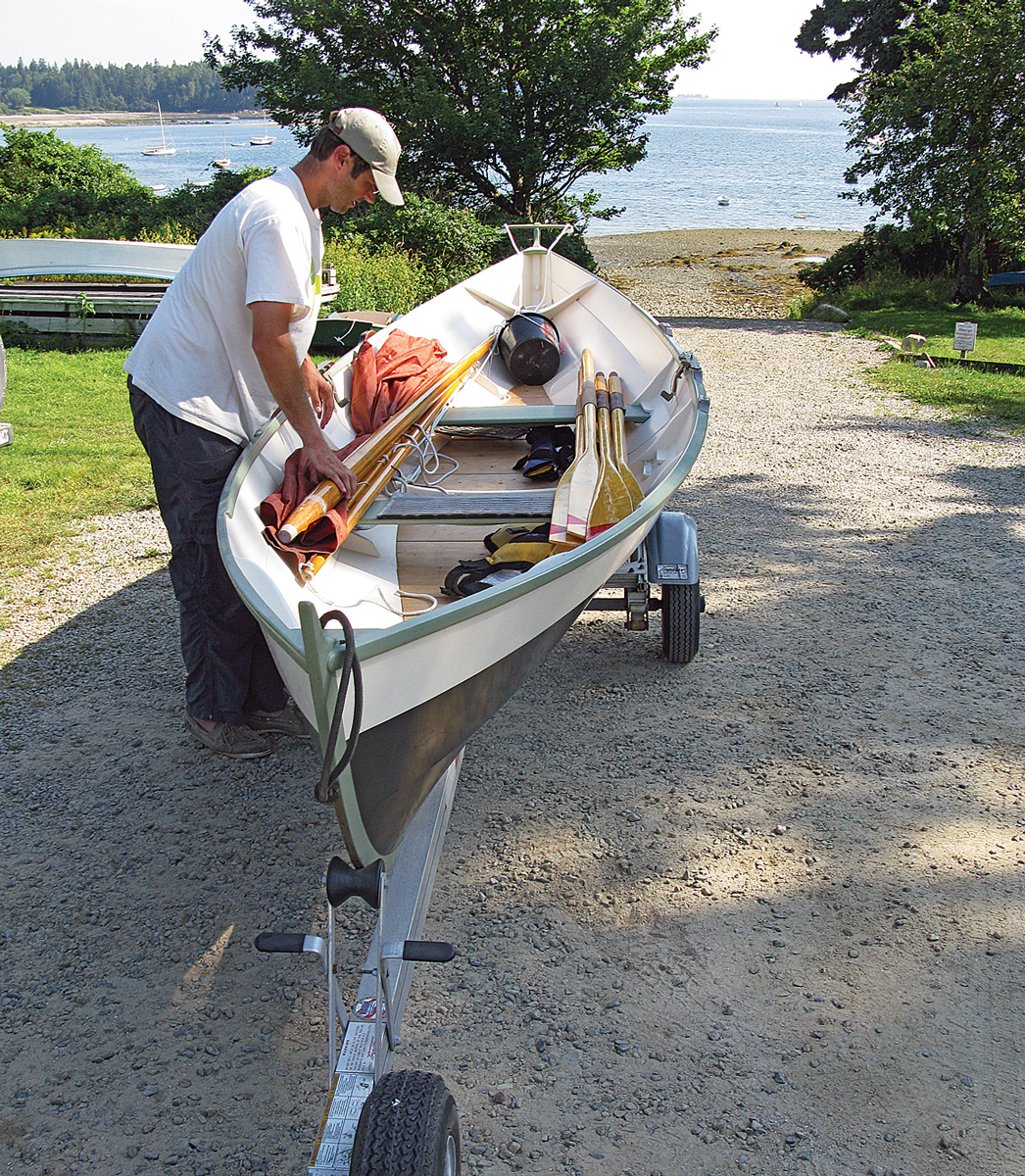 Photo by Tom Jackson
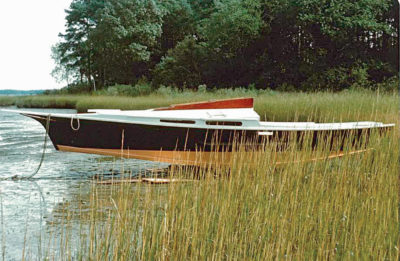
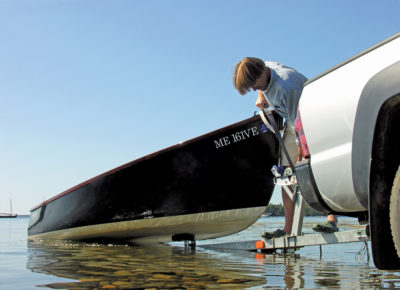
Made with 1⁄4″ marine plywood, Drake’s hull is light—about 130 lbs—and easily trailers behind just about any vehicle. Clint Chase uses a lightweight aluminum trailer, which can be detached from the vehicle and readily rolled down to the water singlehanded.
For Drake’s hull, Clint specifies 1 ⁄4″ plywood, either okoume or sapele, the latter being a bit heavier. He painted the plywood, avoiding sheathing to keep it light, though he would advise fiberglass-in-epoxy sheathing on the exterior for anyone grounding regularly on rough beaches. He has two options for flotation—built-in chambers or tied-down airbags—either of which he views as critically important to the safety of this design. “I was going for the aesthetics in this build,” he says, so for his own boat he chose off-the-shelf canoe flotation bags that can be tied down but easily removed to show her uncluttered interior. Construction is glued- lapstrake plywood, with three strakes per side on a Douglas-fir backbone. He emphasizes lightweight woods, perhaps spruce for frames and even cedar for the keelson and thwarts. Glued-lapstrake construction makes it possible to build a strong and light boat— perhaps 130 lbs for her 17′ 4″ length overall. The boat could be reduced in length to 15′ 5″, but Clint strongly advises keeping the 17′ 4″ length for optimal seaworthiness and speed.
The only pieces of hardware to speak of in the boat are the rudder pintles and gudgeons, which are silicon- bronze. These aren’t off-the-shelf items, and may present some challenge. An enterprising boatbuilder might learn bronze casting (WoodenBoat School has a course in the subject) to make them, or present patterns or specifications to a foundry or a machine shop, which would have no difficulty at all in fabricating them. Clint is thinking of having castings premade, as well, and he is even considering developing the Drake rowboat as a kit.
In her handling, Drake’s steering is the only thing that may seem unusual. It involves a loop of line working through a short two-arm yoke mortised over the rudderhead. Many boats use the device of line-steering (see Coquina and Beachcomber-Alpha dory for two other examples). In my view, for this boat, no other would do. Sitting amidships is most comfortable, most practical, and puts your weight right where it needs to be. Getting used to the rope steering will take no time at all, and it will allow you to go forward to adjust the downhaul or grab your water bottle or the sunblock without having to abandon the helm.
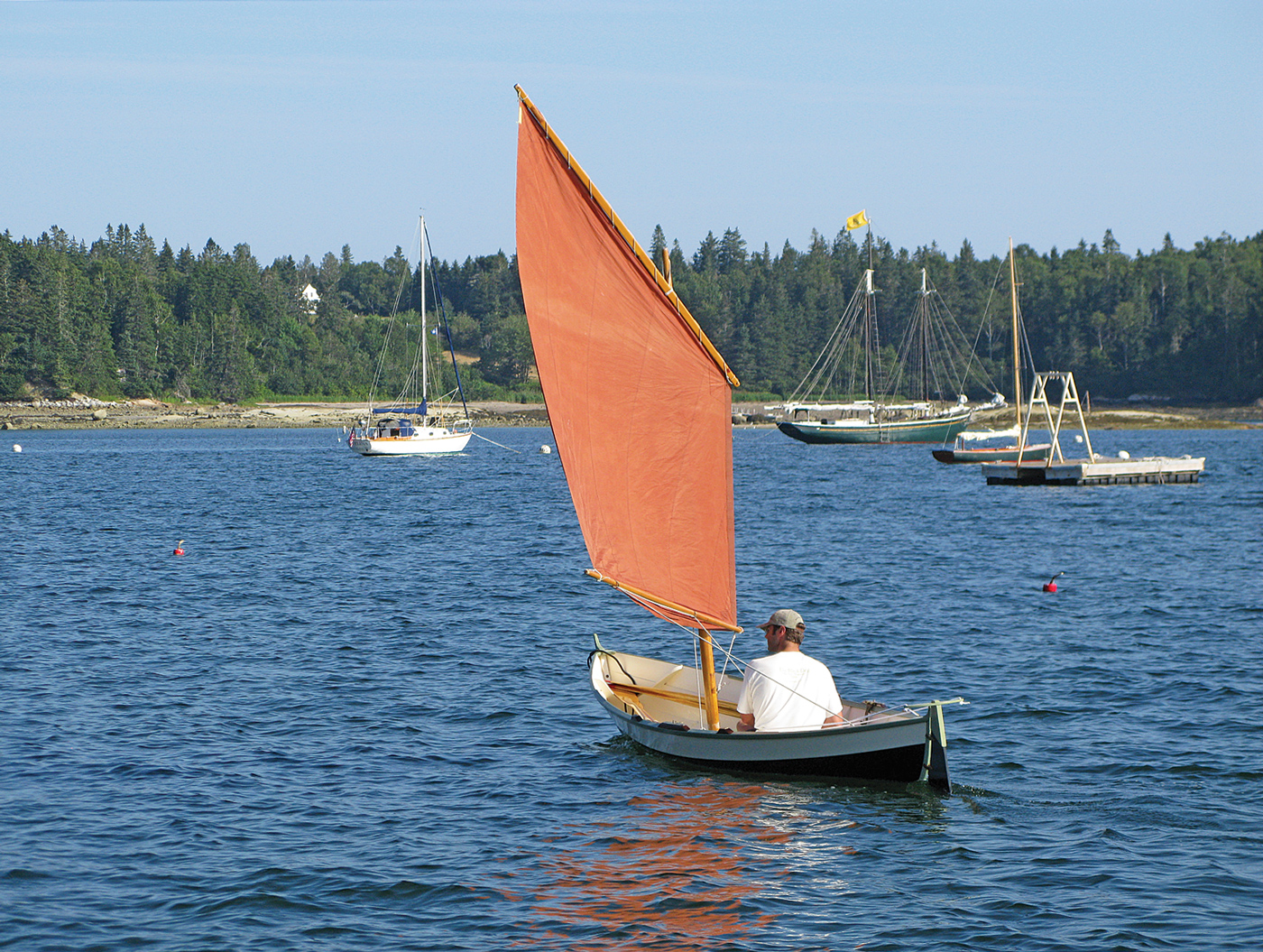 Photo by Tom Jackson
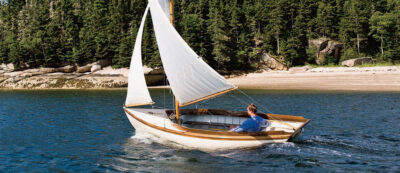
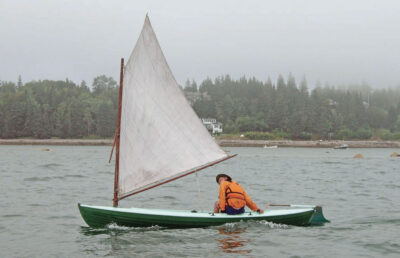
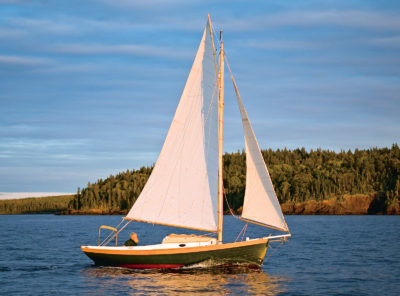
Rowing works best when going to windward, but Drake sails well downwind or on a beam reach. The lugsail, which is the same as used in Shellback dinghies, is readily available and has uncomplicated rigging.
Clint has used his boat primarily in Maine waters. “I’ve gotten out into some open water outside the islands, with swells, and found it to be remarkably seaworthy,” he says. “The feeling of safety I get is more than I expected. At one point, I was rowing out Casco Bay with the tide with me. I knew there would be a tiderip out there and that it would get a little ‘interesting,’ but I got through that really remarkably safely, without water coming in.” Preparing for the Blackburn Challenge rowing race in Massachusetts, he did a 15-mile open-water row. “I learned a lot about rowing downwind with 2′ rolling, whitecapping seas—how much work it is to keep a boat on course. When I was drawing it, I stretched out the forefoot to get the waterline length I was looking for without having it ‘grab’ in following seas. During that row, I realized it was okay. I certainly had to stay focused and square to the waves, but the boat just felt great. The stern lifted up, and it scooted down on the seas, dropped into the next trough, and kept a steady rhythm.”
It all makes me want to go.
Drake Rowboat Particulars
LOA: 17′ 4″
Beam: 4′ 1″
Depth amidships: 1′ 3¾″
Sail area: 58 sq ft
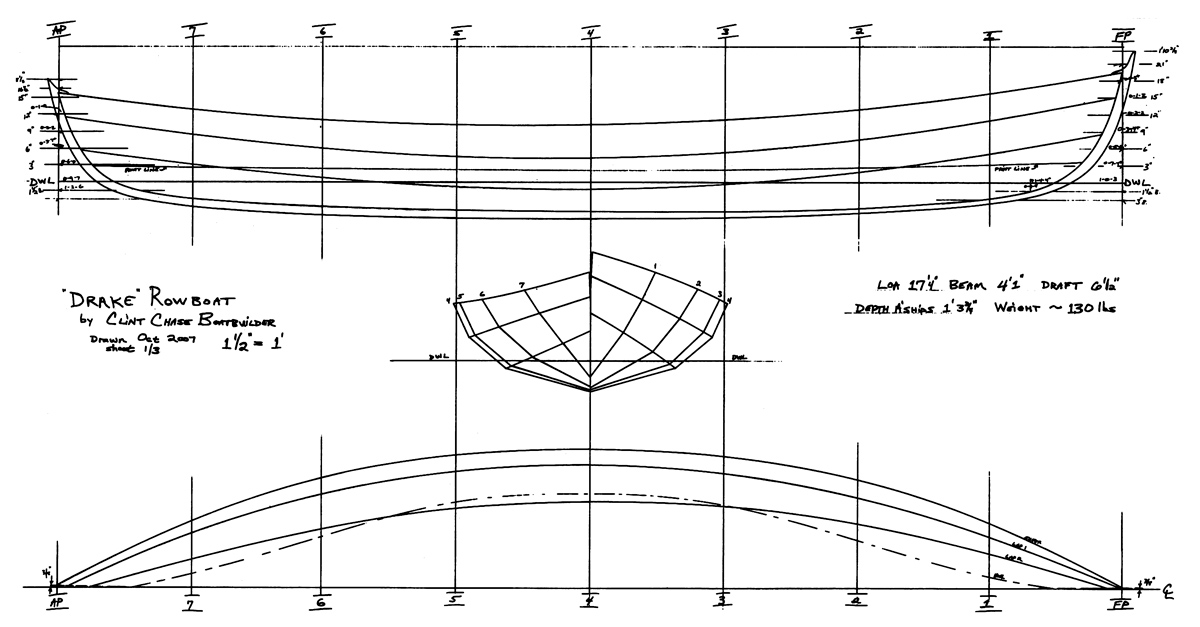
Substantial v-shape to her long, lean hull helps Drake track very well when under oars, yet her rocker makes her maneuverable and a good sea boat.
This Boat Profile was published in the printed edition of Small Boats 2010 and appears here as archival material. Plans are available from Chase Small Craft.
Is there a boat you’d like to know more about? Have you built one that you think other Small Boats readers would enjoy? Please email us your suggestions.
For more boats from Chase Small Craft, see…
Compass Skiff, a lightweight, nimble, outboard skiff designed by Clint Chase
Goat Island Skiff, a high-performance dinghy, family daysailer
Hatch Cove Kayak, a David Wyman design for Chase Small Craft


This is great to see – it was my first real coverage by WoodenBoat and I remember how tickled I was!
Now of course the boat is so much more refined – but looks pretty much the same!
Thanks for rebroadcasting this!
I have a westcoast handliner – similar in many respects as a carvel planked double-ended rowing boat – similar to a peapod. With my down-wind lug sail I have had a double blast rowing and sailing downwind (with a surfing surge that’ll make you smile) in sizable waves and decent wind. It’s a little known sport with a rush, like skiing moguls fast! Give it a try!!
There are too many people missing out on downwind sailing in a rowboat that has the right hull shape for carrying sail.
But people still want to ruin the rowing by installing a trunk of some sort…a daggerboard trunk is something I can live with, but a centerboard trunk will ruin the Drake. A DB trunk is simply not needed because of the lateral resistance provided by the long keel. I bet the handliner has the same.
I built a Wellsford Light dory in 2020. Its final length was 17’3″ and a 4′ beam. Any idea on how it compares to the faering?
This is indeed one heck of a good rowboat! I built one about six years ago and did harbor rowing and camp cruising in it. I wrote a review of the Drake and posted it as a free download at my website https://www.byhandandeye.com/shop/