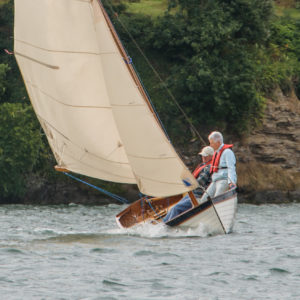
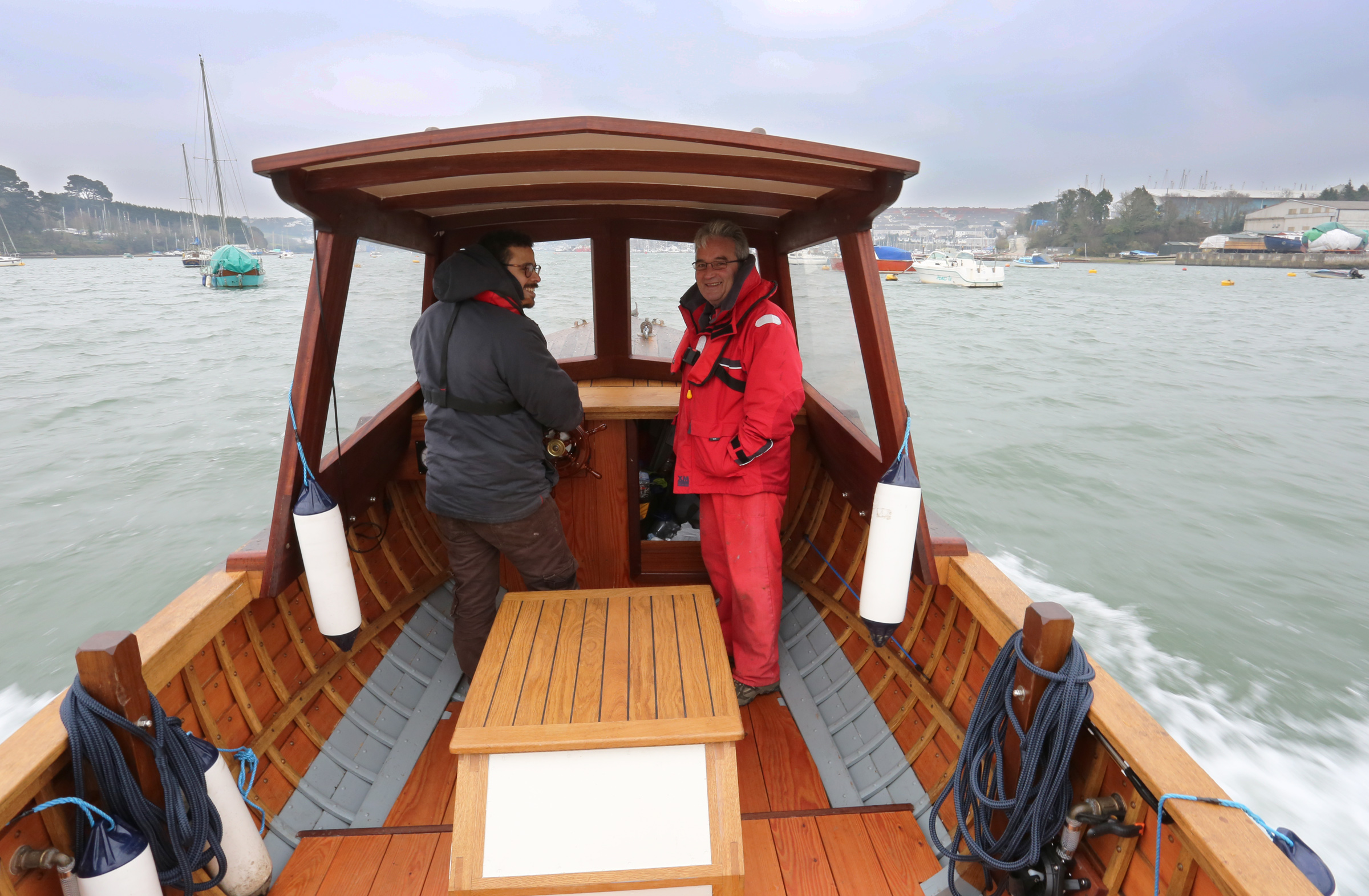
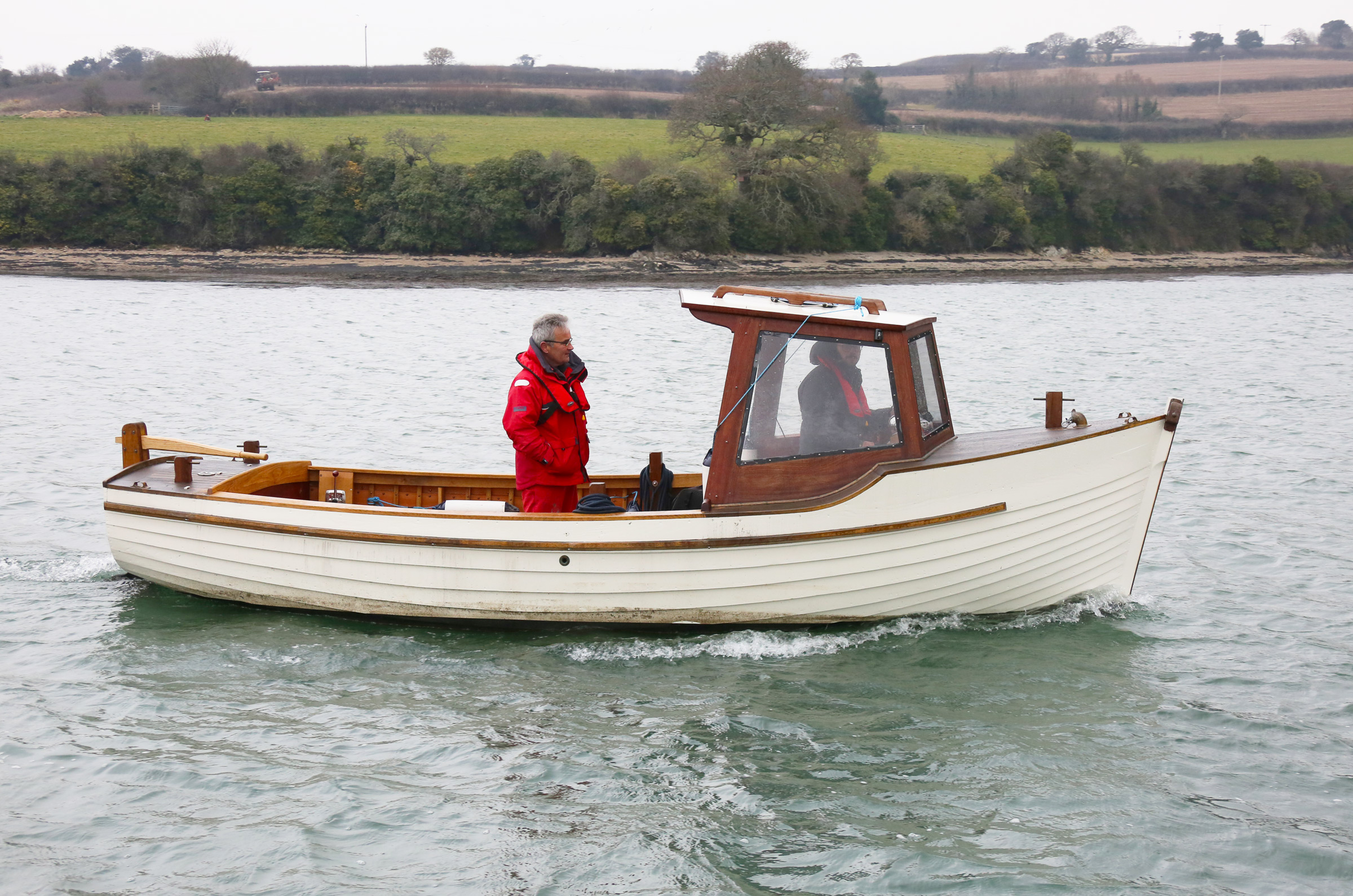
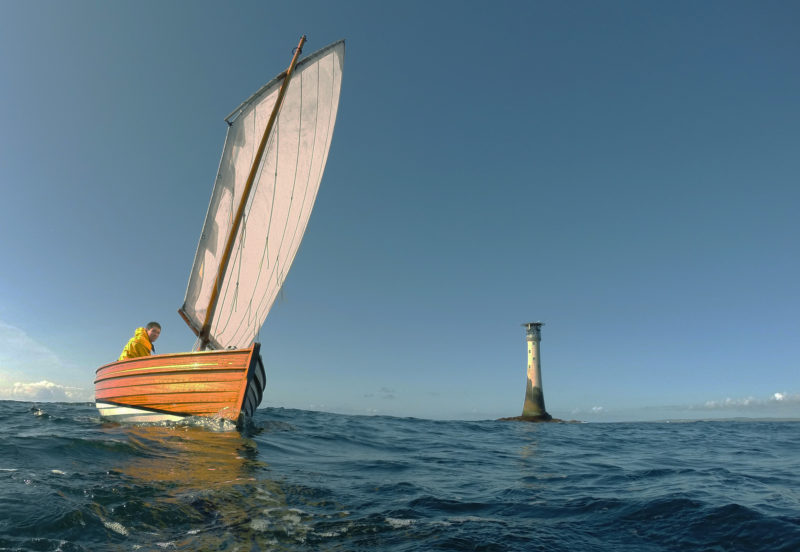
Long before the fine sand and exquisite light of St. Ives were discovered by artists and tourists, the small town on the north coast of Cornwall was a thriving fishing center. At its peak, 300 fishing boats were moored cheek by jowl inside its picturesque harbor and millions of fish were landed, salted, and then exported all over Europe. Each of these boats had a tender and, as the tide went out, each tender had to settle on the sand until it was refloated by the incoming tide, twice a day, every day. Most days, the boats were given a good beating by the notorious ground sea that runs into the harbor, and on bad days they often got swamped and filled with sand. It’s a particular kind of punishment that requires a certain type of boat, as retired physician Scott Bowring discovered.
“When I started sailing in St. Ives 12 years ago, I wanted a boat to keep in the harbor, so I had a 10′6″ Lily-class dinghy built for me by Ashley Butler in Dartmouth,” Scott says. “ZEPHYR is a lovely boat, and I’ve had loads of fun on her, but she was too lightly built for the conditions in St. Ives, and at the end of every season, a couple of ribs would be broken. I realized I needed something stronger for the conditions here.”
Photographs by the author
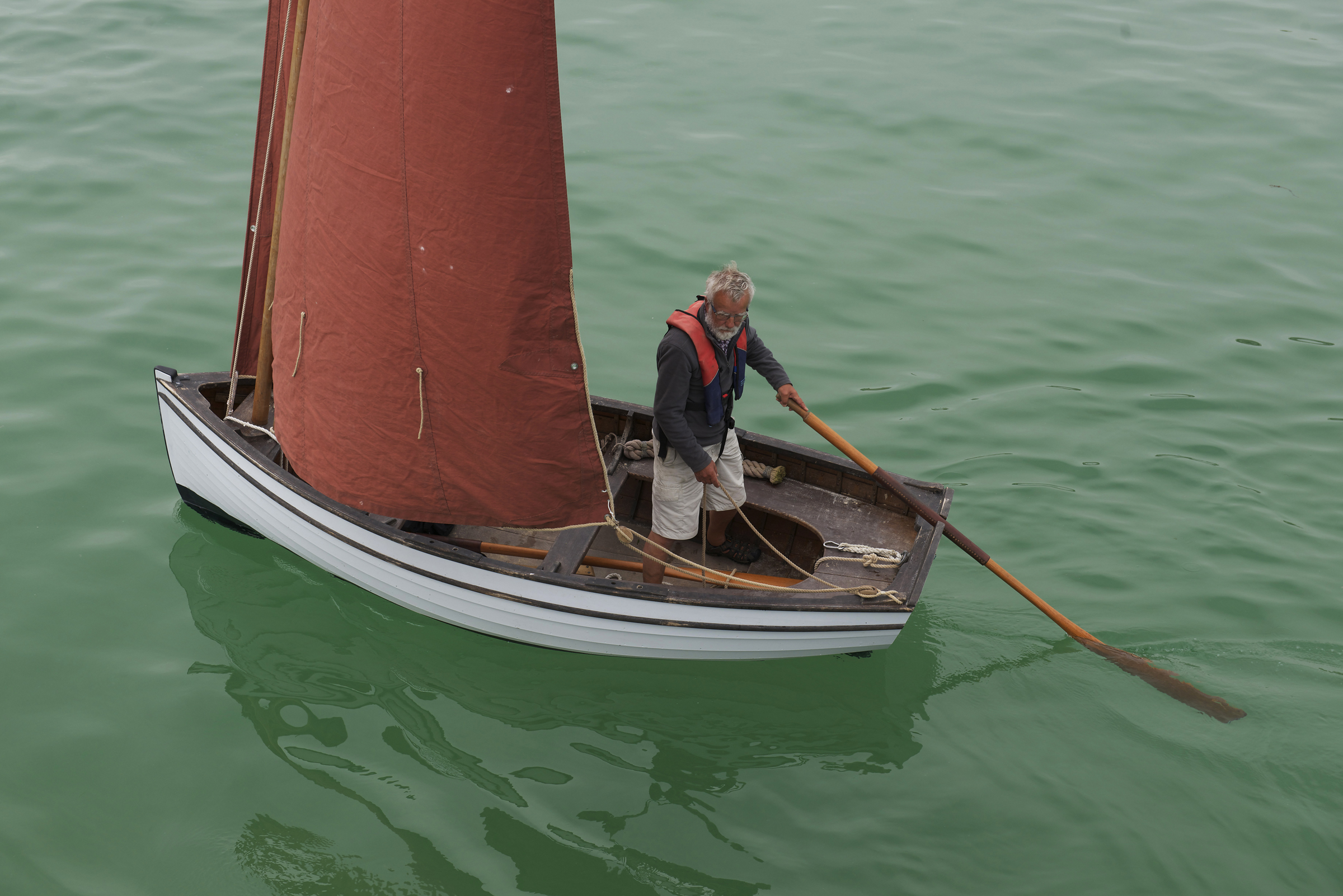
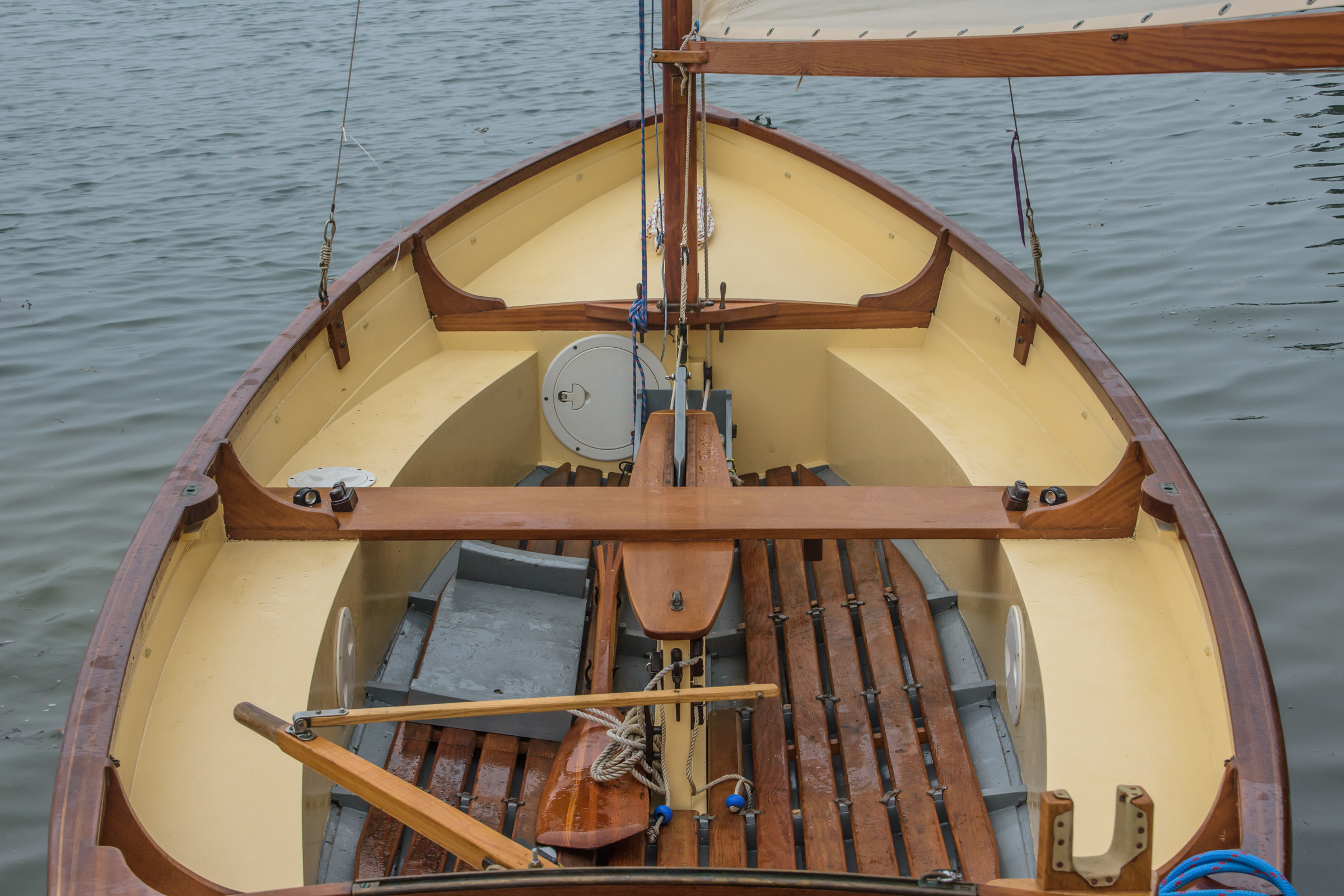
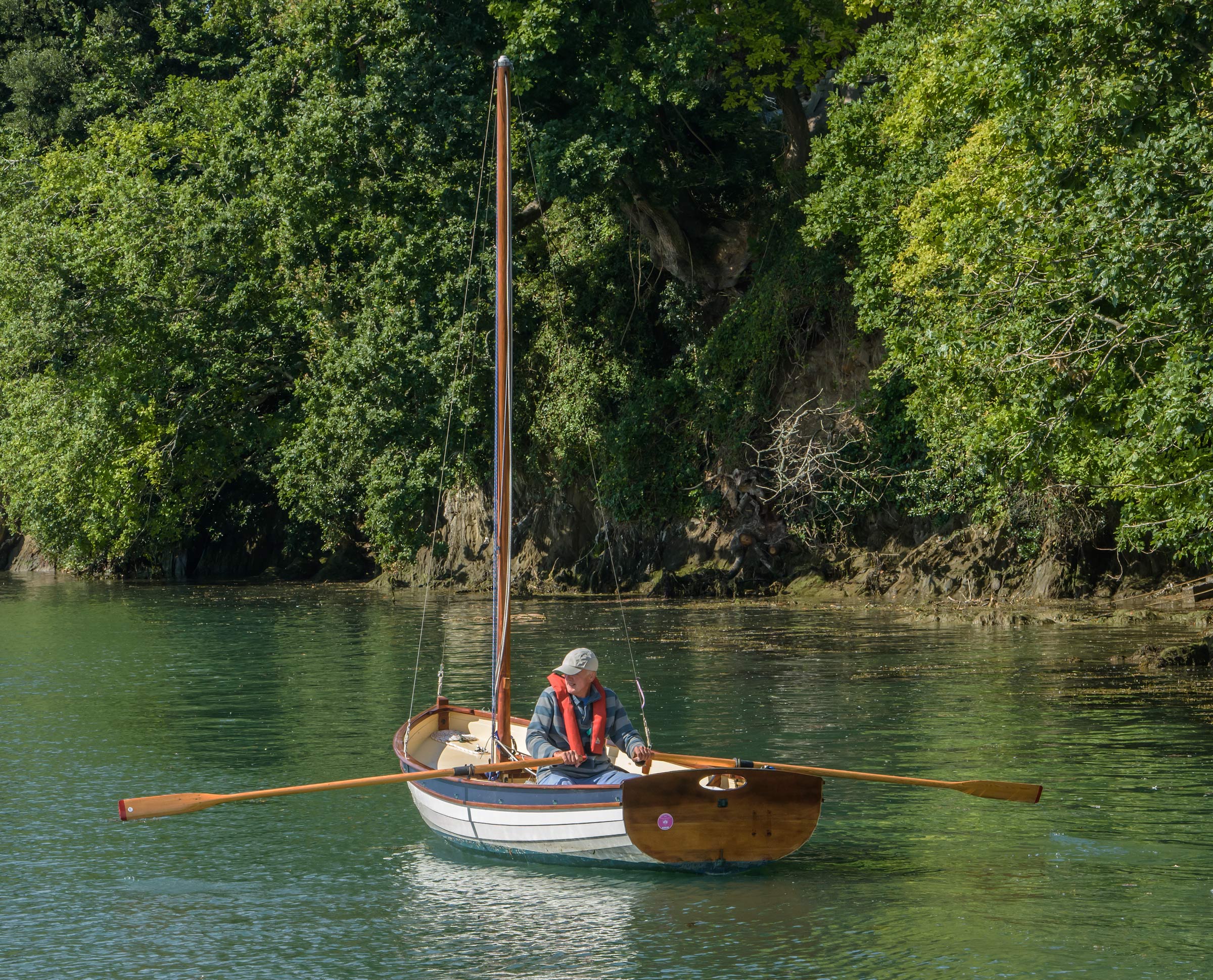
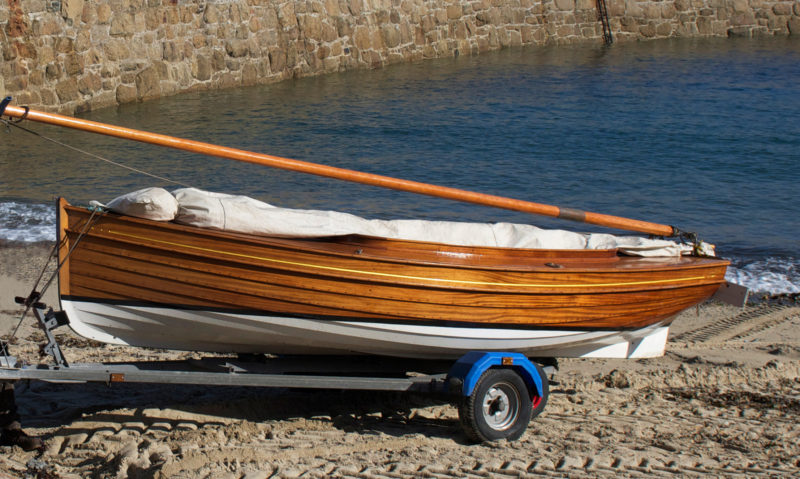
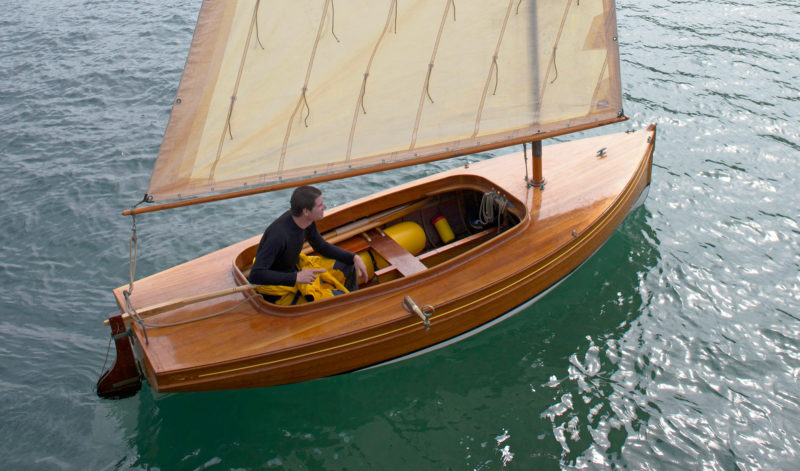
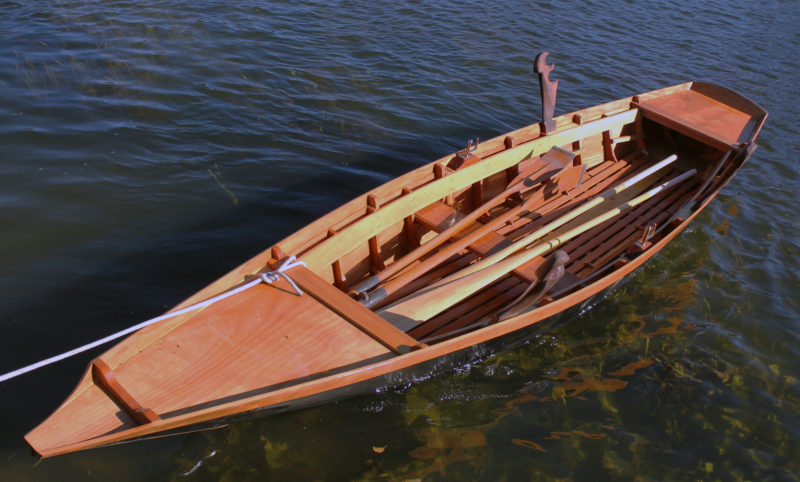
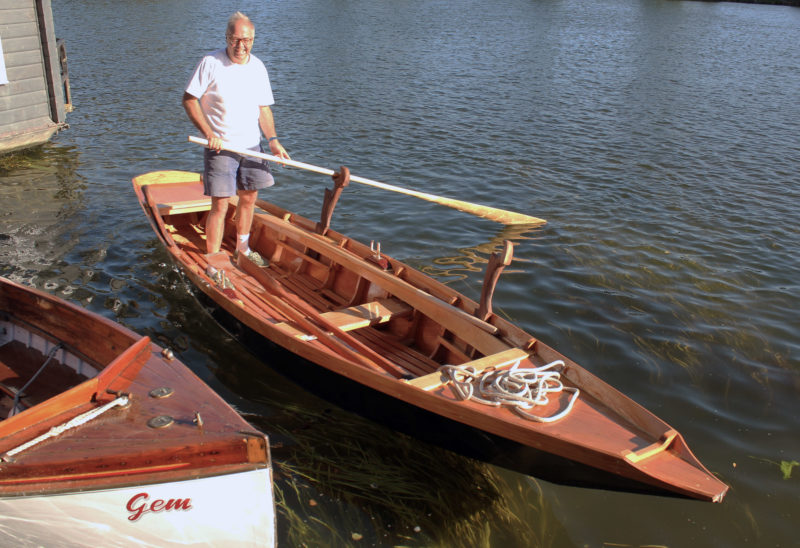
The mainsail, rolled around its yard, fits neatly to one side and below the level of the gunwales, leaving the center free for a rower and a passenger or two.
Scott is a member of the St. Ives Jumbo Association which keeps two 20’ Jumbos, replicas of Victorian fishing luggers, built by Jonny Nance, in the harbor. The starting point for that project was a 13′ rowing punt based on a set of lines Jonny’s father took from a traditional fisherman’s tender in 1975. Unlike the streamlined punts from more sheltered ports such as Falmouth on the south coast of Cornwall, the St. Ives punt was short and stout, heavily built to survive the challenging conditions of St Ives harbor. But could it be made to sail?
To find out, Scott teamed up with fellow Jumbo sailor Pete Lee and asked Jonny to design a sailing version of his father’s punt. The boat they specified had to be smaller and lighter than the rowing punt with a standing lug rig which would stand a trashing. It needed to be stable, so you could stand on the gunwale without tipping over, and withstand the abuse of various feral grandchildren. They didn’t want a centerboard, as the boat would be sitting on the beach at St. Ives—plus they wanted fewer moving parts for kids to get their fingers jammed. And the boat had to be pretty.
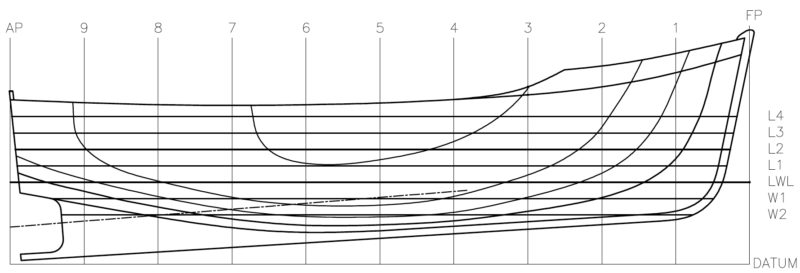
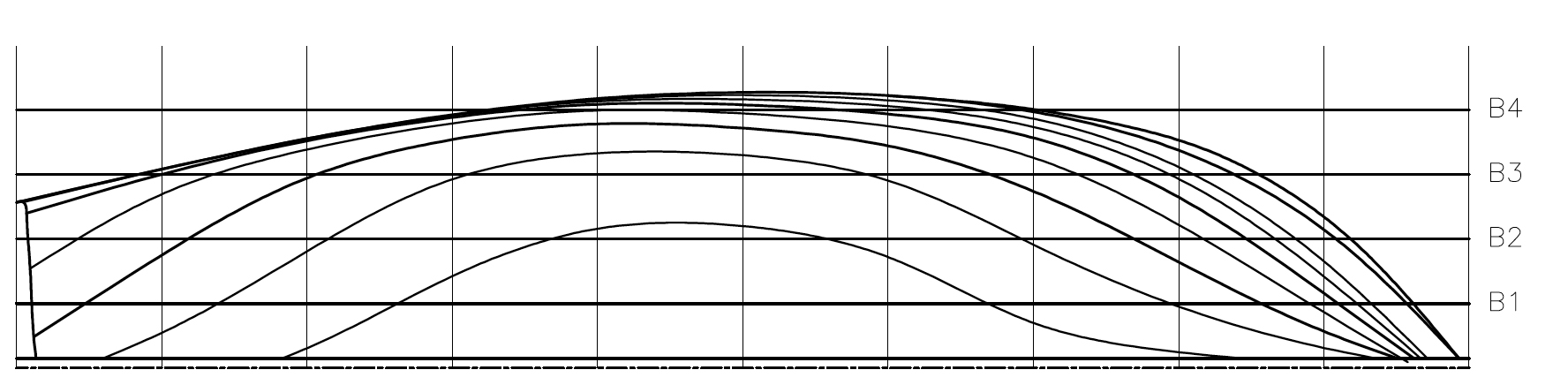
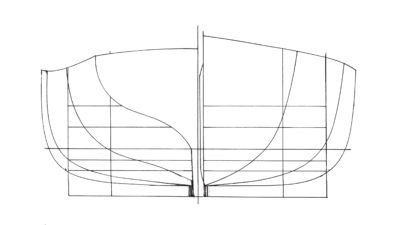
“It was an interesting challenge, given that the traditional punt was primarily for landing fish and had to be capable of carrying the maximum weight in the minimum amount of water!” says Jonny. “I modified the rowing punt lines to make the boat as sailable as possible. I raised the deadrise a little, so it’s not so flat bottomed; the sailing punt’s keel projects about 3″ below the garboard, whereas the rowing punt only has 2″. The sailing punt also has a much more elegant run aft and finer entry. Little things, to make a sailboat shape without diverting too much from the punt type that she is.”
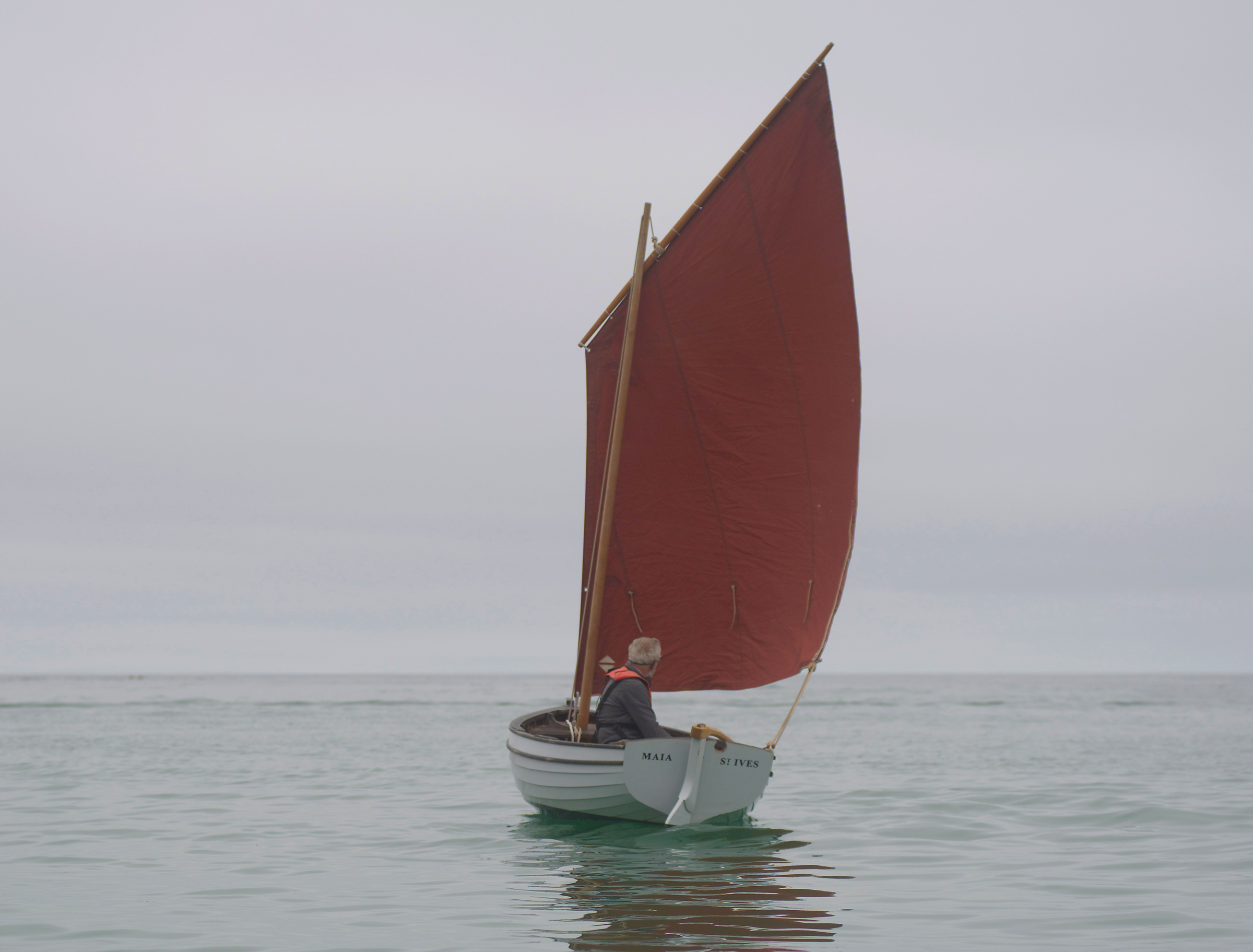
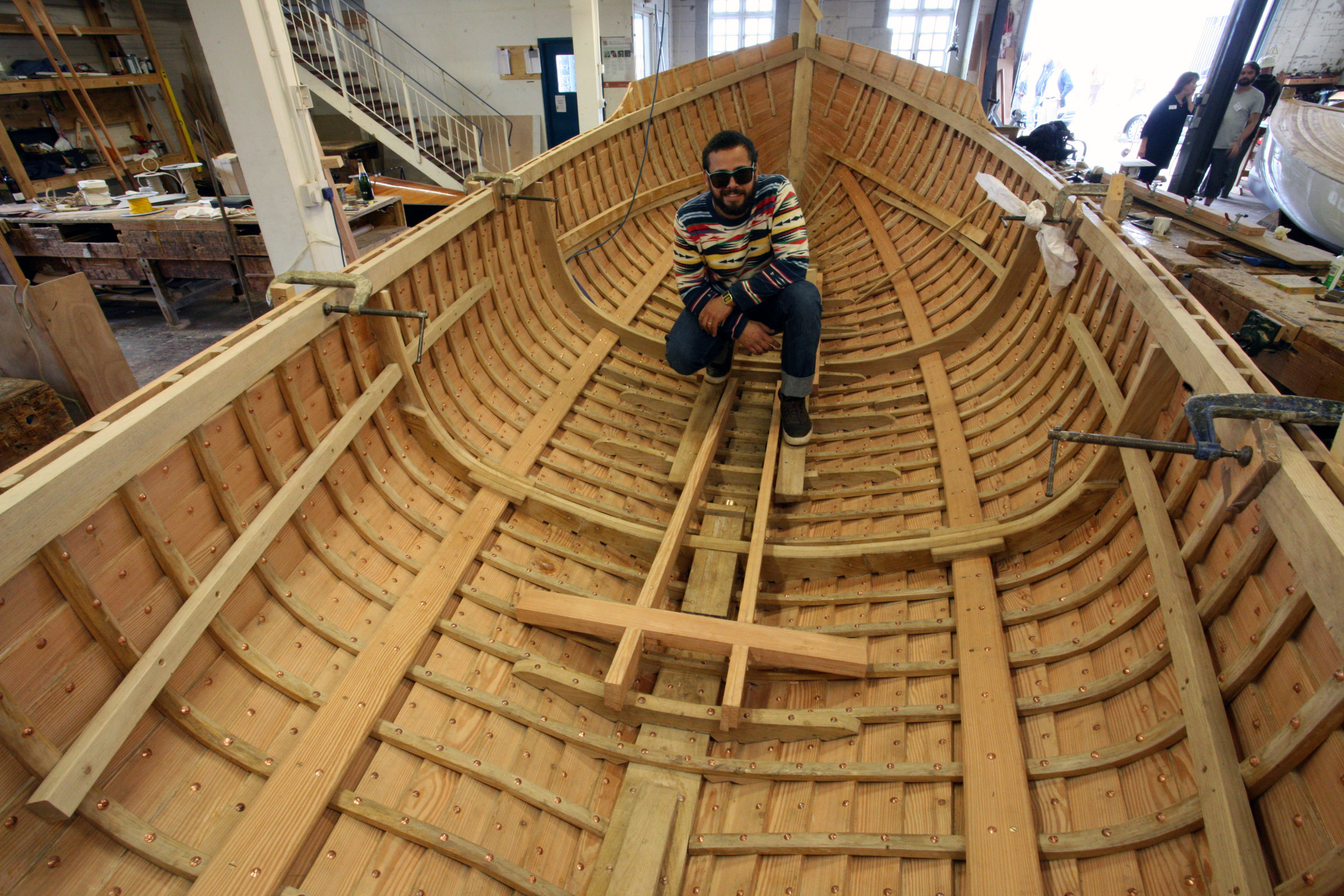
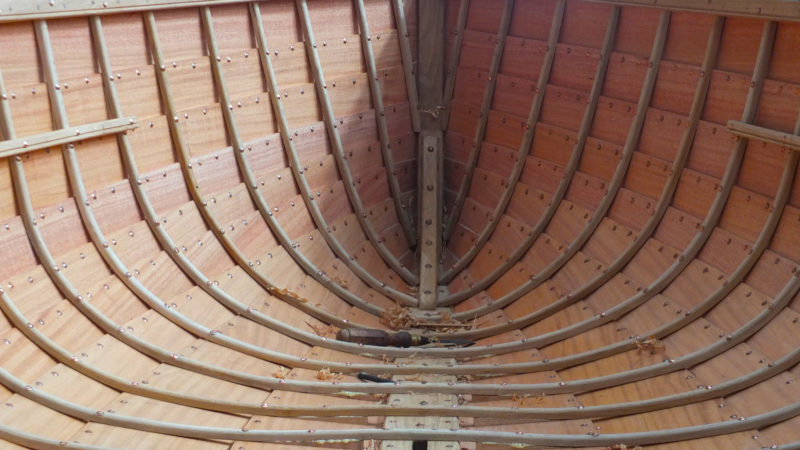
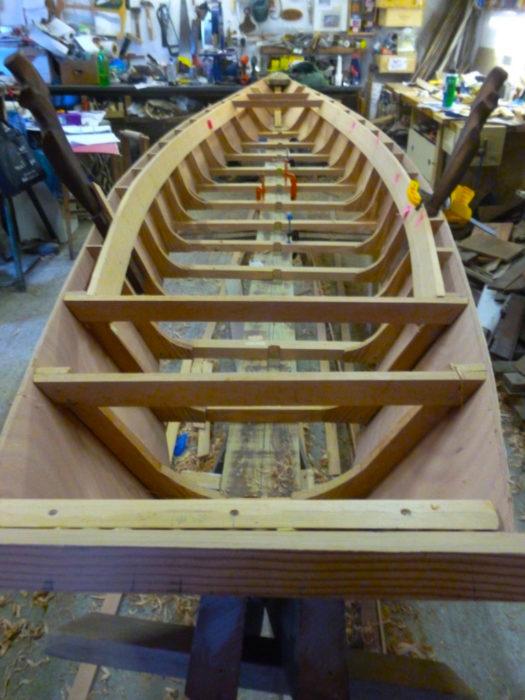
Jonny built the first St. Ives sailing punt for Pete in 2014, followed by a second boat (with a slightly taller mast) for Scott in 2015. Good-quality larch wasn’t available for the planking, so Jonny built both boats of Douglas-fir on oak ribs, fastened with copper rivets. The inside was fitted with oak thwarts and grown oak knees, all sealed with a mix of Stockholm tar, linseed oil, and turpentine, which quickly turns black with age. Scott named his punt MAIA, in part after Saint Ia of Cornwall who, according to legend, sailed to St. Ives from Ireland on a leaf, and in part after one of the Pleiades, Maia, from Greek mythology.
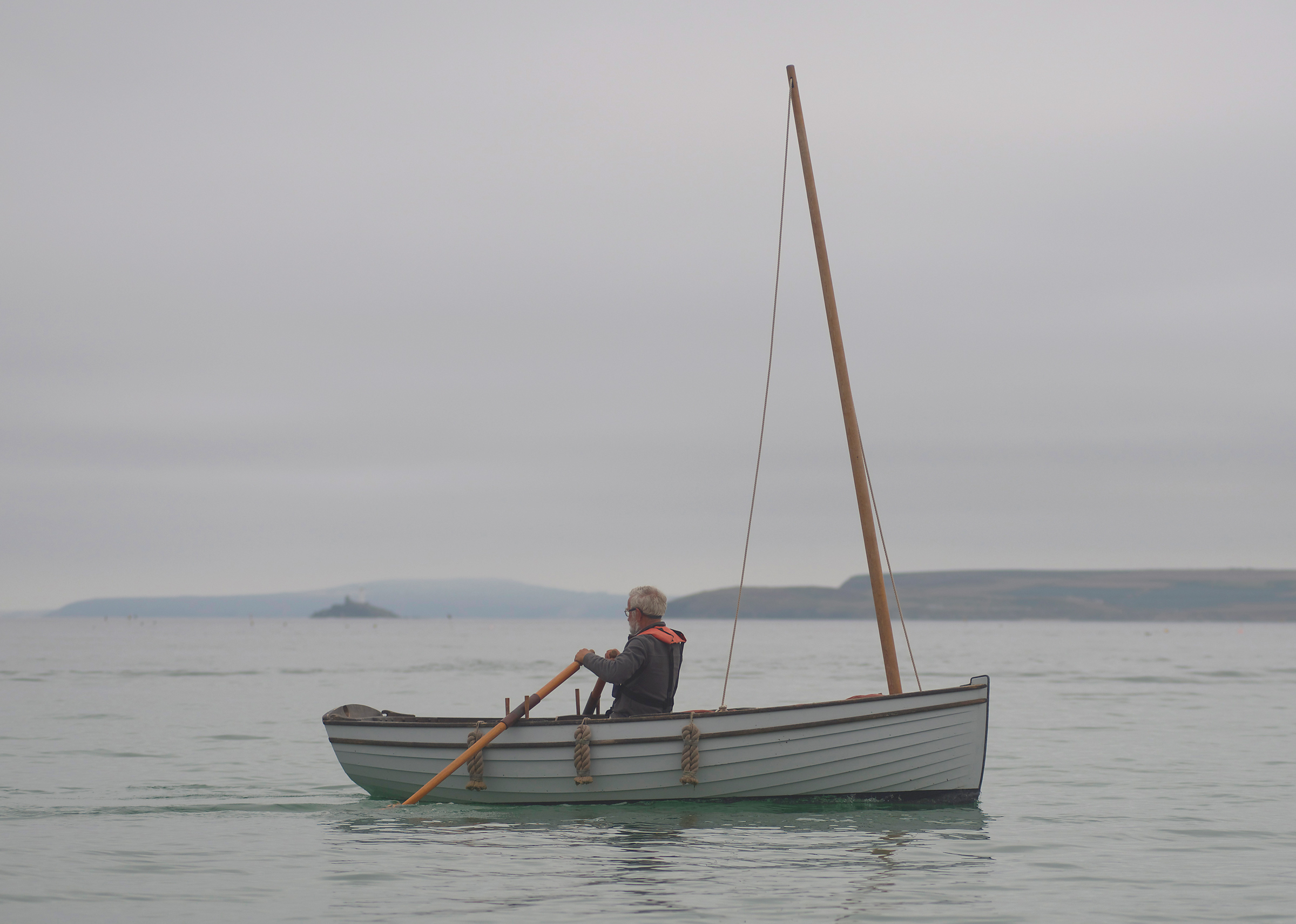
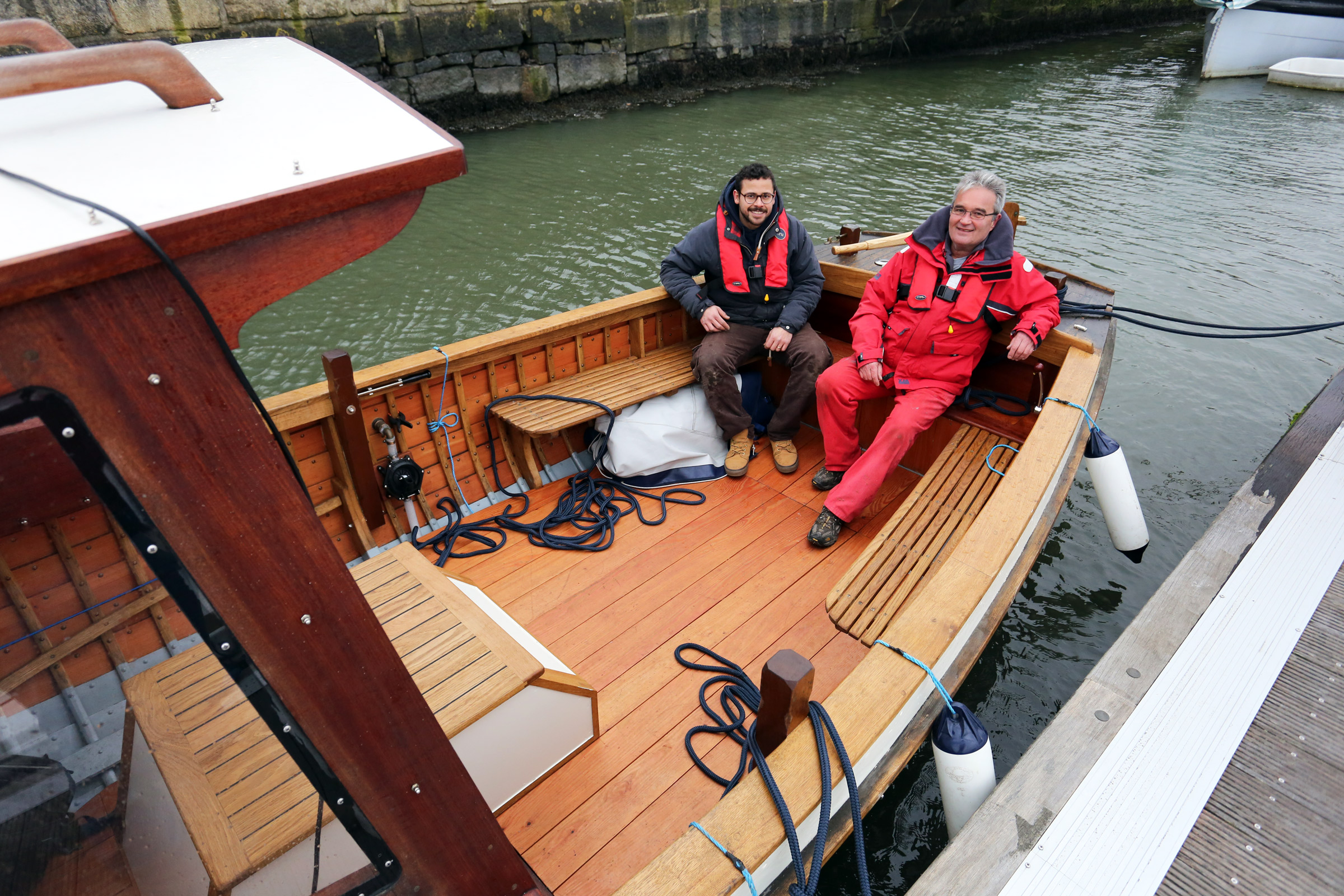
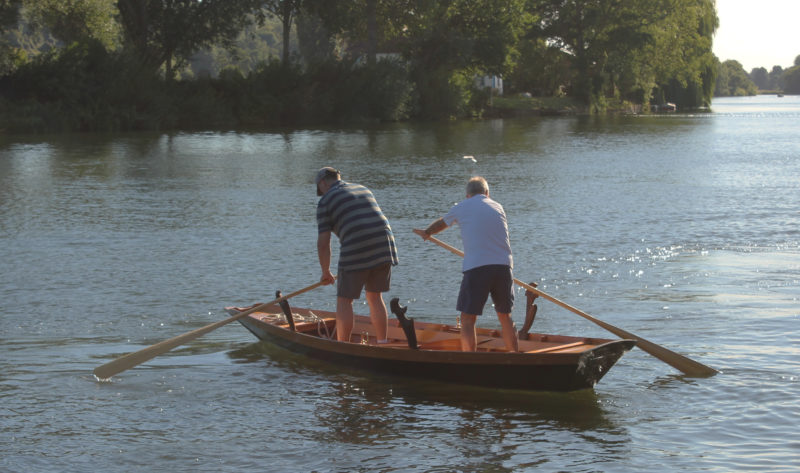
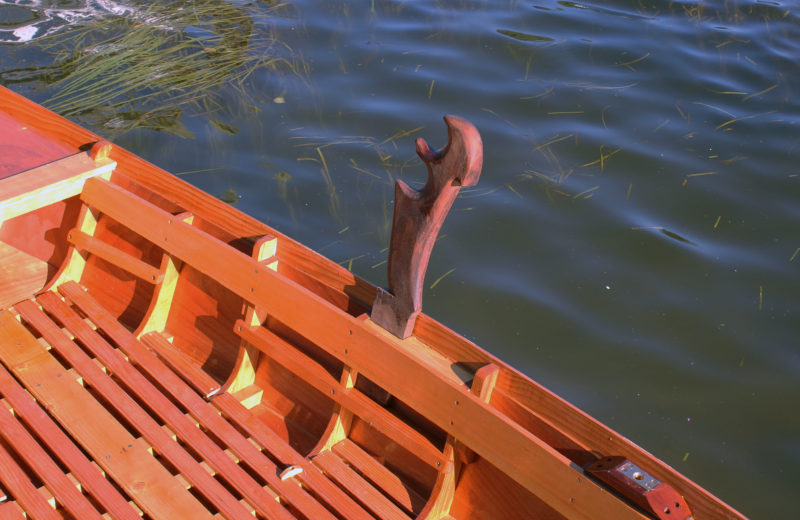
The St. Ives here has two rowing stations rigged with removable tholepins. The oars, as is customary for double tholes, are without collars, requiring a bit more skill from the rower than oars with collars used in oarlocks.
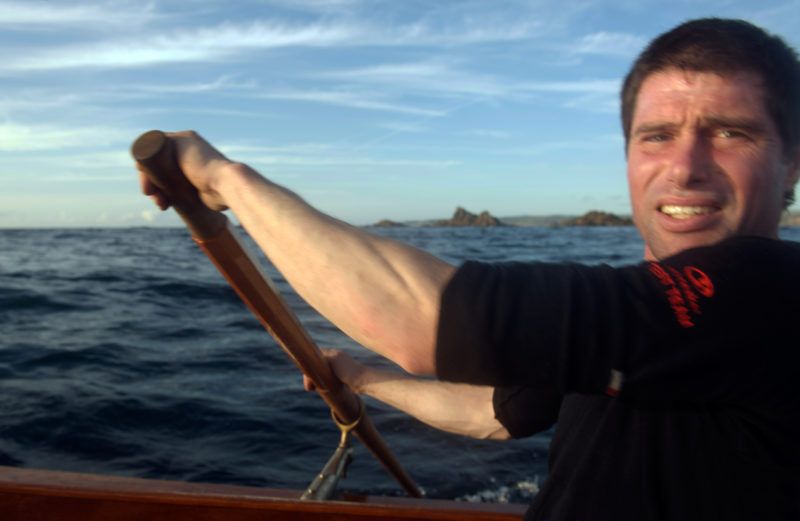
It was glassy calm and cloudy when I arrived in St. Ives to sail MAIA, so we made the most of the weather by first testing the boat in rowing mode. The St. Ives punt has two rowing stations, both fitted with tholepins rather than rowlocks. I’m not a usually great fan of this arrangement, which I suspect is usually used for aesthetic rather than practical reasons, but I have to admit I hardly noticed the difference on this occasion.
With her beamy, burdensome hull, the punt is not best suited to long-distance rowing, though it carries its way well enough and you would happily row home if you had to. In practice, though, I suspect the oars are mostly used to get her in and out of harbor. The Jumbo crews are keen scullers, and the transom has been fitted with a sculling notch, set off-center so it can be used with the rudder and tiller in place.
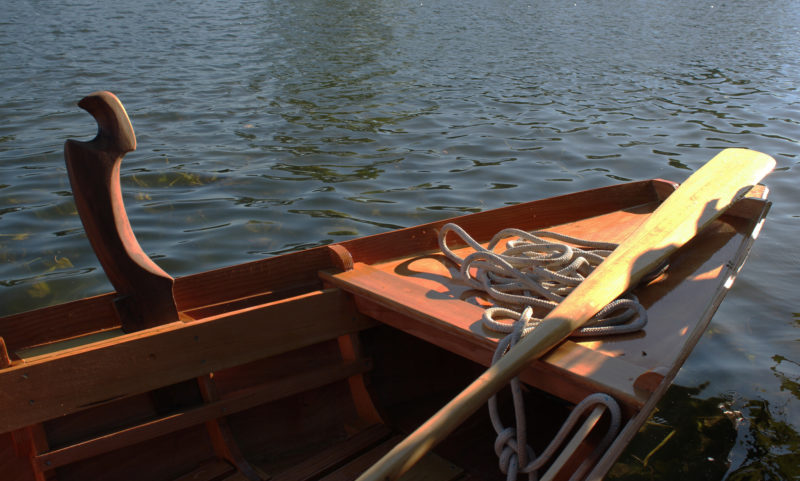
The rudder isn’t in place at the moment, but if it were, it wouldn’t interfere with sculling because the notch in the transom is set to port. The notch is circular with an opening at the top wide enough to accept the throat of the oar, but too narrow to let the leathers slip through. The arrangement keeps the oar from slipping free, handy when sculling or when using the oar as a stand-in for the rudder, as seen here.
“Sculling was the principal means of propelling a punt in crowded fishing harbors, as it was seldom possible to row,” says Jonny. “So sculling isn’t just a quirky revivalist fad. It remains a very useful skill and is frequently the most appropriate option.”
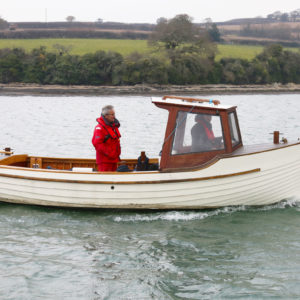
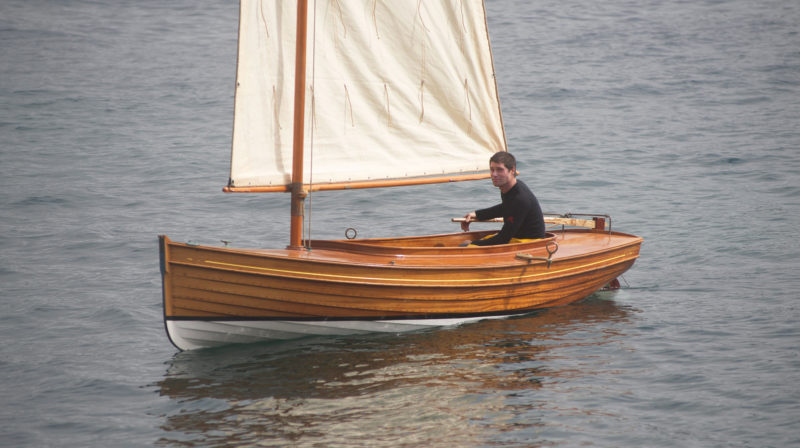
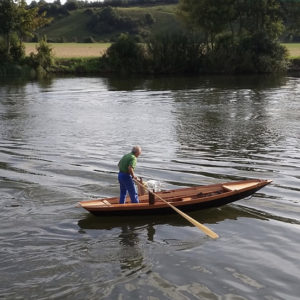
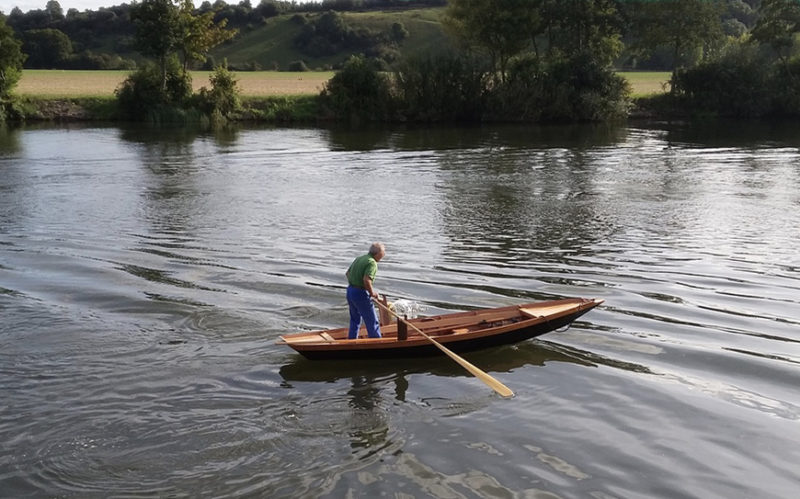
While we were trying out the oars, Scott’s other boat, ZEPHYR, turned up, and I jumped aboard to take some photos of Scott rowing and sailing his punt. The simple standing-lug rig, with its stayless mast, is extremely easy to raise and lower—one reason it was so popular with fishermen—and within a couple of minutes the boat was under way.
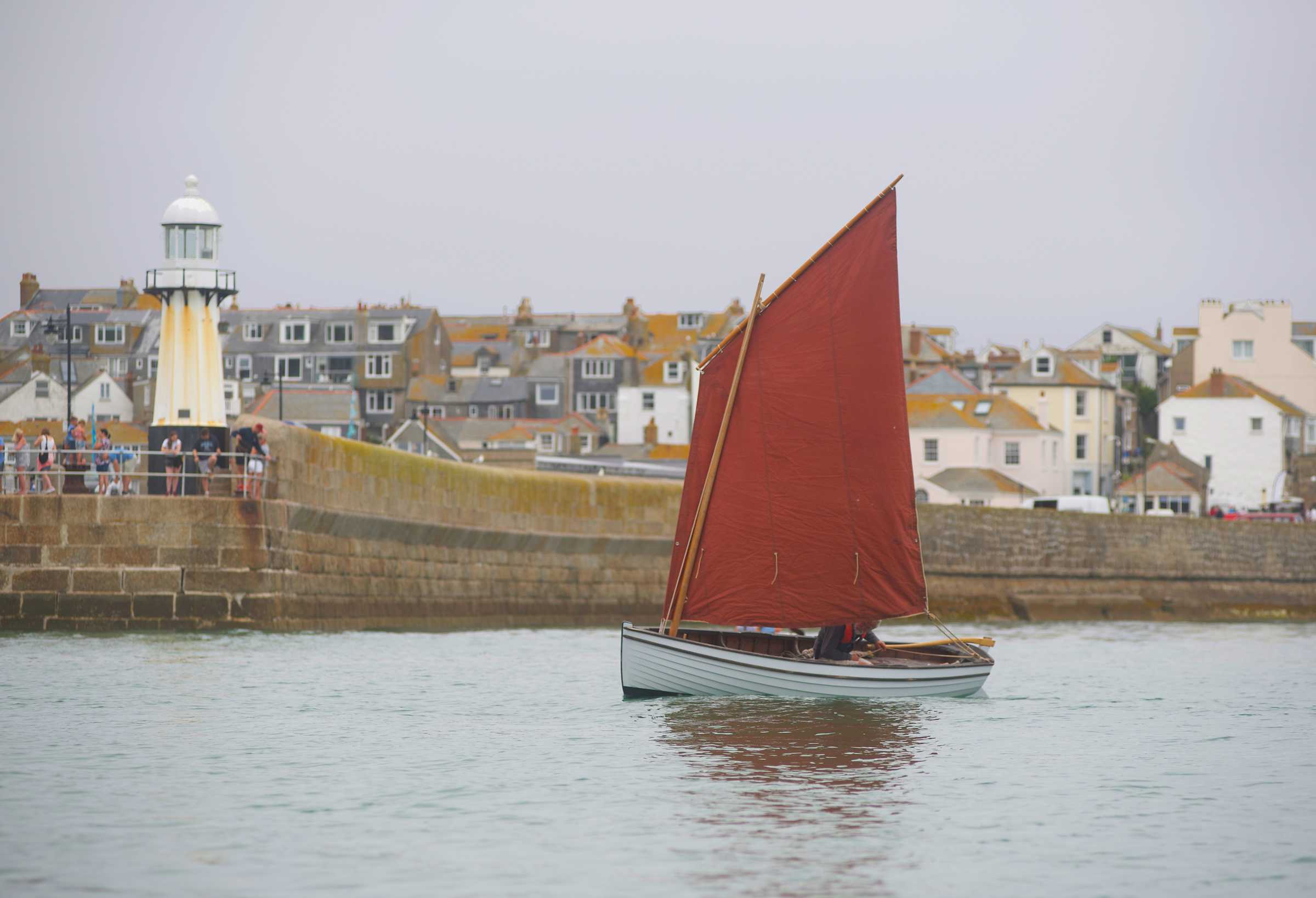
I feared the St. Ives punt might be a bit sluggish under sail, but it soon proved me wrong. Even before the surface of the water had been ruffled by the breeze, it managed to catch a breath of wind and, as if by magic, sailed away purposefully over a glassy sea, before the natural order was restored and a few ripples appeared below the bow. Even then, as a feeble wind blew hesitantly across the bay, it seemed to keep its way and made steady headway almost regardless of the wind.
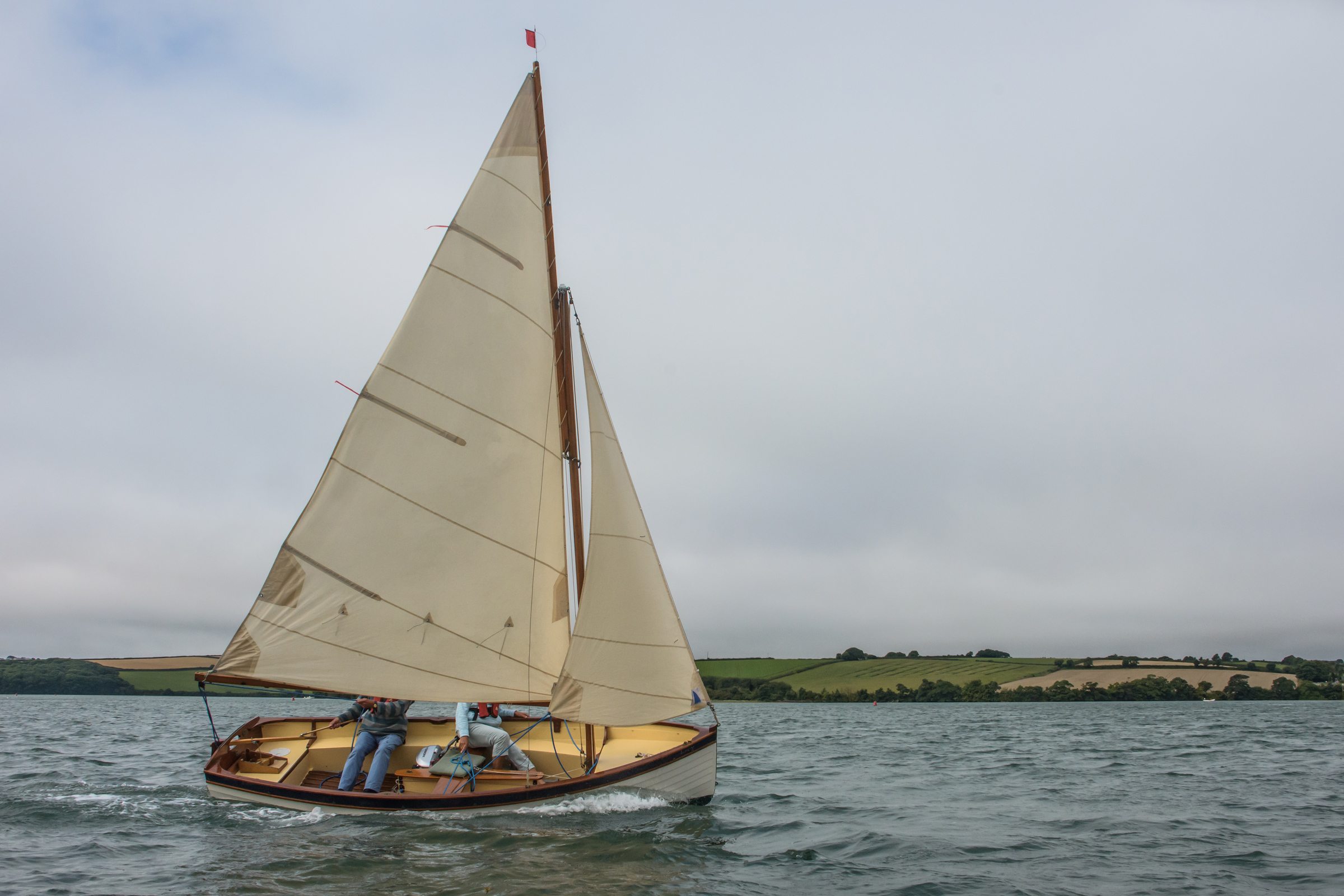
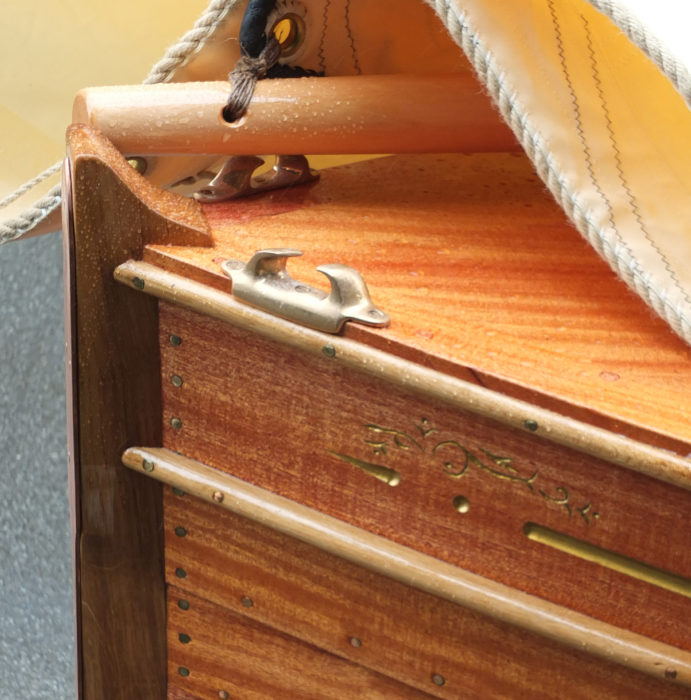
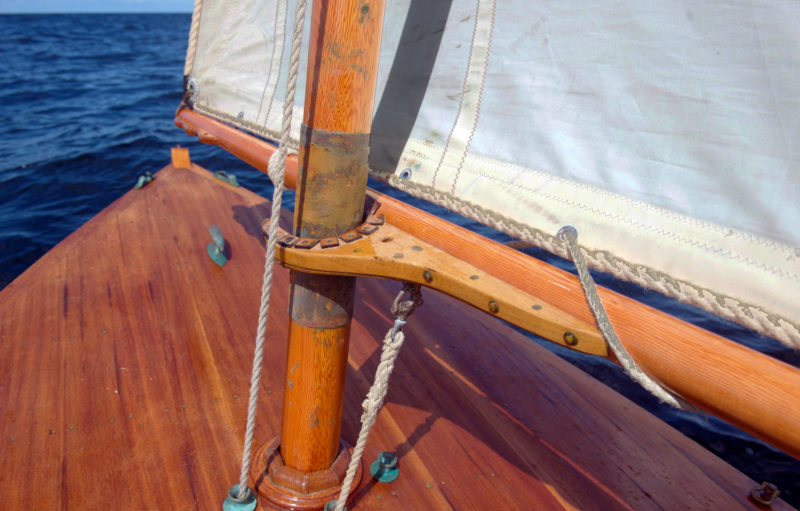
The loose-footed lugsail makes setting sail as simple as it can be. The mainsheet runs through a rope-stropped block with an eye that slips over thumb cleats, one on either quarter, close to the transom. A second block at the clew gives the skipper a 2:1 advantage.
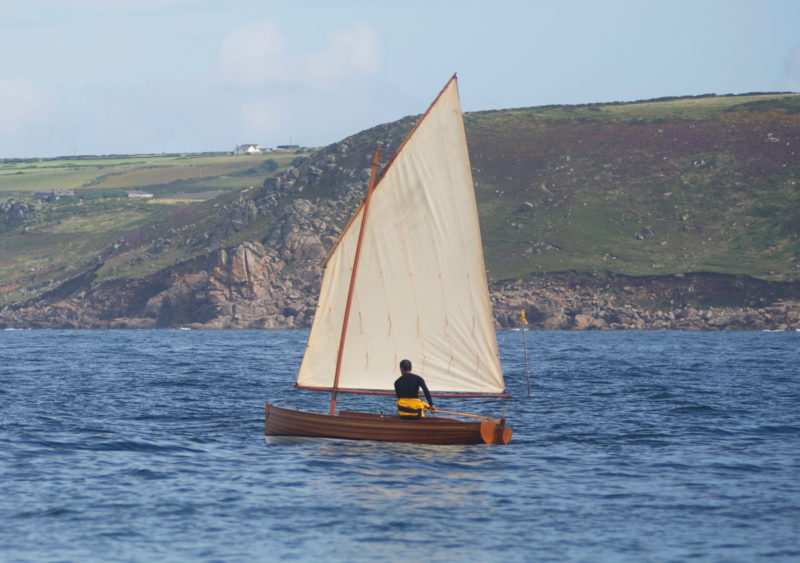
The punt kept up its uncanny ways after I climbed on board to join Pete, and we headed out past Bamaluz Point toward the open sea. A strong current was setting us to the west, with just a puff of wind from the southwest, yet as we turned around and headed back to St. Ives, the punt slipped along as if pulled forward by an invisible line. Of course, by then we were on a broad reach, and I suspect it would have been a very different matter if we’d had to tack to windward, not the St. Ives punt’s strong point.
One unusual feature in an otherwise quite standard lug rig is the sheeting arrangement, which runs through a single block with a line which is looped over a thumb cleat on the leeward rail. When the boat comes about, the block is simply unhitched and hooked onto the opposite cleat. I wondered if a rope horse wouldn’t make life easier, but Scott told me he had tried that and the current arrangement worked better. It certainly seemed the optimum position for the sheet to be in, judging by how well the sail set, though I had my doubts about how handy it would be in really windy weather.
The calm conditions combined with a strong current made it hard to judge the boat’s true sailing performance during our short outing. But certainly the absence of a deep keel or centerboard will affect the punt’s windward performance, though her builder insists that, providing you sail the boat full and by (not sheeting her in too tight) it performs very well. Indeed, he suggests the sailing St. Ives punts make very good training boats for the bigger Jumbos, teaching sailors how to manage a heavy boat with only a shallow keel to resist leeway.
“There’s nothing to stop the boat going sideways,” says Jonny. “And if you sheet too hard when tacking, it will just go sideways. So, you’ve got to get way on first. As soon as you’ve got momentum, it heads up fine, and there’s no question of not being able to make it to weather.”
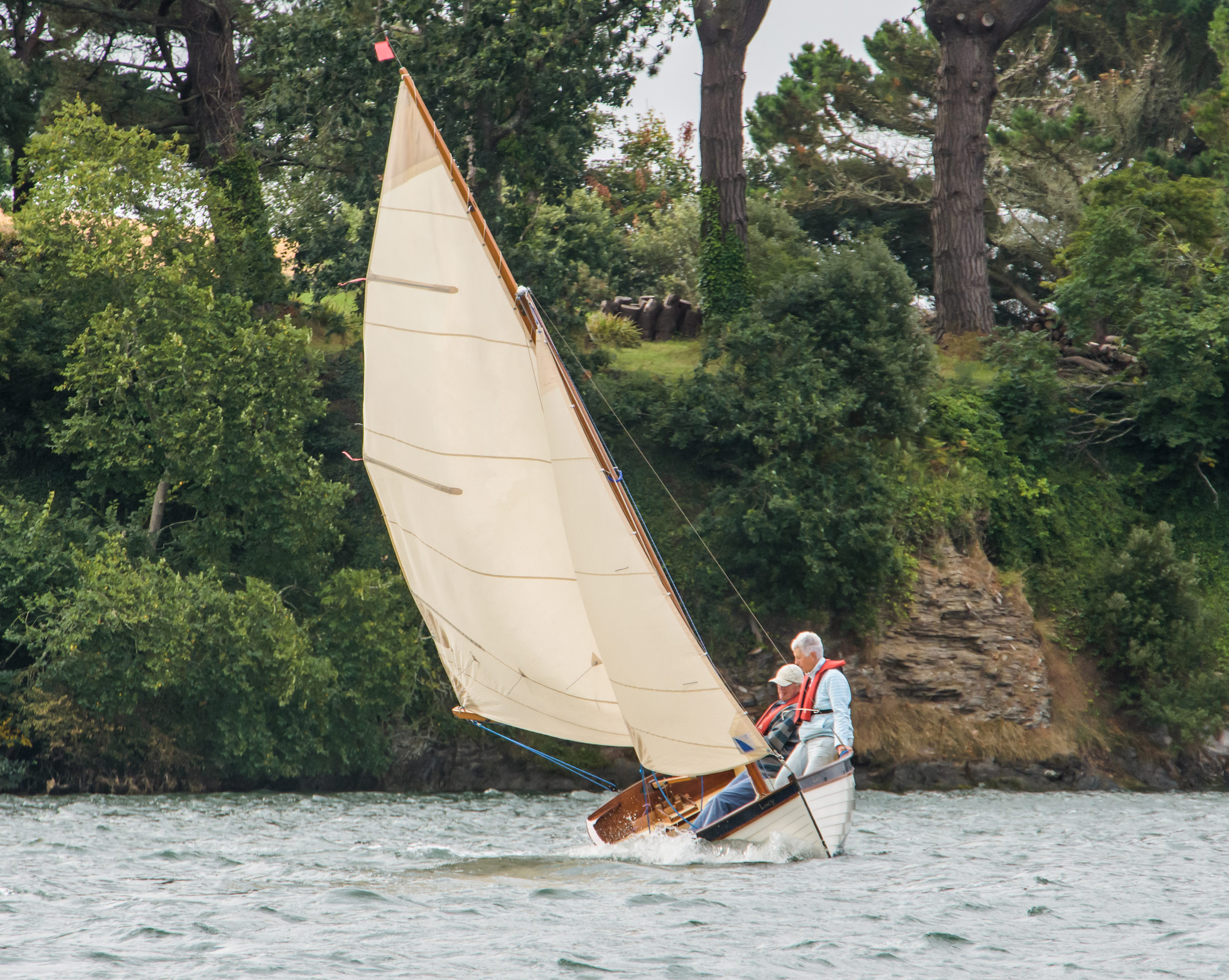
Lacking a centerboard, the punt doesn’t take well to being sheeted in too hard when working to windward.
The proof of a boat is in her sailing, and MAIA certainly showed the St. Ives punt is no slouch by winning the small boat class at the Looe Luggers Regatta, in open water and against several other bigger boats, just a couple of weeks after she was launched in 2015. The following year, she won the Prettiest Boat award in her class at the Falmouth Classics regatta, proving that even a hardy St. Ives lass can win the hearts of those South Coast yachties.
So confident is Scott in the St. Ives punt’s seagoing abilities that he and his wife are planning to take MAIA gunkholing around the U.K., starting with an Old Gaffers Association rally on the Isle of Wight and then heading up to Scotland to explore the lochs. And it’s this use as an expedition boat that might give the boat a greater purpose. Not everyone wants to keep a boat on a mooring in a tidal harbor that dries at low tide, but more and more people are discovering the pleasures of dinghy cruising and coastal sailing in small boats. Although the St. Ives sailing punt is small, it’s certainly sturdy and would cope with some dirty weather.
For now, MAIA is doing a very good job moored off the jetty at St. Ives, going up and down with every tide, weathering the relentless ground sea just as her forebears did, and without breaking a single rib so far. Watching her sailing in her native waters, surprisingly nimble despite her sturdy construction, I can’t help feeling that a bigger future awaits her beyond St. Ives, beyond the Isle of Wight, and beyond Scotland even. This traditional, local design, reborn for modern times, deserves to travel the world.
Nic Compton is a freelance writer and photographer based in Devon, England. He has written about boats and the sea for 24 years and has published 14 nautical books, including a biography of the designer Iain Oughtred. He currently sails a 14’ Nigel Irens skiff and a 26’ Chuck Paine sloop.
When I retired, my wife and I decided to move from the middle of Wales to Modbury, a town in Devon, England, just 4 miles from the coast; the prospect of a move and more time on the water with my family encouraged me to look for a slightly roomier dayboat than my 14′ 6″ Oughtred-designed Whilly Boat. I spent many happy hours studying designs from France, America, Australia, and, of course, nearer home here in the U.K.
I became increasingly interested in the work of the British naval architect Andrew Wolstenholme. Two of his lapstrake plywood dinghies, the 11′ Coot and the 12′ Mallard, really caught my attention. Both were already very popular owing to their lovely lines and excellent performance under sail. I approached Andrew to persuade him to design a bigger dinghy for estuary use in Devon. The boat needed to be light enough for easy trailering but big enough to take care of itself on a mooring for the summer months. Andrew agreed and produced a set of plans for a new 15′ gunter-rigged dayboat, the Swallow.
photographs by Mike Wynne-Powell
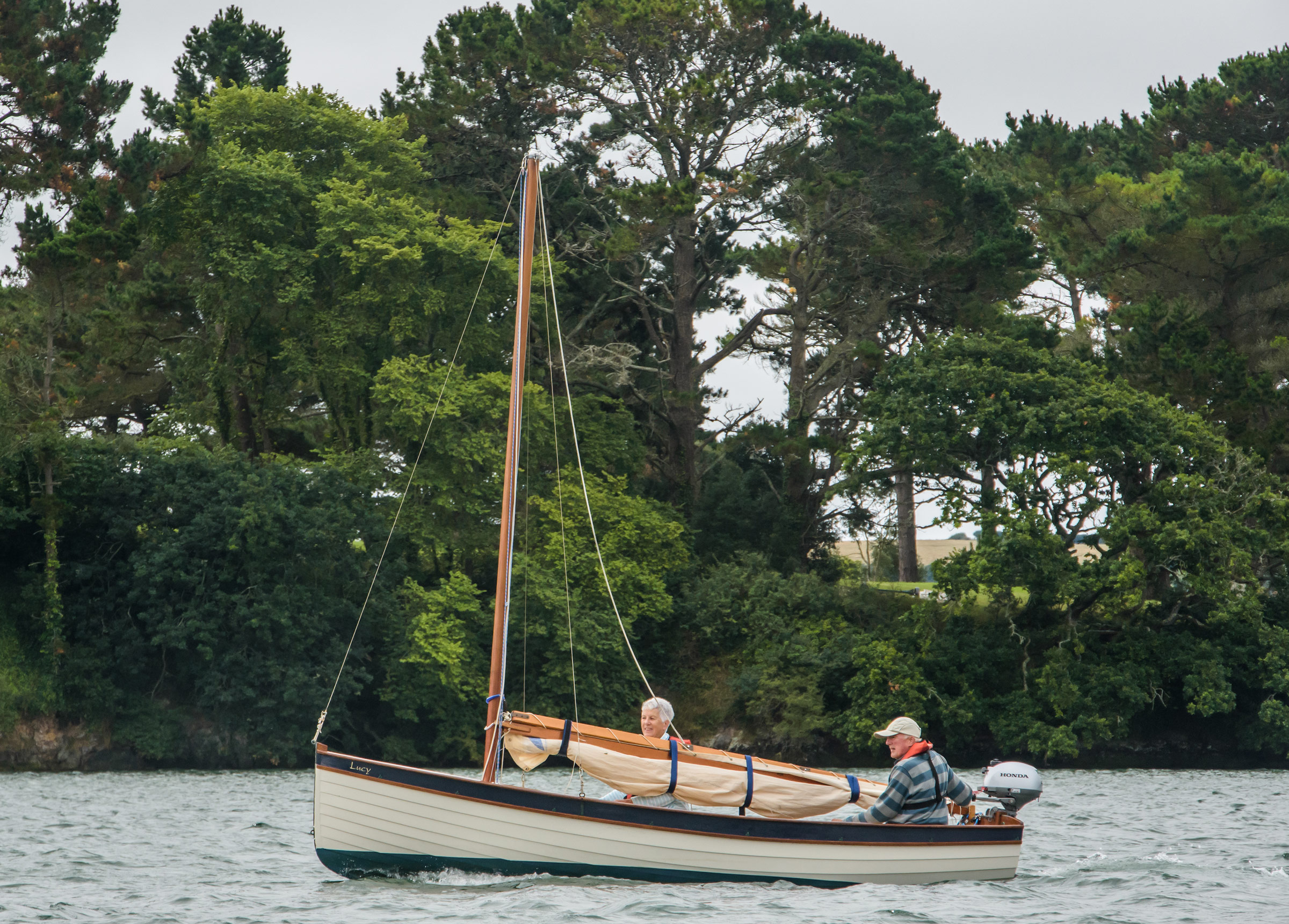
Airtight chambers along the boat’s entire perimeter give the hull stiffness and ample buoyancy in the event of a capsize.
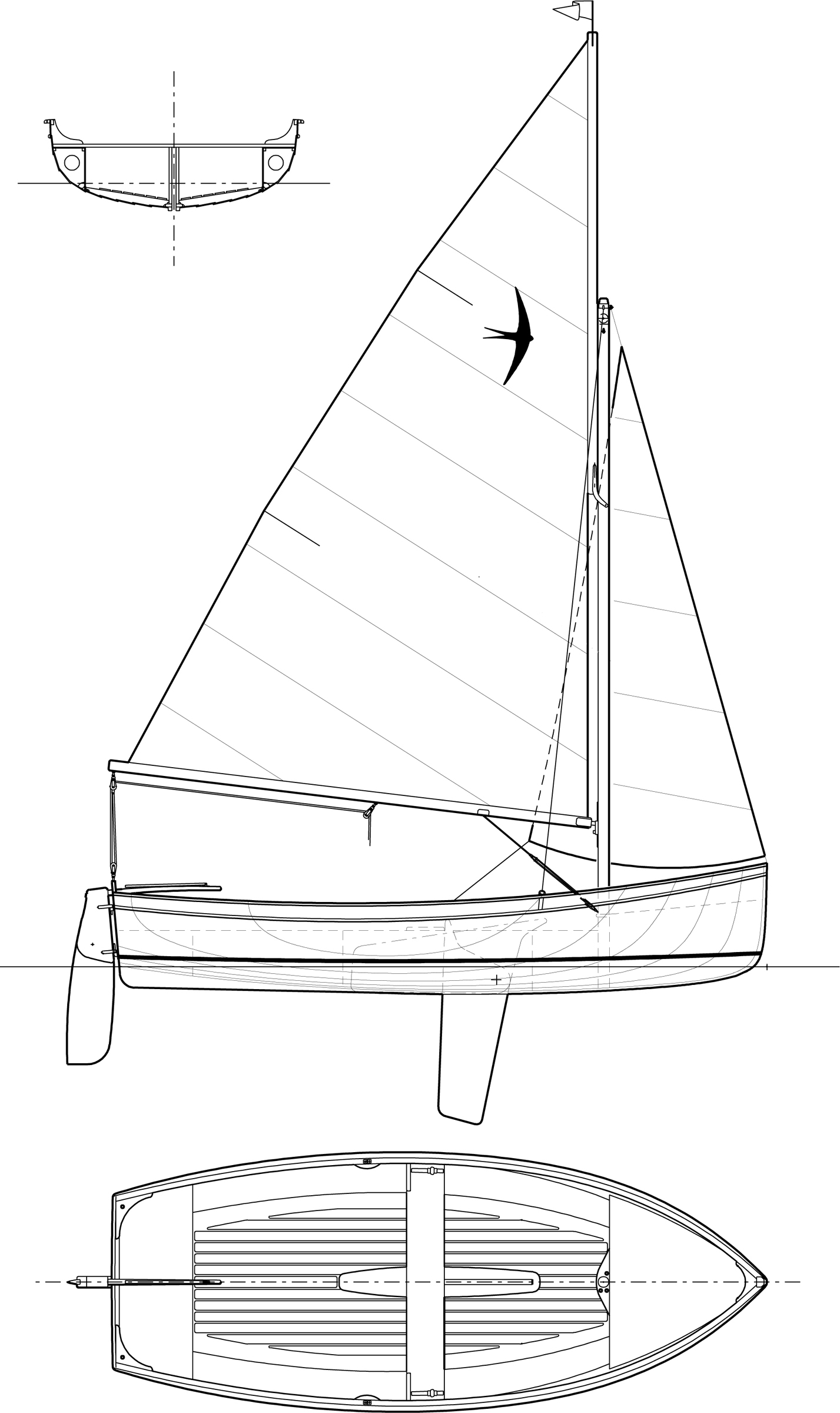
The lines of the Swallow seemed to offer an ideal compromise of lightness, speed, and roominess. The plans are suitable for skilled amateurs, as there are no step-by-step instructions or patterns for planks. Lofting isn’t required—full-sized patterns for the molds and transom are provided with the plans—but the hull must be lined off and the plank shapes spiled. When I realized each sheer plank might have to be scarfed together from three pieces of plywood, I asked Andrew to reduce the overall length to allow for two 8′ lengths of ply, joined by 10-to-1 scarfs, to have sufficient length for the sheer planks. Andrew agreed, and the dinghy became 14′ 6″. The straight stem and slightly raked heart-shaped transom, coupled with epoxy-glued planking, give the Swallow a very traditional appearance.
Fairing the planking lines on a new design is quite time-consuming, and I spent many hours peering at a batten laid over the hull while I tried to visualize how the boat would look when turned the right way up. The plank widths were worked out for the stem, ‘midship mold, and transom. The marks for other molds were determined by laying a batten through the known points and then marking the remaining points where the batten intersected with the molds.
Throughout the planking process, the 13 molds kept the lightweight 6mm marine plywood fair. I sometimes used up to 30 plywood U-shaped, wedged clamps to hold each new plank in place until the epoxy hardened—they have the reach to get around the plank, cost next to nothing, and are lighter than metal clamps, whose weight could distort the planks. Each plank has a 20mm-wide beveled edge which provides ample gluing surface for the subsequent plank.
The Swallow has 10 strakes, making 20 planks to cut, trim, and bevel before fitting. The backbone is a substantial keelson in khaya laminated to a sapele keel. The 7/8” sapele transom is faceted rather than curved, so each plank end can lie on a flat beveled surface for a perfect fit. The gunwales and inwales are substantial, with three laminations of sapele sandwiching the sheer plank.
The Swallow carries a gunter main with an area of 94 sq ft and a jib with 29 sq ft.
The interior layout is simple and comfortable, with the aft seat at the same height as the side benches, making it relatively easy to slide from one position to another inside the boat. The foredeck is above the bench level, but well below the sheer, and supported at its aft edge by a 12mm ply bulkhead. A large hatch on the bulkhead gives access to the watertight storage area under the deck. I stow the jib there, along with fenders and clothing. The rear compartment is accessed through two small hatches mounted on the bench and is used for stowing cordage, a chart, outboard motor parts, and safety equipment.
A pair of longitudinal buoyancy chambers span the bulkheads in the bow and stern and are fitted with removable hatches for ventilation and access. These chambers greatly increase the rigidity of the hull and comply with the EU Recreational Craft Directive regulations on safety. A pair of 7/8″ sapele knees at each bulkhead and at the center thwart secure the gunwales strongly to the hull. The centerboard case is topped by a 6″-wide 1/2″ plank, forming an additional perch in the middle of the boat. A 3’-deep swinging centerboard was fabricated from edge-glued sapele and carefully worked into an efficient foil from the plans. A 3” lead disc, epoxied in, provides some slight negative buoyancy. The nicely profiled kick-up rudder, offered in the plans as a full-sized pattern, is controlled by an uphaul and downhaul. The tiller projects from the rudderhead through an elliptical hole in the transom.
The boat carries a gunter rig, and the spars for the tall mainsail stow within the length of the boat. The mast is supported by two shrouds and a forestay. The plans call for a mast set in a tabernacle, but I opted for a strong bronze hinge. In raising the main, the yard is pulled tightly and parallel to the mast, in effect acting as a Bermudan rig. During windier conditions, the yard can be lowered about 18″ for attaching the main halyard with a quick-release pin to a second, higher slot on the yard when the sail is reefed.
Shrouds to the masthead support the rig when the Swallow is sailed hard.
Under sail, the Swallow is very responsive and light on the helm. The underwater profile of its hull not only gives a good turn of speed but the well-rounded shape, with a beam of 5′ 6″, is very stable when being boarded or sailed. There is room enough for up to four adults; with an agile crew of two aboard, the Swallow can be sailed very fast under full sail. On the Salcombe estuary in Devon, in a wind of Force 3 to 4, my wife Linda and I managed to keep completely dry despite the choppy conditions.
When sailing single-handed, the helmsman is provided with the main halyard and centerboard adjustment to the starboard of the centerboard trunk. A boom downhaul, with a 2-to-1 gun tackle to tighten the luff, leads to a cam cleat on the port side of the trunk. The Swallow sails wonderfully under main alone when going solo. I have experimented with leading the mainsheet to a block anchored on the centerboard trunk, but prefer handling the mainsheet as it comes from the boom end in the present arrangement. A kicking strap could be added to prevent the boom lifting, but I prefer less clutter. In recent years, I have fitted an auto ratchet block on the end of the boom to take the load in windy conditions. The mainsheet is led from the boom end around a block attached to a 2′ traveler on the transom.
With a beam of 5′ 6″, the Swallow needs long oars. The pair here are 9’6″.
The Swallow has a single rowing station at the center thwart and, with 9′ 6″ oars, rows with ease, but I stopped carrying oars some years ago and use an outboard for auxiliary power. I stow a Honda 2.3 outboard on the port side horizontally under the center thwart over a wooden block that protects the larch floor boards. To use the motor, a special two-piece plywood mounting fits over the transom, covering the hole for the tiller and protecting the mainsheet traveler. The outboard is then quickly clamped on the centerline and can be used in minutes. The motor powers the boat so easily that I rarely get to half-throttle.
With the rudder removed, the Swallow will take a small outboard for auxiliary power. Half throttle is all it takes to get the boat up to speed.
Over the past 14 years, I have appreciated and enjoyed Andrew Wolstenholme’s timeless design for the Swallow—a traditional-looking dinghy which could happily sail in the lightest airs. I had originally wanted a dayboat that was roomy with easy lines and ideal for exploring the estuaries of South Devon, but I got that and so much more.
Nick Hanbury was a cartographic surveyor with Ordnance Survey, Great Britain’s mapping agency, and spent all his working life making maps. In 1992, he joined John Kerr at his boatyard in West Wales for a week and was introduced to concepts of lapstrake building. In 1997, Nick’s Whilly Boat won the Amateur Shipwright Award at the Wooden Boat Show at Greenwich. His Swallow, christened LUCY, went to the Boat Show at Beale Park in 2004 and won 3rd overall and special prize for Best Constructed Boat. He is grateful to Linda for her support during these projects. He’ll be happy to share more about his building and sailing experience through correspondence directed to [email protected].
Swallow Particulars
[table]
Length/14′ 6″
Beam/5′ 6″
Draft, board up/7.5″
Draft, board down/3′ 9″
Sail area, main/94 sq ft
Sail area, jib/29 sq ft
[/table]
Plans for the Swallow are available from Wolstenholme Yacht Design for £125 ($162 USD) for e-mailed PDF files, and printed for an additional £20 ($26 USD) plus shipping.
Is there a boat you’d like to know more about? Have you built one that you think other Small Boats Monthly readers would enjoy? Please email us!
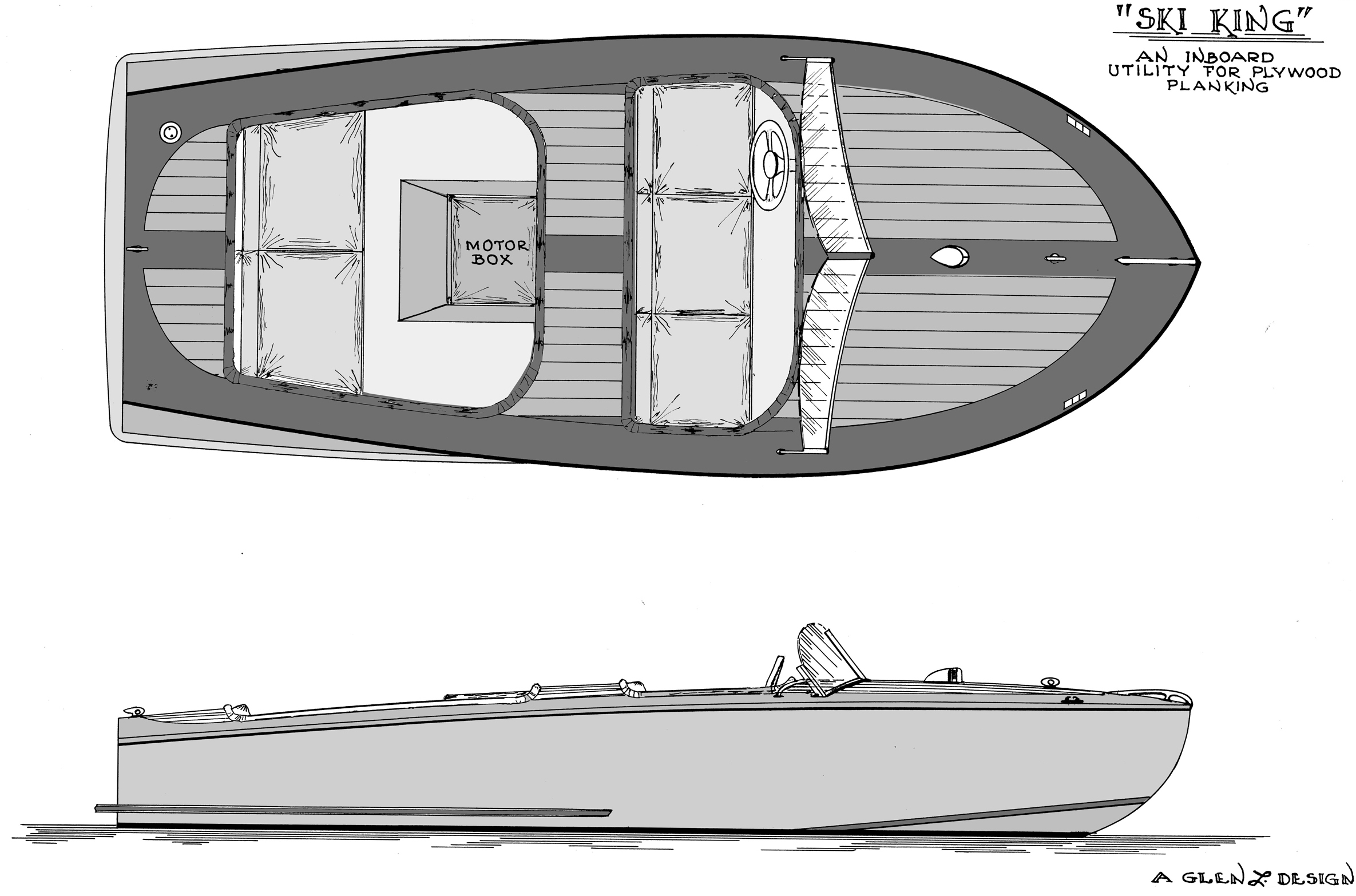
The Ski King was designed by company founder Glen L. Witt—a keen water-skier and a boat designer—in 1953, the year he went into business selling plans and kits to home boatbuilders. Although he enjoyed boating in his own 15′ Ski King for many years, at some point sales of the plans diminished and they were removed from the Glen-L catalog. But in 1976, Dwain Colton of Portland, Oregon, was keen to purchase a set of Ski King plans which, luckily, were still stored within the company’s archives. As it turned out, Dwain didn’t complete his Ski King until 2003, but the plans are now in Glen-L’s online catalog and “even made it back into our print catalog, which is something that I don’t remember ever happening before,” said Gayle Brantuk, Witt’s daughter who now runs the company.
In August 2017, Jonathon Clark, a former manager in the construction industry, started a 40-week course at the Boat Building Academy in Lyme-Regis. He decided that he would build a Ski King and ordered a set of plans and instructions from Glen L. He could have gone started making the frames—the comprehensive plans include detailed frame dimensions—but because lofting is required part of the Academy’s curriculum, Jonathon began work by drawing the lines full size.
As the lofting process progressed, Jonathon investigated what engine he would install. The plans recommend engines between 45 and 90 hp, noting “the only limitation on the motor is size.” In the higher horsepower range, only car engines would fit; they would have to be marinized, and Jonathon didn’t want to take on the additional challenge. He looked for as big a marine diesel as he could find, and this led him to a 57-hp, four-in-line, water-cooled Yanmar. He soon discovered that this engine wouldn’t fit in the Ski King as drawn, and so he would have to stretch the hull. The plans say that it’s acceptable to increase the 15′ length by up to 10 percent, to 16′ 6″, by spacing the frames farther apart. Jonathon had more or less completed the lofting at this point, so to stretch the hull to 16′ 6″ he simply extended the stern and added an additional frame.
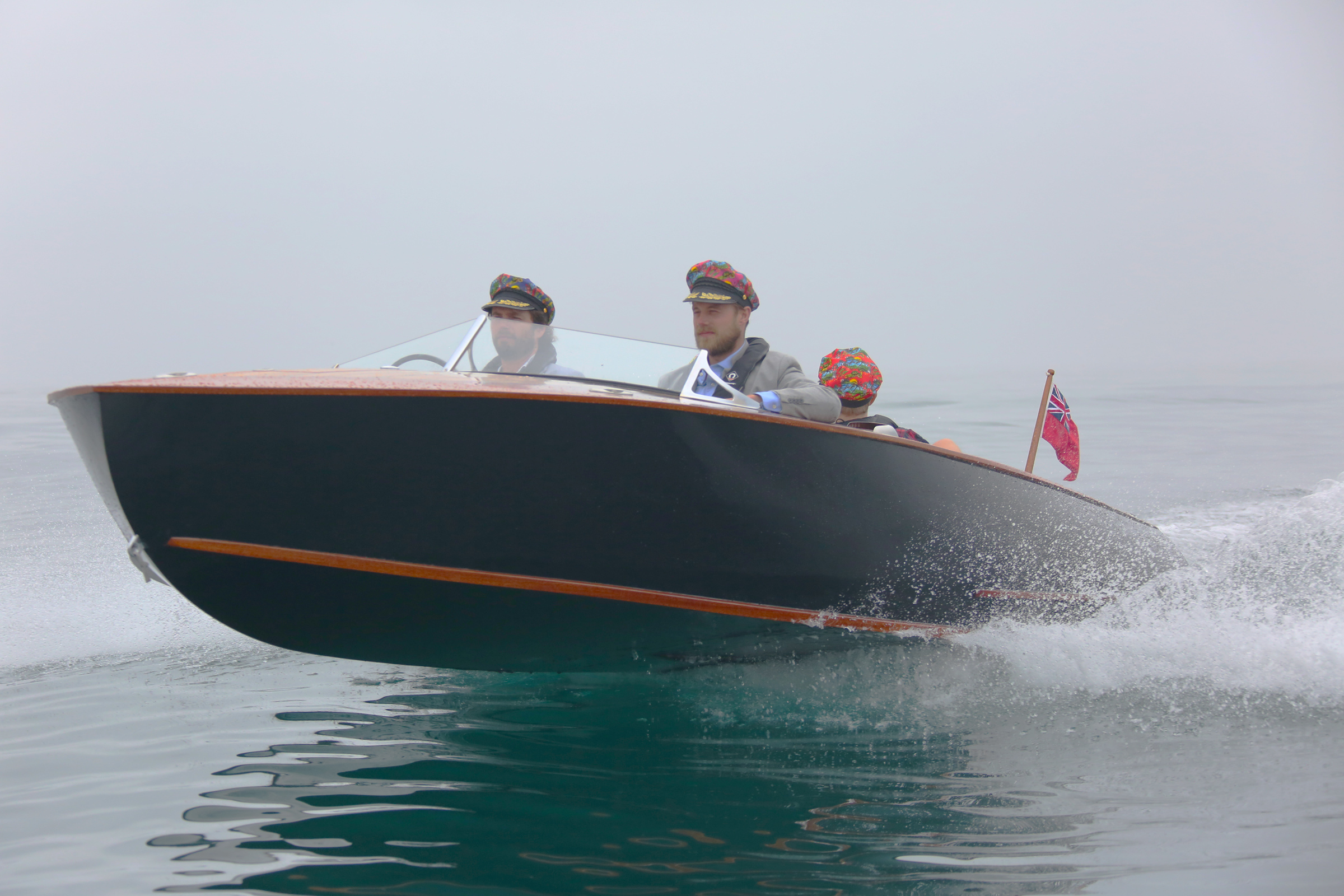
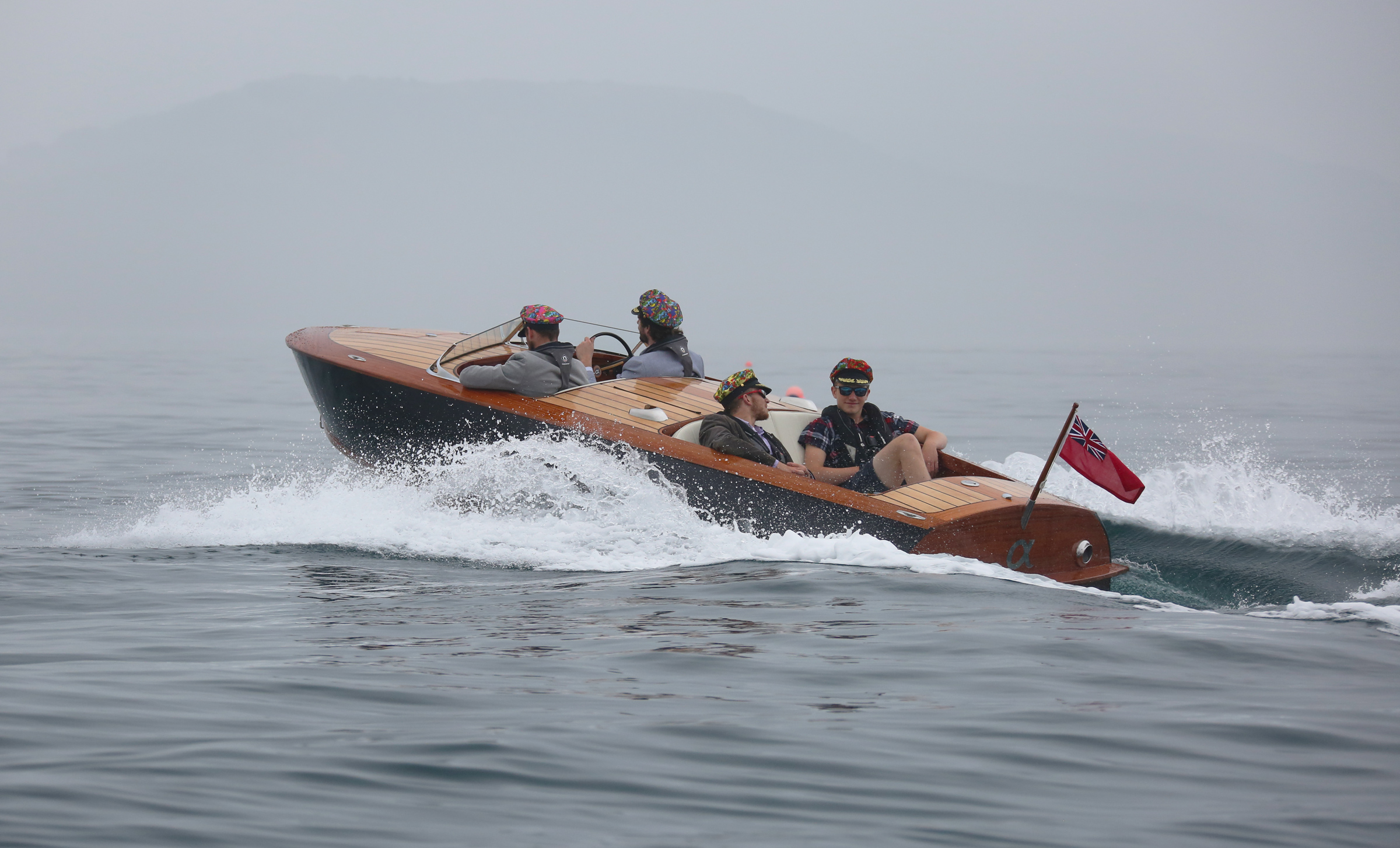
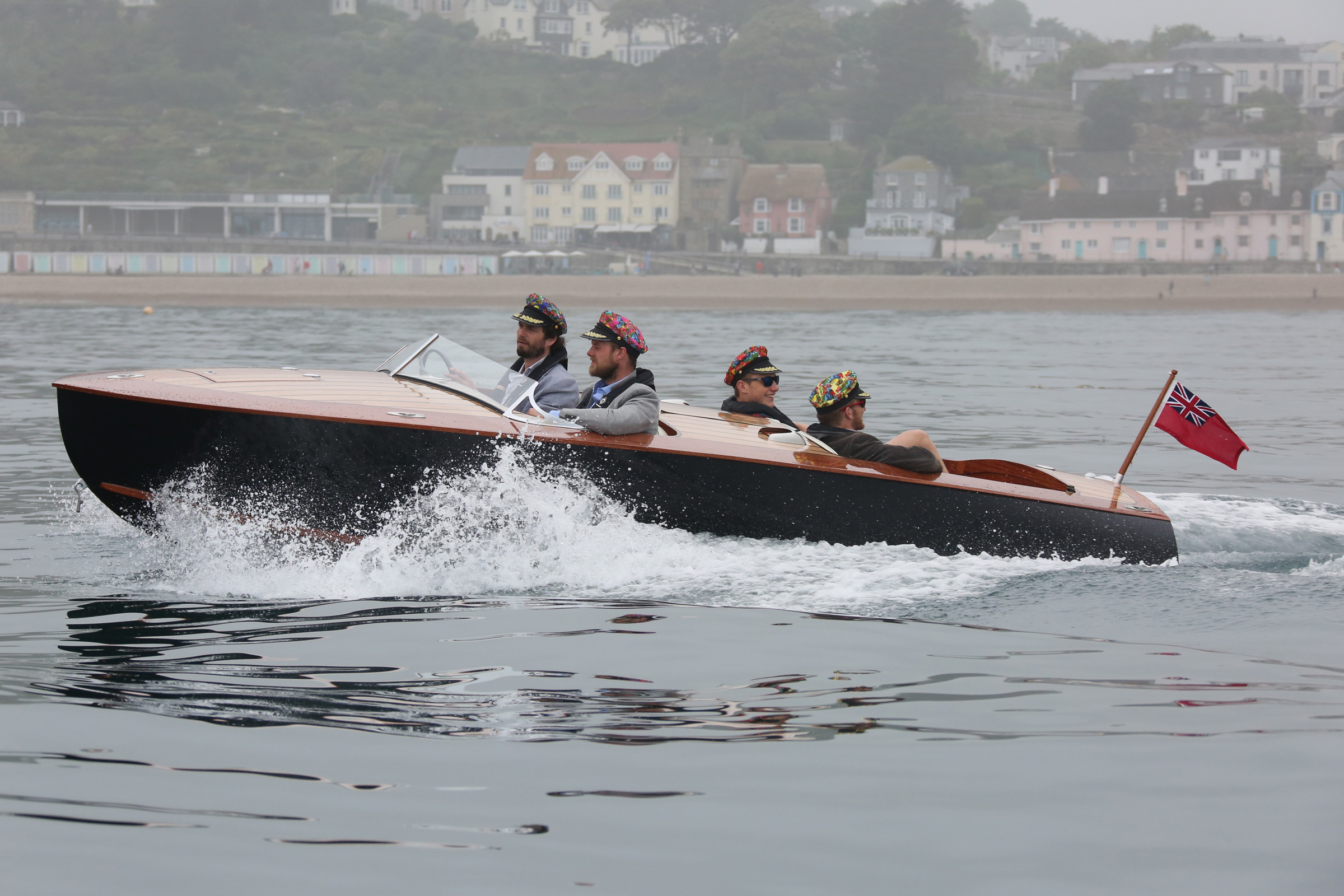
The 57-hp marine diesel installed in AGAPE has enough power to get on plane with a full complement on board.
The hull is constructed upside down, with the motor stringers serving as twin strongbacks supported on temporary uprights and cross cleats. Jonathon and his fellow students would then set the transom and frames in notches cut into the stringers. The plans call for five frames: three of them ring frames, one just a floor, and the forwardmost a ring frame fitted with a plywood bulkhead.
Jonathon ended up fitting seven. He added one frame aft, and another near the bow, which would make it easier to fit the hull planking. The frames were made of 3/4″ thick sapele with 3/8″ plywood laminated to their floor timbers. Jonathon made the transom, originally drawn for 1″ framing and 1/4″ plywood, with 3/4″ ply faced on the outside with 3/32″-thick khaya veneers. The two motor stringers, which are fitted 1′ to either side of the centerline and run from the transom to the bulkhead at station No. 5, are 1″-thick sapele with 3/8″ ply laminated to their outboard faces to keep them from splitting, and they are interlocked into the frames. The stem is made up of two layers of 3/4″ plywood interlocked with the bulkhead at station No. 5 where it is joined to the keelson, which is made up of a laminate of 1-1/8″-thick sapele and 3/8″ ply, again to prevent the splitting that plywood-on-frame construction occasionally suffers. Other longitudinal components—all sapele—include 1″ x 2″ bottom battens, chines laminated in place from two pieces of 5/8″ x 2”, and sheer clamps from two 1/2″ x 2″ pieces, also laminated in place.
Once this framework was completed, the keelson, motor stringers, chines, and sheer clamps were faired to receive the plywood planking.
The plans call for 16’ sheets of plywood, 1/2″ on the bottom and 1/4″ on the sides. That may well have been available in the USA in the 1950s, but Jonathon could only obtain plywood in 8′ lengths. The plans include instructions for using butt blocks to join 8′ sheets to get the full length needed, but Jonathon opted to scarf two sheets to get the length for the bottom. Then, rather than use 1/4″ plywood for the side planking as specified in the plans, he decided that the simplest solution was to cold-mold the curved sides with three diagonal layers of 1/8″ ply.
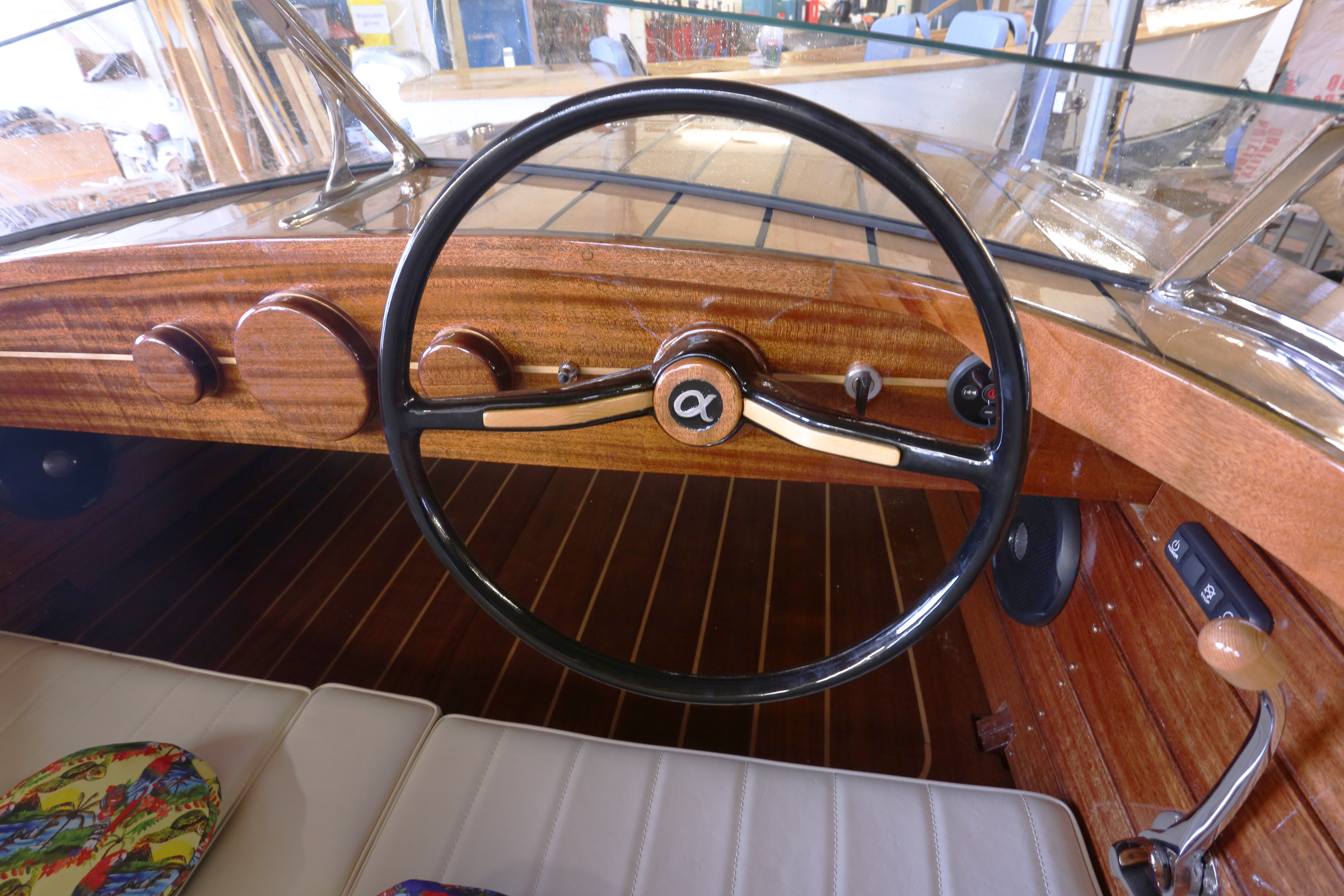
The wheel was originally manufactured for a Volkswagen. The wooden discs are magnetically attached instrument covers that are removed when the boat is in use.
The plans suggest that, as an option, the outside of the hull could be ’glassed for increased durability. In the ’50s that would have meant using polyester resin, but Jonathon used epoxy and one layer of 450-gsm (13.2-oz) biaxial cloth. And while the plans call for Weldwood resorcinol glue, another pre-epoxy standard, epoxy was used throughout the construction, and during assembly everything was held together with a minimum number of bronze screws (far fewer than the plans specified).
Khaya sprayrails were then fitted along the chines, and in the aft part of the boat—where the tumblehome is pronounced—khaya rubbing strakes were fitted along the point of maximum beam. Once the hull was turned over, all the structural components were epoxy-filleted to each other on the inside.
The propeller shaft needed to be angled at 15 degrees, but if the engine was set at that angle, its forward end would be too high. So, it was fitted at an angle of 8 degrees on fabricated stainless-steel engine beds which were bolted to the motor stringers. A 1.47:1 gearbox made up the difference with a down-angle of 7 degrees.
The 14″-diameter, three-bladed bronze propeller came from Michigan Marine. It was supplied with a 12″ pitch, but BT Marine, a company near Lyme-Regis Academy, after examining all the available data, and tweaked the prop to produce a 13.5″ pitch with cupping to give a virtual pitch of 14″. A custom 304 stainless-steel fuel tank with a capacity of 53 liters (14 gallons), which Jonathon hopes will give him a full day’s use without refueling, was installed under the aft deck.
Photographs by the author
While the plans illustrate a motor enclosure that extends into the aft cockpit, ultimately the layout is determined by the builder and the motor chosen. In AGAPE, the motor is hidden under the deck between cockpits.
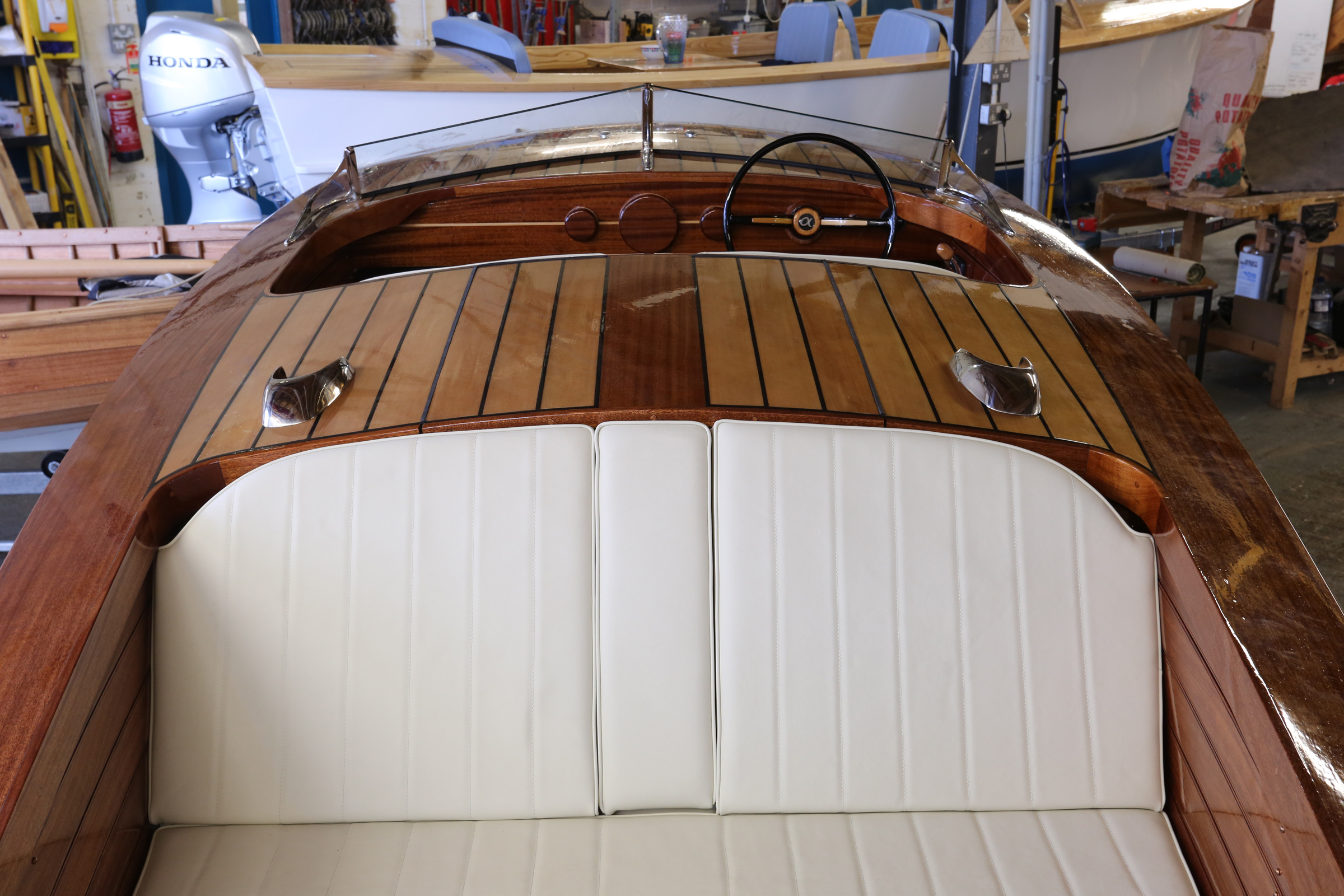
Although Glen-L’s plans suggested a narrow bridge deck with an engine box extending aft from it, and a forward-facing seating in the aft cockpit, the details are left to the builder to accommodate the engine chosen. Jonathon felt that a wider bridge deck to completely enclose the engine with aft-facing seating behind it would better suit the 1950s aesthetic and the designer’s intended function for the boat: towing a water-skier.
The top portion of the ring frames serve as deckbeams, and the remainder of the deck structure is sapele. The deck itself is made up of a 1/4″ plywood sub-deck with 1/4″ khaya covering boards and kingplanks, and spruce laid planks. While there is a hatch in the foredeck for access to a stowage locker, Jonathon was keen to avoid obvious hardware such as piano hinges, and the engine hatch will only need to be opened for major servicing or removal, so he has fitted it semi-permanently. Removing the upholstered backrests forward and aft of the engine provides everyday access. Both sets of backrest cushions are in three sections, partly to make them easier to remove and replace, but Jonathon’s attention to detail is well reflected in the fact that the middle sections line up exactly with the kingplank, and the stitching in the outer sections line up with the other deck seams.
Jonathon found it difficult to source suitable chrome and stainless-steel deck hardware in the U.K., but he was able to find much of it in the USA. The windscreen framework came from a 1950s Chris-Craft, and the steering wheel was salvaged from a 1960s Volkswagen Beetle.
The seats in the aft cockpit face the stern, appropriate for the design’s original purpose of towing water skiers.
The Academy’s launch day, with an enthusiastic crowd looking on, can be a nerve-wracking affair, especially with a high-performance boat such as the Ski King, now christened AGAPE. Initially Jonathon took co-builders Rory Pullman, Arthur Scott, and Sam Stephens, each of whom, along with fellow student Andrew Petter, gave him invaluable support throughout the project. After the inaugural spin around the bay, he returned and invited me to join him.
There was not a breath of wind, and in a very slight swell at close to the full 3,000 rpm, AGAPE got up to 22 knots. Jonathon was delighted: he had expected something like 20 knots with just one person on board. He was reluctant to try turning hard at full speed, but at 17 knots the turning circle was around 20 boat-lengths. Maneuvering at slow speeds was tricky, partly because the engine was set to idle at 800 rpm, a little high, and gave us a minimum speed of just over 4 knots. At that speed the turning circle was about five boat-lengths.
With 54-hp propelling the AGAPE, it is on the low end of the recommended power range. The upper range of 90- to 100-hp would provide a very lively ride.
Jonathon later contacted his engine supplier, Purbeck Marine, and learned this was computer controlled and would settle to about 600 rpm once the engine broke itself in. In reverse, AGAPE is very difficult to steer, but Jonathon accepts that these are typical characteristics of such a boat and hopes that some tweaks will lead to minor improvements.
Sitting in the stern seating area was very comfortable, with less motion than in the driving seat. Even at full speed I was able to write legible notes, and it was possible to have a conversation with my companions above the engine noise. It will be a perfect spot from which to safely keep an eye on a water-skier being towed astern. It was easy to see why Glen L. Witt, who passed away in 2017 at the age of 98, chose to build this one for himself.
Nigel Sharp is a lifelong sailor and a freelance marine writer and photographer. He spent 35 years in managerial roles in the boat building and repair industry and has logged thousands of miles in boats big and small, from dinghies to schooners.
Bryn Morgan has spent all his working life at sea, but until now he had never had a boat of his own. For many years he had his eye on an 18′ Plymouth Pilot, a fiberglass production boat with lines based on a 1930s pilot vessel that operated out of Teignmouth in Devon, on the south coast of England. But when his son-in-law, Adrian St. Aubyn, a Venezuelan with Cornish ancestry, enrolled at the Lyme Regis Boat Building Academy in 2015, he realized there might be a better opportunity.
Six years earlier, another student at the Academy, Alasdair Grant, had built STEADFAST, a 16′5″ version of a 15′3″ Beer Beach boat called WILD DUCK. Beer is a village located in the middle of the Lyme Bay coast, and the boats built there had evolved over many years and came in various shapes and sizes, all seaworthy enough to cope with the exposed coastline of south Devon and durable enough to be hauled up the steep, heavily pebbled beach there. WILD DUCK was built in 1963 for crabbing and bareboat charter, and she was still on Beer Beach when Alasdair and his classmates took the lines off her.
When Bryn saw photographs of STEADFAST, he fell in love with her and started talking to Adrian about building something similar while he was at the Academy. Bryn wanted something bigger than WILD DUCK, around 21′ but the administrators were concerned that would be too big to complete in the time available. They settled on 19′ with a raised foredeck and wheelhouse, agreeing that STEADFAST’s lines were a perfect starting point.
Adrian took STEADFAST’s table of offsets, put it into AutoCAD, and scaled it up to the desired 19′ with all other dimensions increased proportionally. He then faired the lines on a full-sized lofting and adjusted the offsets.
photographs by the author
Builder Adrian St. Aubyn perched on the engine mounts to enjoy his handiwork.
Construction began with an all-oak backbone. The stem was laminated from 18 pieces of 5/32” veneer; the 5-1/2″ x 2” hog and 2-3/4″ square keel were both laminated from two pieces; and the deadwood, made up of 14 pieces, incorporated a swelling through which the stern tube would be bored. An extension from the deadwood’s lower edge provided an attachment point for the bottom rudder pintle. All the pieces were joined with epoxy and copper and bronze fastenings.
Adrian cut rabbets in the hog and keel for the garboard, and in the stem for the hood ends of all the planks. The whole assembly was then erected on a temporary structure about 2′ off the workshop floor, and the top of the stem was secured to an overhead beam.
The 2-1/4″ stern knee and 1-1/4″ oak transom were then fitted, and then the nine temporary molds were set up at their stations and secured to the overhead beam. Sixteen ribbands were laid along the length of the boat so that the position of the top edge of each plank could be determined and then marked on the molds, transom, and stem. When the ribbands were removed, it was time to fit the 3/4” larch lapstrake planking.
The builder, left, and owner Bryn Morgan make themselves comfortable in the sternsheets. The throttle used while steering with the tiller is just below Bryn’s left hand.
The garboard plank—8″ wide at its widest point—was taken a little further up the stem than initially lined with the ribbands to induce more taper and lift to the forward ends of the other planks for a more pleasing profile. As soon as this was fitted, the gains, known locally as geralds, were cut at each end of the top of the garboard to allow the next plank to finish flush with the outer part of the stem and transom.
From there the remaining 14 strakes were fitted. They all had to be steamed at their ends to cope with the twist, and most had a scarf joint in them. In each case, the lands were bedded with an oil-based mastic and then fastened with copper clench nails while the ends were epoxied and screwed to the stem and transom.
The 1-1/4″ x 5/8″ oak frames were then steamed and fit between the molds on 6” centers. Almost all of these were continuous from sheer to sheer, but the forward-most five were fitted in separate halves on each side. The molds were then removed after two braces were temporarily laid across the hull to retain its shape, and the remaining frames were fitted. The sheer forward was then extended upward for the raised foredeck by fitting an extra plank flush with the sheerstrake and supported by an extra 10 short frames.
The motor housing conceals a 14-hp two-cylinder Yanmar diesel.
Adrian fit the internal structure: the 4-5/8″ x 1” oak beam shelf, the 3-3/4″ x 7/8″ larch bilge stringer, the 1-1/2″ x 1-1/8″ oak risers (the aft parts of which would support the side seats), and five 1-3/8″-thick laminated oak floors. Two sawn frames, 1″ thick and averaging 3″ deep, are joggled with limbers above every lap and doubled up from about the riser downward to stiffen up the open part of the boat. The 3-1/2″-thick engine beds span the sawn frames.
After the 1-1/2″ x 2″ oak deckbeams were fitted forward and aft, an oak laid deck with no plywood subdeck was fitted over them. The oak railcap, running the length of the boat between the decks, is 4-5/8″ x 1″. The wheelhouse is made up of 1 ¾”-thick solid sapele sides and front, with 1-7/8″ x 1-5/8″ roof beams, covered by 3/4″ ply and a layer of ’glass and epoxy.
The four 3″-square mooring posts were made of reclaimed wood that had been Falmouth docks. They were the only pieces of wood on the boat for which no money changed hands, but Adrian described them as “priceless, because they belong to this place,” referring to ELLY ROSE’s home port. That was where Bryn, Adrian, and I met up for a sea trial on ELLY ROSE on a blustery winter’s day.
Cruising speed with the 14-hp diesel is around 5.5 knots.
With Adrian at the helm, we maneuvered our way out of a tricky berth and then motored down the Penryn River. The Yanmar 14-hp two-cylinder diesel gave us 5.2 knots at the cruising rpm of 2,500, and 5.6 knots at 3,000, but the Force 6 headwind was clearly having a significant effect on the sizable wheelhouse. So we turned around and found that going downwind, she went a little faster: 5.4 knots and 5.9 knots at the respective rpm. Not surprisingly, her turning circle was also affected by the conditions. While it was about three boat-lengths (at 2,500 rpm) turning into the wind, it was little more than half that turning away from it.
Bryn and Adrian told me that they had decided to fit the engine in the deepest part of the boat without calculating the effect on the center of gravity. When the boat was launched, they found that she was bow-down and difficult to steer, especially when in reverse. The prop was too close to the surface and not really biting properly. They put around 575 lbs of lead ballast aft, which seems to have done the trick—I found her easy to steer in both directions. They have in mind moving the engine aft at some point in the future.
The rudder can be operated at the tiller or by a wheel in the pilothouse. A hydraulic piston mounted under the aft deck is connected to a bolt through the rudder stock that extends through a slot high on the transom.
There are two steering positions: a wheel in the wheelhouse (especially welcome on that very cold day!) and a tiller aft. Both have gear and throttle controls, and it is a simple matter to make sure one is in neutral before assuming command at the other station. A valve in the aft locker disconnects the hydraulic wheel steering to allow the tiller to be used. I am 6’ tall and, although I could stand in the wheelhouse, I had to stoop a little to get a clear view forward. I also had to stoop at the tiller to get a view through the wheelhouse windows. Bryn is 5′8″ and has no trouble in that respect, and neither of us did when sitting on the engine box forward or on the seats adjacent to the tiller.
Bryn and Adrian had been farther out to sea than we went that day, and Bryn said he was delighted with ELLY ROSE’s seakeeping qualities, especially when punching her way through the waves in a more exposed stretch of water.
Bryn is very much looking forward to using ELLY ROSE during his impending retirement. He plans to use her for fishing, hauling crab pots, picnicking, and visiting secluded beaches accessible only by boat. She will, I am sure, be perfect in all those roles.
Nigel Sharp is a lifelong sailor and a freelance marine writer and photographer. He spent 35 years in managerial roles in the boat building and repair industry and has logged thousands of miles in boats big and small, from dinghies to schooners.
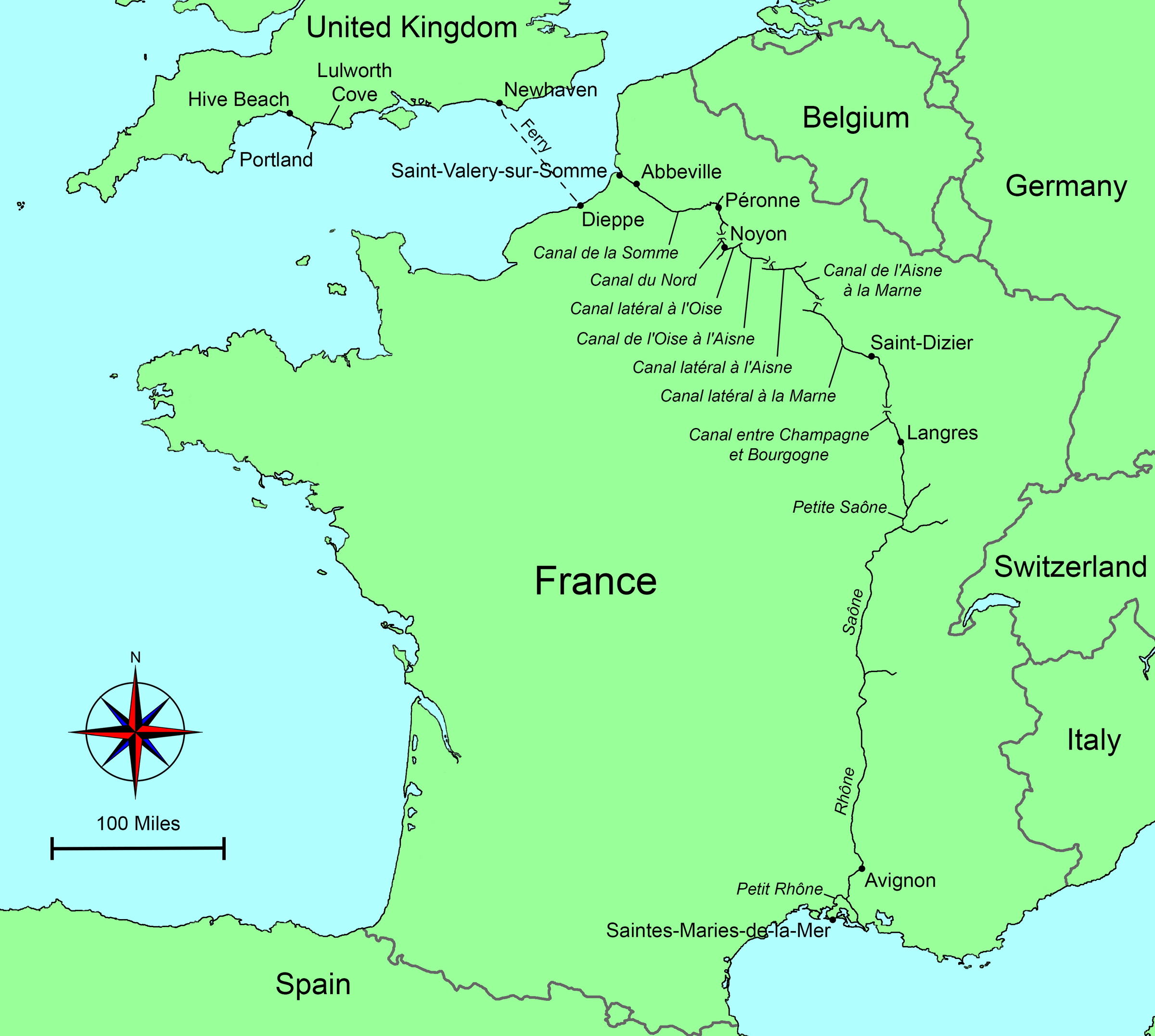
When my husband Mat and I set off from Sidmouth, England, our destination was the Mediterranean, roughly 870 miles (1,400km) south. We planned to reach it through the inland waterways of France. We had two months off work and arranged for friends to meet us with the boat trailer in the port of Sète on August 5, 2017, to bring us home. We estimated we’d need to row at least six hours every day to make it. With just weeks to go before we planned to depart, Mat finished our boat, DUNLIN. The lapstrake dinghy, 13′ 7″ long with a 4′ 6″ beam, was the first boat he’d built and is based on a traditional workboat designed for both rowing and sailing with a gaff sloop rig.
As our families waved goodbye from Sidmouth beach, we clumsily zigzagged east along the English Channel coast, unable to row in a straight line. We had only rowed DUNLIN together for the first time a few days previously and we weren’t helped by a poor distribution of gear that had disrupted the proper trim. That morning we’d stuffed the tiny lockers with camping gear, a gas stove, a solar panel, some clothes, and emergency canned food, all inside waterproof bags. Stowed under our seats were water bottles, inflatable rollers, and swimming floats, which made cheap, compact fenders.
Roger Siebert
.
With one oar each, we kept practicing in different positions until we settled on Mat to starboard on the aft thwart and me to port on the forward thwart. We eventually learned to keep our strokes rhythmically consistent to row in a straight line. With Mat setting the pace, I had to ensure the blade of my oar would catch the water to start the stroke at exactly the right moment. We counted aloud together, aiming for a long reach and fluid movement. We kept the retractable rudder out of the water while we rowed.
We planned to row as far east as possible before having to put DUNLIN on a ferry for crossing the Channel to France. We had wanted to make it to France ourselves by oar or sail, but found out this would be illegal since the French classified DUNLIN as an “unorthodox vessel” and not permitted to make the crossing
For the first few days along the south coast of Devon and Dorset there was not a breath of wind, so we rowed until we saw somewhere to stop then set up camp on the beach.
photographs by Polly and Mat Hilton
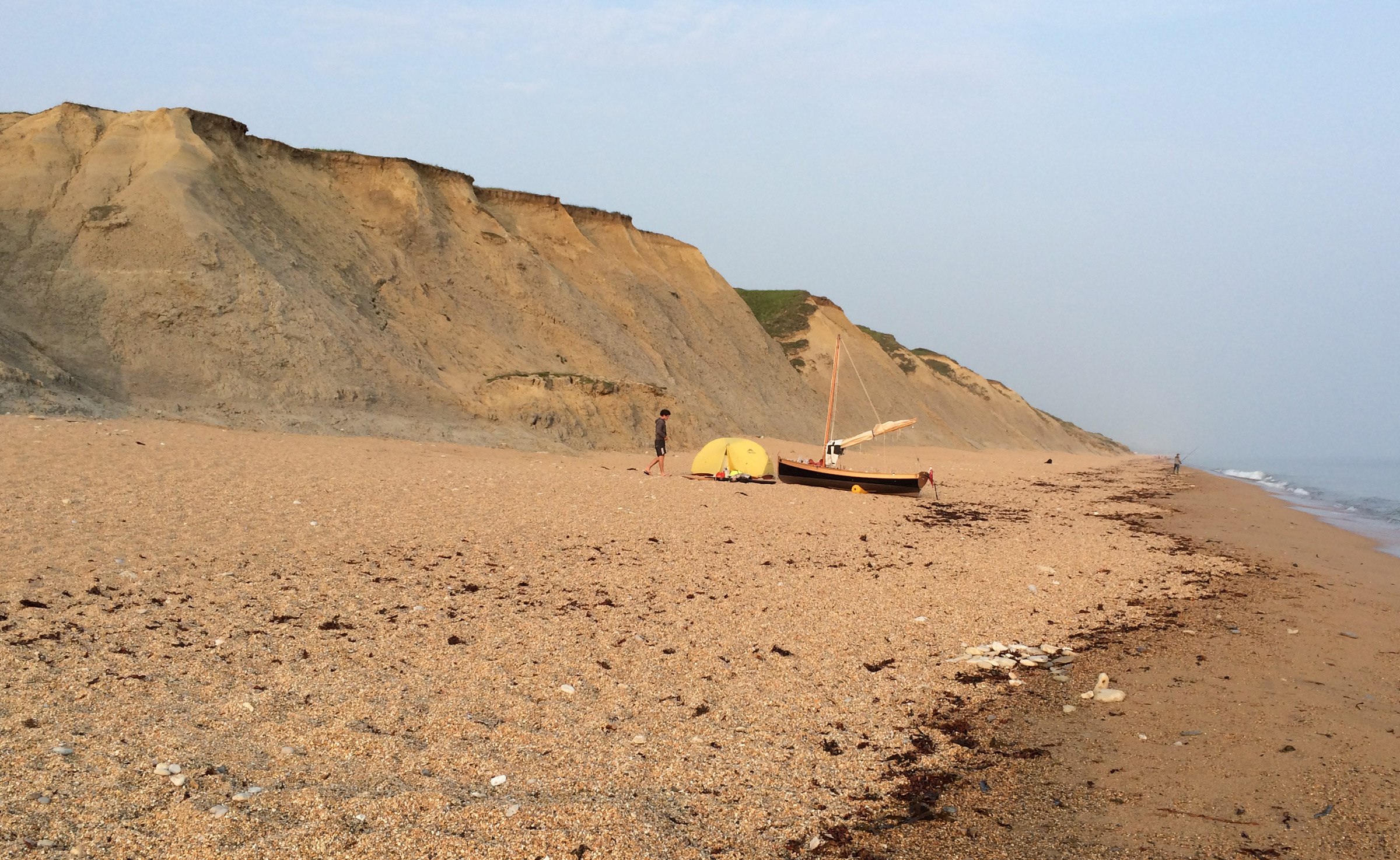
At Hive Beach, near Burton Bradstock, Dorset, we used our inflatable boat rollers to push DUNLIN up the beach. We pitched the tent and cooked canned macaroni and cheese on our multi-fuel stove. There weren’t many people on the beach, just us and a few fishermen.
We slept well on Hive Beach, Dorset, and awoke at 6:30 a.m. to a perfectly still day. The sun was warm; there was no chill in the air despite the early hour. We launched DUNLIN and rowed more harmoniously than before as we gained practice, gliding through the glassy sea. We had soon shed layers and felt warm in T-shirts.
We were heading east along the south coast approaching Chesil Beach, an 18-mile-long pebble ridge reaching 40’ high and 175 yards wide. By 7:30 a.m. a Force-3 wind had picked up, rain fell, and we threw on waterproofs and we beat up wind, bashing through gray waves, searching for a spot to land on Chesil beach. Mat had decided we would drag up over the bar of the mountainous shingle beach, sail up through the shallow fleet lagoon behind it, then sneak under the low bridge into Portland Harbour to ensure we could reach a safe place to sleep for the night, instead of wasting hours waiting for the right conditions to go around Portland Bill, a rocky point notorious for its ferocious tidal race.
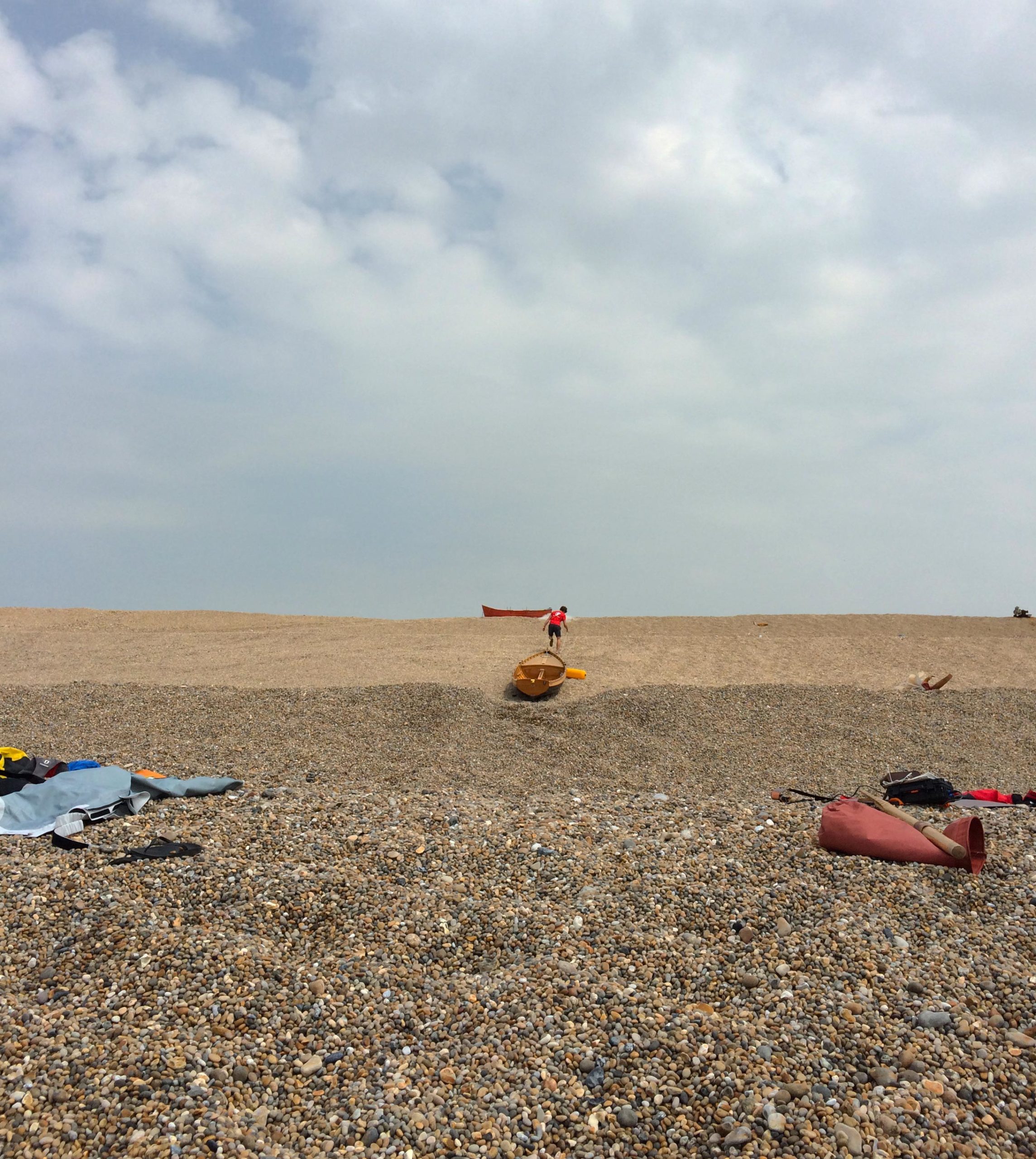
We emptied DUNLIN to reduce the weight before we started heaving her up over Chesil Beach, a pebble and shingle tombolo that connects the Isle of Portland to the mainland. We did the portage to avoid having to face the turbulent waters at Portland Bill at the isle’s southern extremity. We found a shovel to dig holes in the pebbles to bury the anchor and used a makeshift block-and-tackle pulley system to ease the load as we dragged the boat up the beach.
From our position on the water, the landing on Chesil Beach appeared as a vertical, rock solid wall, a few feet high, that we would collide with head-on—not a soft landing. As we sailed closer, it became no less intimidating, so just before we reached it I clumsily hauled myself over the side to avoid collision while Mat landed on the not-quite-vertical ledge.
We spent the next three hours dragging and pushing our quarter-of-a-ton, solid wood boat up and over the steep pebble ridge. We blew up our inflatable boat rollers, and Mat rigged up a block-and-tackle system using the sheets, pulleys, and the anchor. We even found a shovel on the beach, which helped us bury the anchor. The clouds and wind had disappeared and the sun beat down on us again while we slowly, with exhausting effort, pushed DUNLIN 40’ up the steep mound of pebbles. By the time we reached the top we had run out of water to drink and were parched.
Sliding the boat down to the lagoon was easy, and we were soon sailing through the shallows toward what we prayed would be somewhere we could get some water. We landed on a little muddy beach and walked up to a stately Georgian Manor Hotel, where we filled our bottles and gorged on afternoon tea under the shade of a calico umbrella.
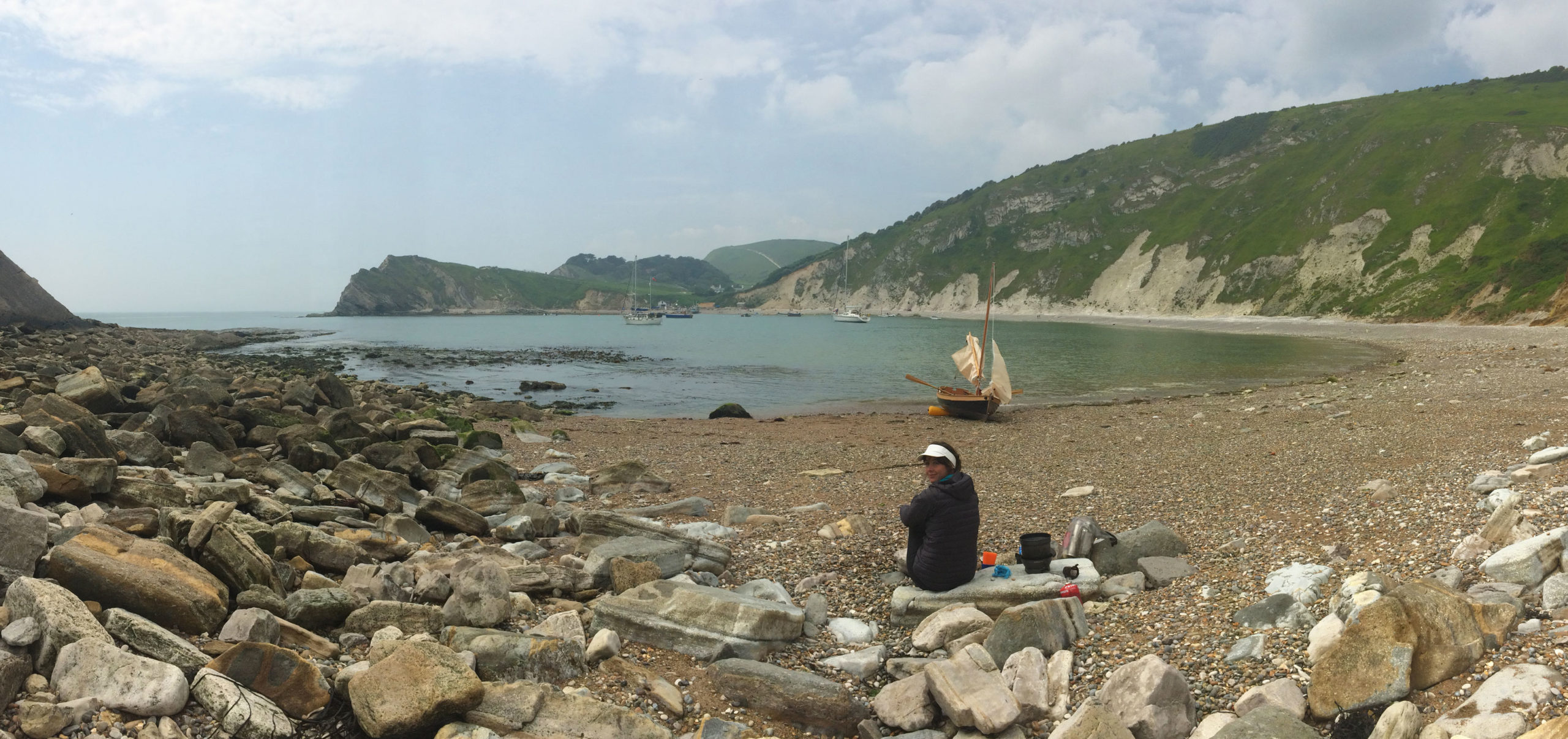
We had a lovely sail around Durdle Door, a hammerhead peninsula on the Dorset coast, and arrived here at Lulworth Cove. Mat’s parents would arrive the following day with DUNLIN’s trailer and drive us to the ferry that would take us across the English Channel. We camped on the beach opposite the village of West Lulworth, expecting to have a quiet stay, but an Army firing range was active through much of the night and made too much noise for us to sleep.
The next day we rowed and sailed to Lulworth Cove, a quarter-mile wide natural harbor, where we rendezvoused with Mat’s parents, Gill and Dave, who drove us, with DUNLIN on the trailer, to the ferry landing at Newhaven.
After the four-hour crossing of the English Channel, the ferry dropped us in France at Dieppe. Gill and Dave drove us to Saint-Valery-sur-Somme, a village at the head of the Baie de la Somme where we found the first spot we could launch into the canalized river. It was flooded and fast-flowing. We had to fight against the current and made painfully slow progress rowing as hard as we could.
After a few hours’ rowing we made it to Abbeville, made a right turn, and headed to our first lock. Floodwater spilled violently over the gates. There was no lock keeper around. A local explained in broken English that the locks were closed because of flooding. We rowed back to the river up a dead-end toward the town center and docked against a towering old ship’s wall. A rusty ladder gave access to the street. It was getting dark, and this was no place for putting up the little tent we’d slept in on the beaches, so we pulled out the boat tent.
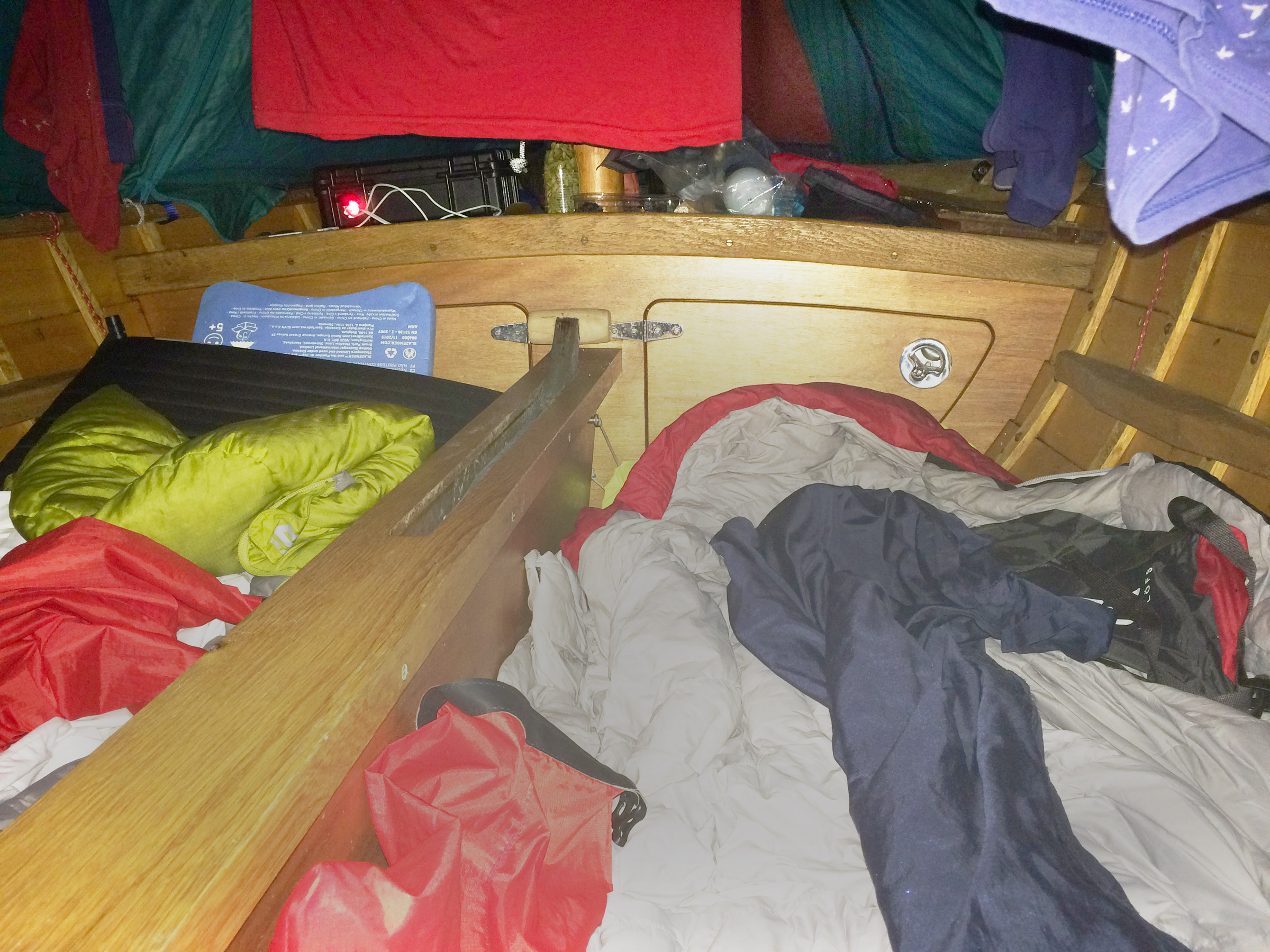
Our sleeping arrangements aboard DUNLIN under the boat tent were quite snug but we usually slept well. Mat made all of the thwarts removable so that we could take them out at night and lie on either side of the centerboard. We both had inflatable sleeping pads and good sleeping bags, which we stored in waterproof bags in the lockers during the day. There was no space for pillows. Clothes that got wet in the rain would hang overnight above us.
In the days before our departure Mat had raided his parent’s attic, where he found an ancient tent and set to it with scissors and a sewing machine. He reshaped it to fit snugly over the top of DUNLIN, with the poles hooking into clips he attached to the gunwales, and with Velcro doors at both ends. The mast had to be in place to put it up, so Mat would balance precariously on the tiny foredeck while I directed the foot of the mast into the step. With the cockpit covered, we settled into our coffin-like beds in the bilges, which were surprisingly comfortable once inside a sleeping bag on a pad.
When we woke from the first sleep aboard DUNLIN we heard the hiss of rain outside. We headed to Abbeville tourist office with Mat’s parents, who had slept in their campervan, knowing they would need to help us get past the flooded locks.
We were told we’d have to row back to Saint-Valery-sur-Somme where we had launched DUNLIN the previous day. Though it was disheartening to go back over previously covered ground, it was a rapid passage aided by the flow of floodwater. The four of us hauled DUNLIN out on to the trailer, drove upstream past the closed locks to the village of Long, 11 miles to the southeast, and launched where the canal was open.
Gill and Dave headed home with the trailer.
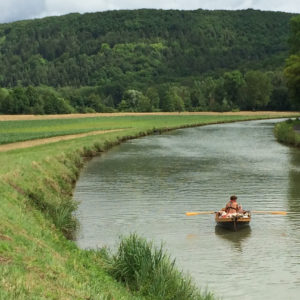
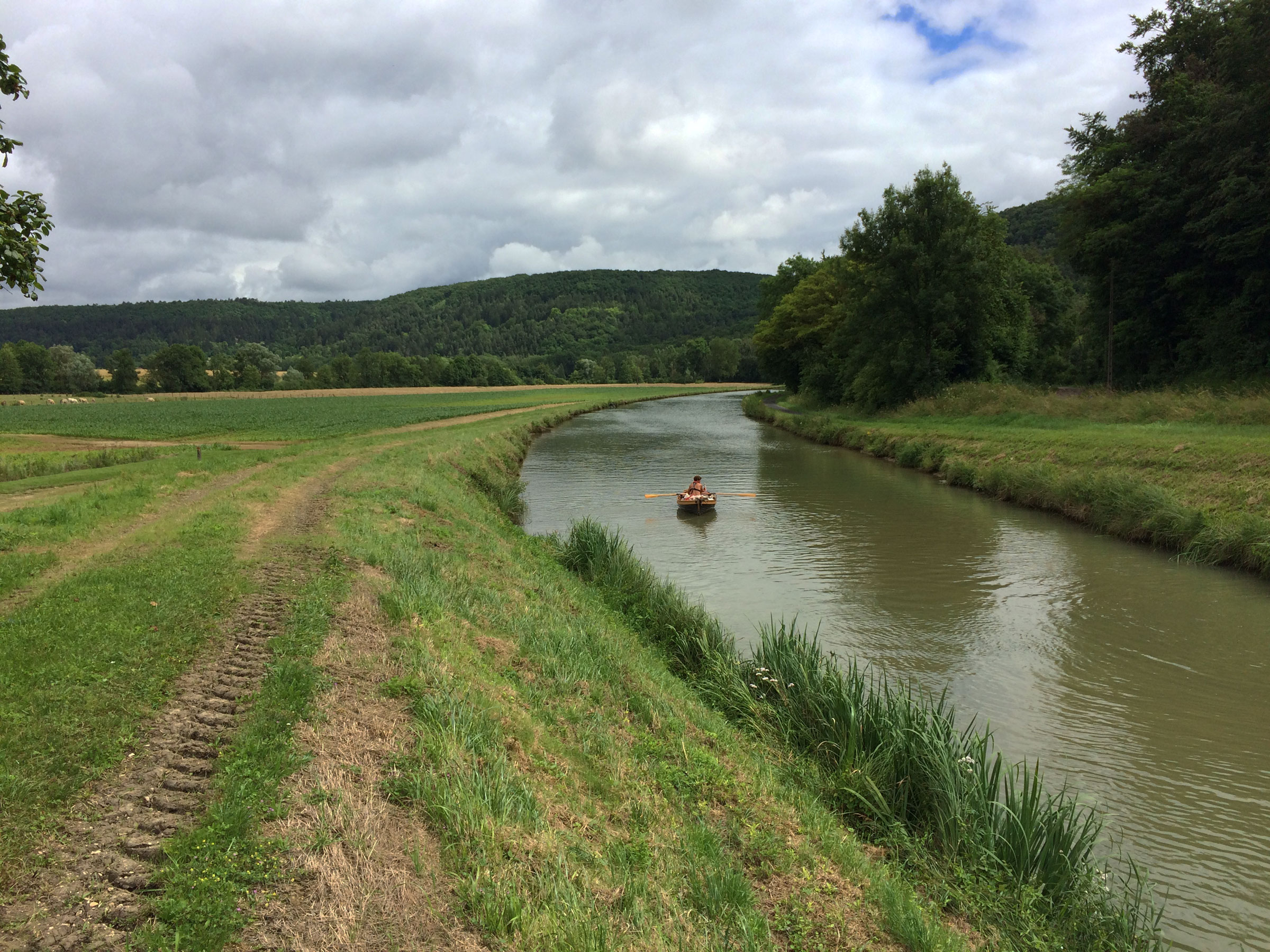
Mat and I spent the next week rowing 80 miles against the strong current of the Somme. I slathered my hands in Gurney Goo—a parting gift from my mum—which helped keep blisters away.
At the slightest hint of wind, Mat would hustle to put down his oars, grab the mast (which lay between us while we rowed), and teeter on the foredeck trying to put it in place, then unpack the sails and rigging from the lockers, and get everything ready to sail, while I took both oars and rowed alone against the current.
The wind was always too short-lived to make any progress under sail. The waterway was lined with trees, which allowed the occasional gust but sheltered us from most wind. We would pick up our oars again and row with the sails up and I’d bang the back of my head on the mast at the end of every stroke until we took it all down again.
When we reached Péronne, the pastoral, serpentine Somme joined the canal du Nord, a busy, often arrow-straight, 59-mile-long commercial waterway carrying hundreds of péniches—huge commercial barges, some weighing thousands of tons. It was our only route to the Med; the way to the alternative route via the Canal de Saint Quentin was closed, and in need of restoration.
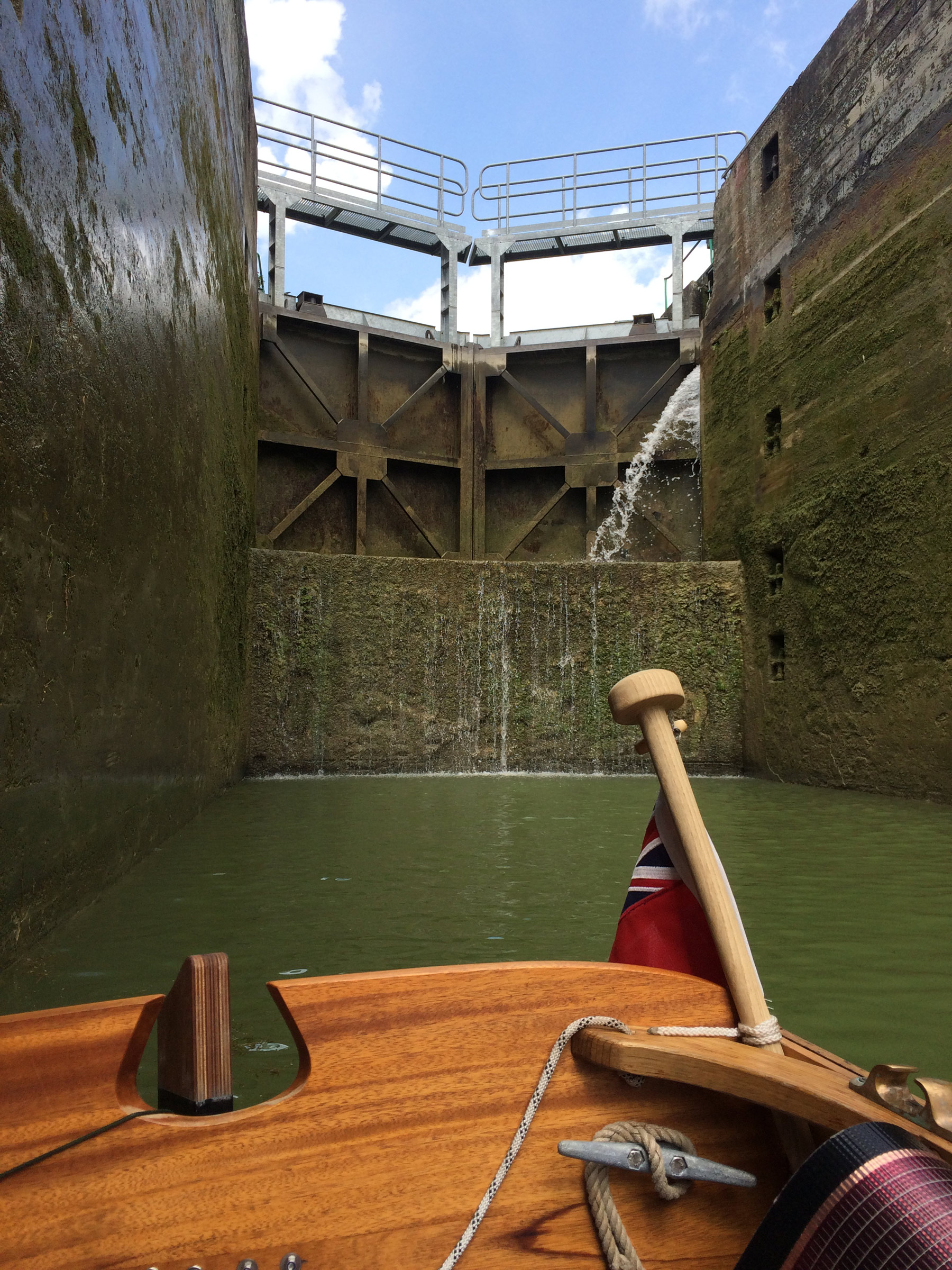
Each new canal had a new type of lock to get used to. This is one of the smaller locks on the waterways in the north. On one series of locks you’re accompanied by a youngster on a moped, usually a female student, who rides along the towpath and works the locks ahead of you. This was a luxury.
Violent thunderstorms and heavy rain began to arrive daily. On a supply run to a grocery store in Noyon we saw newspaper headlines: “Storms & heavy rain batter continent,” “More than 330,000 lightning strikes hit Europe in just eight hours,” “Extreme lightning strikes, killing and seriously injuring dozens of people.”
We spent the next 12 days dodging thunderstorms, rowing 120 miles southward on a network of canals: Canal du Nord, Canal de l’Oise à l’Aisne, Canal lateral l’Oise a l’Aisne, Canal de l’Aisne à la Marne, and Canal lateral à la Marne.
Near Saint-Christ-Briost, on the Canal du Nord, we spotted a place we could moor just as tar-black storm clouds darkened the sky. We hastily erected our little yellow tent under a tree on sharp gravel, dotted with dog crap and brown puddles. We dived into the tent as sheets of heavy rain hit the canvas; the noise was so intense we were shouting to hear one another despite being huddled like two Antarctic penguins trying to keep warm. A violent crack of thunder pierced the air around us at the same time that lightning flashed, so intense it burned your eyes before they clamped shut. I flinched every time, certain that lightning so close couldn’t miss us. We huddled for an hour while fierce thunder clapped every few minutes. When the rain eased, we carried on.
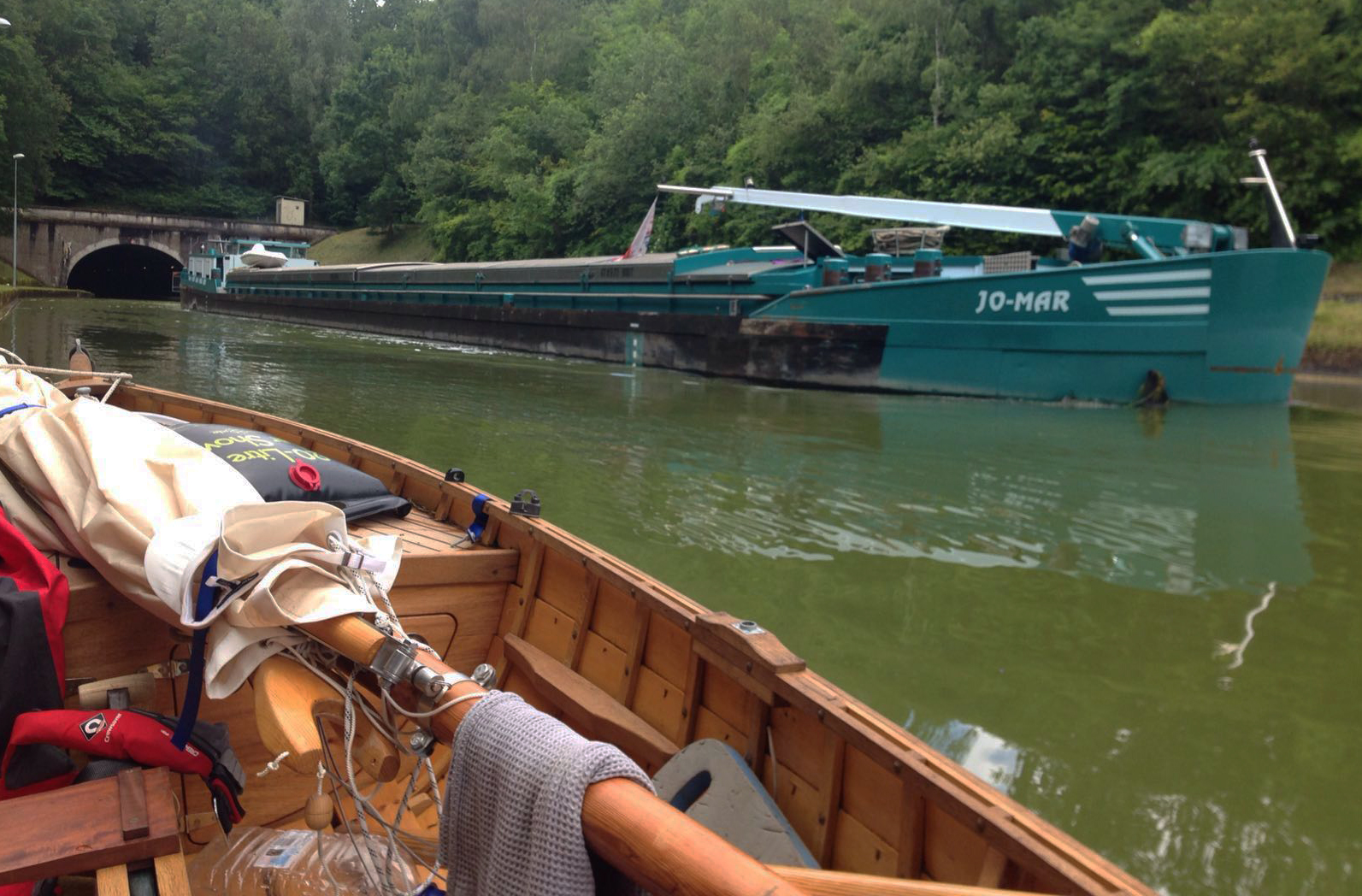
We were careful not to get in the way of barges. When big ones overtook us, we could surf the bow waves which sped us forward. On narrow straits, barges approaching from the opposite way pulled the water ahead of them and dragged us toward the wake coming off the bow. We had to row hard to avoid collision.
At the 1200-yard-long Panneterie Tunnel on the Canal du Nord, we had to wait our turn while a commercial barge emerged heading in the opposite direction. Many of the tunnels in France are too narrow to allow boats traveling in opposite directions to pass by each other; lock keepers who control a traffic-light system at both ends of the tunnel. It was always a little nerve wracking waiting for a green light to give us the go ahead, since our guide book told us that boats without engines would not be allowed through. But, as we’d hoped, we were given the green light to pass through all four of the tunnels along our route.
The Canal du Nord has no accommodations for pleasure boats, so finding a suitable camp for the night wasn’t easy. The first night we rowed until it was too dark to continue, searching for a suitable place to stop. Sleeping in the boat wouldn’t be safe, as the wake from any passing barge could capsize us while we slept. At about 9 p.m. we had put on headlamps, devised a way to secure the boat to the canal bank using an anchor attached to the bow line, and then tried to decide where to put the tent. The bank sloped toward the canal, then dropped 2′ straight down to the water. Between the canal and a stagnant swamp, humming with insects, on the opposite side, there was even ground about 6′ wide, just enough space to pitch our tent, but tire tracks running along it suggested it was occasionally used as a road. It was dark and drizzling and we were hungry. We put up the tent on the slope, on the edge of the canal, overlapping the tire tracks as little as possible.
We warmed canned dauphinoise potatoes on the camp stove, then turned in and fidgeted on the sloping ground in our sleeping bags until exhaustion forced us to sleep. A few hours later I was awakened abruptly staring straight into the glow of two headlights that illuminated the yellow canvas of our tent as they sped toward us. I thought we were about to be run over, trapped inside the two zipped doors of our tent with no time to escape. I let out a terrified scream that tore through Mat. Still half asleep, he leapt up out of his sleeping bag, wildly thrashing about as if trying to tear his way out of the tent. We were inches from the water’s edge, on the brink of toppling in. My fear of falling into the canal while zipped inside the tent surpassed that of being run over. I yelled at Mat, “Wake up! Wake up!”
The car inched past us just as Mat awoke from his sleepwalking state. He had snapped a tent pole and now the canvas was sagging. The sound of drizzle pattered on the tent and at 3 a.m. we quietly packed up our things and re-pitched our tent on a hummock in the swamp in a dense cloud of insects that swarmed and glowed in the light of our headlamps.
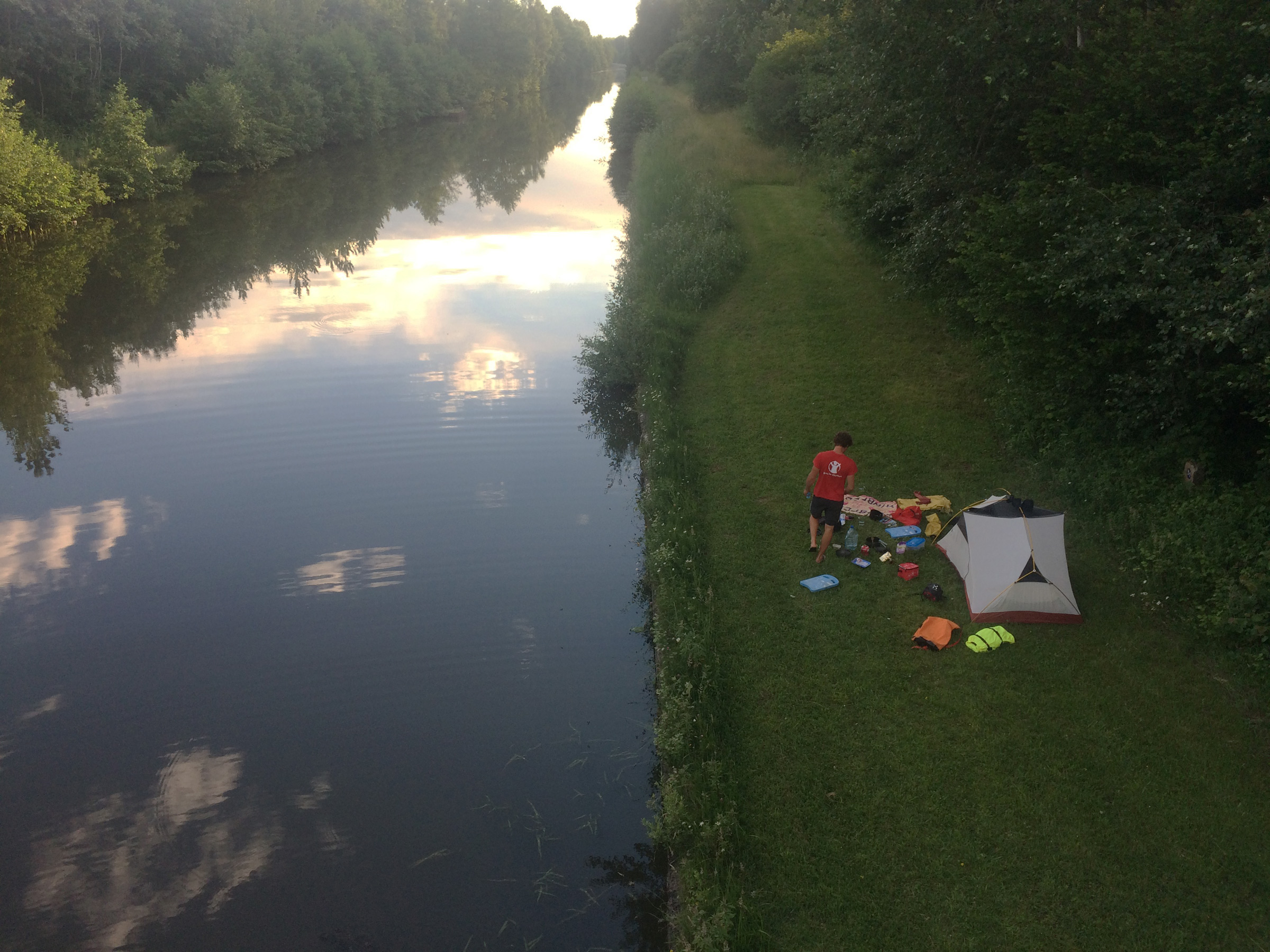
We had not intended to camp here on the Canal de l’Oise à l’Aisne, but its locks are remote-controlled and won’t allow pleasure boats through after 6 pm. We missed getting through the lock (where I was standing to take this photo) by seconds after rowing as hard and fast as we possibly could for the previous hour. We didn’t reach the place with showers or toilets we were aiming for, but this spot was beautiful.
We rowed as fast and long as we could on the Canal du Nord and covered the roughly 27 miles to the Canal de l’Oise à l’Aisne in under three days. After that we usually found places to moor at night. Occasionally we made it to towns on the river with toilets, showers, and Wi-Fi.
We rowed into the Champagne region of northern France, where the murky green-brown water we’d become accustomed to became a translucent, chalky blue. We could see shoals of fish dart and dive to avoid our oars. So far we had passed through over 30 locks, all lifting us higher into the French countryside. We began to see the surrounding hills; a neat patchwork of vineyards, dotted with chateaux.
The Canal de L’Aisne à la Marne carried us up 24 more locks on its 36-mile (58km) length from Berry-au-Bac to Condé-sur-Marne and through the centers of beautiful old cities like Reims and Chalons-en-Champagne. We bought fresh food from bustling markets piled high with brightly colored fruit and vegetables. We explored narrow streets and ate lunch in shaded parks. But sleeping aboard the boat near a city center had its drawbacks. In St-Dizier we were awakened repeatedly by drunks. At around 2 a.m. someone cast off our bowline while we were asleep and we were awakened only when DUNLIN crashed into the quay, tearing a fender. The following morning the lack of sleep didn’t help as we tried to row through thick weeds in the canal. The plants clung to the bow with an enormous dead weight that dragged us to a near halt; it hung in long strands over our oars as we tried to heave them out of the water.
We docked DUNLIN in Châlons-en-Champagne, a city 90 miles due east of Paris. We were able to pass under several low bridges and get right to the city center. It had been raining, so we got the boat tent up as soon as we arrived to give the sleeping area a chance to dry.
We climbed through 71 locks to the summit of the 140-mile-long Canal entre Champagne et Bourgogne. Every day we’d row for nine hours, three of which were spent sitting in locks. They lifted us to an elevation of 1,115’ above sea level, where we arrived at the 134-year-old, 3-mile-long Balesmes Tunnel, near the town of Langres.
We had read that only motor-driven vessels were allowed to pass through tunnels, which were controlled by a traffic-light system. To our relief, we had already been allowed to pass through one such tunnel, so with fingers crossed again we put on our life jackets, switched on our tiny navigation lights, and waited for the red light ahead to turn green…and waited some more. There was no alternative to the tunnel.
Twenty minutes later as we began to lose hope, a double-length péniche came squeezing out of the tunnel, like toothpaste from a tube. We watched as it glided slowly past us. When we looked at the traffic light again we had a green!
The shade of the tunnel was a relief from the heat outside, cold slimy drips fell on us from the ceiling, it was pitch black— no light at the end. When we entered, our boat should have triggered a sensor that turned the lights along the ceiling on, but being so small we’d failed to trigger them. We rummaged around for our headlamps.
About halfway through the tunnel we began to hear the low rumble of a distant engine and smell faint diesel fumes. We were counting aloud to keep our rowing strokes in time, after a month rowing all day, every day we could row in a perfectly straight line. We were both reluctant to disrupt our smooth progress by acknowledging that it smelled and sounded like a péniche was coming toward us. The rumble of the engine grew louder. Just as we thought we would choke on the fumes, we could make out a pale glow at the end of the tunnel. As we rowed closer we could see a maintenance barge but it was only partially obstructing the view out and we’d have room to row around it. We burst past into the hot, bright day and breathed a simultaneous breath of fresh air and sigh of relief. The barge had not been about to motor into the tunnel; it was parked at the entrance, working on reconstructing the façade.
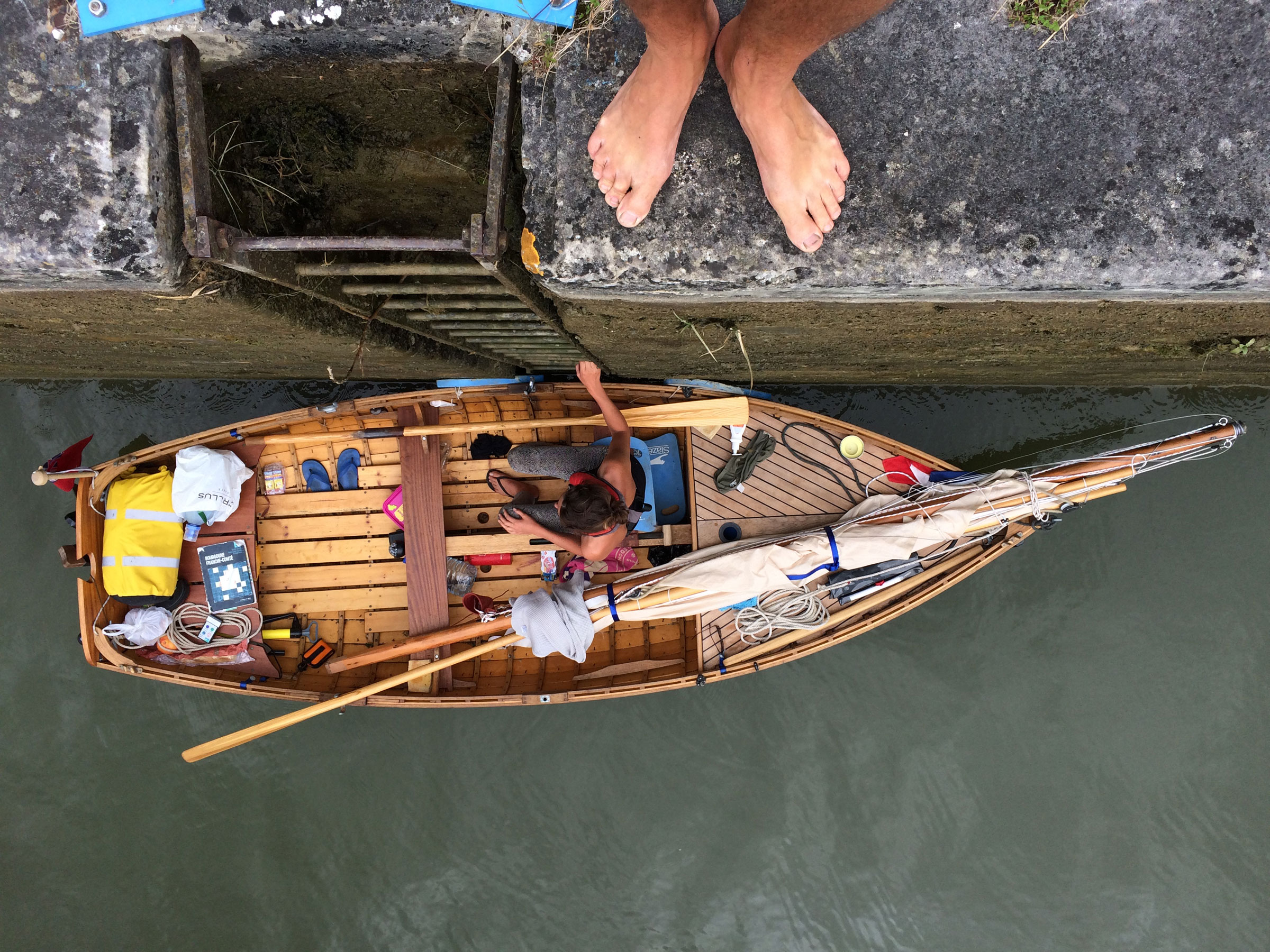
Mat stood on the wall of one of the many small locks we transited while I descended aboard DUNLIN. Dealing with the locks in such a small boat was very easy compared to being in a big, heavy barge, as we could easily hold ourselves in position holding on to the ladders built in to the walls.
With the tunnel behind us we began the downhill leg of the journey. Just 43 more locks until we reached the river flowing to the sea. The remainder of this canal was a series of automated locks. I ran along the bank while Mat rowed so I could manually trigger the sensors that opened and closed the locks because DUNLIN wasn’t substantial enough to trigger them. It was a great relief to be running instead of rowing through the French countryside, passing golden fields dotted with straw bales and white Charolais cows, and picking sweet wild cherries along the way to feast on while we were waiting at the locks.
At the end of the canal we reached the Petite Saone, then the Saone, a wide, open river bustling with rental boats. After weeks of traveling straight, narrow, stagnant canals the feeling of space and fresh water was extremely refreshing. The wind could reach the water, and for the first time since we’d arrived in France, we could sail! We zoomed with ease at twice the speed we had been rowing. It was glorious, but we had to keep an eye out for giant river cruise ships, 360’ long and three stories high, charging up and down the river with their onboard swimming pools and cinemas.
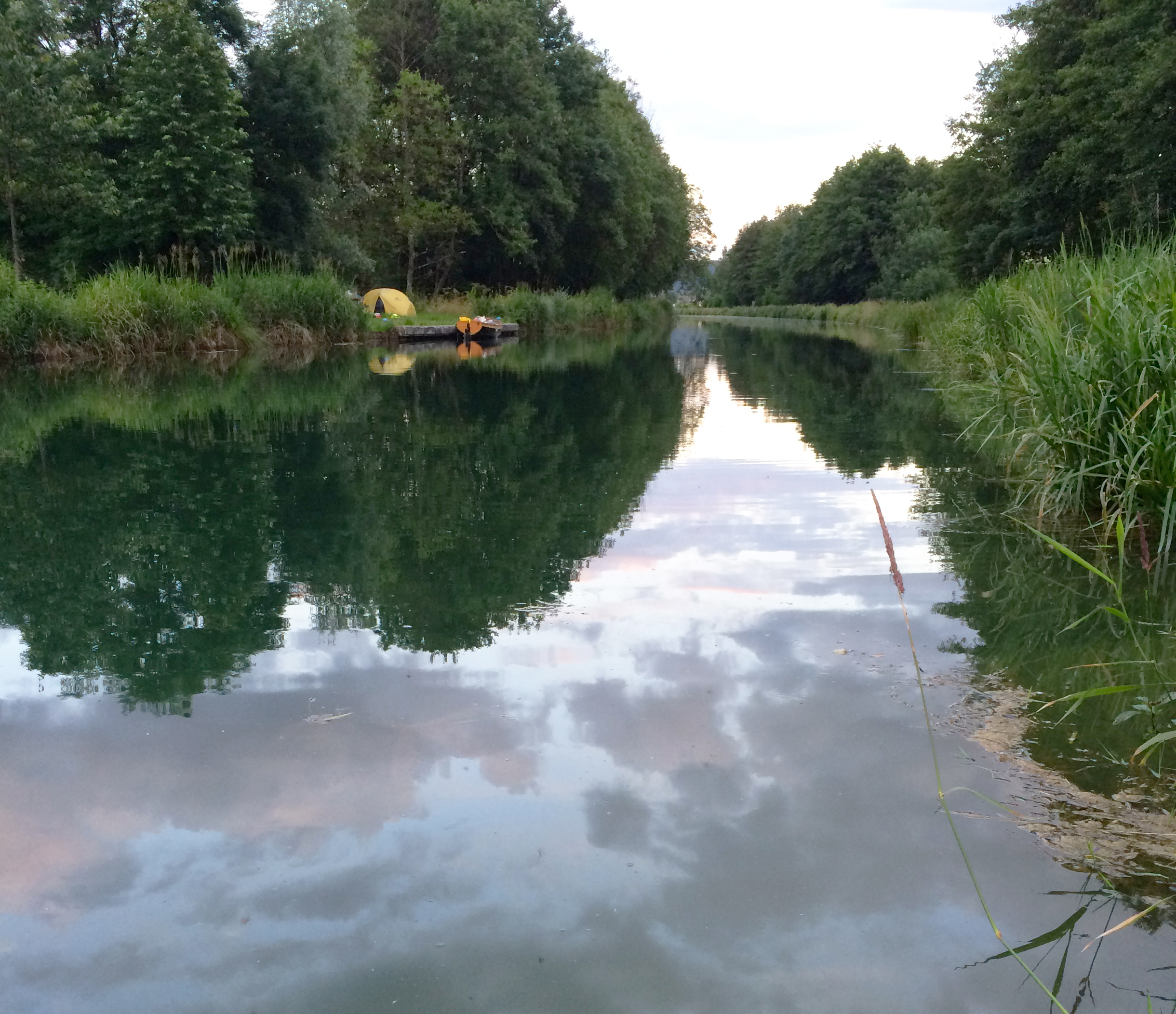
We found this bucolic camping spot on the banks of the Canal Latéral à la Marne, which we joined at Condé-sur-Marne and left at Vitry-le-François, where it joins the Canal entre Champagne et Borgogne. This canal featured very long, straight, relatively uninteresting sections. We passed many péniches that use this route to transport goods from Vitry-le-François to Paris.
We sailed more than we rowed on the 130-mile length of the Saone, sometimes covering over 25 miles a day. The next river, the Rhône, wouldn’t be so accommodating; we had been warned and read that DUNLIN would not be permitted in the locks and on much of the river’s length because we didn’t have an engine. It wasn’t possible to lift DUNLIN past the locks, but we could still make it to the Petite Rhône where we would row out to the sea, if we could find a boat with an engine that was willing to raft DUNLIN alongside to get us past both the locks and through long sections designated as dérivations, on which we were not permitted alone.
A couple of days previously, ashore in Lyon, we had a met Malté and Aladino, two friendly Swiss guys, who were motoring their 30’ sailboat, JULIETTE, to the Med as quickly so they could to sail in Sardinia for the summer. We pulled up onto a slipway at the edge of the Rhône just upriver from the first lock and kept watch over the wide stretch of water. We knew they would pass eventually, and just a couple of hours later we caught sight of JULIETTE. We waved and shouted, leaping about madly to get their attention from 200′ away. Aladino and Malté steered over to us and said they were happy to have us aboard with DUNLIN rafted through the locks and in tow along the dérivations.
Rowing through the French countryside, we were aiming for the village of Froncles, and a halte fluviale (river stop) that accommodates boaters. Our waterway map indicated it had hot showers. It was just under 20 miles away along the river but we were making slow progress fighting with weeds that tangle our oars for much of that distance. I hopped out on to the bank for a moment to stretch my legs while Mat continued rowing.
Being aboard JULIETTE was good fun but after three long days motoring 150 miles we couldn’t wait to be back aboard DUNLIN, sailing and rowing as we’d planned. Motoring felt like cheating.
With just one more lock on the Rhône separating us from the wild, shallow Petit Rhône, the western arm of the Rhône Delta, Aladino and Malté cast us off. All the motoring put us ahead of schedule, so we decided to row up the arm of the Rhône that leads to the center of the historic city of Avignon. The current was flowing fast, so we tucked into an eddy that helped us make our way upstream. We rowed under the world-famous bridge, the Pont d’Avignon, then spent a day wandering within the city walls and doing chores. The next day, we sailed downstream from Avignon with just the jib on a strong mistral wind for over 10 miles, steering well clear of an 850’ cargo ship and carefully navigating its bow wave.
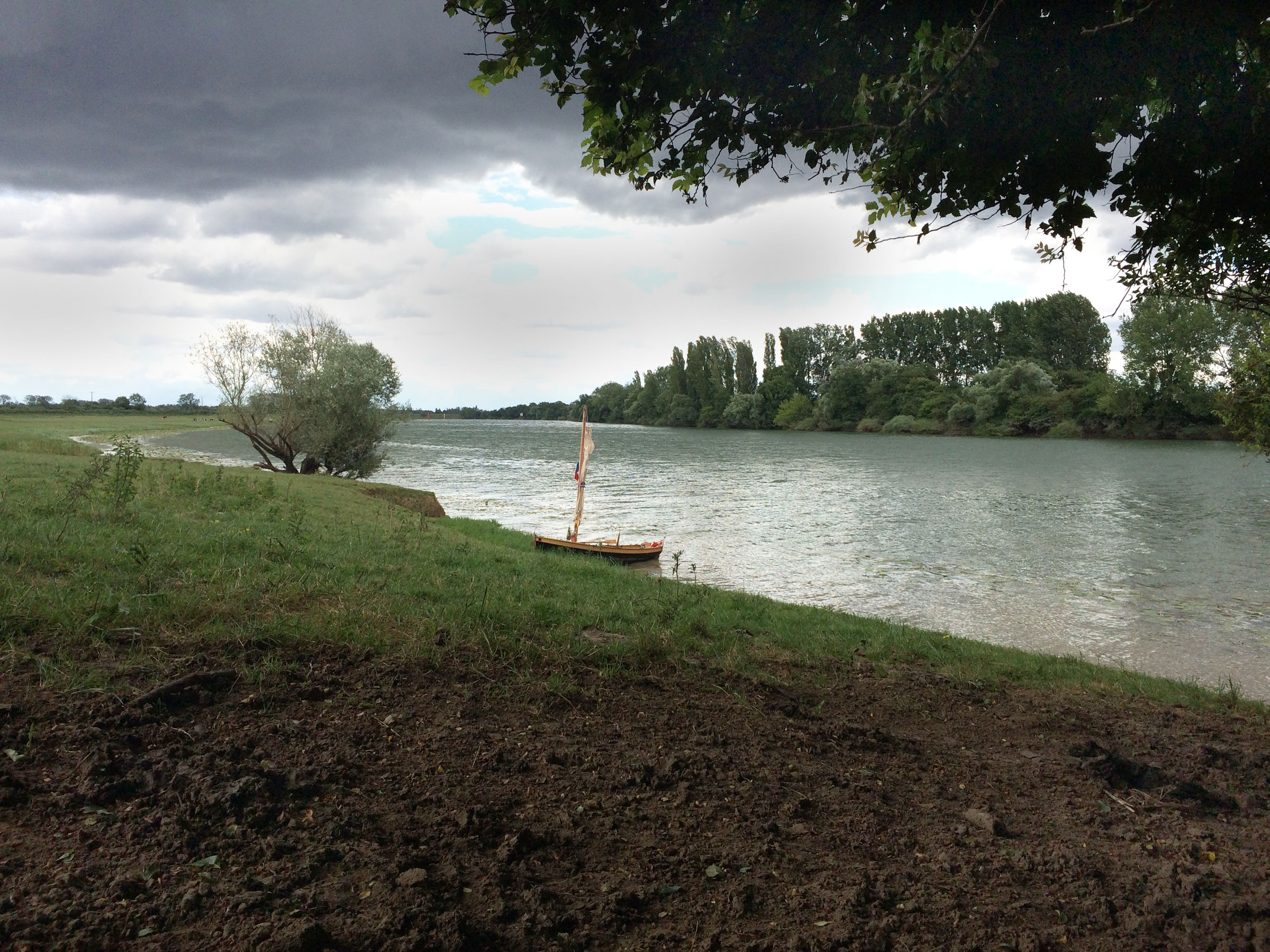
Just downriver from the bustling medieval town of Verdun-sur-le-Doubs, we took shelter under a tree to wait for a storm to pass. DUNLIN sat tied to the bank of the Petite Saone at the edge of a cow pasture. A strong wind was blowing directly against us but the river here was too narrow and too shallow at the edges to tack to weather. We could have taken to the oars, but in the muggy heat we’d get wetter rowing in rain gear than sitting in a thunderstorm, so waiting for the rain to blow over was the best option.
We stopped at a little river port run by a memorable ex–fighter pilot named Olivér. We also met Roger and Mary, a retired Australian couple, who were heading south the following day on their barge. A plan was formed. The next morning, we set sail toward the lock where Roger and Mary caught up with us just before we reached it. They threw us a line. We rafted alongside their 50′ barge without stopping, then climbed aboard. They let Mat take the helm for a while, while I kept an eye on DUNLIN, then reclined on their sofa reading the paper. Mary prepared lunch which we enjoyed while waiting for the lock to open. We passed through smoothly, said thanks and farewell, and jumped back aboard DUNLIN. We had passed through the 202nd and final lock of our journey.
We kept to the right bank and entered the distributary of Petit Rhône. It felt wild and secluded and it was good to be rowing again. It was much narrower than the Rhône and flowing slowly, just a third the speed of the Rhône. We found an idyllic little sandbank to set up camp and lit a fire for cooking and keeping mosquitoes away.
We awoke full of excitement, knowing that roughly less than 30 miles downstream the river spilled into the Mediterranean Sea. Mat relit our campfire and cooked omelets for breakfast while I packed away the camping equipment. After wolfing down omelets, which tasted a lot like wood smoke, we pushed DUNLIN off the sand, jumped in, and continued rowing downstream. There was not a single cloud in the radiant blue sky and the riverbanks, dense with trees, were alive with birdsong.
We rowed hard for 18 miles, with the heat of the Mediterranean sun building. By 1 p.m. we were desperate to find shade and replenish our energy stores. There were no convenient places to stop along the banks, so we grabbed an overhanging branch and tied our bowline to it, then dropped a stern anchor to keep us from swinging under low branches. We refueled on stale baguette and bottled water that had become hot in the sun and tasted strongly of plastic.
When we were ready to get under way again and tried pulling up the anchor, it was stuck. Mat dove in and I watched him swim down until his feet disappeared in to the murky water. He untangled the anchor from roots on the riverbed and we set off toward the Camargue, a marshy lowland island separated from the mainland only by the two slender branches of the Rhône. The river began to widen and groups of tourists paddled past in brightly colored kayaks.
We found perfect sailing conditions on the south-flowing Saone River in east-central France. With the oars are stowed we sailled goose-winged downstream.
Soon after we’d had lunch, a strong breeze picked up, causing a loud rustling in the trees and carrying the smells of hot sand and seawater. Instead of continuing to row directly in to it, we hurriedly stowed the oars, hoisted the sails, and began tacking into the sea breeze. The Mediterranean felt close. DUNLIN was heeling at an unnerving angle, so we leaned out over the windward gunwale as we pushed our way onward. The outhaul block on the boom suddenly came loose and the main flapped wildly. We quickly took down both sails, grabbed the oars, and resumed rowing. After another hour of rowing against the wind, we arrived at vast open plains where wild, white horses and black bulls wandered among grasses, and pink flamingoes on stilt-like legs waded in shallow ponds. Reaching the wetlands of the Camargue felt like rowing into a new continent and promised we were close to the sea.
We rowed around a couple of big meanders, past a charging 60′ paddle cruiser, with a foaming white wake spreading out from its bow, and all of a sudden we could see the sea. The prospect of rowing out into saltwater swell and open sea now seemed a little daunting. For me, a slight panic crept in, but we rowed on, pausing to take in that surreal moment when we were out in the sea looking back up the river. We’d come out at the other end of France! We made it to the Med! The sun was just beginning to sink from view and a pink hue lay along the horizon. We took turns to dive off the boat. The seawater was shockingly cold compared to the warmth of the river we’d become accustomed to bathing and swimming in. When we got back aboard we could feel the salt clinging to our skin.
We had been underway for 52 days since leaving Sidmouth—I had not dared to believe we would actually make it to the Mediterranean. We looked in both directions along the coastline for sign of ports, rechecked our chart, then rowed a mile east through the small, rolling swell to Saintes-Maries-De-La-Mer for the night. We rowed in to Port Gardian, a marina on the west side of the town, and looked for an open spot along the docks among the huge white yachts. The staff didn’t know what to do with us and our tiny wooden boat, they had us move three times before deciding on a place we could stay. Mat rummaged in the locker and pulled out the bottle of champagne we’d bought a month earlier, which we had stowed away for this very moment.
Polly Hilton lives in Devon and founded Find & Foster, a small fine cider company. She has always loved being in and on the water and she kayaked growing up, but was not interested in boats before Mat built DUNLIN and had never sailed before meeting Mat. She has become a keen rower since the trip through France.
If you have an interesting story to tell about your adventures with a small boat, please email us a brief outline and a few photos.
This was the sound of a large gray seal as it poked its head out of the water and looked in my direction with unabashed interest. Now, I love seals as much as anyone and relish my regular encounters with them while I’m rowing on the river near my home in South Devon, England. But this was different. This seal was swimming in the Atlantic Ocean, eight miles off Land’s End, and I, rather than being safely ensconced aboard my skiff, was bobbing about in the water in a semi-inflated dry suit, just a few feet away from it. And, was it my imagination, or was this seal much, much bigger than the ones back home?
After a few moments’ contemplation, the seal sighed and slipped under the water again. A feeling of relief was quickly followed by unease at the thought that this huge creature was now swimming somewhere beneath me and I had no way of knowing where it was or what it was going to do next. Even though I knew a seal was highly unlikely to hurt me, my instincts told me a different story. So I crashed about and made what I thought were suitably macho seal noises.
“Arrfff! Arrfff!”
Almost immediately the seal appeared on the other side of me, and once again gazed at me with those big dark eyes. I had assumed it was a male seal protecting his territory, but it occurred to me then it might be just trying to be friendly, or possibly more. Perhaps a bright yellow dry suit holds an irresistible attraction to an ocean seal, normally sheltered from modern pinniped fashion trends.
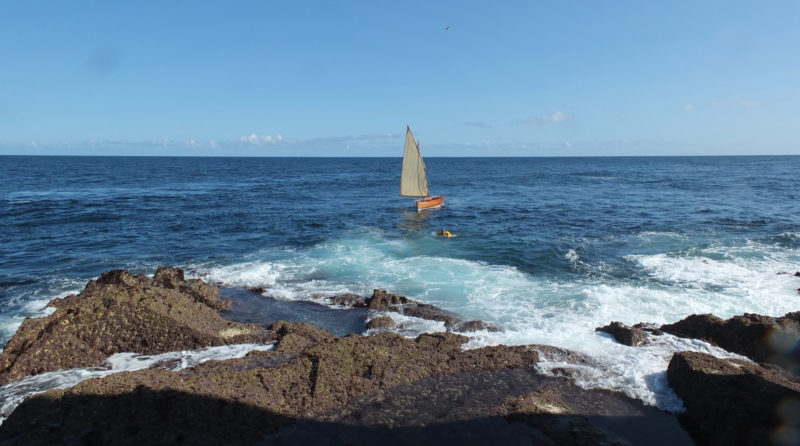
Our moment was interrupted by the appearance of Will Stirling’s 15′ dinghy suddenly looming large with her bold cream-colored lugsail. The seal glanced over, its eyes bulged open in alarm and, with a grunt, it dove underwater. It didn’t reappear again, and I was relieved when Will luffed up beside me and I was able to clamber out of the water to safety.
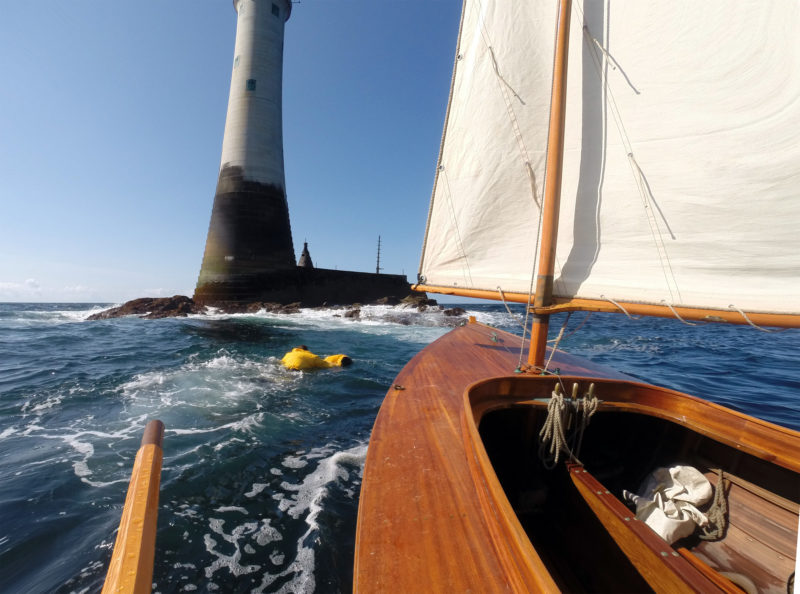
The incident took place while I was a participant in Will’s madcap plan to sail around every offshore lighthouse in Britain. The project began in March 2012 when he and his wife Sara sailed around the Eddystone Lighthouse, 13 miles south of Plymouth, in a 14′ open dinghy. The couple did that trip to raise money for WaterAid, a global nonprofit devoted to bringing clean drinking water and hygiene education to disadvantaged communities, and the idea grew from there. Will’s scheme is an ambitious one, not least because of the sheer number of offshore lighthouses—at least 50—but also the remoteness of some, for example, Sule Skerry is 35 miles north of Scotland. But Will isn’t in any hurry, and regards it as a lifetime project.
By summer 2017, he had ticked six more lighthouses off the list: Les Hanois in Guernsey, La Corbière in Jersey, Godreavy near St. Ives in Cornwall, both lighthouses on the isle of Lundy in the Bristol Channel, and the Longships off Sennen, Cornwall.
In one 120-mile voyage he tackled two lighthouses, Les Hanois, and La Corbière in a 14′ open sailing dinghy, a type he has been building at his boatyard for the past 15 years, but an incident during that journey convinced him he needed something a bit more seaworthy. He and a crew member were off Jersey, hanging onto a mooring buoy to hold their positon in a strong adverse current, and almost capsized the boat. Will decided there and then he needed a boat that could cope with a greater angle of heel.
The result was GRACE, his 15-footer with side decks and a cockpit coaming all around to keep the water out, and an extended foredeck to give more shelter to anyone sleeping in the bow. I joined Will for the second attempt on his eighth lighthouse: Wolf Rock, 8 miles off Land’s End at the westernmost tip of England. He had to abort his first attempt because of bad weather, and indeed our departure was postponed when a Force 5 headwind and driving rain appeared on the appointed day. The next day, however, the clouds cleared and, after rejecting several possible launching places on the south coast of Cornwall, we finally launched GRACE at Sennen on the north coast, which we judged would give us a better sailing angle in the west-northwesterly winds that had been forecast.
Nic Compton
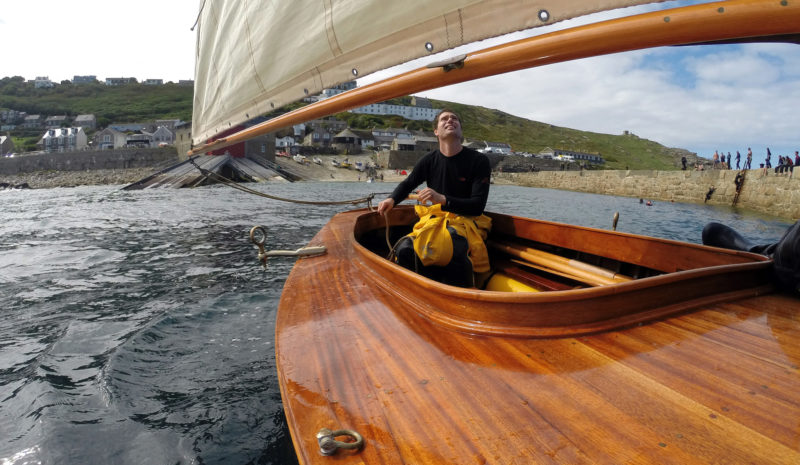
Leaving Sennen, Will keeps an eye on the sail as we round the end of the breakwater. His 15’ Expedition Boat was a development of his standard 14’ dinghy with side decks and a longer foredeck added to provide more protection from the elements.
Sennen is a picturesque Cornish village, popular with vacationers and surfers alike. At its western end is a beautiful little stone harbor, whose main claim to fame is being the most westerly harbor in mainland England. It is still used by a fleet of fishing boats that are dragged by tractor up and down the beach for launch and haul. A steep slipway runs down from the parking lot to the beach, which made launching the 500-lb boat slightly treacherous. The last time Will launched the boat here, his van couldn’t cope with the gradient and had to be towed up by the tractor.
Will is one of these very organized skippers who’ll send you a passage plan several weeks in advance, complete with course information, estimated timings, local tides, times of sunrise and sunset, and even the phase of the moon. He is also reassuringly safety conscious, and brought along all the essential safety gear in a waterproof bag, including EPIRB, GPS, VHF, compass, and flashlight. All I had to do was turn up with my lifejacket, a dry suit, a packed lunch, and a waterproof camera.
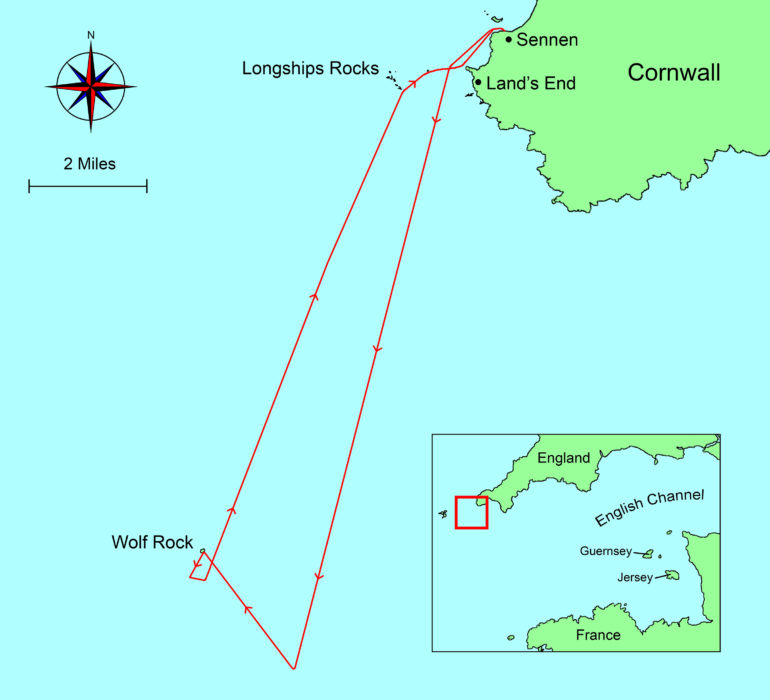
A light northwesterly breeze was blowing as we headed out of Sennen at 11 a.m. sharp, 30 minutes ahead of Will’s schedule. The Cornish coast is famously rocky and thousands of shipwrecks litter its shore; we were put straight to work just off the harbor entrance negotiating a reef growling ominously to windward. We cleared it without any trouble and a few minutes later passed one of the most dangerous rocks along this whole coast, the infamous Longships, the site of dozens, if not hundreds, of shipwrecks. Even after a lighthouse was erected there in 1873, that didn’t stop the 282′ steam-powered coaster BLUEJACKET being driven onto the rocks just a few yards away from the lighthouse, nearly destroying it in the process, on a perfectly calm, clear night in November 1898. The crew was saved but their embarrassment was never-ending.
Will Stirling
Having overshot Wolf Rock on the previous tack, we approached it from the southeast. The east-going tide added about 45 minutes to our crossing, as we had to claw our way back.
Given the fearsome history of this coast, it might seem foolhardy to navigate it in such a small boat, and certainly the sight of those shadowy cliffs rising dramatically on our port side made me feel very small and insignificant indeed. But there were definite advantages in having such a diminutive steed. For a start, we wouldn’t have been able to sail between the rocks and the shore on a bigger boat, and would have had to take a longer route around the seaward side of the Longships. And even if we had hit a submerged rock with the dinghy, in most cases it would have been a case of simply raising the centerboard and sailing into deeper water, something that was definitely not an option for the unfortunate BLUEJACKET.
Will had a more philosophical take on going to sea in a dinghy, quoting first a great poet and then a great explorer: “As T.S. Eliot said: ‘Only those who will risk going too far can possibly find out how far one can go.’ To start with I didn’t know the capabilities of the boat or myself. But with each trip I’ve got more confident and realize we can do this. My planning’s got better too, because that’s the key. And as [Roald] Amudsen said: ‘Victory awaits him who has everything in order—luck, people call it.’ You have to be prepared, and then hopefully you can sort out whatever’s thrown at you.”
Land’s End. The very words conjure up a feeling of foreboding, and before Europeans discovered America it had a much more literal meaning. Nowadays, while the cliffs are as dramatic as ever, with clusters of fierce-looking rocks peppering the coast, the overall impression is slightly marred by a hotel and tourist developments that look anything but wild.
Roger Siebert
.
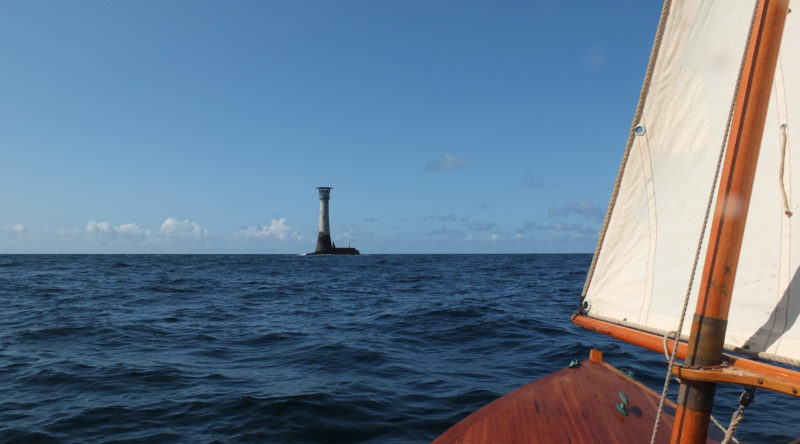
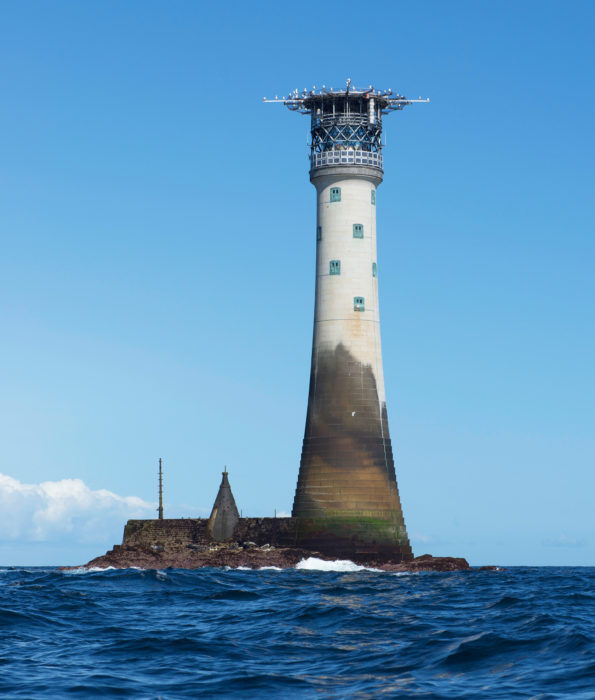
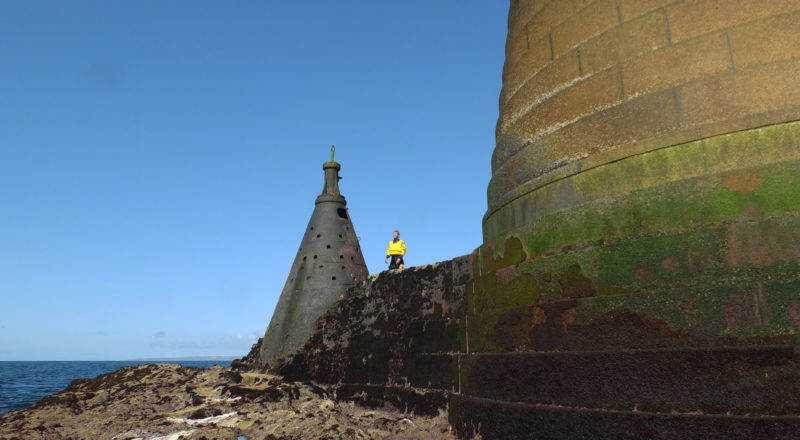
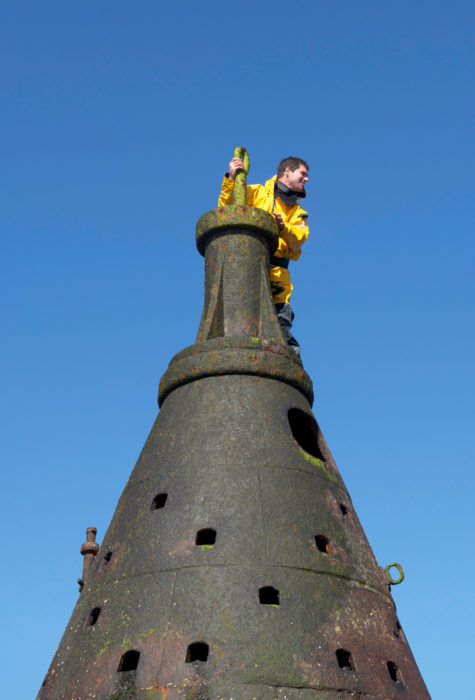
By the time we passed Land’s End, a quarter of a mile off to port, the Wolf Rock lighthouse was clearly visible as a faint finger on the horizon, 8 miles to the southwest. For centuries, the semi-submerged rock that the lighthouse rests on presented a hazard to shipping passing around Land’s End. A local diver estimated there are at least 100 wrecks between the rock and the mainland alone. From 1795 onward, four attempts were made to erect a beacon on the Wolf, all of which were smashed to smithereens by the sheer power of the Atlantic waves. Finally, in 1848, a 14′-high cast-iron beacon filled with concrete rubble was built and held fast. In 1861, work started on an elegant 135′ tower modeled on the Eddystone lighthouse. It took eight years to build, with work interrupted by severe weather and brutal waves. The new light was first lit in 1870 and operates to this day, sending out a single white flash every 15 seconds when darkness falls.
It was bright sunshine as we headed for the Wolf—so named because of the howling noise the wind makes when it blows through the islet’s fissures—and GRACE seemed to delight in the steady westerly Force 3 breeze. It was certainly a fine day to be out at sea on a small, exquisitely built wooden boat, with the sun high in the sky and the water just a few inches away. Behind us, the rocks of west Cornwall receded into the distance, while ahead of us lay what looked like an endless expanse of sea. Next stop, the Azores.
Nic Compton
Wolf Rock was the first lighthouse in the world to be fitted with a helipad on top of the tower.
We were soon surrounded by wildlife, another advantage of traveling by sail in a small boat. An endless array of seabirds passed us by; the ubiquitous gannets, a Manx shearwater, and what I took to be a black tern, went about their business without the slightest concern for the little wooden cockleshell in their midst. Halfway to the Wolf, I spotted a big, floppy fin straight ahead and steered GRACE to leeward of it. It turned out to be an ocean sunfish, a strange-looking white slab of a fish, as tall as it is long, that seems to be all head and no body or tail. It seemed reluctant to interrupt its sunbathing and only dipped down under the surface at the last minute, passing so close we could have touched it.
Soon after, I spotted some strange splashes in the sea about 200 yards off our starboard bow. Eventually I could identify the commotion as some dolphins, but far from being the being the playful, friendly sort who come and frolic off the boat’s bow, these guys were hard at work apparently using shock-and-awe tactics to confound a shoal of fish. We passed by unnoticed.
Nic Compton
With the boat anchored off Wolf Rock, Will swam ashore with our cameras, phones, and VHF in a dry bag.
With the Wolf Rock light drawing closer, Will made a strange confession. As he described his previous trips on the boat, he admitted that none of his crew had come back for a second go, so each trip had to be done with a new crew. That gave me pause for thought. I was crew No. 8.
With the wind backing to the west and a stronger-than-expected current setting us to the east, we weren’t able to make it to the Wolf Rock in one tack. Instead, we overshot it and took a few short tacks to windward, and soon the lighthouse began to loom large over the port bow, its elegantly tapered tower making a distinctive L shape with the rock below. One of the rules Will has set for himself is to sail completely around every lighthouse on the list, so we rounded the Wolf to port and made a counterclockwise circumnavigation, and then dropped anchor in a small cove in the lee of the rock.
Will Stirling
Can’t go over it, can’t go under it. The only way to get ashore safely was to go through the wash. We floated onto the rocks in our dry suits, relying on their buoyancy to keep us afloat.
Anchored about 50’ away from rocky islet, we were faced with the same dilemma the builders of the lighthouse and its subsequent keepers faced: how to get on and off it. Even in the relatively benign conditions of that sunny August day, a big swell surged around the rock, rising and falling about 6’ and creating swirling eddies. Back in the days when the lighthouse was manned, the keepers came up with ingenious ways of transferring people and stores from ship to shore, including using a kite to fly a line out to the relief ship. Once the ship was in position, the men put their feet in a bight in the line and hung for dear life as they were winched on or off the rock.
Will Stirling
This ledge seemed to be a favorite sunbathing spot for seals. They scampered away when they saw us. The 1848 beacon is visible on the left. The landing area between the beacon and the lighthouse built in 1870 was a key part of the building the towers, as well as making it easier to get keepers and stores on and off the rock.
Judging by news clips from 1950 and 1952, it was pretty hazardous in good weather and completely impossible in bad, which meant the keepers often went weeks on end without supplies or a relief crew if a storm was blowing. The problem was finally solved in 1972 when a helipad was built on top of the lantern, the first lighthouse in the world to be modernized in this way. Once the lighthouse was fully automated in 1988, there was no need to transport keepers or bring supplies.
Nic Compton
Will climbed to the top of the 1848 beacon. Made of cast iron and filled with concrete rubble, it was the fourth attempt to build a light on Wolf Rock–all the others were swept away by the power of the waves.
Our solution to the problem of getting ashore was simpler. With the dry suits zipped up, they provided enough buoyancy to more or less float us over to the rock. Then it was a matter of choosing the right rock and the right wave, washing onto it, and hanging on for dear life as the water rushed out again. Will went first with the VHF and cell phones in the dry bag (in case the dinghy were swept away while we were on the rock), and I followed behind slightly apprehensively.
Will Stirling
The Trinity House logo, cast in bronze above the main entrance, includes its motto Trinitas in Unitate—Three in One.
It was certainly more tiring than it looked, and by the time I had flapped my legs and arms at full tilt to navigate from boat to rock (pulling a leg muscle in the process, as I discovered the next day), then scrambled up the rocks and climbed up the platform sides, I was puffed out. That only added to the sense of achievement, however, as we stood there and gazed over what was really a different world.
The base of the lighthouse forms what must be one of the strangest mooring docks ever built, with rings to attach lines to, steps at the northern end (away from the prevailing winds) and the remains of the crane used to hoist those keepers and parcels onto the rock. Everything is covered with an even layer of barnacles, like a giant’s sandpaper, a reminder that everything we were standing on is submerged for much of the time. To one side, built into the concrete dock, is the 1848 beacon, a specter from the past, squat and defiant, an embodiment of man’s struggle with nature.
Standing guard over all of this is an almost dainty lighthouse. You would hardly believe this lofty structure is made up of 3,300 tons of granite, tapering from 41′8″ at the base to 17′ at the top, and completely solid for the first 30’. Above that, the walls of the hollow section are tapered, starting 7′9″ thick and gradually thinning to 2′3″ at the top—every external stone dovetailed not only to the ones on either side to it but the ones above and below it. It’s poetry in granite, and a complete contrast to the stumpy, rubble-filled beacon built 20 years earlier, yet equally able to withstand the might of the Atlantic storms.
When Will climbed the bronze ladder rungs to reach the lower front door of the lighthouse, he found it too was made of solid bronze. Above the doorway, also cast in bronze, is a bas relief of four sailing ships on a shield and the words Trinitas in Unitate—Three in One. It was the coat of arms of Trinity House, a charity devoted to maritime safety, responsible for all lighthouses built in England and Wales since 1514. Its motto is a reference to its original purpose of running lighthouses, providing pilotage, and serving as a charity for distressed sailors. It’s as if the builders recognized that, even in this harsh environment, a decorative touch would help ease the burden of the unfortunate souls confined to this inhospitable place for months on end. Sadly, this grand entrance has been blocked on the inside since the construction of the helipad.
We clambered around the rocks and a herd of seals sunbathing on the south side of the rock squirmed back into the sea when they caught sight of us. I climbed down to where they had been and was surprised to see a rainbow on the side of the lighthouse: dark brown barnacles at the bottom merging with the bright green seaweed which became yellow where it was dry, followed by pinky brown granite which became black at the top. Even in this most austere of places, nature performs its magic.
Nic Compton
It was while photographing GRACE from the water, to provide documentation that Will had actually sailed around the lighthouse, that I had my close encounter with an amorous seal.
The wind was easing, and we were all too aware that if it died altogether we would have to row the 9 miles back to Sennen. So, about 20 minutes after we landed, Will swam back to the boat, while I swam farther out to sea to take pictures of GRACE sailing past the lighthouse—proof that we had indeed sailed there and that he could tick it off his list. It was then that I encountered my overly friendly seal. And to those who might scoff at my trepidation, I say: you weren’t swimming out at sea with a large sea mammal making unwanted advances.
Nic Compton
A stronger-than-expected west-going current swept us off course and pushed us onto the infamous Longships Rocks (visible behind Will). Some committed rowing was required to get us past the rocks and into a more favorable current.
Having been rescued by Will, and with both of us safely back aboard GRACE, we set course for Land’s End. As we feared, about halfway back the wind died and we were forced to bring out the oars, first Will rowing on his own with me at the helm, and then the two of us rowing side by side, each wielding an oar. It was at this point we realized we had misinterpreted the tidal charts and underestimated the strength of the west-going current, which had set us nearly half a mile west of our intended course. It doesn’t sound like much, but it meant we had to row straight into the current to stop ourselves being swept onto the Longships rocks, and added nearly an hour to our time. Once we were inshore of the Longships, however, we found a favorable tide which swept us back to Sennen.
The sun was setting as we pulled the boat out of the water and packed our gear. Our total journey time was 9 hours, quite a bit longer than the 6 hours Will had estimated in his passage plan, but then the wind was considerably less than forecast and we had had our mishap with the tidal charts.
Next on Will’s list is the Bishop’s Rock, 29 miles west of Wolf Rock, which guards the western edge of the Isles of Scilly. Would I be tempted to join Will again and become the only person to crew for him more than once on his madcap quest? Without a doubt.
Nic Compton is a freelance writer and photographer who grew up sailing dinghies in Greece. He has written about boats and the sea for more than 20 years and has published 12 nautical books, including a biography of the designer Iain Oughtred, available at The WoodenBoat Store. He currently lives on the River Dart in Devon, U.K. He previously wrote about his adventures in his Western Skiff.
If you have an interesting story to tell about your adventures with a small boat, please email us a brief outline and a few photos.
Will Stirling’s 15’ Sailing Dinghy has a shape that emerged gradually over a period of 15 years. He built his first dinghy in 2002, while he was in Cornwall working for Working Sail, a boatyard that builds pilot cutters. In his time off from building cutters, most of them over 40’ long, he decided to build a boat (just for a change!) and, constrained by the size of the small bedroom/workshop he inhabited at the time, settled on the 7’10” Auk designed by Iain Oughtred.
That dinghy, built of larch on oak, ended up as the tender to EZRA, one of the pilot cutters built at Working Sail. Stirling reshaped the design of the Auk to create his own 9’ lapstrake dinghy and so started a process of refinement—adjusting the shape of the transom, the stem, the sheer, and even the number of planks—that homed in on a hull shape he was satisfied with. By 2004 he had built four dinghies, and six years later he was producing a steady stream of dinghies, ranging from 9’ to 14’ long. He’s currently building his 38th dinghy.
It wasn’t until he had built 14 or 15 of the small boats that he was happy enough with the shape to commit it to paper as a set of lines, the first of what is now a range of six dinghies available as plans from Will’s company, Stirling & Son, in Devon, England.
When it came to building a boat for himself for coastal voyaging in 2012, he naturally chose what was then the biggest boat in his range, the 14’ Sailing Dinghy, and adapted it for adventure sailing. It was on that boat that he made the first two voyages of his slightly madcap project of sailing around every offshore lighthouse in Britain. A potentially dangerous incident (a near-capsize too complicated to explain here) during a 120-mile offshore trip from Devon to the Channel Islands and back, however, convinced him he needed something a bit more seaworthy.
Will Stirling
The Stirling dinghies are all built of mahogany on oak and are copper riveted.
The 15’ Sailing Dinghy was born by simply spacing the molds of the 14’ dinghy apart an extra inch per foot. The main changes were an extension to the foredeck and the addition of side decks and a deck aft with a coaming around the cockpit to keep the water out. The longer foredeck allows someone to sleep under it without getting a shot of spray in the face. The 15-footer also has a slightly stronger sheer. Like most of Stirling’s dinghies, it is varnished on the outside and oiled inside.
Will Stirling
The rudder blade is weighted with disks cut from lead sash weights. Hammering the lead spreads it out to cover the beveled edges of the hole, locking the lead in place.
Well-thought-out details abound in the 15-footer; some are purely decorative, others extremely practical. The sheerstrake has an elegant, gold-leafed cove; the thwarts have nice decorative beads scribed into their bottom edges. The dinghy also has some special features to fit its role as expedition boat, such as the enclosed centerboard case, which prevents water flooding into the boat in case of capsize. The plate-brass centerboard will drop when the uphaul is released, but it is fitted with a downhaul in case stones jam in the board and prevent gravity from doing its job. There is even a short length of line, which Stirling calls a “pig’s tail,” secured to the lower aft corner of the centerboard so it can be pulled out of the slot from beneath the hull if all else fails.
Will Stirling
The sheer strake is protected above and below and decorated with gold leaf coves and carvings.
For planking, Stirling long ago abandoned larch in favor of mahogany (Khaya ivorensis, FSC-certified). To keep the garboard from cupping, small wedges are inserted between the plank and the steam-bent frames, and riveted through to hold them in place. It takes about 2,000 copper rivets to build the boat, with three rivets per foot on each of the planks holding the laps together and the frames to the planks. The plank ends are triple-fastened with bronze nails.
Nic Compton
The dinghy’s bottom has brass half-oval along the keel and bilge guards to protect the hull on the beach.
The boat I sailed, christened GRACE after Stirling’s seven-year-old daughter, had been out of the water for nearly two years before we launched her at the end of this past summer, yet she only took on a wee bit of water before the planks swelled up and she was watertight again. She certainly made a pretty sight, bobbing at her anchor in Sennen, Cornwall, with her balanced lug sail set. Weighing in at almost 500 lbs, she’s not the lightest boat, and while it was easy enough for the two of us to drag her across the 30’ strip of sand from the stone slipway down into the sea, we were glad to have help with her recovery eight hours later, by which time the strip of sand had tripled in size. But lightness is not necessarily what you are looking for in a small boat intended for big voyages, and this boat is built to last.
Nic Compton
Cast bronze outriggers add 18″ to the span between locks.
There was a light westerly breeze and a confused sea as we headed out of Sennen, but GRACE cleared the off-lying rocks without any fuss and we were soon in the open sea making good, if not spectacular, progress. GRACE has a burdensome hull well suited to her role as expedition boat, but that doesn’t mean she’s slow. Stirling has combined a full ’midship section with moderately fine bow and a nicely tucked-up transom—a hull form that slips along very nicely indeed.
Stirling opted for a balanced lug rig, which performs excellently on every point of sail except close-hauled. The boat slowed down whenever we tried to pinch her up into the wind, and took off as soon as we eased off onto a more comfortable angle. It was probably no better or worse than on many traditionally rigged boats, where it’s usually better to opt for the extra speed rather than try to claw an extra few degrees upwind. Once she was sailing at a sensible 45 degrees or so to the wind, GRACE was unfailingly steady and, well, graceful.
Nic Compton
A half jaw is used instead of a parrel to keep the boom tight to the mast.
Even though we were only sailing 8 miles offshore and the wind was never more than moderate, mostly 4 to 6 knots rather than the forecast 7 to 10 knots, I was grateful for the extra protection provided by the side decks and cockpit coaming. The only slight drawback is that, when seated inside the cockpit, you can’t lean out as much as you would on a completely open dinghy. You soon get used to this, however, and when the boat does heel over you can sit out on the rail and take advantage of the extra comfort provided by the side decks.
On the longer journeys this expedition dinghy is intended for, you can’t always rely on having continuous wind, so it’s important the boat rows well. Stirling fitted a pair of custom-made bronze outriggers, which were bolted through the side decks and extended the rowlocks a good 9” outboard of the hull. The arrangement was fine when I rowed the boat in flat water but awkward in a seaway when the oar blades tended to catch the waves and the looms chafed the top of the coamings. Stirling has since added a pair of collars around the rowlock shafts which should raise the oars enough to clear the coamings and the water.
Nic Compton
The dinghy’s deck keeps spray out on rough passages and is wide enough to sit on to get some weight on the weather rail when the wind has piped up.
GRACE proved a pleasure to row, even against the strong contrary current we encountered at one point. I’m a sucker for rowing and will happily row at my own slow but steady pace for hours on end, but if you’re looking for a dinghy that you’ll mainly row, there are other boats that will be more nimble under oars. One obvious use for Stirling’s expedition dinghy is for so-called “raids.” The boat is both seaworthy and fast enough with two people on board to do very well in the events.
Nic Compton
The balanced lug sail is made of Clipper Canvas, a stable fabric woven of spun polyester designed to look and feel like canvas.
GRACE was sold just a few weeks after I sailed her and packed off to some superyacht in Mallorca to start a new life in the Mediterranean. Whatever use any of the Stirling dinghies are put to, it’s a comforting thought to know they will almost certainly end up as someone’s family heirloom, with owners decades down the line appreciating their handsome design and solid construction.
Nic Compton is a freelance writer and photographer who grew up sailing dinghies in Greece. He has written about boats and the sea for more than 20 years and has published 12 nautical books, including a biography of the designer Iain Oughtred. He currently lives on the River Dart in Devon, U.K.
15′ Sailing Dinghy Particulars
[table]
Length/15′
Beam/5′2″
Draft, board up/8.75″
Draft, board down/32″
Sail area/130 sq ft
[/table]
The 15′ Sailing Dinghy is a stretched version of Stirling’s 14′ Sailing Dinghy (lines shown here).
The 15’ Sailing Dinghy is available as a finished boat from Stirling & Son. The company also offers plansfor some of their other sailing and rowing dinghies, including the 14′ Sailing Dinghy that preceded the 15′ Sailing Dinghy.
Far from the canals and lagoons of Venice, Richard Nissen plies the pastoral waters of the River Thames. His oars are crossed in the alla valesana style.
Richard Nissen lives in a houseboat on the Thames, and naturally he has gathered a collection of small boats for taking advantage of the river that flows past his home. He has an 1890s lapstrake single racing shell that he restored, a double, and a catamaran single—all for sculling—a stitch-and-glue canoe that he and a friend paddled 200 miles down the Thames to its mouth, and GEM, a 1920s electric launch.
Phil Wragg
With an additional forcola forward, the s’ciopon can be rowed with a pair of oars. The stern rower, popièr, customarily rows a starboard oar and the bow rower, provier, rows port.
Richard traveled to Venice and while there took a lesson in Venetian rowing. The experience piqued an interest in forward-facing, stand-up rowing. The Venetians have two techniques: alla veneta with a single oar, in the manner of gondoliers, and alla valesana with two oars crossing each other—the port oar is rowed with the right hand and the starboard oar is handled with the left. Both methods take a lot of practice to master and Richard wanted to continue working on his Venetian technique when he returned home, so he decided to build a Venetian boat.
Phil Wragg
As a workboat, a s’ciopon doesnÆt have a forcola as elaborate as those used aboard gondolas.
He chose the smallest and simplest of traditional designs, a s’ciopon. The name is derived from the Italian word for rifle, and reflects the design’s original purpose—hunting waterfowl. The boats are about 15′ to 18′ long and were once meant to carry a massive gun up to 9′ long with a 3″ bore. Richard bought plans for a 5-meter s’ciopon from Gilberto Penzo, one of Venice’s leading authorities on traditional boats and rowing. To get the project to fit into his garage shop, he had to shorten the length from 18′ to 16′.
Richard Nissen
Nissen’s s’ciopon has traditional framing, making it quite stout, but the plywood sides and bottom reduce the boat’s weight.
The plans provide beautiful drawings, but not much advice on the construction, so the project was ambitious, especially as Richard’s first venture into building a boat from start to finish. The wooden oarlocks, or forocle, are complex pieces with many curves, each meant for a particular stroke, and the oars, remi, have some subtle asymmetries, but Richard took on those challenges. Workboats in Venice can have very crude versions of these two items, but Richard’s efforts were to his credit.
Phil Wragg
A Venetian oar, called a remo, appears to be quite simple, but it is neither straight nor symmetrical in plan or profile.
A traditional s’ciopon would be heavily built, and that weight, settling the hull well into the water, provides stability. Richard used plywood for the bottom and sides, which reduced the weight and, as he discovered, “the lighter the boat, the less secure you feel standing up in it to row.” He got used to the lesser stability, but as a precaution for choppy water, he lowered the center thwart a few inches from its normal position just below the sheer, and added a set of oarlocks so he could row sitting down with conventional oars.
Phil Wragg
With the lowered thwart amidships and a pair of spoon-bladed oars aboard, this s’ciopon can be rowed with the oarsman seated.
Richard takes his s’ciopon out on the Thames in the evenings when the river is usually undisturbed by large powerboats. He continues to work on rowing alla valesana and says, “with the traditional open forcula you can take the oar out when you want, but keeping the oar in place is terribly hard. Every time I go Venetian rowing I take lots of strokes perfectly, and then suddenly the oar pops out.”
Phil Wragg
The ’midship thwart was originally intended to support the butt of the large rifle that a s’ciopon once carried. Richard lowered the thwart in his s’ciopon so it could also be used for conventional rowing.
Once he gets his two-oar technique honed, he’ll take on rowing solo alla veneta where the veering of the bow away from the oar has to be corrected by angling the blade of the oar forward and keeping it submerged on the return stroke. Holding a straight course isn’t easy. The intersections of Venice’s canals require boats that can spin around a tight corner, so their bottoms have lots of rocker and aren’t outfitted with skegs. Boats like the s’ciopon have very little directional stability.
“A Venetian boat is designed for operating in Venice and, culturally, are a million miles from other sorts of boats,” notes Richard. “They are seldom seen in other parts of the world.” At least one is now seen on the Thames.
Have you recently launched a boat? Please email us. We’d like to hear about it and share your story with other Small Boats readers.
Continue Reading - Enter your email to log in or subscribe
New to Small Boats? Create a free account to get our weekly emails and two free articles each month.
Time to upgrade!
You've read all of your free content for the month. Upgrade to a paid subscription for unlimited access.
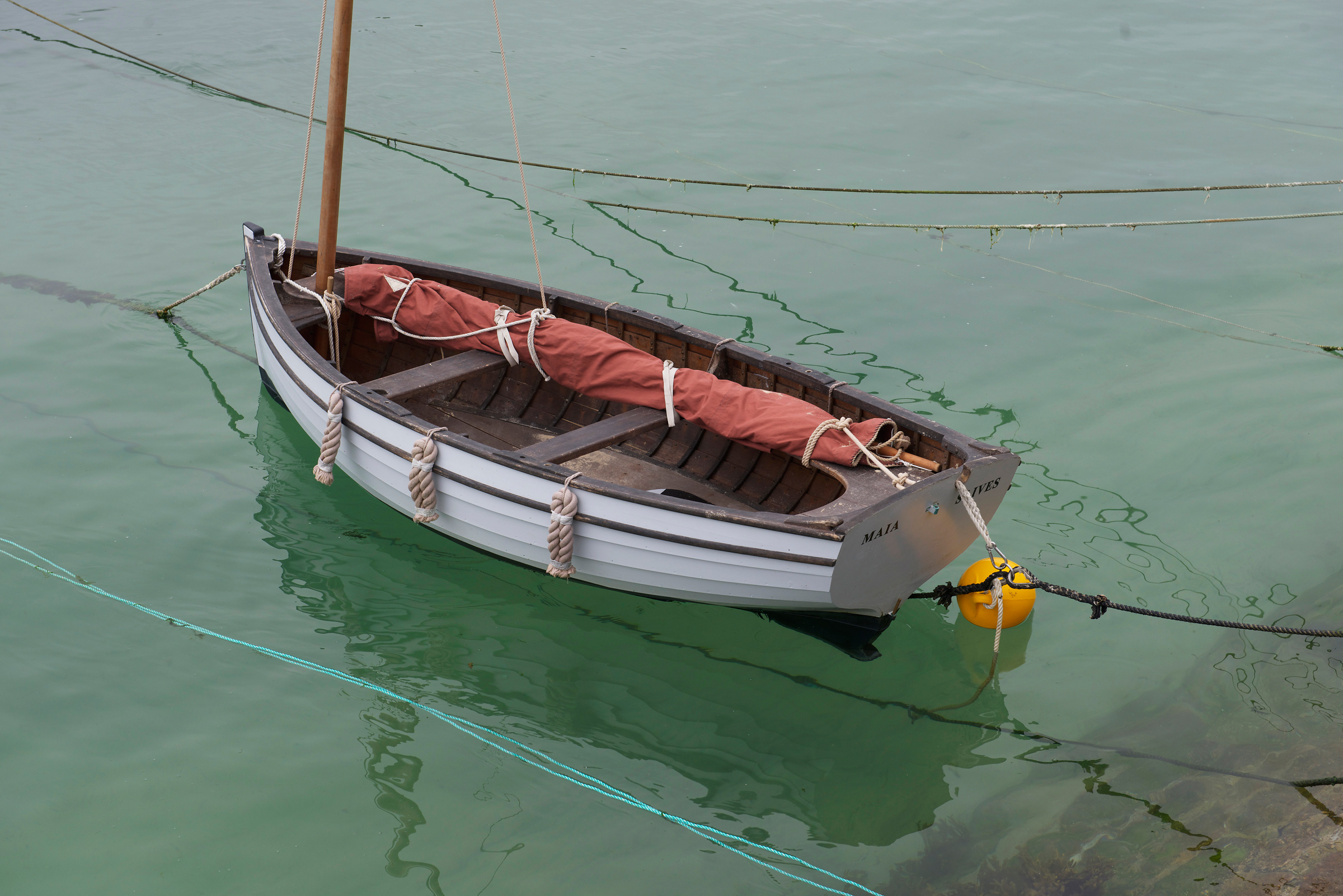 Photographs by the author