A wave slapped the windward gunwale and splashed the back of my neck—a new experience for me. I sat scrunched up in the stern of our little skiff, LA MADALINA, one white-knuckled hand gripping the tiller, the other clinging to the sheet. My wife, Heidi, sat facing me, cross-legged behind the mast, laughing every time water came over the bow and hit her. She was laughing a lot. Armed with a scoop and a sponge, her job was to keep the water in the boat to a minimum. Mine was to get us to the island without going swimming. The 11′ 8″ flat-bottomed skiff was swashing gamely along to windward and seemed to be moving at a good clip. We were dealing with more wind and waves than we ever had before, and I didn’t really know just how much we—or the boat—could handle. I had launched the skiff only a month ago, and already I was thinking we might need something bigger. But she was heavily laden with two adults and camping gear for three days, and she hadn’t capsized yet. It was a glorious afternoon, with a pale blue sky studded with puffy white clouds, sunlight sparkling off the dark blue waters of Priest Lake, and we were having a blast.
Back in my school days I’d messed around on the bays and estuaries of Long Island Sound in a friend’s lateen-rigged Super Snark, but I hadn’t set foot in a sailboat since. Now, some 37 years later, I had decided to try sailing again and so had built this little boat, a Summer Breeze flat-iron skiff designed by David Beede. For the sail, I’d pulled a discarded tarp from a dumpster, cut it out on my lawn, stuck it together with double-sided carpet tape, and (without quite knowing how) had wound up with a decent enough shape. I launched the skiff on our local lake and was surprised by how well it had performed. Mind you, I had little to compare it to, which may have had a lot to do with my appreciation of the “sparkling” performance. But the boat moved along faster than we could paddle a canoe, and could actually sail to windward. What more could I ask for?
 Roger Siebert
.
Flushed with early success, I immediately began planning a boat-camping trip to the most beautiful place we knew, Priest Lake, in the Idaho panhandle. And so, a month later, in mid-July 2017, on a warm, sunny afternoon, Heidi and I set off on our first ever beach cruise, headed for Kalispell Island.
Kalispell Bay to Kalispell Island
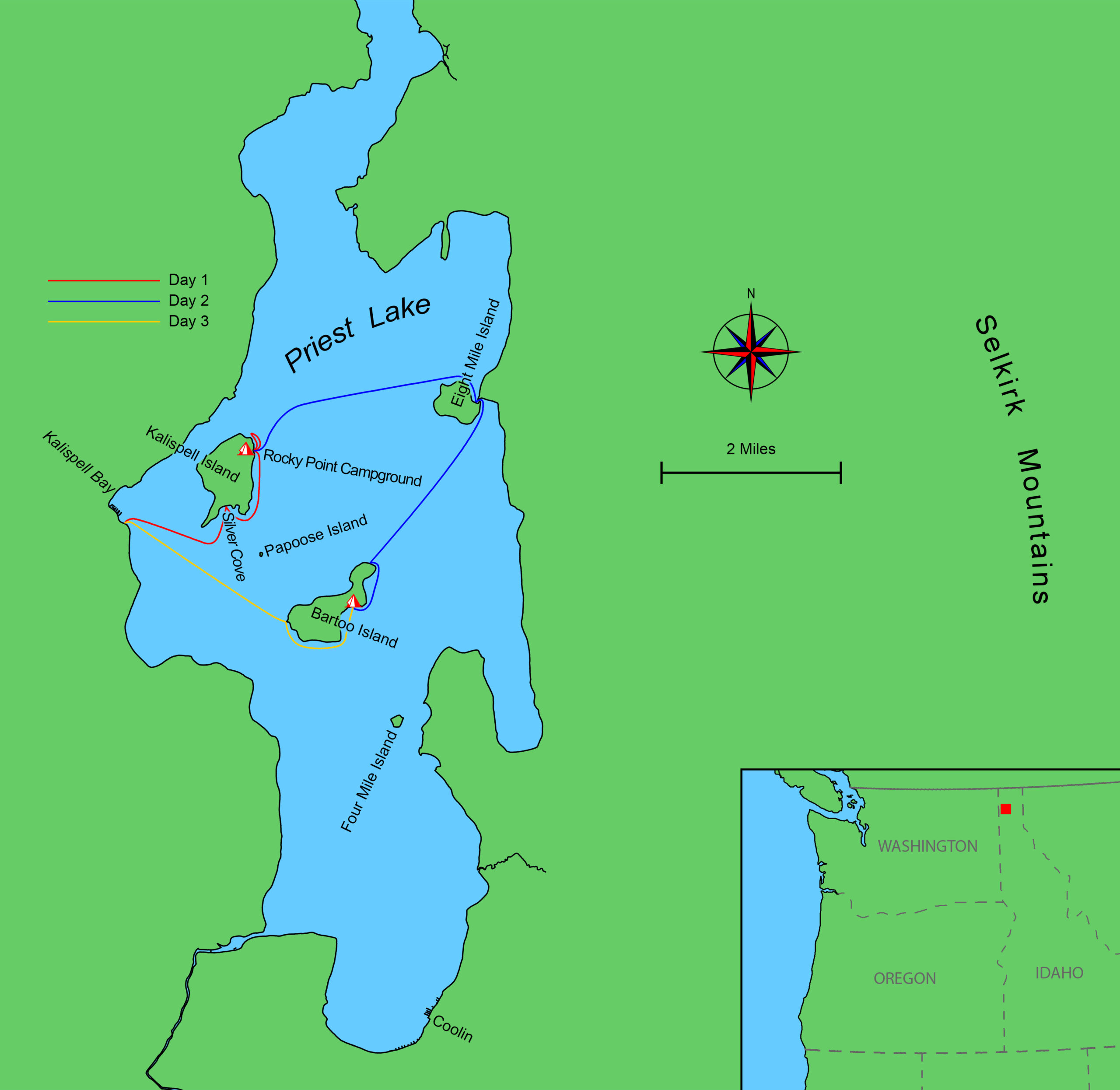
Priest Lake is 19 miles long and 4 1⁄2 miles wide at its widest point, with several small islands in its southern half. Often calm in the morning, it is surrounded by mountains, which funnel the afternoon’s southerly winds up the lake and at times can create a steep chop. Heidi and I had launched in the late morning at the Forest Service boat ramp in Kalispell Bay, on the western shore of the lake about a mile from the southernmost tip of Kalispell Island. The bay is sheltered from the southerly winds, but the farther out we ventured, the more the wind built.
The cedar-sapling mast supporting the 63-sq-ft standing lugsail creaked in the stiffening wind. There were not yet any worrisome whitecaps, thanks to the partial shelter provided by Bartoo Island 2 miles to our southeast, but the wind was a growing concern; and the waves were being confused by the wakes of motorboats that came and went across our bows. Still unsure of the boat and my mastery of her, I instinctively handled her as I would a canoe.
Heidi and I were old hands at canoeing, and had paddled out to Kalispell Island before. Once, we had even paddled out in a canoe laden with three people and a whole load of camping gear in a brisk November snow squall. On that occasion, we had quartered the wind and waves on the starboard bow, not daring to set a course directly to the island, which would have put the canoe broadside to the big waves rolling up from the south.
Halfway to Papoose Island—a heavily wooded island, barely 90 yards long, which lies off the southern tip of Kalispell Island—we had waited for a break in the waves, and then turned the canoe to surf downwind to Kalispell with the wind on our port quarter. I used the same tactic now—there might be neither snowstorm nor paddles but, I reasoned, the maneuver would work just as sweetly under sail.
As we neared Papoose, I pulled the tiller to windward and turned the boat to scud away on a broad reach to the southeast end of Kalispell. The wind felt overwhelming as I awkwardly tried to manage both helm and sheet, keep my weight low, and drive the boat in mostly the right direction; she was affected by a fierce weather helm and was constantly trying to round up, fighting me all the way. As we neared the island, the leeboard hit rocks and pivoted back several times, reminding me that in a sailboat depth of water is of more concern than in a canoe. But, at last, we ducked into Silver Cove, a narrow inlet, barely 100 yards wide, full of sunlight and clear water, edged by granite boulders and with a white sandy beach at the end.
 Photographs by Bob and Heidi van Putten
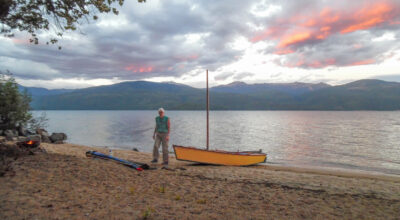
When we left the Kalispell boat ramp, we had thought to camp at Silver Cove at the southernmost point of Kalispell Island. But finding it crowded with motorboats and beach campers, we headed north to Rocky Point where we had this beach to ourselves.
The calm was immediate. We looked around. Silver Cove is a beautiful, sheltered spot in which to camp in the off season, but in July, even mid-week, it was a different story. The cove was filled with motorboats drawn up on the shore or anchored off, and the beach was busy with tents and people. There was no way we were going to land there.
Under the gawking gaze of countless campers we struggled to turn around and head back out. As we made our retreat, I clearly heard someone on the beach say, “Is that a blue tarp for a sail?” And then, moments later, our rudder snagged an anchorline and we stopped dead in the water. The skiff sagged to leeward and rocked as Heidi struggled to free an oar lashed to a tholepin, and I plunged an arm over the transom to grab the rudder blade and swing it up.
The kick-up blade had no lanyard and the single pivot bolt held the blade tight. Somehow I managed to pull it up and we were released, getting away without hitting another boat or snagging anything else. Our pride somewhat bruised, we tacked silently out of the narrow cove, rounded the southeast point of the island, and ran downwind half a mile to the Rocky Point campground, where a narrow crescent of fine sand is backed by a jumble of granite boulders and a thick forest of cedar and fir.
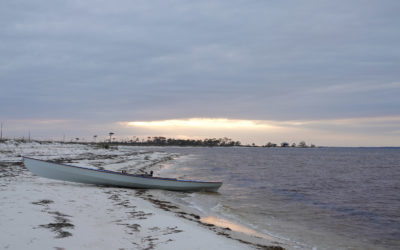
Completely exposed to the east, this shore is less popular with motorboats, but for a small boat that can be drawn up on the beach, it is perfect. Both beach and campground were deserted. We pulled in to the shore, pitched the tent in a shady spot, prepared a meal and a pot of tea, and retired to the tent for an afternoon nap. We’d sailed just a handful of miles, but the effort had been exhausting.
High winds of Kalispell Island
Later that afternoon, feeling well rested, we thought it would be fun to circumnavigate the island—a voyage of about 3 miles. Heedless of the wind that was now blowing a good Force 6, we flew off downwind and reached the north end of the island in a jiffy. Belatedly, we decided that perhaps discretion was the better part of valor, and turned to head back to camp.
Clawing our way back was almost impossible. In the high winds, the weather helm was as strong as ever, and again and again the boat stalled in irons. We could go down or across the wind, but getting upwind was a real struggle. Without the ballasting weight of our camping gear the boat seemed less stable, and time and again I let the sheet fly to keep from driving the rail under. Then the little skiff would round up and stall, and I would fight to get her underway again. At the time I was convinced the sail needed a reef, but the real lesson here was simply to stay off the water when it’s blowing that hard! We managed in the end, but what had taken us only minutes to run downwind took us half an hour to work back upwind. These days I’d drop the rig and row, or just walk along the beach and tow the boat along by the painter.
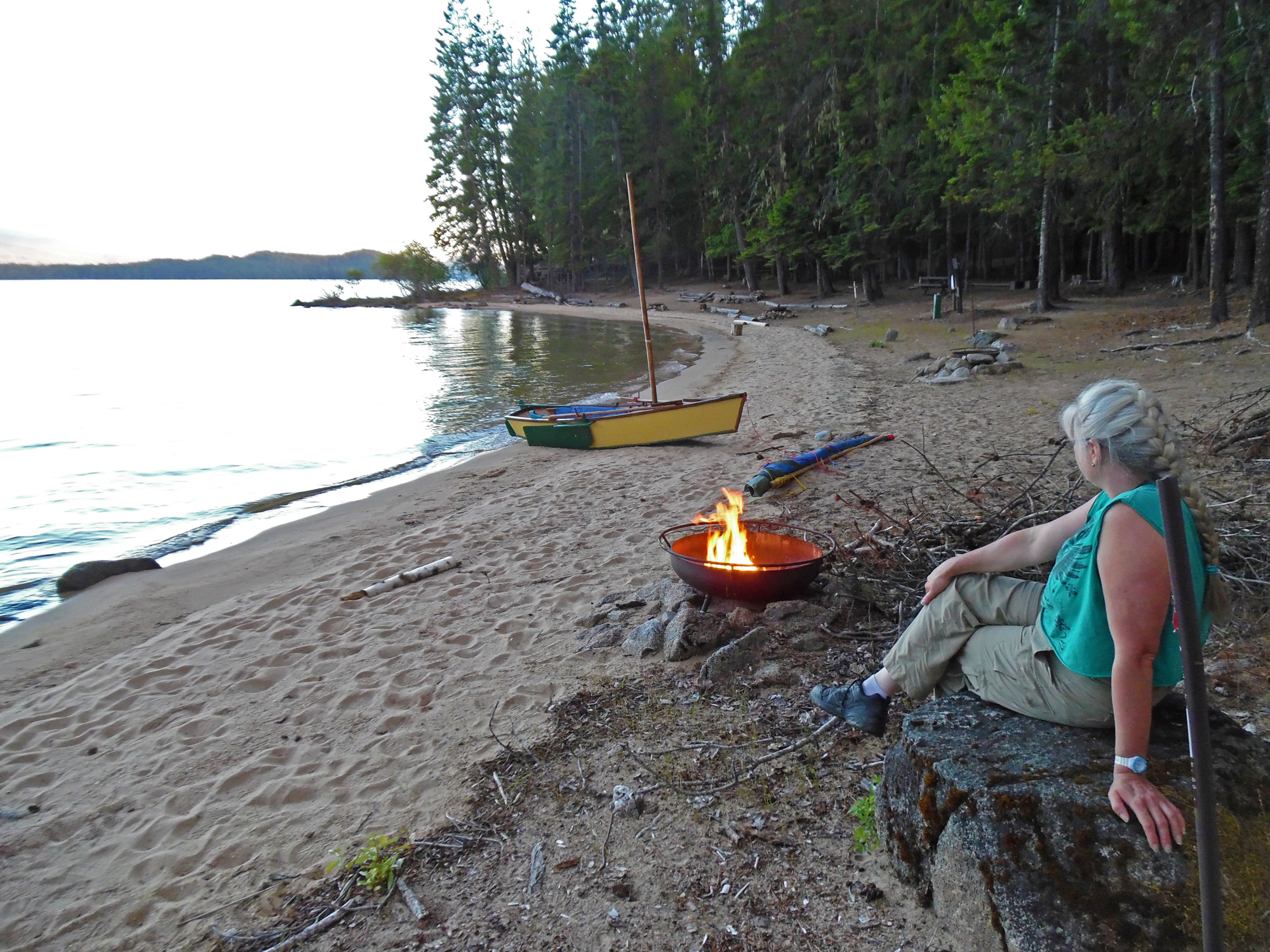
After the adventures of the day, the peace and solitude of Rocky Point were welcome.
Back at camp we looked out across the water between Kalispell and Bartoo islands. It was a froth of whitecaps. Somehow, even in those wild conditions, two sea kayaks were working along, and I watched them until they passed from sight behind the southern end of Kalispell. I marveled at their ability to survive, but worried that if they went over they might not be able to right their kayaks again.
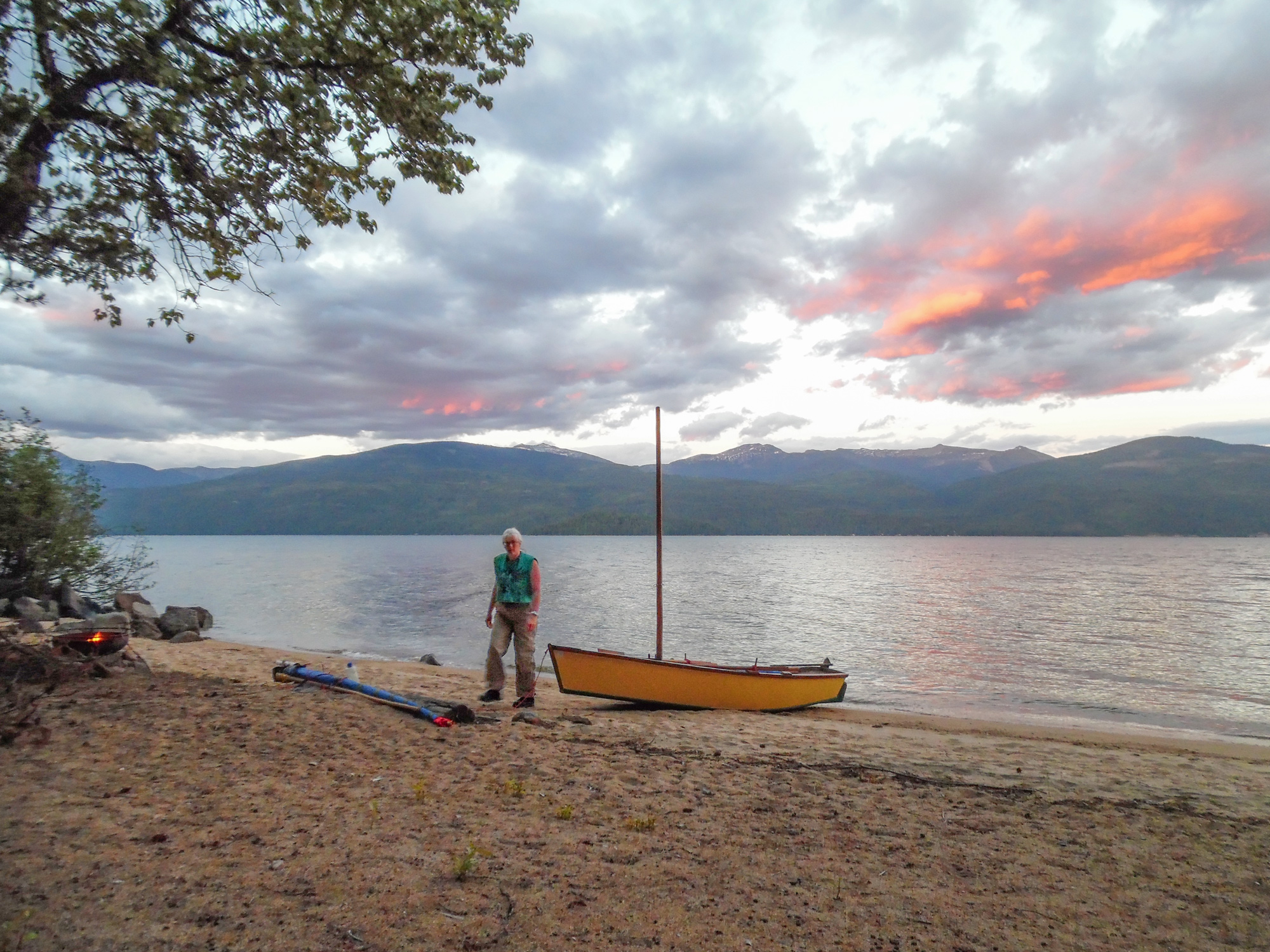
The sunset lit up the clouds in the eastern sky, and on the ridgeline of the distant Selkirk Mountains we could make out the last of the snow still clinging to the high slopes.
Around nine o’clock, as the sun went down, so did the wind, and the lake grew calm. The lowest clouds turned peach and suddenly all was still. The ragged peaks of the Selkirk Mountains across the lake to the east were still crested with snow that gleamed in the last of the light. On the beach our little yellow skiff sat jauntily on the sand, ready to carry us off on whatever adventure we fancied. The contrast between boisterous day and tranquil evening was striking, and we lingered long on the beach as darkness gradually overwhelmed the lake. Sitting by our fire I noted in my journal that the sail needed reefpoints, and that the boat had terrible weather helm—in hindsight we were lucky she had been rounding up rather than falling off in that strong wind.
Across the lake to Eight Mile Island
The day dawned bright and cloudless and calm; the smooth blue lake ruffled here and there by soft, warm breezes. We had no itinerary—we never do—preferring instead to make things up as we go. It looked to be a perfect day for crossing the lake to Eight Mile Island, a distance of a little more than 2 miles to the east–northeast. But I was worried: if the afternoon wind returned as strong as the previous day, we could be stranded there. We pushed worry aside, figuring we’d deal with it later. If need be we could always stealth-camp on some flat spot that we’d be sure to find along the shore of Eight Mile Island. “Why not?” I wrote in my journal that morning. But I did note that in future it might be smart to carry a flare gun or smoke signal in case we ever got into trouble far from land.
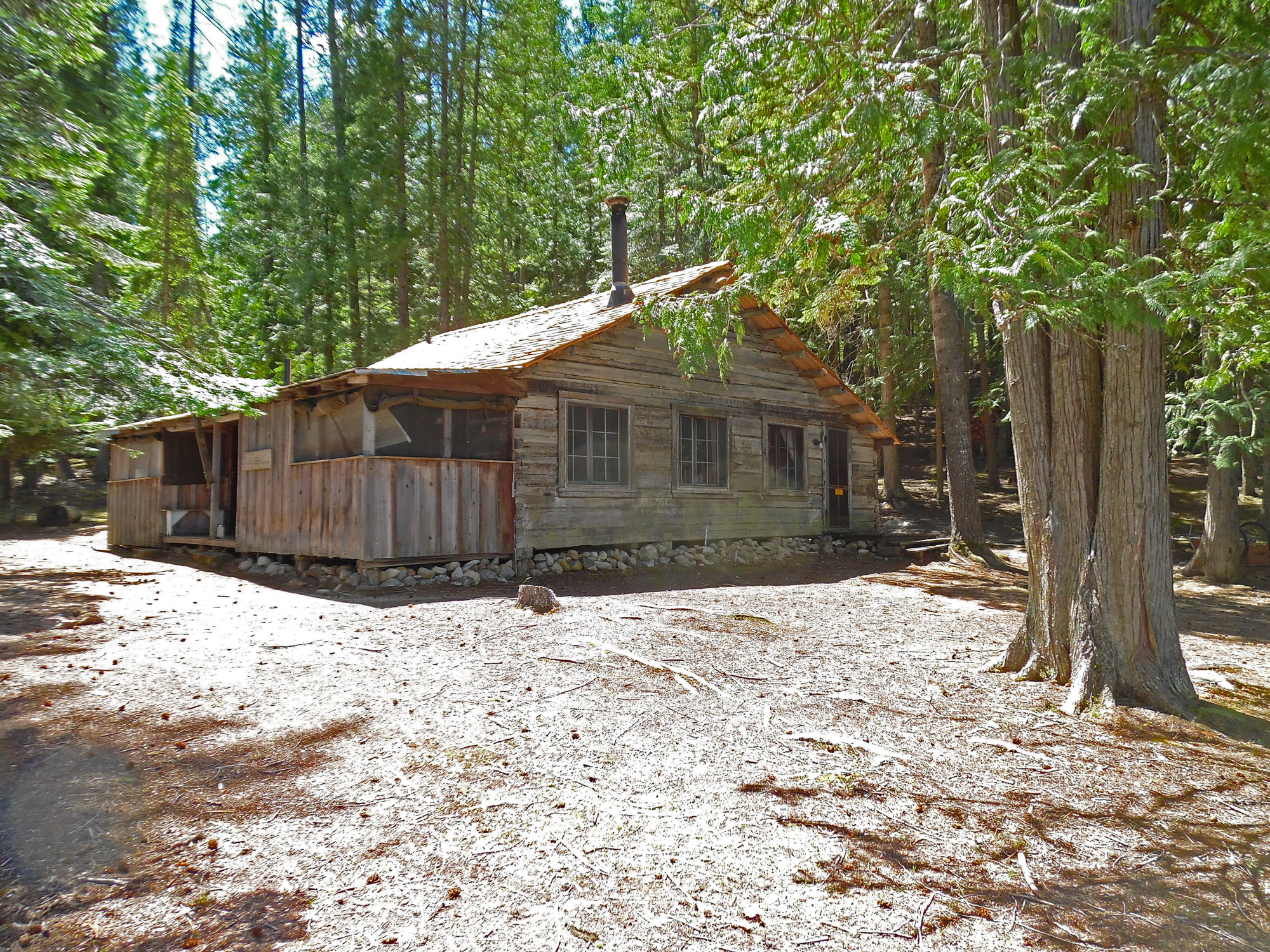
The Vinther-Nelson cabin on Eight Mile Island was built by brothers L. and Curtis Crenshaw in 1897 and purchased that same year by Samuel Vinther and Nels Nelson. In 1909, the Vinther and Nelson families were granted a special-use permit by the Forest Service to use the cabin as a summer residence, which they did until 1981. Today, the cabin is on the National Register of Historic Places and is restored and maintained by the Vinther and Nelson families and the USDA–Forest Service for public use.
We worked the morning zephyrs away from the island and northward, then set course straight across the 2 miles of open water to Eight Mile Island. Away from shore we caught a gentle wind from the north and slid across the smooth lake on a reach. We were exhilarated. Never had we dared to cross so much open water in our canoe; and the previous day’s sail had been exciting, if a little dangerous. This morning our small boat, modest as she is, was like a magic carpet carrying us swiftly and effortlessly across this big lake. We were officially hooked on sailing.
We landed on the north side of Eight Mile and discovered a cabin built in the 1890s and which, by special arrangement with the Forest Service, is still maintained and used by descendants of the original owners. Part of the cabin is a museum and the entire island is open as a day-use area. We whiled away the heat of the day in the cabin grounds, exploring, eating a big lunch, sitting in the shade, and talking to an elderly gentleman who introduced himself as one of the descendants.
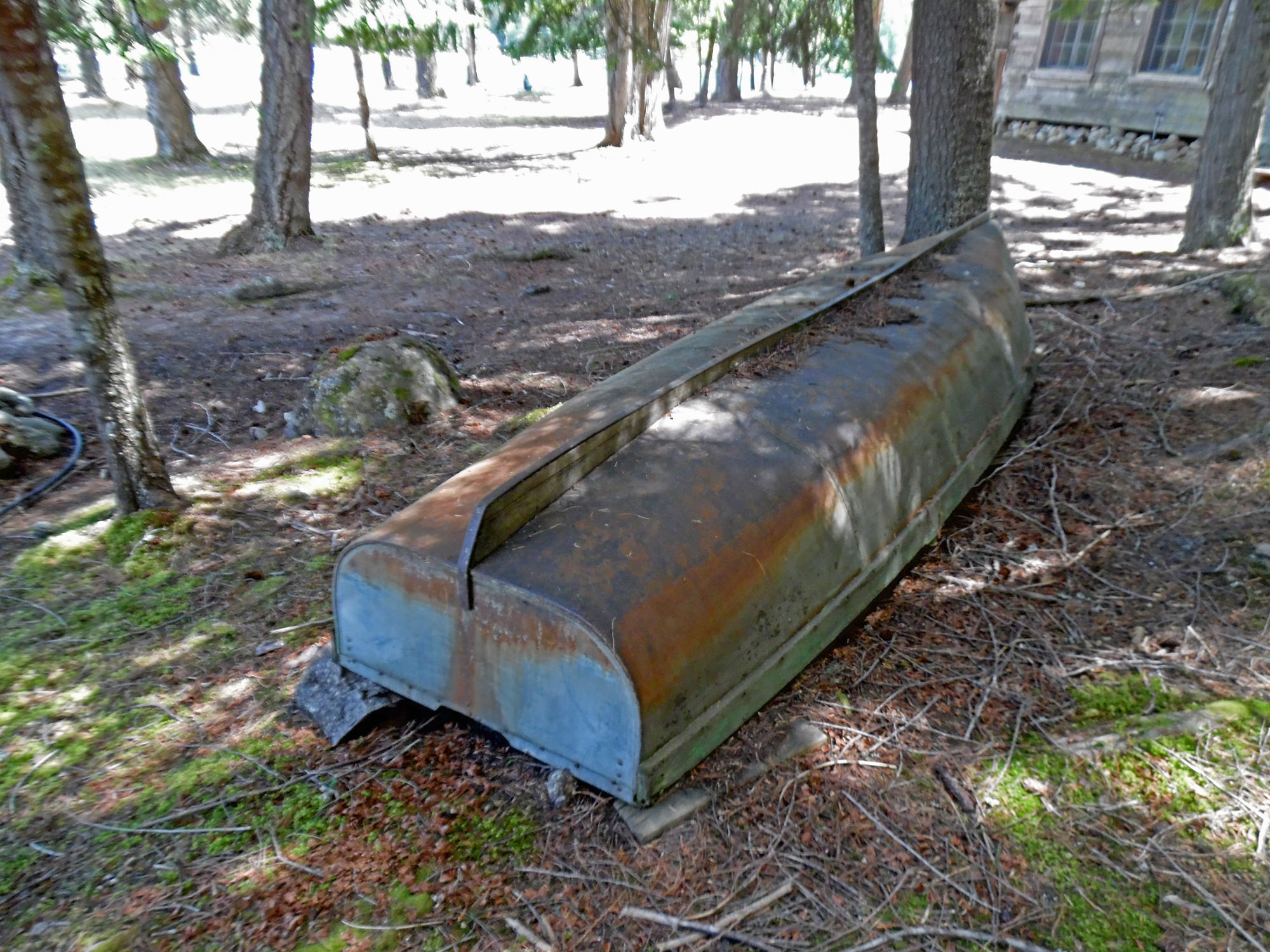
Near the cabin on Eight Mile Lake, a rowboat—built generations ago, according to the owner—lay upturned on the ground. The boat’s frames were wood but the hull was sheet-iron. It had been the family’s main means of transport between the island and the town of Coolin some 8 miles away.
Overturned nearby was an ancient rowboat with wooden ribs and sheet-iron hull which, according to the gentleman, had been built in Spokane, Washington, generations ago. Once, the only way to get to and from the cabin and Coolin, 8 miles away to the south—and the only sizable town on the lake—was to row that heavy boat, fully laden with supplies and people. The gentleman empathized with our small-boat voyage, and told us how, as a young man, he’d once rowed the 12 miles from the island clear to the top of the lake in one day; he’d been lucky enough to catch a tow home in the evening.
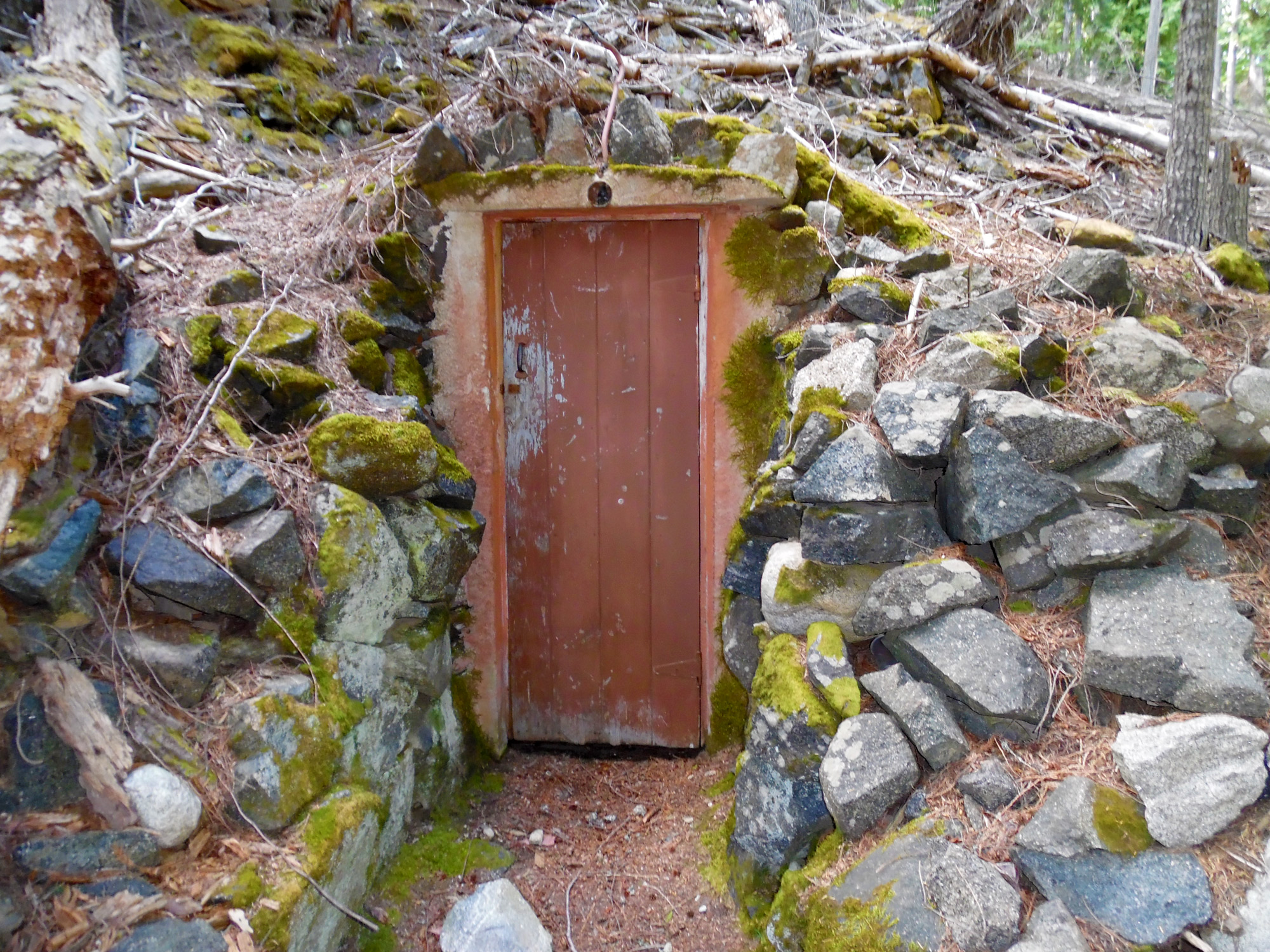
At an abandoned homestead on Bartoo Island we found an old root cellar, built with remarkable ingenuity into a rocky hillside.
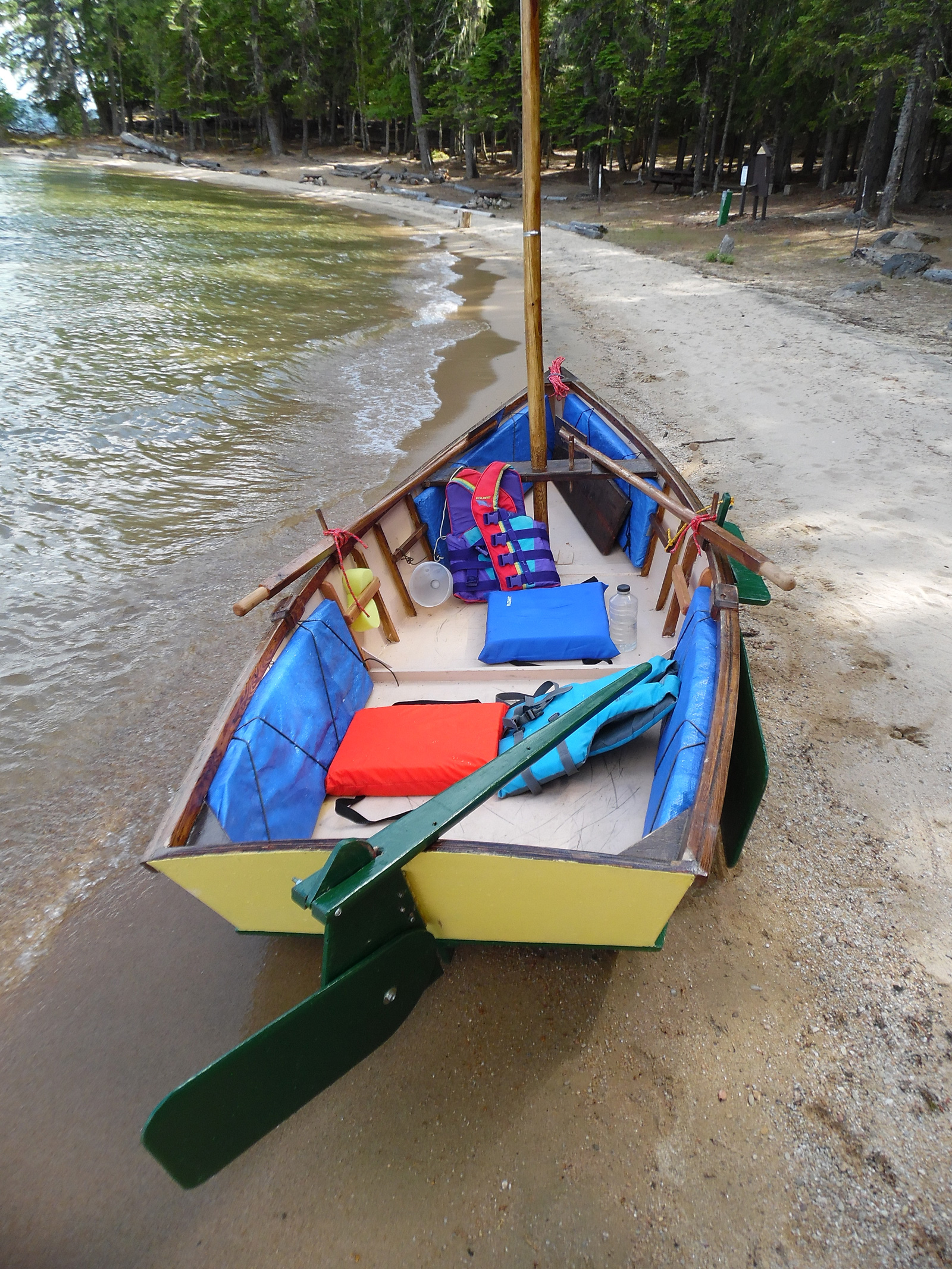
Other people came and went in motorboats throughout the day. Some stopped to chat with us, and several wondered how two people could travel in such a small craft, and without an engine. In truth, our pocket-sized skiff was pretty much maxed out on this voyage, and we had only managed by traveling light. A canvas packsack holding our food and cookstove was stashed in the stern beneath the tiller. A drybag holding our clothing, two sleeping pads, and one sleeping bag, which we spread over the two of us as a blanket, was stowed forward of the mast, and our pup tent, in its own stuff sack, was wedged in the bow. Unlike many of the motorboaters, we didn’t feel the need for cabin tents, folding chairs, barbecue grills, huge coolers of ice and beer, and portable stereos.
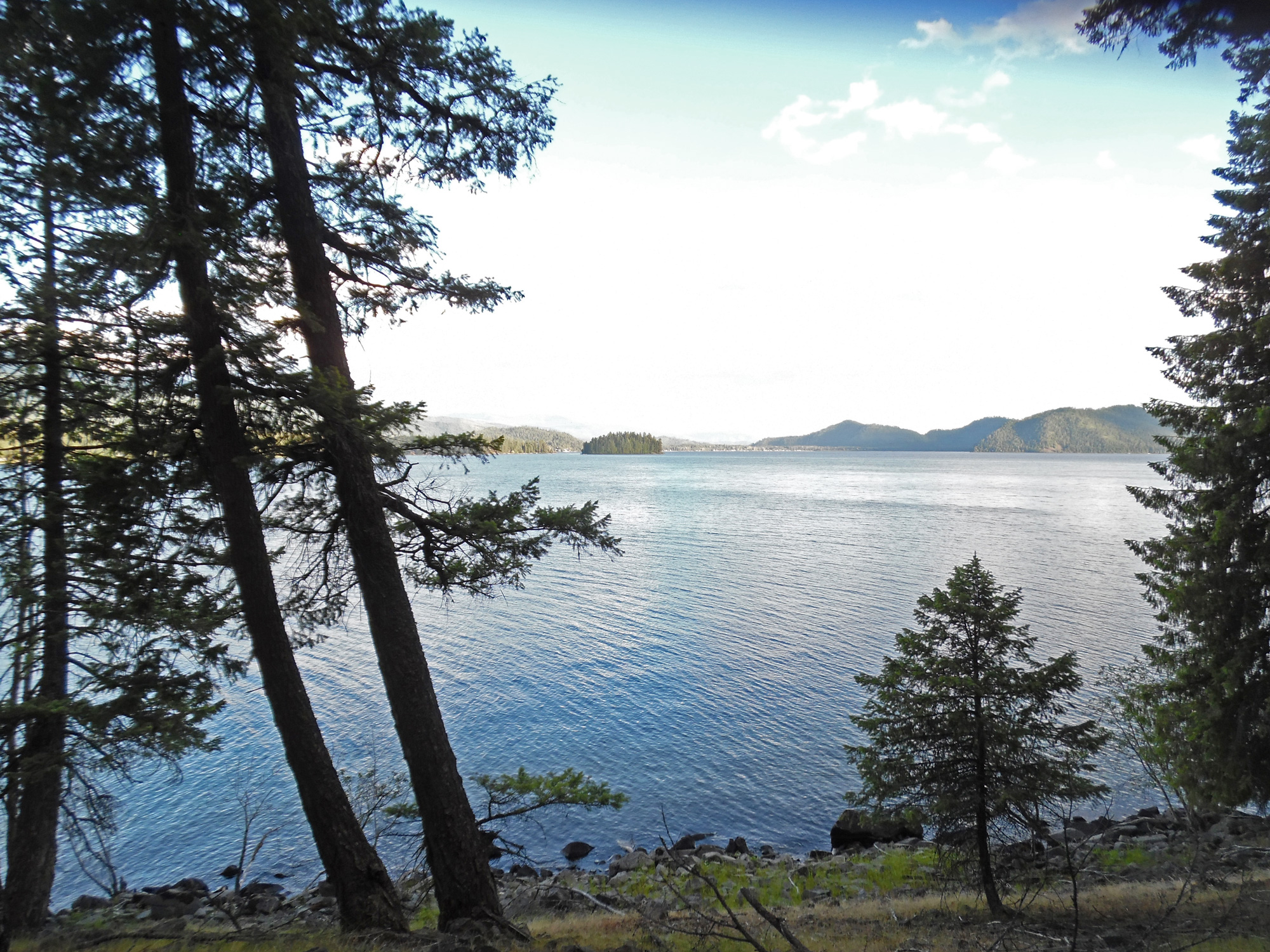
Looking south from Bartoo Island we could see the densely wooded Four Mile Island, seen here in the center of the picture. If we had had more time, we might well have stopped there to spend a night at a secluded campsite accessible to only the smallest of boats.
In the afternoon we set sail, rounding the northeast corner of Eight Mile Island and setting a course for Bartoo Island, 2 miles to the south. The old south wind was back, as reliable as ever, but it wasn’t as strong as the day before. Plenty of waves were rolling up the lake, but no whitecaps. The skiff reared and stamped over the waves, sending a good deal of spray flying, but she never stopped or buried her bow. The wind was angled just right for us to hold a port tack all the way to the eastern shore of Bartoo, and it moderated as we entered the lee of the island. My journal records that Heidi reported the crossing as “uneventful.”
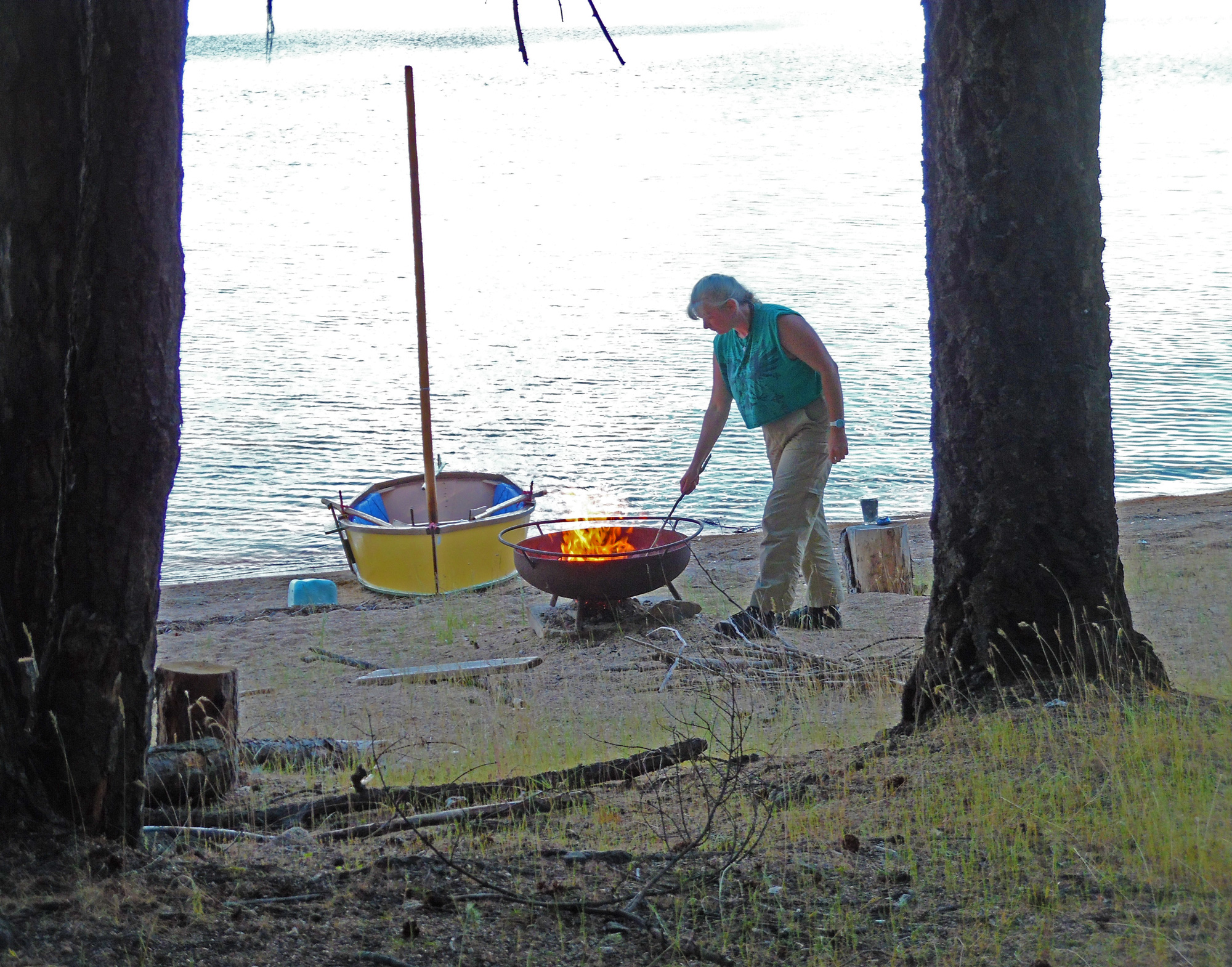
South of the Bartoo homestead site we found an alternative campsite, which again we had to ourselves. Heidi cooked up some Jiffy Pop, which we enjoyed with some cold Rolling Rock beer that a previous visitor had left behind.
We landed and explored the island, finding the remains of an old homestead with a stout root cellar built into a rocky hillside, and an old riveted-iron tank almost as large as our boat—it looked like the boiler for a steam engine. We had considered staying at the homestead, but previous campers had seemingly used the entire area as an outhouse, scattering toilet paper (and more) everywhere. Disgusted, we bushwhacked inland, pushing through a tangled forest of cedars and ferns to the rocky northeast–southwest spine of the island about 150′ above the lake where, to our surprise, we found a small pond. From this high vantage point we could see whitecaps marching up the lake to the west—as expected, the south wind was building and blowing unimpeded up the lake.
As the sun sank low toward the horizon, we pushed off the beach and sailed southward along the shore in search of a place to spend the night. Rounding a point about a mile south of the homestead we discovered a large empty campground with pit latrines, picnic tables, and tent sites. We landed alongside a six-pack of Rolling Rock beer that someone had left cooling in the shallows. We built a fire and, not for the first time, Heidi proved herself master of the campfire Jiffy Pop pocorn. We settled down to enjoy the quiet evening as we chewed popcorn and sipped beer, but it had been a long day and by full dark we were fast asleep in the tent.
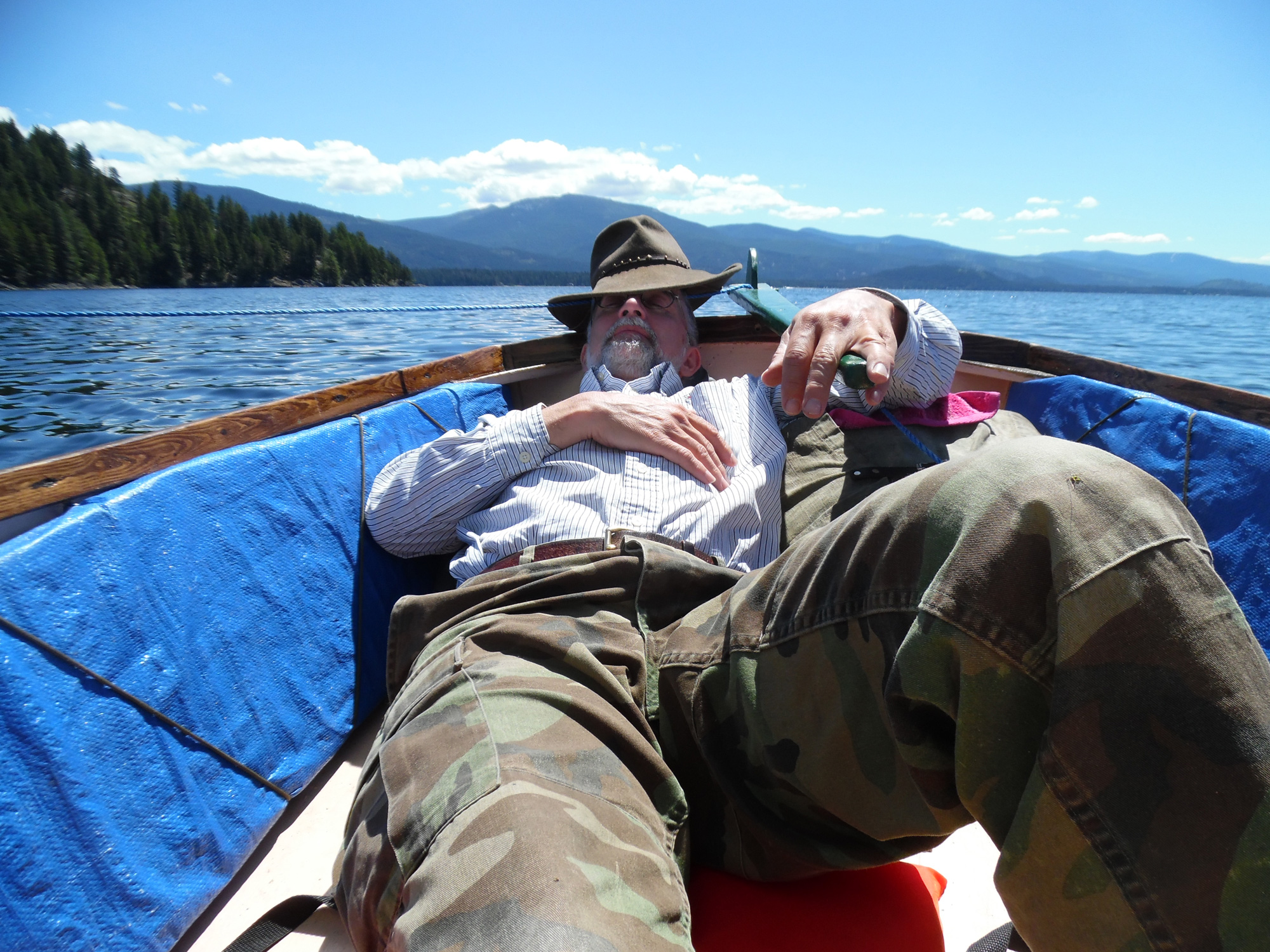
In the light morning breeze, we ghosted around the southern tip of Bartoo and inched northward waiting for the southerly to pick up and carry us back to Kalispell. I lay sprawled in the stern, resting a hand on the tiller, and taking an occasional peek from under my hat to see where we were going.
Return to Kalispell
The last day of the cruise dawned as flawless as the day before. Puffy white clouds chased each other across the pale blue sky, dragging dark shadows up and down the thickly forested mountains that surround the lake. From our camp we could clearly see the hump of Four Mile Island to the south, maybe 1 1⁄2 miles away. We knew that this tiny rocky and heavily forested island, only some 300 yards across, concealed a primitive north-facing campsite that is accessible only by the smallest of boats. It would have been the perfect spot to spend another night, but regrettably we had to be home this day—Four Mile would have to wait for another trip.
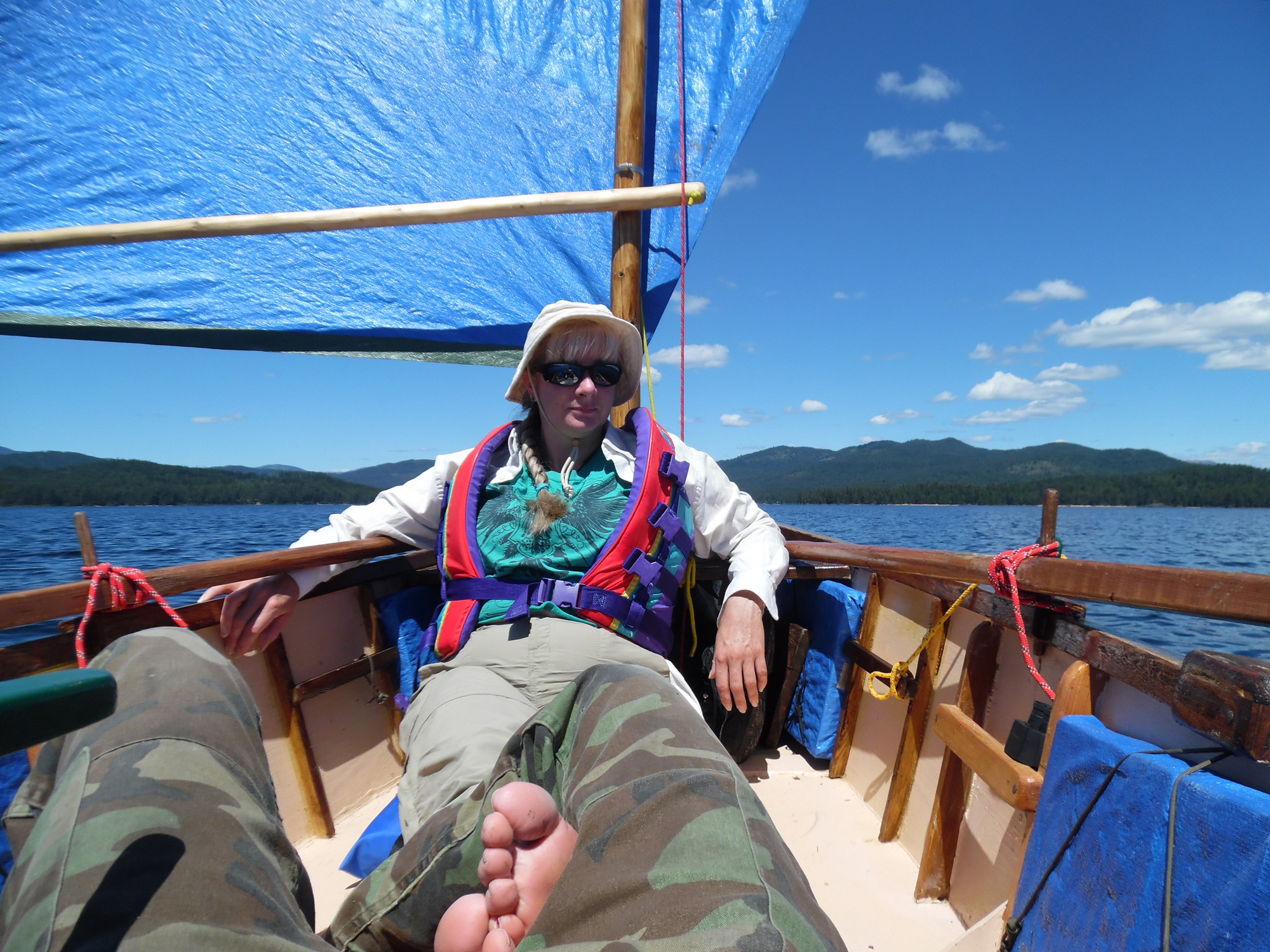
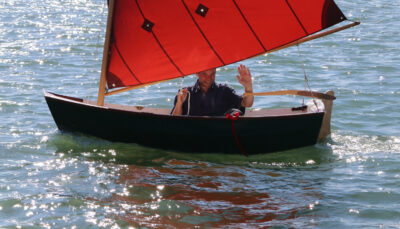
Making the most of the space, Heidi leaned back against the mast. The foot of the sail occasionally threatened to tip off her hat, but the boom angles up to the mast, easily clearing her head.
Through the morning we explored the thick forest and swam in the cool water off the sandy beach, and just before midday we set sail once again for Kalispell Bay and the end of our midsummer cruise. Stretched out lazily in the bottom of the boat, my head resting on the transom, tiller balanced on my shoulder, hat over my eyes, I could barely keep awake as we ghosted around the southern end of Bartoo under the high sun.
Heidi reclined comfortably against the mast, her legs stretched out before her. The “passenger space” in the skiff, between the ’midship frame and the mast, is roomy, and the sail’s sprit boom angles up from clew to mast, leaving plenty of headroom below; sitting up against the mast, Heidi’s hat might get knocked off by the foot of the sail, but she’d never be hit by the boom. We lazed along for another mile or two before landing on the westernmost tip of Bartoo to stretch our legs. As the afternoon’s south wind looked like it was picking up, we set sail one last time and began the 2-mile downwind glide back to Kalispell Bay and the boat ramp.
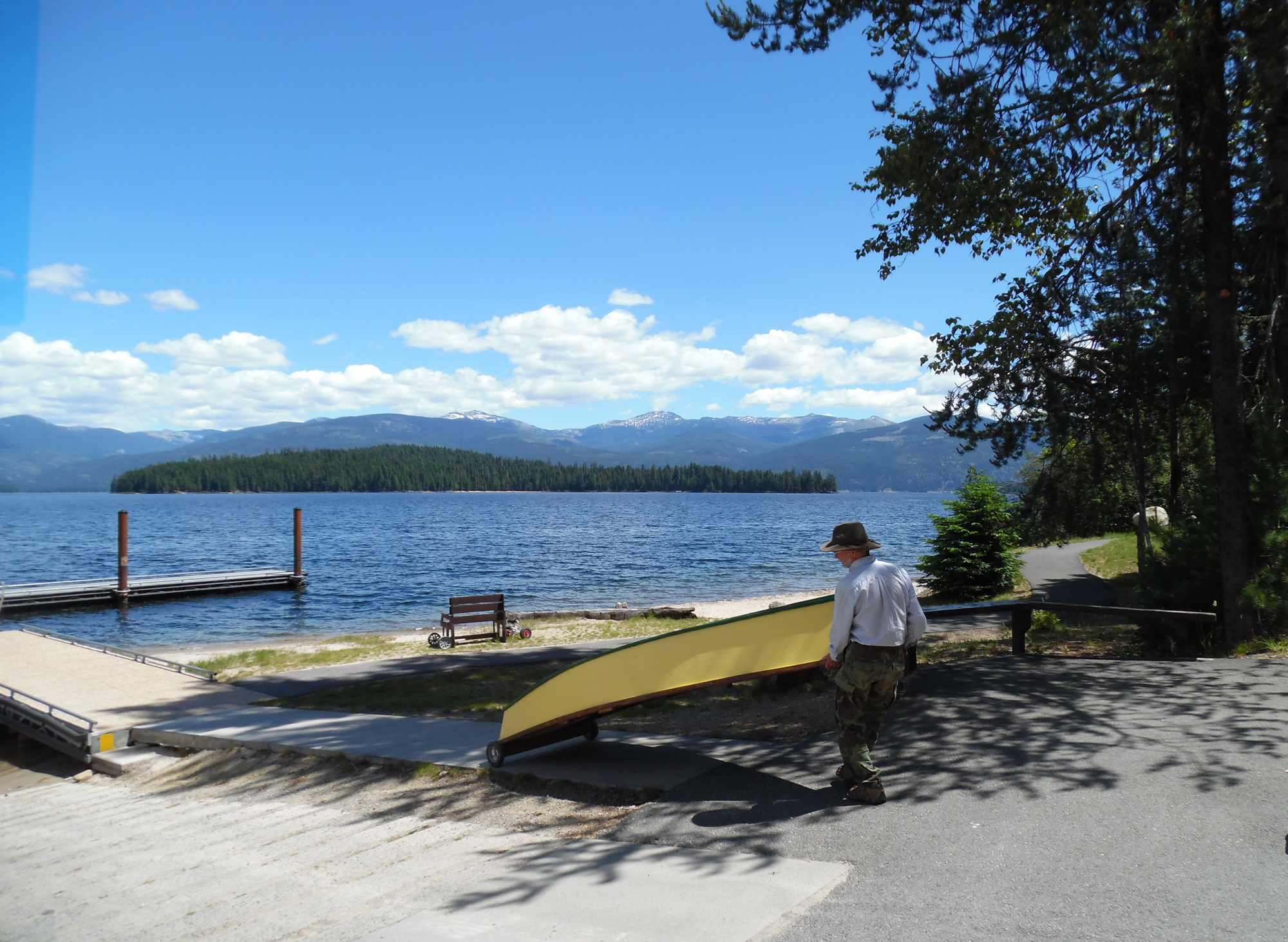
Back at the Kalispell ramp with all our gear from the previous days offloaded and stowed in the truck, we flipped the boat and hauled her up on her simple two-wheel dolly.
The skiff quietly gurgled off the miles as the southerly gradually grew from a gentle breeze to a modest wind. As we made the crossing, we could see Kalispell Island, which we had struggled to reach the first day, and there was little Papoose Island half a mile to its south. Behind us was Bartoo, and off in the distance we could just distinguish Eight Mile Island from its backdrop of the wooded eastern shore. What an ideal place to explore in a small boat! Our first beach cruise had been a delight. We’d run into some strong winds and chop, but not once had we needed to down sail and row. I might have toyed with the idea of a bigger boat as we’d first set out, but by journey’s end I was remembering the old saying, “The smaller the boat, the bigger the adventure.”
Bob and Heidi Van Putten live off-grid deep in the Washington mountains in a straw-bale cottage they built for themselves more than 20 years ago. After canoeing happily for decades, one day on Ross Lake they were trying to round a point in a canoe in high wind and waves, when it occurred to Bob that it might be nice to have a boat that could harness the wind.
If you have an interesting story to tell about your adventures with a small boat, please email us a brief outline and a few photos.
For more low-cost adventures with Bob Van Putten see:
Sailing on Lake Roosevelt, a two-day end-of-season adventure
Lake Roosevelt, a summertime single-handed cruise
and for his review of the Summer Breeze design:
Summer Breeze, the most boat from the least materials
Join The Conversation
We welcome your comments about this article. To include a photo with your remarks, click Choose File below the Comment box.