sam devlin Archives | Small Boats

The Education of a Serial Boatbuilder

A little learning is a dangerous thing

That’s according to a poem Alexander Pope wrote more than 300 years before Dennis Ward of Riviera Beach, Florida, figured it out for himself. Reading a book on stitch-and-glue boatbuilding inspired him to design and build a boat in 2004 even though he had no experience with either skill.

Fired at first sight with what the Muse imparts,
In fearless youth we tempt the heights of Arts

Dennis’s muse was Sam Devlin and his temptation was the boatbuilding method detailed in Sam’s book, Devlin’s Boat Building. After reading the book, Dennis went straight to work to create a boat of his own: “I sketched a dinghy on paper, then glued some pieces of wood together with epoxy, and was amazed I had made a boat that didn’t sink.” Cutting out pieces of plywood, drilling a bunch of holes, and wiring and gluing the pieces together just happens to be the easy part, but the goal is more than just keeping the water out. Dennis quickly discovered that the dinghy was unsafe on the water. Pope expressed that awakening of a novice to what has yet to be learned:

But, more advanced, behold with strange surprise
New distant scenes of endless science rise!

The subtitle of Devlin’s Boat Building is “How to build any boat the stitch-and-glue way”. Sam likely intended “any boat” to encompass the sizes and types the system works for—he has designed and built boats ranging from a 6′3″ dinghy to a 45′ motor cruiser—but “any boat” could also be taken to mean good boats as well as bad boats. Sam’s boats, the result of a wealth of education and experience in boat design and construction, belong in the former category. Dennis admitted that his boat had fallen into the latter: “That dinghy has since become yard art.” The lesson he learned was “Let the professionals design the boat!”
Photographs by and courtesy of Dennis Ward

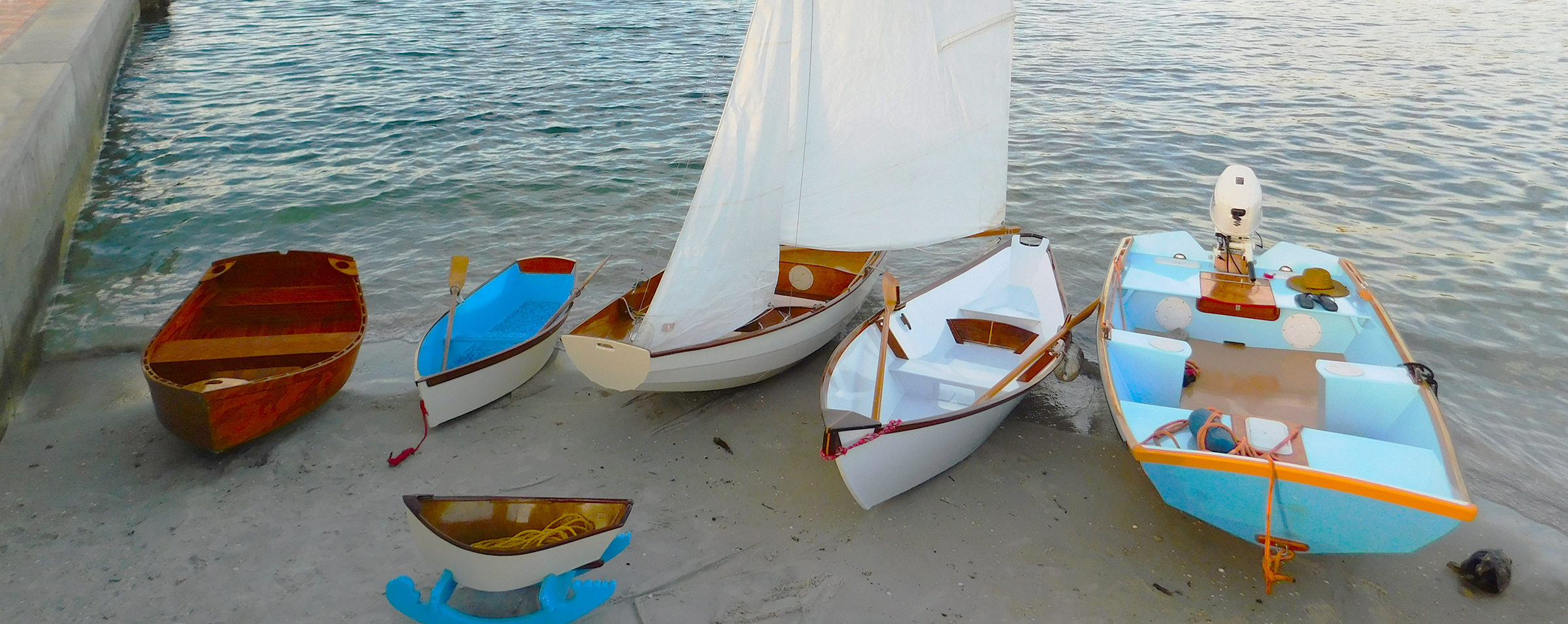
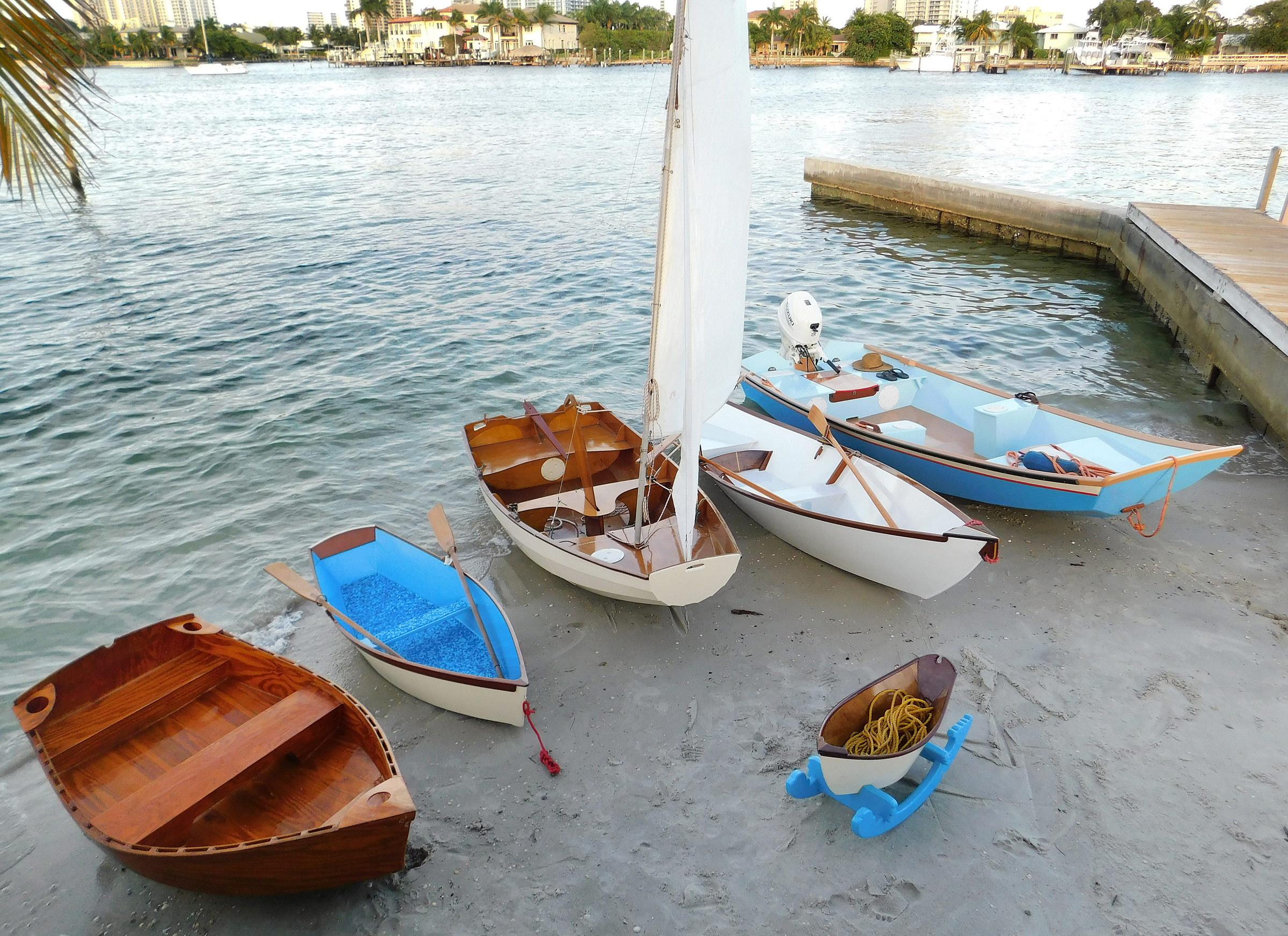
In October of 2021, Dennis retired after a 35-year career as a Palm Beach County ocean lifeguard, rower, rescue-boat driver at Jupiter Inlet, Boynton Inlet, and Boca Raton Inlet. A couple weeks later, he got all six of his boats in the water for some photos. At the water’s edge, from left: Dennis’s self-designed dinghy, kid’s rowboat from a thrift store, Passagemaker Dinghy, Gloucester Gull, and Ben Garvey. The Gloucester Rocker is safely away from the water. His Chester Yawl isn’t shown.

Despite the disappointing results of his first efforts, Dennis thoroughly enjoyed the time he spent building the dinghy. For his second boat, he skipped the designing and bought a kit for Chesapeake Light Craft’s 11′ 7″ take-apart Passagemaker Dinghy. He finished it in 2007 and, although it had all the characteristics that would put it in the “good boat” category, the Passagemaker was only afloat a few times before Dennis was back in his back yard under a 10′ by 20′ canopy, “making more sawdust.” His series continued with a Gloucester Gull and a partially built child’s rowboat he bought in a thrift store for $30. The Gull was afloat only a few times, and the little rowboat has yet to be launched and is waiting for an interested kid he can give it to.

The mild weather in Florida made it practical for Dennis to build the garvey outdoors under a canopy.

One of Dennis’s friends bought plans for Doug Hylan’s Ben Garvey, decided the project was more than he could manage, and gave the plans to Dennis, who started building it in 2011. After he had finished the hull and flipped it right-side up to begin work on the accommodations, he decided to do away with the center thwart. “That way I wouldn’t be stepping over it, and there’d be 8′ of space on the bottom for horizontal activities, like napping.”
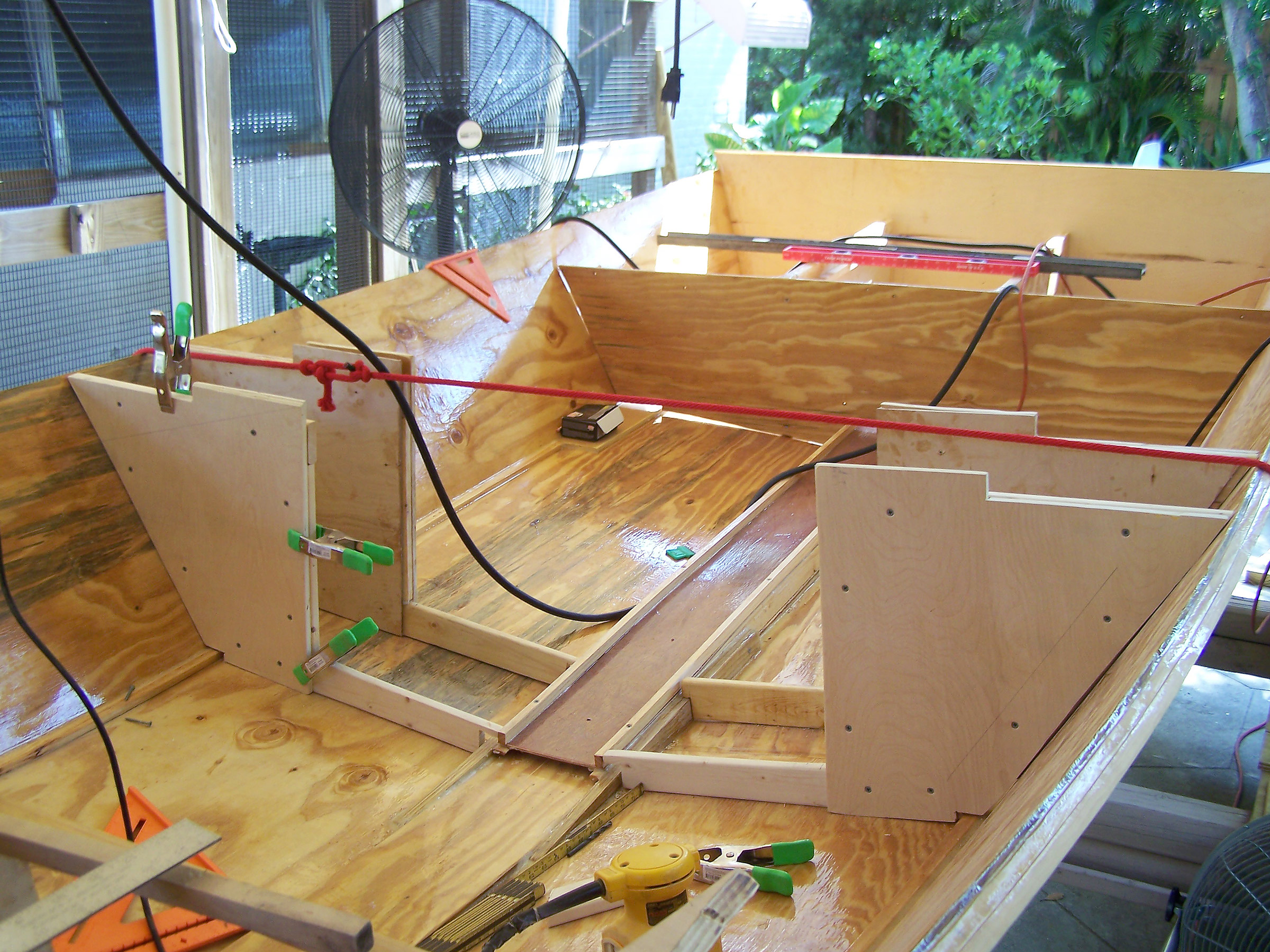
Having decided to omit the center thwart to open up the center, Dennis devised a structure that provided a walk-through passage between partial side benches and framing across the bottom.
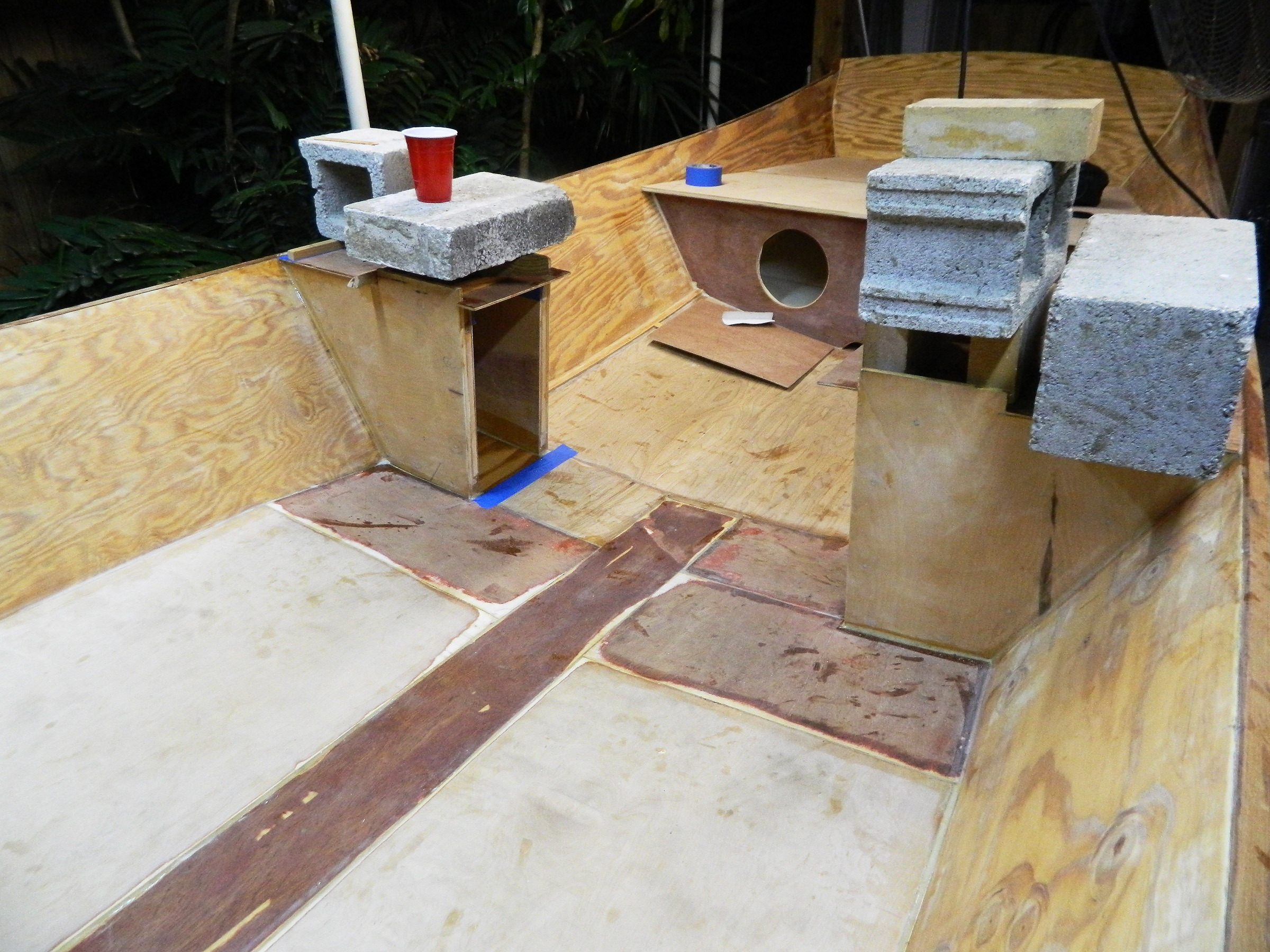
 

A cockpit sole over the added interior framing provides a smooth surface for napping and enclosed spaces for flotation.

Concerned about losing the strength the thwart would have provided to the hull, he replaced it with two enclosed storage-compartment seats on either side. “I also intended to add several more frames on the bottom to add more strength to the chines and sides. The extra frames would be a tripping hazard and make napping uncomfortable; adding a cockpit sole on top of the frames seemed to be the ideal solution. I ended up with a double-hulled boat with flotation in between.”
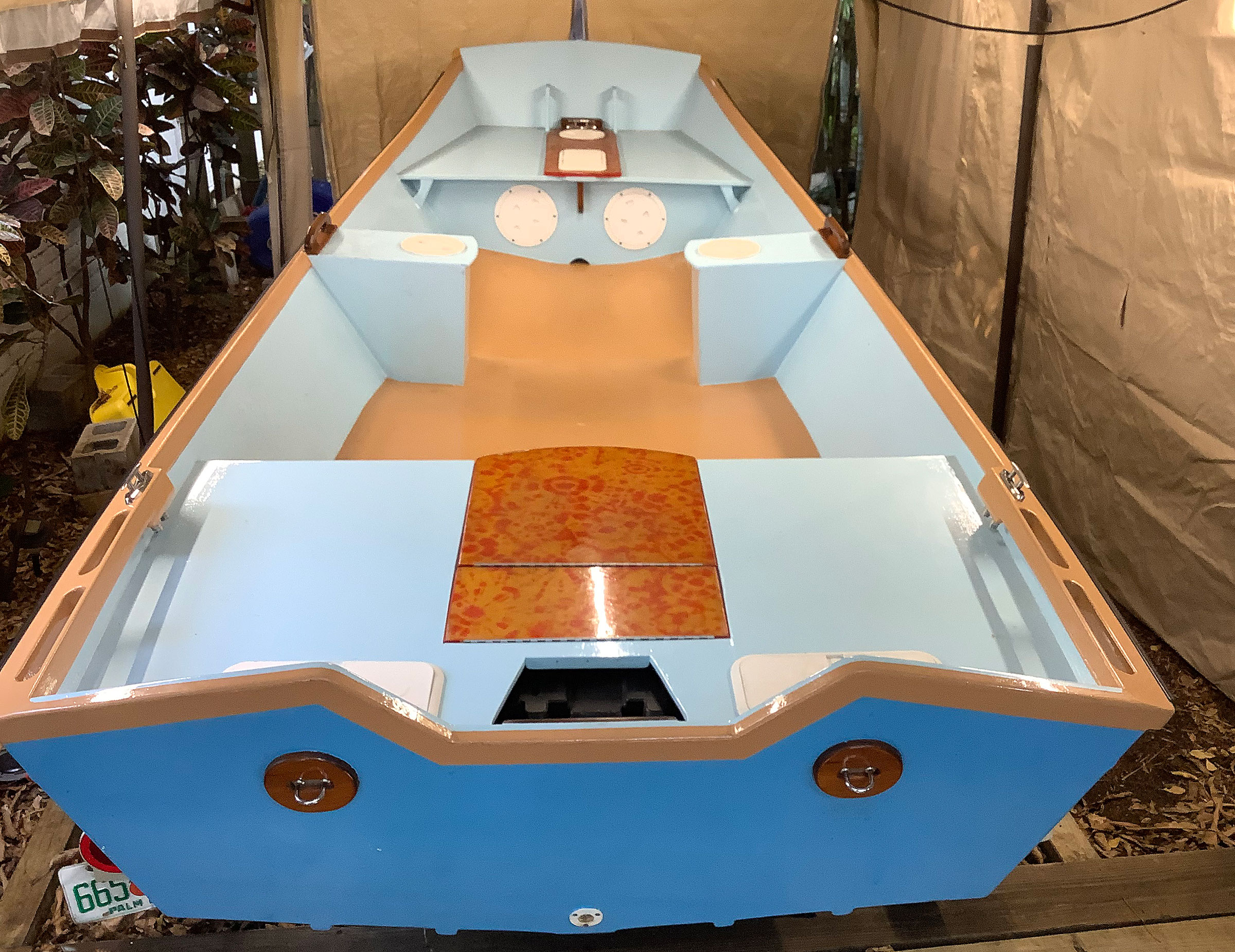
The teak rails were painted over in a beige/orange color. The boat's interior is light blue and the outer hull is electric blue.

The gunwales are teak and were initially varnished but Dennis decided “it’s like lipstick on a pig. This is basically a workboat, not a fancy piece of furniture.” He also embedded tie-dyed fabric on a pane forward and a hatch aft “because I wanted to learn how to do that. What I didn’t know at the time is that I coulda bought clear epoxy, instead of regular yellowish epoxy. So the tie-dyed bright whites turned yellow.”

Dennis finished building the garvey in 2012 but then left it on sawhorses under a canopy for several years until he could afford a trailer. A few more years drifted by as he saved enough for a 25-hp outboard for it.
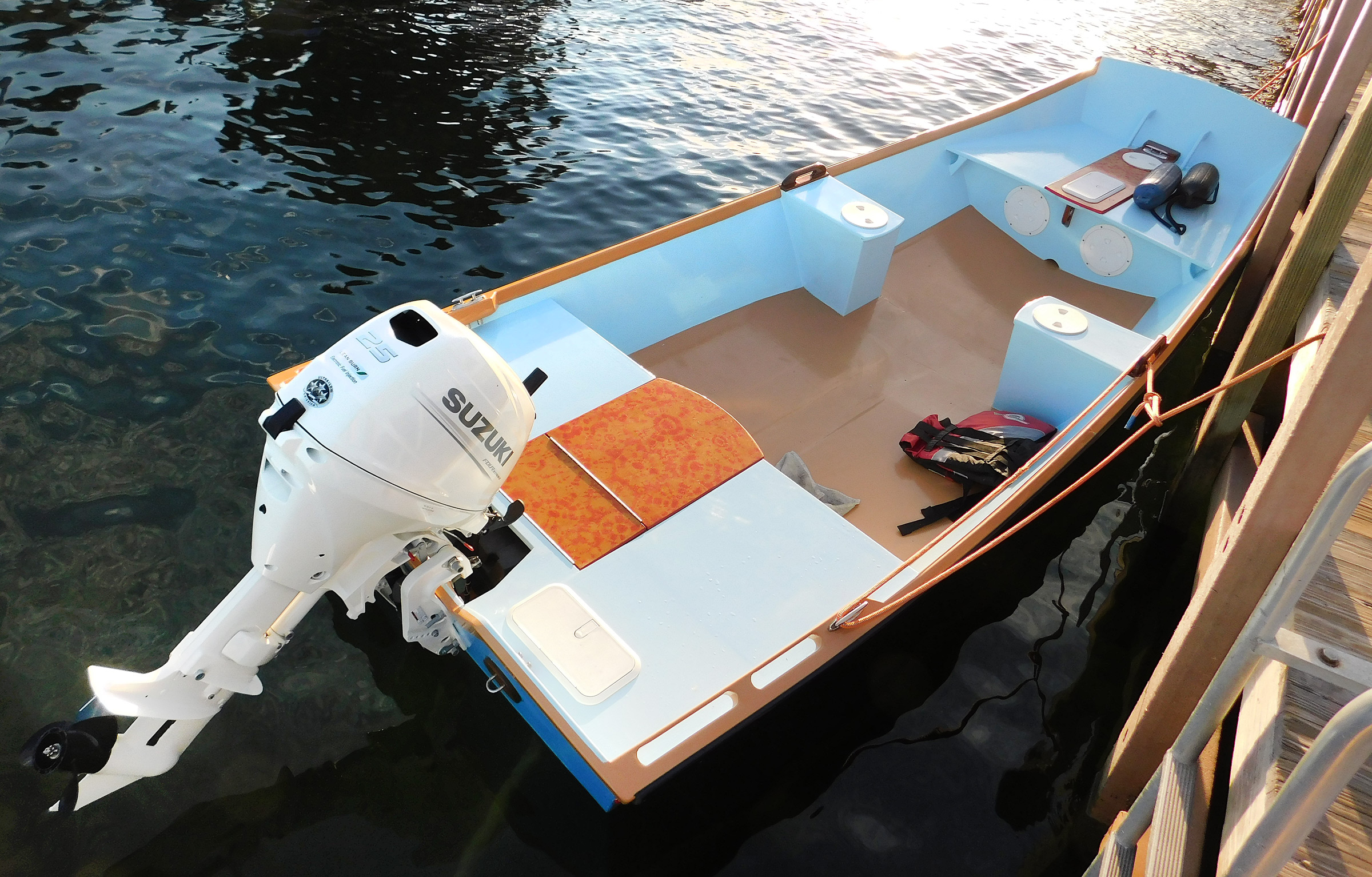
Dennis worried that his weight in the stern along with that of the motor and fuel tank would cause the bow to rise too high, but It sat in the water perfectly.

While the garvey waited, Dennis’s mother gave him the plans for the Gloucester Rocker as a Christmas present. That was in 2017, and all through the following year he worked on it without telling her. The hull and rockers were straightforward work but the seat and grab bar—fashioned from walnut and holly that he had harvested on his mother’s lot—were not. The curved and beveled joints were not easy to get right and by the time he got perfect fits, the two pieces had taken more time than the rest of the boat. The next Christmas he surprised his mother with the rocker; she was delighted with it and she uses it to hold her dog’s toys.

The square bow of the Garvey just barely lifts out of the water while Dennis mans the tiller. Rob Rogerson

On the boat’s first sea trial, Dennis was “somewhat surprised how powerful the 25hp motor was. The garvey is a heavy boat but it got up on plane right away and I wasn’t comfortable going any faster than half throttle. An hour later, the garvey was back under the canopy.”

The garvey was finally ready to launch in 2020, but it wasn’t launched until this year for what Dennis says are “various lame reasons. Mostly, I’d rather build boats than go boating.”
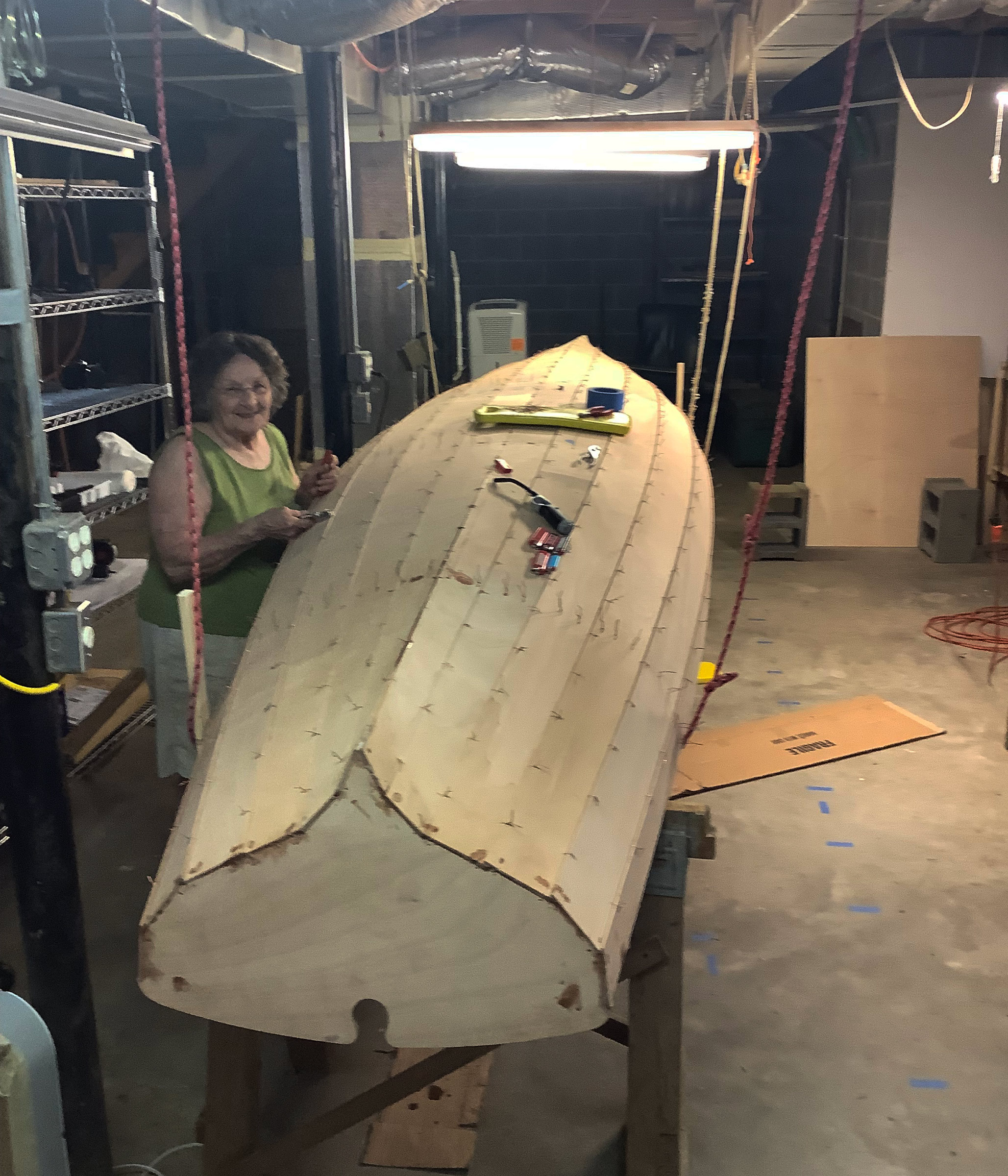
The 15-foot Chester Yawl is supported by sawhorses and lines from the basement roof. The boat's hull is completed and Dennis's mom smiles while examining it... possibly she, too, is impressed that the boat fit in the basement.

Dennis’s 15′ Chester Yawl kit boat is being built with the help of his 86-year-old mother. She offered her basement for the project.

And he has been building boats. A Chester Yawl is in the works in his mother’s basement in North Carolina. Earlier this year, Dennis built the molds and a ladder frame for the L. Francis Herreshoff pram featured in John Gardner’s Building Classic Small Craft. The hull of the 10-footer is usually built in lapstrake cedar on steam-bent white-oak frames, but Dennis had been given a generous assortment of sapele strips and was eager to turn them into a boat.

In fearless youth we tempt the heights of Arts

Strip-building would be uncharted waters for him and, more cautious now after the experience of his first dinghy, he floated the idea of strip-planking the pram on the WoodenBoat Forum. He was dissuaded from making an attempt that could waste time, money, and valuable wood.

New distant scenes of endless science rise!

Rather than forge ahead, he bought Nick Schade’s book, Building Strip-Planked Boats. “I’ll read up some more before I decide what to do.”
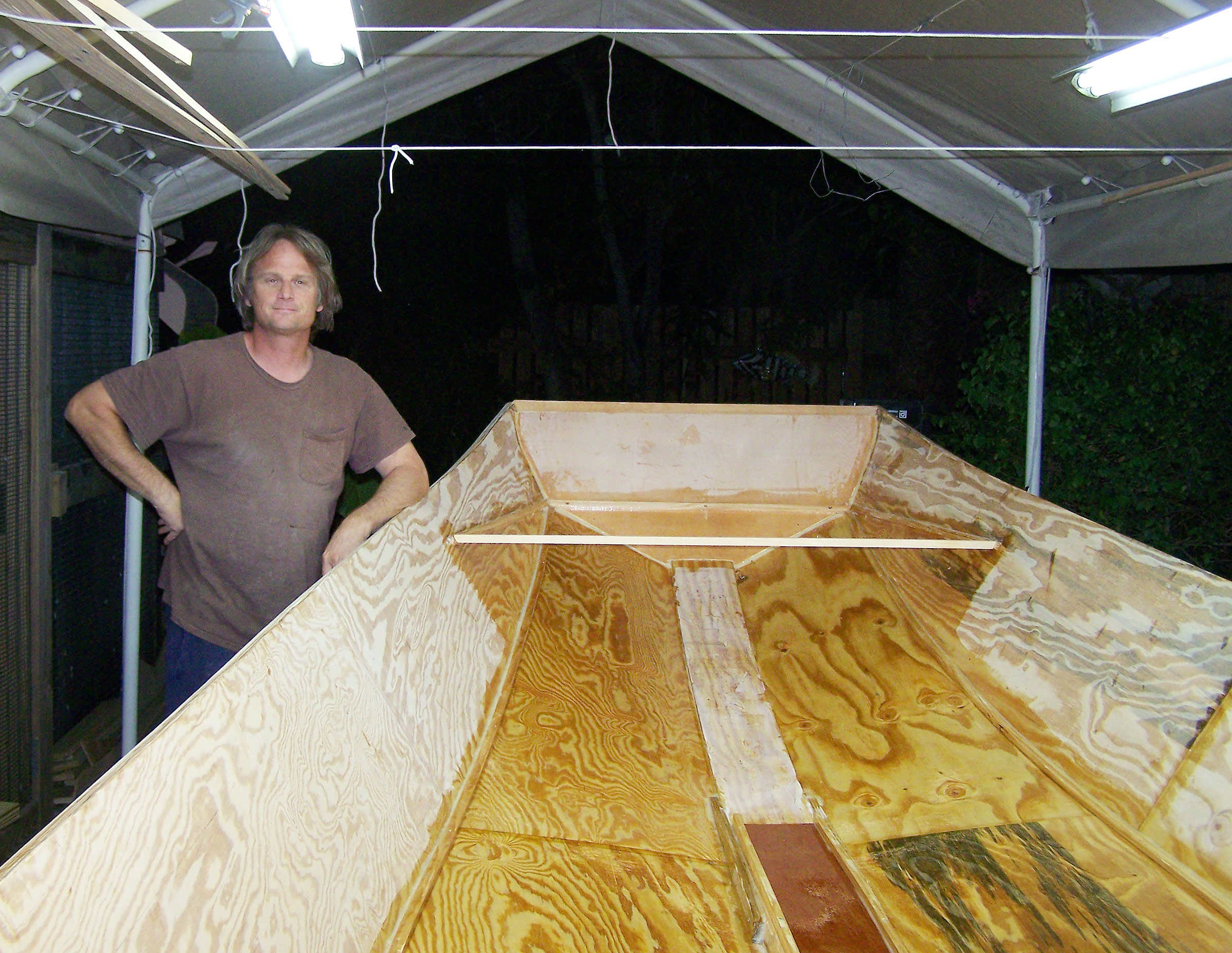
Dennis is happier building boats than using them: “The prominent pleasure of wooden boats is in all the different things I learn in the building process.”


Do you have a boat with an interesting story? Please email us. We’d like to hear about it and share it with other Small Boats Magazine readers.
Winter Wren II

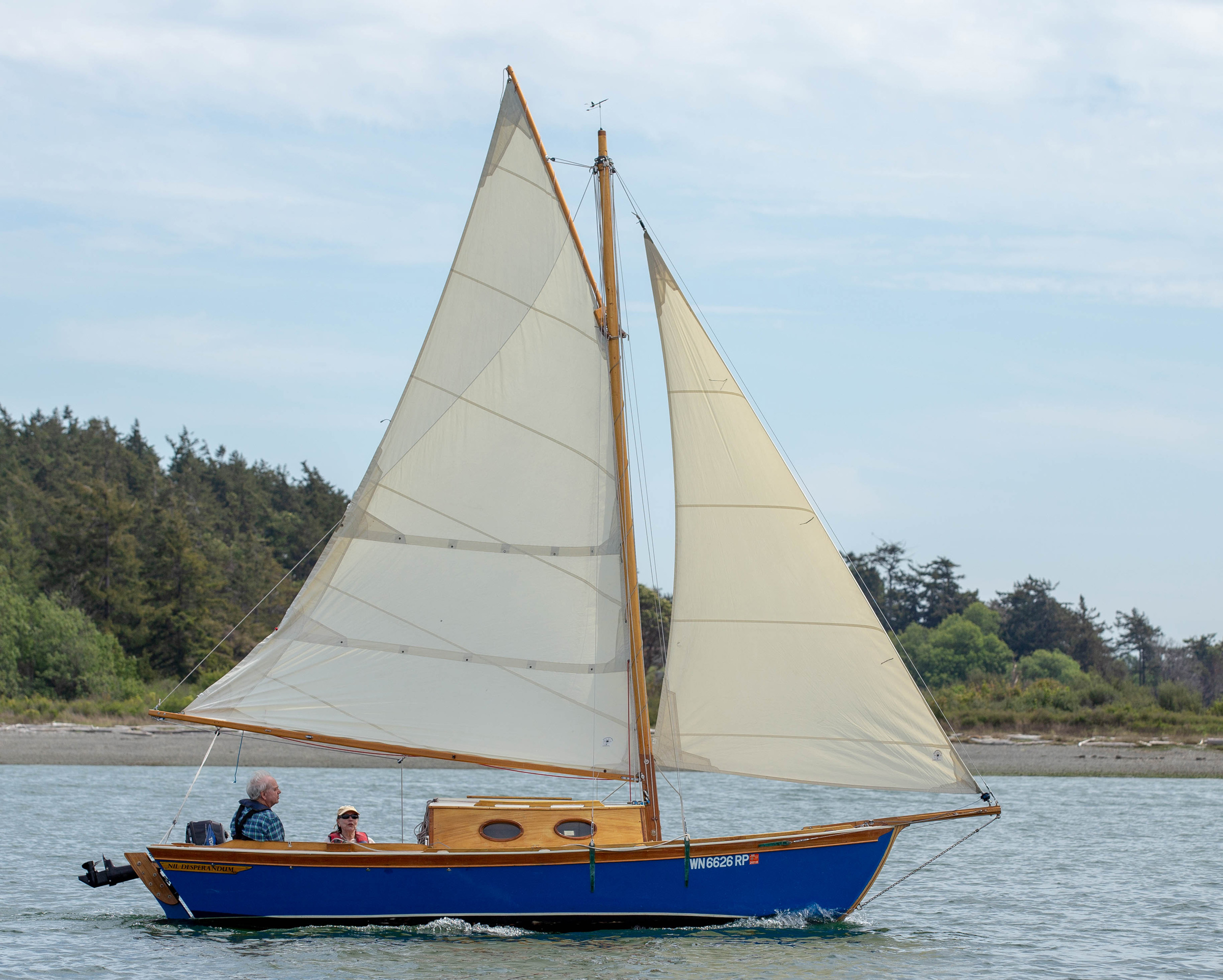
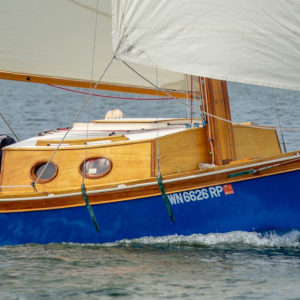
Sam Devlin’s boat designs always major in strength, practicality, and versatility. But Sam is an artist, a complicated, self-contradicting, cigar-smoking romantic, and frequently he can’t help himself: He draws a boat that’s as unapologetically cute as it is strong. This describes the Winter Wren, one of his older designs (the earliest example dates from 1980), and the one that lured me down a life-changing path a decade back.

I had already built a smaller and simpler Devlin boat, the 13′ 6″ Zephyr daysailer, a project that seemed plenty challenging at the time. The Winter Wren, while employing the same stitch-and-glue composite construction that I’d begun to get comfortable with, added the complications of cabin, outboard motor, electrical system, much more structure, and vastly more rigging. Listen, this rig is stout. One day I was scrutinizing a 24′ production sloop whose owner was embarking on a bluewater cruise to Hawaii, and I noted that the much smaller Winter Wren’s standing rigging was far more robust. This gave me a warm feeling.

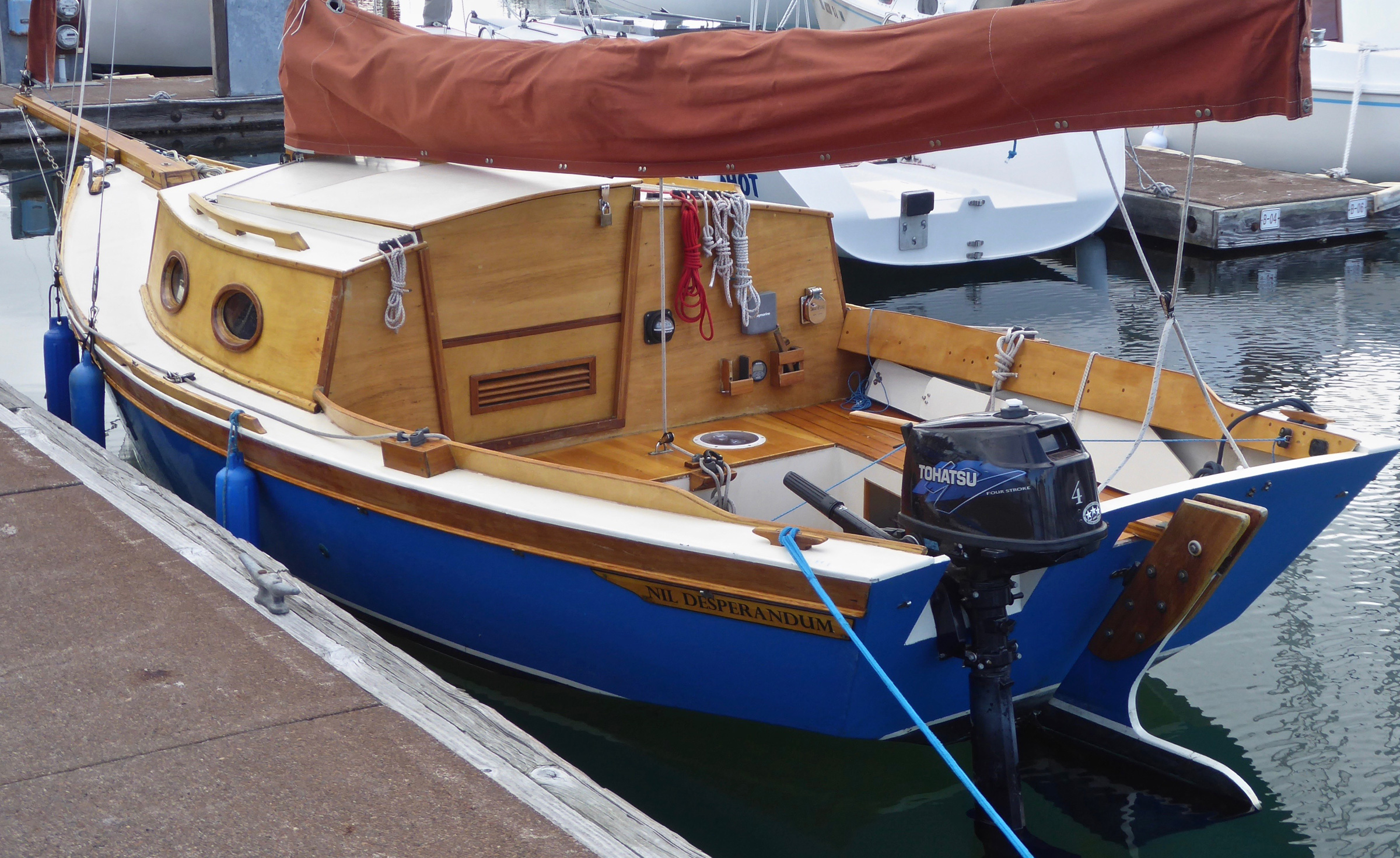
The Winter Wren II ill take an outboard between 2 and 4 hp. The slot in the transom for the mount is narrow and the motor is fixed against rotating. Steering is done with the boat's rudder.Lawrence W. Cheek

The Winter Wren II will take an outboard between 2 and 4 hp. The transom motor-mount cutout—the author’s design and not in the plans—does allow about 15 degrees some swiveling in each direction, which is used in concert with the rudder for maneuvering inside marinas.

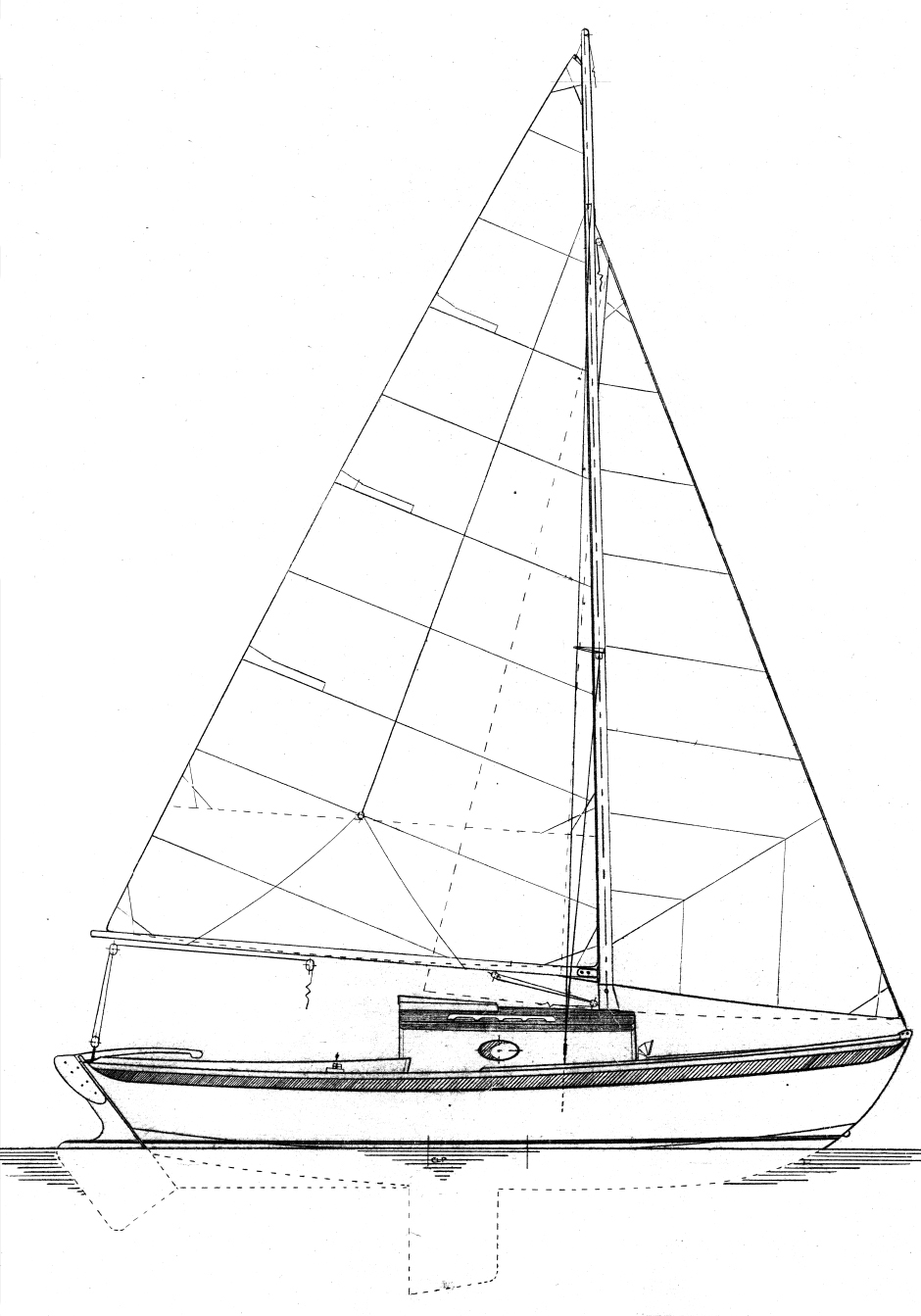
The original Winter Wren, still available in Devlin’s plans catalog, is a full-keel gaff-rigger measuring 18′ 8″ on deck, 22′ 7″ overall, with a 6′ 10″ beam. The Winter Wren II wears the same dimensions except for a 7′ beam, and it substitutes a daggerboard for the full keel. Both versions weigh about 1,800 lbs and carry 685 lbs of lead ballast, all lodged internally. Plans for the latter include both marconi and gaff sail plans, either measuring 176 sq ft. I chose to build the gaff daggerboard Winter Wren II with visions of trailer excursions to sailing destinations around the Pacific Northwest. I now know that was unrealistic. The Winter Wren II is too big and complicated to serve routinely as a trailer-sailer: it takes me 2 hours to wrangle the rig up or down; plus, I’ve learned that I hate trailering. If I had it to do over, I’d opt for the full-keel outfit, which is stiffer under sail and enjoys more unencumbered cabin space.

Although it’s one of Devlin’s older, hand-drawn designs, the Winter Wren II is now available as a CNC-cut hull kit. If you build from scratch you’ll have to scarf plywood sheets, loft the hull panels, and craft your own building jig. While some of this is fun, a kit offers advantages in precision and saves considerable time. Either way, this design teeters on the cusp of being a reasonable first build for the amateur: maybe so for someone with substantial woodworking and some sailing experience; probably not for the woodshop rookie. I had built a pair of kayaks and the Zephyr daysailer, so I was moderately confident starting out—and I still came to spend many nights awake at 2 a.m., questioning my judgment and competence. In an effort to drown the doubts, midway through construction I named the boat NIL DESPERANDUM, “Nothing to Worry About.” It did not help.

The Winter Wren II's sail area of 176 sq ft is good for light summer breezes, and the entirely feasible addition of a topsail would make it even better.Dennis Ryerson

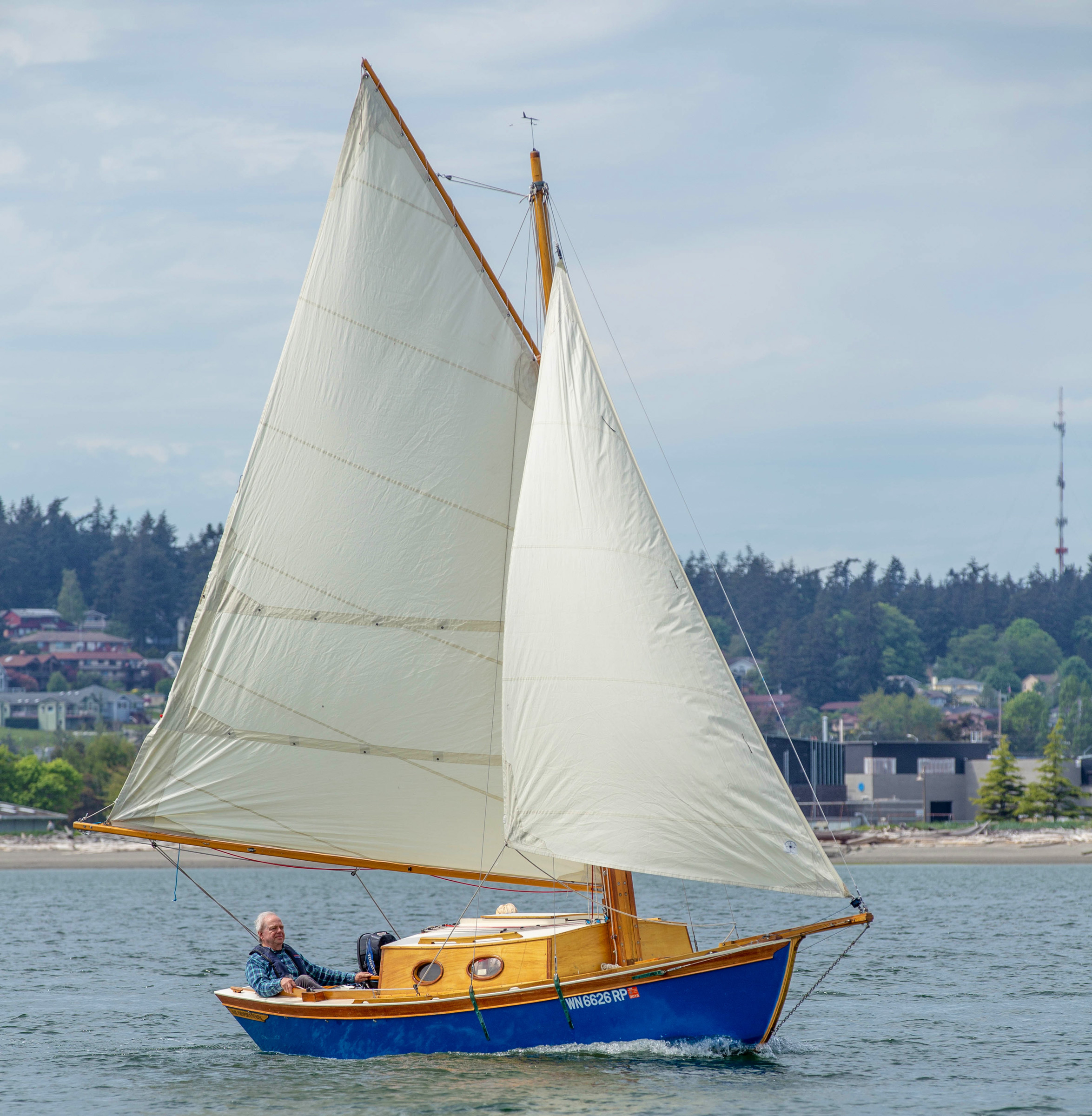
The Winter Wren II’s sail area of 176 sq ft is good for light summer breezes, and the entirely feasible addition of a topsail would make it even better.

I made a couple of changes in the design—one practical, one aesthetic. I sacrificed some storage to build in 14 cu ft of positive flotation, equaling about 900 lbs of saltwater. I’ve never even approached capsize, but in a worst-case scenario, I’m confident NIL DESPERANDUM would stay afloat. I also wanted to invite more daylight inside, so I built competing cabin side mockups with Devlin’s one and my two portlights and photographed each on the boat. I emailed the photos to eleven friends, all either sailors or architects. Eight voted for the two-light version, so I felt I had authorization, though I didn’t ask Sam.

The plans don’t call for a ceiling (a wooden liner around the inner hull), but I felt it would make the cabin visually warmer, so I built one of 1⁄8″-thick vertical-grain fir planks screwed to battens epoxied to the hull. It was worth the effort. Even with just 43″ maximum sitting headroom, the cabin is a pleasant place to hang out. The Winter Wren II’s main drawback as a minimalist cruiser is that storage space is likewise minimal. On the several multi-day cruises I’ve taken with my wife or a friend, we’ve stashed our accumulations on the V-berth during the day but had to shuttle some of them out to the cockpit when sleeping time arrived. Even if deploying sail covers over the banished goods, this tends to be a soggy solution.

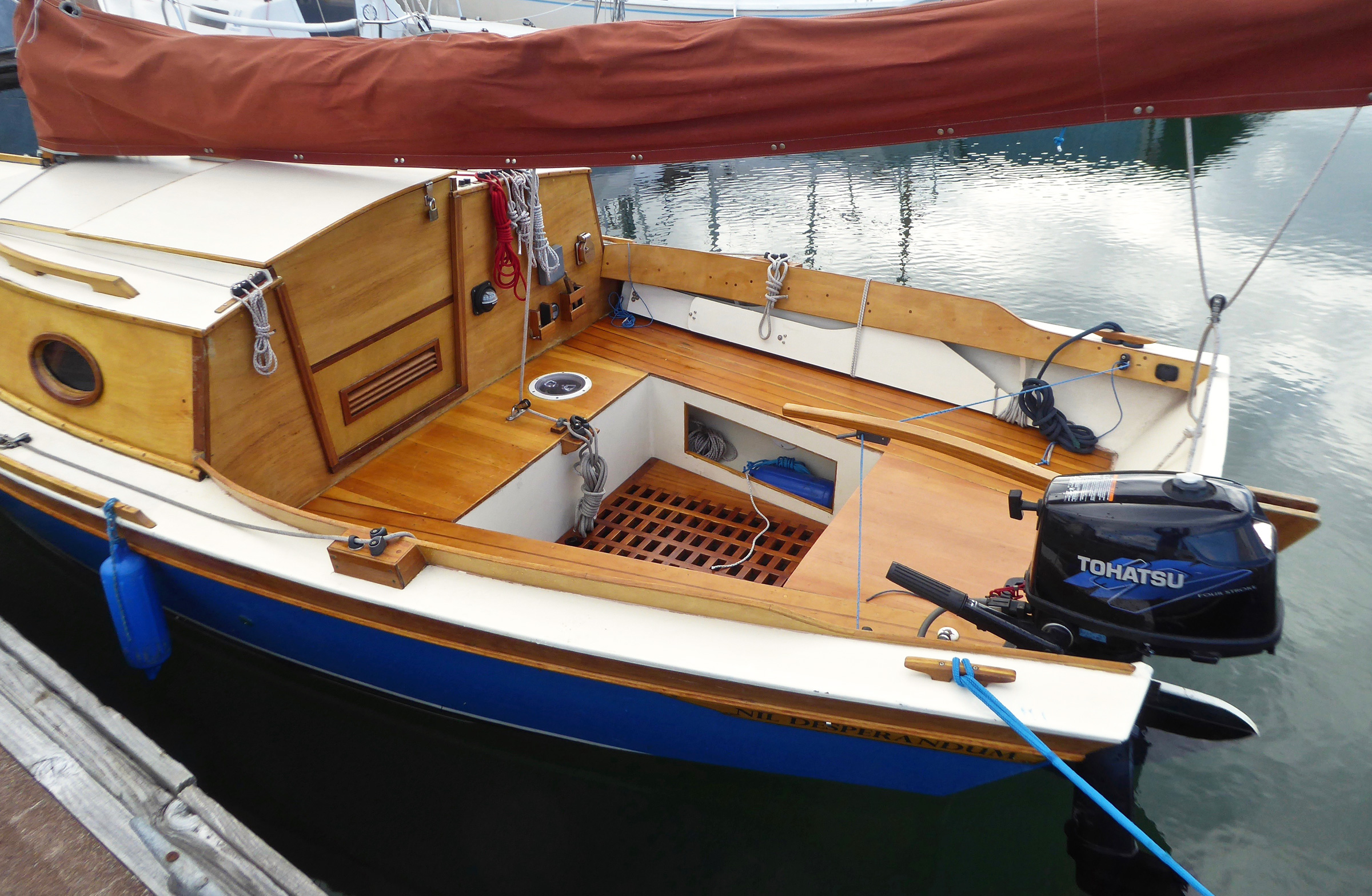
Everything falls easily to hand in the cockpit for singlehanding: all lines, tiller, and motor controls. A folding plywood reboarding ladder stashes under the starboard coaming and side deck.Lawrence W. Cheek

Everything falls easily to hand in the cockpit for singlehanding: all lines, the tiller, and motor controls. A folding plywood boarding ladder stashes under the starboard coaming and side deck.

The most difficult aspects of the construction, looking back, were the hull fairing after the ’glassing—long, tedious, and ultimately imperfect; I have since discovered the blessings of System Three’s Quikfair—and the rigging. I had no experience with rigging, and I was determined to bring all sail control lines into the cockpit, which added complication. I took camera and notebook to marinas in Seattle and Port Townsend, haunted the docks, and studied. Helpful reassurance came from a friend who’s a retired professor of physics and a sailor. “The loads on a rig like the Winter Wren’s are so small that almost anything you do will work,” he said. He was right.

The Winter Wren II splits accommodation space between cabin and cockpit perfectly. The 6′ 6″ cockpit seats welcome four adults for daysailing, and are tolerable for sleeping if you carry a boom tent (we’ve accomplished two-day cruises with three aboard). There’s a bridge deck 16″ deep with storage underneath for a porta-potty and quick-access miscellany such as tools and first-aid kit. The footwell is too deep for self-draining, so an automatic bilge pump or a cockpit cover is essential. My only ergonomic criticism is that the cockpit is slightly too wide for comfortable tiller management; a short-armed helmsperson can’t quite lounge back on the coaming and hold the tiller on center. Curving the aft side decks in 2″ more would solve the problem.

Summer sailing in Puget Sound asks for boats that are satisfying in light air, and the Winter Wren complies. It starts sailing with 3 knots of poke, feels alive in 5, and can make her official hull speed of 5.3 knots on a close reach with about 8 knots of breeze. I reef at around 10 knots of wind when the boat is beginning to feel a bit harried. I have a second row of reefpoints on the mainsail but no longer use them; the Winter Wren doesn’t seem to like a double-reefed main. What works best is to take the first reef at 10, roll up the jib at 15, and start heading for home if it seems likely to rise much further.

The Winter Wren's cabin acreage is mostly given to the V-berth, which is punctuated with the mast compression post, a 1" steel tube dressed up with a mahogany sheath. The daggerboard case, slightly offset to starboard, bisects the rest of the available space.Lawrence W. Cheek

The Winter Wren’s cabin acreage is mostly given to the V-berth, which is punctuated with the mast compression post, a 1″ steel tube dressed up with a mahogany sheath. The daggerboard case, slightly offset to starboard, bisects the rest of the available space.

Like any self-respecting gaffer, the Winter Wren II resists being ordered tight to the wind, like a distinguished dinner guest being asked to do the dishes. It tacks in 100 degrees and makes rather gradual progress if you have an actual destination from which the wind is huffing directly at your nose. One strategy in such cases is to fire up the outboard—I have a 4-hp four-stroke, which is adequate—and run it quietly just above idle, which will tighten up the close-haul vector by 4 or 5 degrees. In compensation for its windward reluctance, the rig is an efficient delight on a broad or beam reach, or even a downwind run. In light air, I love to clip a preventer line to the boom and sit out front on the cabin roof, poling out the jib with the boathook for a wing-and-wing configuration. It’s so peaceful out there.

The great joy of the Winter Wren is its responsiveness. Every nuance of change in air or water conditions translates into some sensation transmitted directly through the tiller, sail controls, or seat of pants. There are no filtering mechanisms such as winches between controls and fingers, so every input has a tangible effect that you not only see but also feel. Tiller touch is light; when you find the groove there’s barely a fingertip’s worth of weather helm. You’ll frequently choreograph the crew to change sides, sometimes during a tack, and tinker constantly with the mainsail shape by playing the peak halyard, outhaul, and mainsheet. For me, this is what sailing is about: savoring the multi-sensory array of interactions between natural environment and machine, and learning to gracefully negotiate among them. On days when conditions are reasonable for small boats, the Winter Wren feels like an extension of your body, an organic being in itself.

The rig has its complications—four halyards and five stays—but the 20' mast pivots on a bolt in a tall and beefy tabernacle, which makes it reasonably easy to raise and lower. NIL DESPERANDUM's solid spruce mast weighs 40 pounds, but hollow birdsmouth construction would save about 15 pounds.Dennis Ryerson

The rig has its complications—four halyards and five stays—but the 20′ mast pivots on a bolt in a tall and beefy tabernacle, which makes it reasonably easy to raise and lower. NIL DESPERANDUM’s solid spruce mast weighs 40 lbs, but hollow birdsmouth construction would save about 15 lbs.

Devlin’s shop will cheerfully build you a Wren  if you ask. I have a copy of the January 1984 Small Boat Journal in which a Devlin-built Winter Wren was the cover story, and it then carried a base price of $10,980. I hardly have to add that today’s bill would be several times that, which is why few pocket cruisers are being professionally custom-built now. I spent about $20,000 for parts and materials to build NIL DESPERANDUM in 3,000 hours over three years from 2008 to 2011, including motor, sails, covers, and cabin cushions. In heartless economic terms, that makes no sense—I could have bought a used production pocket cruiser in good condition for half that.

Some paragraphs ago I wrote that NIL DESPERANDUM had lured me into a life change. I have built two boats since, one smaller, one larger, and I am now more boatbuilder than writer, my previous lifelong profession. This is my career now, regardless of the fact that it consumes income rather than generating it. But building boats, like owning them, is never about heartless economy.

Lawrence W. Cheek is a journalist, frequent contributor to WoodenBoat magazine, and serial boatbuilder. He lives on Whidbey Island, Washington, and since 2002 he has built two kayaks, three sailboats, and currently is at work on a fourth: 21′ 3″ Song Wren, a Sam Devlin–designed gaff cutter.

Winter Wren II Particulars

Length on deck:   18′ 8″
LOA:   22′ 7″
Beam:   7′ 1″
Draft, board up:   1′ 1″
Draft, board down:   /3′ 6″
Outboard power:   2 to 4 hp
Displacement:   1800lbs
Sail area:   176 sq ft
Maximum load:   1,250 lbs


Plans for the Winter Wren II are available from Devlin Designing Boat Builders for $162 (print) or $132 (download). Study plans are $1.

Is there a boat you’d like to know more about? Have you built one that you think other Small Boats Monthly readers would enjoy? Please email us!

Continue Reading - Enter your email to log in or subscribe

New to Small Boats? Create a free account to get our weekly emails and two free articles each month.

Yes! I would like to access this article and the Small Boats newsletter.